

Martin M. Miles' photos with the keyword: Saint-Nicolas
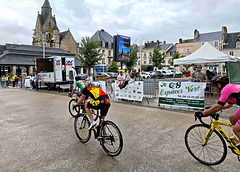
Mamers - Cycling Race
| 02 Oct 2025 |
|
|
|
The village of Mamers originated from a Gallo-Roman settlement. It was first mentioned in the 6th and 7th centuries in the lives of the hermits Saint Rigomer and Saint Longis.
In 1171, Saosnois, where the village is located, passed into the hands of John I, Count of Alençon, and then, through marriage, into the hands of the Châtellerault, Harcourt, and Alençon families. During the Hundred Years' War, Mamers was destroyed by the army of the Count of Salisbury. The end of hostilities allowed for economic recovery and the beginning of reconstruction.
The Reformation and the religious struggles of the 16th century led to a new wave of violence and ruin. After the assassination of Henry III, Saosnois remained loyal to its master, Henry IV. In 1650, however, by which time Mamers had become an important center of the Reformed religion, the town was besieged and subsequently burned.
The cycling race („Grand Prix Mamers“) in the foreground. In the back the "Halle aux Grains" and Saint-Nicholas.

Mamers - Saint-Nicolas
| 02 Oct 2025 |
|
|
The village of Mamers originated from a Gallo-Roman settlement. It was first mentioned in the 6th and 7th centuries in the lives of the hermits Saint Rigomer and Saint Longis.
In 1171, Saosnois, where the village is located, passed into the hands of John I, Count of Alençon, and then, through marriage, into the hands of the Châtellerault, Harcourt, and Alençon families. During the Hundred Years' War, Mamers was destroyed by the army of the Count of Salisbury. The end of hostilities allowed for economic recovery and the beginning of reconstruction.
The Reformation and the religious struggles of the 16th century led to a new wave of violence and ruin. After the assassination of Henry III, Saosnois remained loyal to its master, Henry IV. In 1650, however, by which time Mamers had become an important center of the Reformed religion, the town was besieged and subsequently burned.
The building was constructed in the 13th century on the foundations of an old fortress. In the second half of the 14th century, it was extended to include the current Gothic nave and the bell tower was raised. The Renaissance portal was added in 1556. In 1590, the church, along with the rest of the town center, was burned down during the Wars of Religion by Huguenot troops under Pierre de Fontenay. The building was not restored until 1654 and 1659.
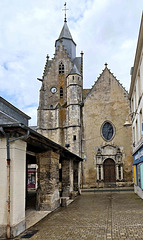
Mamers - Saint-Nicolas
| 02 Oct 2025 |
|
|
The village of Mamers originated from a Gallo-Roman settlement. It was first mentioned in the 6th and 7th centuries in the lives of the hermits Saint Rigomer and Saint Longis.
In 1171, Saosnois, where the village is located, passed into the hands of John I, Count of Alençon, and then, through marriage, into the hands of the Châtellerault, Harcourt, and Alençon families. During the Hundred Years' War, Mamers was destroyed by the army of the Count of Salisbury. The end of hostilities allowed for economic recovery and the beginning of reconstruction.
The Reformation and the religious struggles of the 16th century led to a new wave of violence and ruin. After the assassination of Henry III, Saosnois remained loyal to its master, Henry IV. In 1650, however, by which time Mamers had become an important center of the Reformed religion, the town was besieged and subsequently burned.
The building was constructed in the 13th century on the foundations of an old fortress. In the second half of the 14th century, it was extended to include the current Gothic nave and the bell tower was raised. The Renaissance portal was added in 1556. In 1590, the church, along with the rest of the town center, was burned down during the Wars of Religion by Huguenot troops under Pierre de Fontenay. The building was not restored until 1654 and 1659.
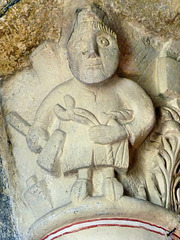
Droiturier - Saint-Nicolas
| 12 Sep 2011 |
|
The small village of Droiturier hosts (at least) two remarkable architectoral structures. These are a roman bridge and the church Saint-Nicolas. The 12th century romanesque church was once a part of a benedictian collegiate, belonging to Cluny. The collegiate community is gone since centuries and with all its buildings.
The most interesting capital depicts a man and an ape. Here is the stout master of the ape. He holds the rope, - pincers and a hammer. Another object is placed on the ground to the left. He obviously is a tradesman or artisan. There is no trade, where an ape could be of any use. At least not in Europe.
The icon (man/rope/ape) is somehow typical for the Auvergne area, the French call this "singe cordé". I found a couple of these pairs and will upload more. Meanwhile I learned, that within the Auvergne are about 20 (!) similar carvings.
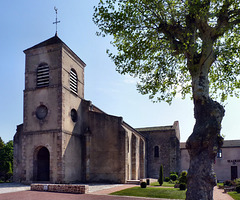
Droiturier - Saint-Nicolas
| 12 Sep 2011 |
|
The small village of Droiturier (near the border Burgundy/Auvergne) hosts (at least) two remarkable architectoral structures. These are a roman bridge and the church Saint-Nicolas. The 12th century romanesque church was once a part of a benedictian collegiate, belonging to Cluny. The collegiate community is gone since centuries and with all its buildings. Only the church, with its now unimpressive front, still stands and is a parish church meanwhile.
Trémolat - Saint-Nicolas
| 14 Jan 2016 |
|
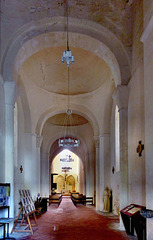
Trémolat developed around an abbey, that existed already within the 9th century. There are many parallels to the village (and former abbey) Paunat (5kms north) in the history as well as in the architecture of the church. Both abbeys have claimed to be founded by Saint Cybard (aka "Cybard d'Angoulême"), who may have been born in Trémolat around 500.
During the heydays of pilgrimage to Santiago, the abbey in Tremolat belonged to the Cluniac network. I found a legend, that a "Holy Robe of Chirst Child" (given to the abbey by Charlemagne) was venerated here.
Maybe a small version if the "Holy Robe" that is still kept in the Cathedral of Trier (Germany). Another "Holy Robe" is existed (upto the French Revolution) in Argenteuil (France). Charlemagne gave this to his daughter Theocrate, who was abbess there. That is what the legends tell..
The nave (with three domes) is dated 11th century, while the crossing (another dome) and the apse are a century younger.
Trémolat - Saint-Nicolas
| 14 Jan 2016 |
|
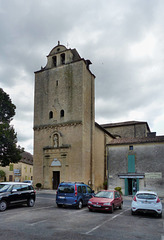
Trémolat developed around an abbey, that existed already within the 9th century. There are many parallels to the village (and former abbey) Paunat (5kms north) in the history as well as in the architecture of Saint Nicholas, that now serves the parish.
The tower may not be as old and massive as the tower in Paunat, but it is from the same time and was as well fortified. It got modified in Baroque times.
Trémolat - Saint-Nicolas
| 14 Jan 2016 |
|
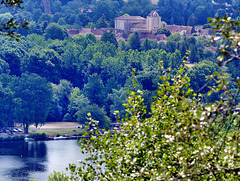
Trémolat (pop. ~600) developed around an abbey, that existed already within the 9th century. The village is placed between two loops of the river Dordogne. Here the former abbey church Saint-Nicolas and the village around are seen from the "Cingle de Trémolat", which is one of the loops.
Droiturier - Saint-Nicolas
| 12 Sep 2011 |
|
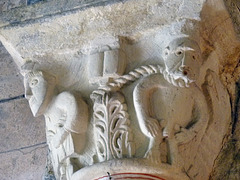
The small village of Droiturier hosts two remarkable architectoral structures. These are a roman bridge and the church Saint-Nicolas. The 12th century romanesque church was once a part of a benedictian collegiate, belonging to Cluny. The collegiate community is gone since centuries and with all its buildings. The church serves the parish today.
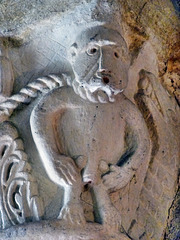
The most interesting capital depicts a man and an ape.
Here is the ape, a thick rope around his neck. The male ape is naked! The round mouth is typical for the most of these apes led on a rope. To the right, the long-neck-dragon. If this carving would be in Inverness (Scotland), this hidden dragon would be a proof for the medieval existence of the Loch Ness Monster.
The icon (man/rope/ape) is somehow typical for the Auvergne area, the French call this "singe cordé". I found a couple of these pairs and will upload more. Meanwhile I learned, that within the Auvergne are about 20 (!) similar carvings.
Droiturier - Saint-Nicolas
| 12 Sep 2011 |
|
|
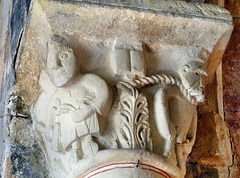
The small village of Droiturier hosts (at least) two remarkable architectoral structures. These are a roman bridge and the church Saint-Nicolas. The 12th century romanesque church was once a part of a benedictian collegiate, belonging to Cluny. The collegiate community is gone since centuries and with all its buildings.
The same capital, seen before. Now from the right side. A strange detail is to the evry right. Next to the ape is the head of "dragon" with a very long neck. The dragon has pretty frightening teeth.
The icon (man/rope/ape) is somehow typical for the Auvergne area, the French call this "singe cordé". I found a couple of these pairs and will upload more. Meanwhile I learned, that within the Auvergne are about 20 (!) similar carvings.
Droiturier - Saint-Nicolas
| 12 Sep 2011 |
|
The small village of Droiturier hosts (at least) two remarkable architectoral structures. These are a roman bridge and the church Saint-Nicolas. The 12th century romanesque church was once a part of a benedictian collegiate, belonging to Cluny. The collegiate community is gone since centuries and with all its buildings.
Despite the unimpressive front, just seen before, the interior of basilica-style Saint-Nicolas is clearly romanesque amd has many carved capitals. This one is the most interesting one.
A man holding an ape by a rope. This icon (man/rope/ape) is somehow typical for the Auvergne area, the French call this "singe cordé". I found a couple of these pairs and will upload more. Meanwhile I learned, that within the Auvergne are about 20 (!) similar carvings.
Jump to top
RSS feed- Martin M. Miles' latest photos with "Saint-Nicolas" - Photos
- ipernity © 2007-2026
- Help & Contact
|
Club news
|
About ipernity
|
History |
ipernity Club & Prices |
Guide of good conduct
Donate | Group guidelines | Privacy policy | Terms of use | Statutes | In memoria -
Facebook
X
