

Martin M. Miles' photos with the keyword: Antwerpener Retabel

Dortmund - Petrikirche
| 21 Jul 2025 |
|
Petrikirche is a hall church in the High Gothic style, which approximates the ideal type of this church form. The building has a nearly square floor plan with a comparatively short choir.
St. Peter's Church, along with St. Reinoldi's Church and St. Mary's Church, is another medieval church located directly on Westenhellweg. The three-bay structure was begun in 1322 and is made of sandstone.
Antwerp retable is the name given to a type of winged altarpiece produced for export, particularly in Antwerp workshops during the first third of the 16th century. Antwerp retables are generally characterized by their intricately detailed carvings, but also by certain standardizations, such as their dimensions and the frequent repetition of certain groups of figures. Over 200 examples are still preserved today in churches and museums in various European countries.
At 5.65 meters high and 7.40 meters wide with the double doors open, the Dortmund carved altar, the "Goldenes Wunder von Westfalen", is considered the largest surviving Antwerp altarpiece. The retable features two pairs of wings, the interior of which is also sculpturally carved.
The altar was originally commissioned by the Dortmund Franciscans from Jan Gillisz Wrage in Antwerp for their monastery church. After the monastery was dissolved during secularization, the St. Peter's congregation acquired the altar and brought it to their church. During World War II, the altar was removed and returned to Dortmund in 1954. It was restored in St. Peter's Church from the early 1960s onwards and reinstalled in 1985.
The winged altar is opened differently throughout the church year, revealing different images on the front.
From Thanksgiving to Holy Week and from Easter to Pentecost, the actual gilded carved altar with 36 compartments and a total of 633 gilded figures can be seen inside. It depicts the detailed story of Jesus' Passion, with the crucifixion at its center.
Detail of the previous upload (Ascension of Christ).
This person needs glasses, to follow the ascension.

Dortmund - Petrikirche
| 21 Jul 2025 |
|
Petrikirche is a hall church in the High Gothic style, which approximates the ideal type of this church form. The building has a nearly square floor plan with a comparatively short choir.
St. Peter's Church, along with St. Reinoldi's Church and St. Mary's Church, is another medieval church located directly on Westenhellweg. The three-bay structure was begun in 1322 and is made of sandstone.
Antwerp retable is the name given to a type of winged altarpiece produced for export, particularly in Antwerp workshops during the first third of the 16th century. Antwerp retables are generally characterized by their intricately detailed carvings, but also by certain standardizations, such as their dimensions and the frequent repetition of certain groups of figures. Over 200 examples are still preserved today in churches and museums in various European countries.
At 5.65 meters high and 7.40 meters wide with the double doors open, the Dortmund carved altar, the "Goldenes Wunder von Westfalen", is considered the largest surviving Antwerp altarpiece. The retable features two pairs of wings, the interior of which is also sculpturally carved.
The altar was originally commissioned by the Dortmund Franciscans from Jan Gillisz Wrage in Antwerp for their monastery church. After the monastery was dissolved during secularization, the St. Peter's congregation acquired the altar and brought it to their church. During World War II, the altar was removed and returned to Dortmund in 1954. It was restored in St. Peter's Church from the early 1960s onwards and reinstalled in 1985.
The winged altar is opened differently throughout the church year, revealing different images on the front.
From Thanksgiving to Holy Week and from Easter to Pentecost, the actual gilded carved altar with 36 compartments and a total of 633 gilded figures can be seen inside. It depicts the detailed story of Jesus' Passion, with the crucifixion at its center.
Ascension of Christ

Dortmund - Petrikirche
| 21 Jul 2025 |
|
Petrikirche is a hall church in the High Gothic style, which approximates the ideal type of this church form. The building has a nearly square floor plan with a comparatively short choir.
St. Peter's Church, along with St. Reinoldi's Church and St. Mary's Church, is another medieval church located directly on Westenhellweg. The three-bay structure was begun in 1322 and is made of sandstone.
Antwerp retable is the name given to a type of winged altarpiece produced for export, particularly in Antwerp workshops during the first third of the 16th century. Antwerp retables are generally characterized by their intricately detailed carvings, but also by certain standardizations, such as their dimensions and the frequent repetition of certain groups of figures. Over 200 examples are still preserved today in churches and museums in various European countries.
At 5.65 meters high and 7.40 meters wide with the double doors open, the Dortmund carved altar, the "Goldenes Wunder von Westfalen", is considered the largest surviving Antwerp altarpiece. The retable features two pairs of wings, the interior of which is also sculpturally carved.
The altar was originally commissioned by the Dortmund Franciscans from Jan Gillisz Wrage in Antwerp for their monastery church. After the monastery was dissolved during secularization, the St. Peter's congregation acquired the altar and brought it to their church. During World War II, the altar was removed and returned to Dortmund in 1954. It was restored in St. Peter's Church from the early 1960s onwards and reinstalled in 1985.
The winged altar is opened differently throughout the church year, revealing different images on the front.
From Thanksgiving to Holy Week and from Easter to Pentecost, the actual gilded carved altar with 36 compartments and a total of 633 gilded figures can be seen inside. It depicts the detailed story of Jesus' Passion, with the crucifixion at its center.
Pentecost

Dortmund - Petrikirche
| 21 Jul 2025 |
|
Petrikirche is a hall church in the High Gothic style, which approximates the ideal type of this church form. The building has a nearly square floor plan with a comparatively short choir.
St. Peter's Church, along with St. Reinoldi's Church and St. Mary's Church, is another medieval church located directly on Westenhellweg. The three-bay structure was begun in 1322 and is made of sandstone.
Antwerp retable is the name given to a type of winged altarpiece produced for export, particularly in Antwerp workshops during the first third of the 16th century. Antwerp retables are generally characterized by their intricately detailed carvings, but also by certain standardizations, such as their dimensions and the frequent repetition of certain groups of figures. Over 200 examples are still preserved today in churches and museums in various European countries.
At 5.65 meters high and 7.40 meters wide with the double doors open, the Dortmund carved altar, the "Goldenes Wunder von Westfalen", is considered the largest surviving Antwerp altarpiece. The retable features two pairs of wings, the interior of which is also sculpturally carved.
The altar was originally commissioned by the Dortmund Franciscans from Jan Gillisz Wrage in Antwerp for their monastery church. After the monastery was dissolved during secularization, the St. Peter's congregation acquired the altar and brought it to their church. During World War II, the altar was removed and returned to Dortmund in 1954. It was restored in St. Peter's Church from the early 1960s onwards and reinstalled in 1985.
The winged altar is opened differently throughout the church year, revealing different images on the front.
From Thanksgiving to Holy Week and from Easter to Pentecost, the actual gilded carved altar with 36 compartments and a total of 633 gilded figures can be seen inside. It depicts the detailed story of Jesus' Passion, with the crucifixion at its center.
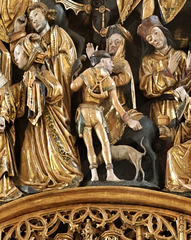
Mater Dolorosa
The life of Jesus is depicted in seven scenes in the framework
Dortmund - Petrikirche
| 20 Jul 2025 |
|
|
|
Petrikirche is a hall church in the High Gothic style, which approximates the ideal type of this church form. The building has a nearly square floor plan with a comparatively short choir.
St. Peter's Church, along with St. Reinoldi's Church and St. Mary's Church, is another medieval church located directly on Westenhellweg. The three-bay structure was begun in 1322 and is made of sandstone.
Antwerp retable is the name given to a type of winged altarpiece produced for export, particularly in Antwerp workshops during the first third of the 16th century. Antwerp retables are generally characterized by their intricately detailed carvings, but also by certain standardizations, such as their dimensions and the frequent repetition of certain groups of figures. Over 200 examples are still preserved today in churches and museums in various European countries.
At 5.65 meters high and 7.40 meters wide with the double doors open, the Dortmund carved altar, the "Goldenes Wunder von Westfalen", is considered the largest surviving Antwerp altarpiece. The retable features two pairs of wings, the interior of which is also sculpturally carved.
The altar was originally commissioned by the Dortmund Franciscans from Jan Gillisz Wrage in Antwerp for their monastery church. After the monastery was dissolved during secularization, the St. Peter's congregation acquired the altar and brought it to their church. During World War II, the altar was removed and returned to Dortmund in 1954. It was restored in St. Peter's Church from the early 1960s onwards and reinstalled in 1985.
The winged altar is opened differently throughout the church year, revealing different images on the front.
From Thanksgiving to Holy Week and from Easter to Pentecost, the actual gilded carved altar with 36 compartments and a total of 633 gilded figures can be seen inside. It depicts the detailed story of Jesus' Passion, with the crucifixion at its center.
Detail of the Crucifixion (previous upload)
This little hunter with a hunting horn, hunting dog, and falcon seems to have wandered here without knowing what was happening.

Dortmund - Petrikirche
| 20 Jul 2025 |
|
Petrikirche is a hall church in the High Gothic style, which approximates the ideal type of this church form. The building has a nearly square floor plan with a comparatively short choir.
St. Peter's Church, along with St. Reinoldi's Church and St. Mary's Church, is another medieval church located directly on Westenhellweg. The three-bay structure was begun in 1322 and is made of sandstone.
Antwerp retable is the name given to a type of winged altarpiece produced for export, particularly in Antwerp workshops during the first third of the 16th century. Antwerp retables are generally characterized by their intricately detailed carvings, but also by certain standardizations, such as their dimensions and the frequent repetition of certain groups of figures. Over 200 examples are still preserved today in churches and museums in various European countries.
At 5.65 meters high and 7.40 meters wide with the double doors open, the Dortmund carved altar, the "Goldenes Wunder von Westfalen", is considered the largest surviving Antwerp altarpiece. The retable features two pairs of wings, the interior of which is also sculpturally carved.
The altar was originally commissioned by the Dortmund Franciscans from Jan Gillisz Wrage in Antwerp for their monastery church. After the monastery was dissolved during secularization, the St. Peter's congregation acquired the altar and brought it to their church. During World War II, the altar was removed and returned to Dortmund in 1954. It was restored in St. Peter's Church from the early 1960s onwards and reinstalled in 1985.
The winged altar is opened differently throughout the church year, revealing different images on the front.
From Thanksgiving to Holy Week and from Easter to Pentecost, the actual gilded carved altar with 36 compartments and a total of 633 gilded figures can be seen inside. It depicts the detailed story of Jesus' Passion, with the crucifixion at its center.
Jesus before the High Priests

Dortmund - Petrikirche
| 20 Jul 2025 |
|
Petrikirche is a hall church in the High Gothic style, which approximates the ideal type of this church form. The building has a nearly square floor plan with a comparatively short choir.
St. Peter's Church, along with St. Reinoldi's Church and St. Mary's Church, is another medieval church located directly on Westenhellweg. The three-bay structure was begun in 1322 and is made of sandstone.
Antwerp retable is the name given to a type of winged altarpiece produced for export, particularly in Antwerp workshops during the first third of the 16th century. Antwerp retables are generally characterized by their intricately detailed carvings, but also by certain standardizations, such as their dimensions and the frequent repetition of certain groups of figures. Over 200 examples are still preserved today in churches and museums in various European countries.
At 5.65 meters high and 7.40 meters wide with the double doors open, the Dortmund carved altar, the "Goldenes Wunder von Westfalen", is considered the largest surviving Antwerp altarpiece. The retable features two pairs of wings, the interior of which is also sculpturally carved.
The altar was originally commissioned by the Dortmund Franciscans from Jan Gillisz Wrage in Antwerp for their monastery church. After the monastery was dissolved during secularization, the St. Peter's congregation acquired the altar and brought it to their church. During World War II, the altar was removed and returned to Dortmund in 1954. It was restored in St. Peter's Church from the early 1960s onwards and reinstalled in 1985.
The winged altar is opened differently throughout the church year, revealing different images on the front.
From Thanksgiving to Holy Week and from Easter to Pentecost, the actual gilded carved altar with 36 compartments and a total of 633 gilded figures can be seen inside. It depicts the detailed story of Jesus' Passion, with the crucifixion at its center.
The preparation for the flagelation of Jesus. The two people in the background are already holding scourges, while one is still being made in the foreground.

Dortmund - Petrikirche
| 19 Jul 2025 |
|
Petrikirche is a hall church in the High Gothic style, which approximates the ideal type of this church form. The building has a nearly square floor plan with a comparatively short choir.
St. Peter's Church, along with St. Reinoldi's Church and St. Mary's Church, is another medieval church located directly on Westenhellweg. The three-bay structure was begun in 1322 and is made of sandstone.
Antwerp retable is the name given to a type of winged altarpiece produced for export, particularly in Antwerp workshops during the first third of the 16th century. Antwerp retables are generally characterized by their intricately detailed carvings, but also by certain standardizations, such as their dimensions and the frequent repetition of certain groups of figures. Over 200 examples are still preserved today in churches and museums in various European countries.
At 5.65 meters high and 7.40 meters wide with the double doors open, the Dortmund carved altar, the "Goldenes Wunder von Westfalen", is considered the largest surviving Antwerp altarpiece. The retable features two pairs of wings, the interior of which is also sculpturally carved.
The altar was originally commissioned by the Dortmund Franciscans from Jan Gillisz Wrage in Antwerp for their monastery church. After the monastery was dissolved during secularization, the St. Peter's congregation acquired the altar and brought it to their church. During World War II, the altar was removed and returned to Dortmund in 1954. It was restored in St. Peter's Church from the early 1960s onwards and reinstalled in 1985.
The winged altar is opened differently throughout the church year, revealing different images on the front.
From Thanksgiving to Holy Week and from Easter to Pentecost, the actual gilded carved altar with 36 compartments and a total of 633 gilded figures can be seen inside. It depicts the detailed story of Jesus' Passion, with the crucifixion at its center.
Below - Jesus carries the cross
Above - Jesus is nailed to the cross

Dortmund - Petrikirche
| 19 Jul 2025 |
|
Petrikirche is a hall church in the High Gothic style, which approximates the ideal type of this church form. The building has a nearly square floor plan with a comparatively short choir.
St. Peter's Church, along with St. Reinoldi's Church and St. Mary's Church, is another medieval church located directly on Westenhellweg. The three-bay structure was begun in 1322 and is made of sandstone.
Antwerp retable is the name given to a type of winged altarpiece produced for export, particularly in Antwerp workshops during the first third of the 16th century. Antwerp retables are generally characterized by their intricately detailed carvings, but also by certain standardizations, such as their dimensions and the frequent repetition of certain groups of figures. Over 200 examples are still preserved today in churches and museums in various European countries.
At 5.65 meters high and 7.40 meters wide with the double doors open, the Dortmund carved altar, the "Goldenes Wunder von Westfalen", is considered the largest surviving Antwerp altarpiece. The retable features two pairs of wings, the interior of which is also sculpturally carved.
The altar was originally commissioned by the Dortmund Franciscans from Jan Gillisz Wrage in Antwerp for their monastery church. After the monastery was dissolved during secularization, the St. Peter's congregation acquired the altar and brought it to their church. During World War II, the altar was removed and returned to Dortmund in 1954. It was restored in St. Peter's Church from the early 1960s onwards and reinstalled in 1985.
The winged altar is opened differently throughout the church year, revealing different images on the front.
From Thanksgiving to Holy Week and from Easter to Pentecost, the actual gilded carved altar with 36 compartments and a total of 633 gilded figures can be seen inside. It depicts the detailed story of Jesus' Passion, with the crucifixion at its center.
A detail from the previous upload
A boy riding a hobby horse

Dortmund - Petrikirche
| 19 Jul 2025 |
|
Petrikirche is a hall church in the High Gothic style, which approximates the ideal type of this church form. The building has a nearly square floor plan with a comparatively short choir.
St. Peter's Church, along with St. Reinoldi's Church and St. Mary's Church, is another medieval church located directly on Westenhellweg. The three-bay structure was begun in 1322 and is made of sandstone.
Antwerp retable is the name given to a type of winged altarpiece produced for export, particularly in Antwerp workshops during the first third of the 16th century. Antwerp retables are generally characterized by their intricately detailed carvings, but also by certain standardizations, such as their dimensions and the frequent repetition of certain groups of figures. Over 200 examples are still preserved today in churches and museums in various European countries.
At 5.65 meters high and 7.40 meters wide with the double doors open, the Dortmund carved altar, the "Goldenes Wunder von Westfalen", is considered the largest surviving Antwerp altarpiece. The retable features two pairs of wings, the interior of which is also sculpturally carved.
The altar was originally commissioned by the Dortmund Franciscans from Jan Gillisz Wrage in Antwerp for their monastery church. After the monastery was dissolved during secularization, the St. Peter's congregation acquired the altar and brought it to their church. During World War II, the altar was removed and returned to Dortmund in 1954. It was restored in St. Peter's Church from the early 1960s onwards and reinstalled in 1985.
The winged altar is opened differently throughout the church year, revealing different images on the front.
From Thanksgiving to Holy Week and from Easter to Pentecost, the actual gilded carved altar with 36 compartments and a total of 633 gilded figures can be seen inside. It depicts the detailed story of Jesus' Passion, with the crucifixion at its center.
Matthew 27:24
When Pilate saw that he was getting nowhere, but that instead an uproar was starting, he took water and washed his hands in front of the crowd. “I am innocent of this man’s blood,” he said. “It is your responsibility!”

Dortmund - Petrikirche
| 19 Jul 2025 |
|
Petrikirche is a hall church in the High Gothic style, which approximates the ideal type of this church form. The building has a nearly square floor plan with a comparatively short choir.
St. Peter's Church, along with St. Reinoldi's Church and St. Mary's Church, is another medieval church located directly on Westenhellweg. The three-bay structure was begun in 1322 and is made of sandstone.
Antwerp retable is the name given to a type of winged altarpiece produced for export, particularly in Antwerp workshops during the first third of the 16th century. Antwerp retables are generally characterized by their intricately detailed carvings, but also by certain standardizations, such as their dimensions and the frequent repetition of certain groups of figures. Over 200 examples are still preserved today in churches and museums in various European countries.
At 5.65 meters high and 7.40 meters wide with the double doors open, the Dortmund carved altar, the "Goldenes Wunder von Westfalen", is considered the largest surviving Antwerp altarpiece. The retable features two pairs of wings, the interior of which is also sculpturally carved.
The altar was originally commissioned by the Dortmund Franciscans from Jan Gillisz Wrage in Antwerp for their monastery church. After the monastery was dissolved during secularization, the St. Peter's congregation acquired the altar and brought it to their church. During World War II, the altar was removed and returned to Dortmund in 1954. It was restored in St. Peter's Church from the early 1960s onwards and reinstalled in 1985.
The winged altar is opened differently throughout the church year, revealing different images on the front.
From Thanksgiving to Holy Week and from Easter to Pentecost, the actual gilded carved altar with 36 compartments and a total of 633 gilded figures can be seen inside. It depicts the detailed story of Jesus' Passion, with the crucifixion at its center.
Jesus Arrested

Dortmund - Petrikirche
| 17 Jul 2025 |
|
|
Petrikirche is a hall church in the High Gothic style, which approximates the ideal type of this church form. The building has a nearly square floor plan with a comparatively short choir.
St. Peter's Church, along with St. Reinoldi's Church and St. Mary's Church, is another medieval church located directly on Westenhellweg. The three-bay structure was begun in 1322 and is made of sandstone.
Antwerp retable is the name given to a type of winged altarpiece produced for export, particularly in Antwerp workshops during the first third of the 16th century. Antwerp retables are generally characterized by their intricately detailed carvings, but also by certain standardizations, such as their dimensions and the frequent repetition of certain groups of figures. Over 200 examples are still preserved today in churches and museums in various European countries.
At 5.65 meters high and 7.40 meters wide with the double doors open, the Dortmund carved altar, the "Goldenes Wunder von Westfalen", is considered the largest surviving Antwerp altarpiece. The retable features two pairs of wings, the interior of which is also sculpturally carved.
The altar was originally commissioned by the Dortmund Franciscans from Jan Gillisz Wrage in Antwerp for their monastery church. After the monastery was dissolved during secularization, the St. Peter's congregation acquired the altar and brought it to their church. During World War II, the altar was removed and returned to Dortmund in 1954. It was restored in St. Peter's Church from the early 1960s onwards and reinstalled in 1985.
The winged altar is opened differently throughout the church year, revealing different images on the front.
From Thanksgiving to Holy Week and from Easter to Pentecost, the actual gilded carved altar with 36 compartments and a total of 633 gilded figures can be seen inside. It depicts the detailed story of Jesus' Passion, with the crucifixion at its center.
The lowest level depicts the story of the discovery of the True Cross by Saint Helena, the mother of Emperor Constantine.
After Heraclius has killed Chosroes, who had stolen the True Cross (previous upload), he brings the Cross back to Jesusalem.

Dortmund - Petrikirche
| 16 Jul 2025 |
|
|
Petrikirche is a hall church in the High Gothic style, which approximates the ideal type of this church form. The building has a nearly square floor plan with a comparatively short choir.
St. Peter's Church, along with St. Reinoldi's Church and St. Mary's Church, is another medieval church located directly on Westenhellweg. The three-bay structure was begun in 1322 and is made of sandstone.
Antwerp retable is the name given to a type of winged altarpiece produced for export, particularly in Antwerp workshops during the first third of the 16th century. Antwerp retables are generally characterized by their intricately detailed carvings, but also by certain standardizations, such as their dimensions and the frequent repetition of certain groups of figures. Over 200 examples are still preserved today in churches and museums in various European countries.
At 5.65 meters high and 7.40 meters wide with the double doors open, the Dortmund carved altar, the "Goldenes Wunder von Westfalen", is considered the largest surviving Antwerp altarpiece. The retable features two pairs of wings, the interior of which is also sculpturally carved.
The altar was originally commissioned by the Dortmund Franciscans from Jan Gillisz Wrage in Antwerp for their monastery church. After the monastery was dissolved during secularization, the St. Peter's congregation acquired the altar and brought it to their church. During World War II, the altar was removed and returned to Dortmund in 1954. It was restored in St. Peter's Church from the early 1960s onwards and reinstalled in 1985.
The winged altar is opened differently throughout the church year, revealing different images on the front.
From Thanksgiving to Holy Week and from Easter to Pentecost, the actual gilded carved altar with 36 compartments and a total of 633 gilded figures can be seen inside. It depicts the detailed story of Jesus' Passion, with the crucifixion at its center.
The lowest level depicts the story of the discovery of the True Cross by Saint Helena, the mother of Emperor Constantine.
Heraclius beheads Chosroes, who had stolen the cross.

Dortmund - Petrikirche
| 16 Jul 2025 |
|
Petrikirche is a hall church in the High Gothic style, which approximates the ideal type of this church form. The building has a nearly square floor plan with a comparatively short choir.
St. Peter's Church, along with St. Reinoldi's Church and St. Mary's Church, is another medieval church located directly on Westenhellweg. The three-bay structure was begun in 1322 and is made of sandstone.
Antwerp retable is the name given to a type of winged altarpiece produced for export, particularly in Antwerp workshops during the first third of the 16th century. Antwerp retables are generally characterized by their intricately detailed carvings, but also by certain standardizations, such as their dimensions and the frequent repetition of certain groups of figures. Over 200 examples are still preserved today in churches and museums in various European countries.
At 5.65 meters high and 7.40 meters wide with the double doors open, the Dortmund carved altar, the "Goldenes Wunder von Westfalen", is considered the largest surviving Antwerp altarpiece. The retable features two pairs of wings, the interior of which is also sculpturally carved.
The altar was originally commissioned by the Dortmund Franciscans from Jan Gillisz Wrage in Antwerp for their monastery church. After the monastery was dissolved during secularization, the St. Peter's congregation acquired the altar and brought it to their church. During World War II, the altar was removed and returned to Dortmund in 1954. It was restored in St. Peter's Church from the early 1960s onwards and reinstalled in 1985.
The winged altar is opened differently throughout the church year, revealing different images on the front.
From Thanksgiving to Holy Week and from Easter to Pentecost, the actual gilded carved altar with 36 compartments and a total of 633 gilded figures can be seen inside. It depicts the detailed story of Jesus' Passion, with the crucifixion at its center.
The lowest level depicts the story of the discovery of the True Cross by Saint Helena, the mother of Emperor Constantine.
Emperor Constantine wins the Battle of the Milvian Bridge in 312 AD.

Dortmund - Petrikirche
| 16 Jul 2025 |
|
|
|
Petrikirche is a hall church in the High Gothic style, which approximates the ideal type of this church form. The building has a nearly square floor plan with a comparatively short choir.
St. Peter's Church, along with St. Reinoldi's Church and St. Mary's Church, is another medieval church located directly on Westenhellweg. The three-bay structure was begun in 1322 and is made of sandstone.
Antwerp retable is the name given to a type of winged altarpiece produced for export, particularly in Antwerp workshops during the first third of the 16th century. Antwerp retables are generally characterized by their intricately detailed carvings, but also by certain standardizations, such as their dimensions and the frequent repetition of certain groups of figures. Over 200 examples are still preserved today in churches and museums in various European countries.
At 5.65 meters high and 7.40 meters wide with the double doors open, the Dortmund carved altar, the "Goldenes Wunder von Westfalen", is considered the largest surviving Antwerp altarpiece. The retable features two pairs of wings, the interior of which is also sculpturally carved.
The altar was originally commissioned by the Dortmund Franciscans from Jan Gillisz Wrage in Antwerp for their monastery church. After the monastery was dissolved during secularization, the St. Peter's congregation acquired the altar and brought it to their church. During World War II, the altar was removed and returned to Dortmund in 1954. It was restored in St. Peter's Church from the early 1960s onwards and reinstalled in 1985.
The winged altar is opened differently throughout the church year, revealing different images on the front.
From Thanksgiving to Holy Week and from Easter to Pentecost, the actual gilded carved altar with 36 compartments and a total of 633 gilded figures can be seen inside. It depicts the detailed story of Jesus' Passion, with the crucifixion at its center.
The lowest level depicts the story of the discovery of the True Cross by Saint Helena, the mother of Emperor Constantine.
In the background, you can see three crosses being unearthed. The True Cross performs a miracle and is thus recognized.

Dortmund - Petrikirche
| 15 Jul 2025 |
|
|
|
Petrikirche is a hall church in the High Gothic style, which approximates the ideal type of this church form. The building has a nearly square floor plan with a comparatively short choir.
St. Peter's Church, along with St. Reinoldi's Church and St. Mary's Church, is another medieval church located directly on Westenhellweg in Dortmund's city center. The three-bay structure was begun in 1322 and is made of sandstone. In its present form, the church once again displays the original, medieval form of the transverse gabled roofs above the side aisles. The elevated tower is striking; after its collapse in 1752, it was not seen in this form for a long time and was only rebuilt to its historic height in 1981, after the destruction of the Second World War.
Antwerp retable is the name given to a type of winged altarpiece produced for export, particularly in Antwerp workshops during the first third of the 16th century. Antwerp retables are generally characterized by their intricately detailed carvings, but also by certain standardizations, such as their dimensions and the frequent repetition of certain groups of figures. Over 200 examples are still preserved today in churches and museums in various European countries.
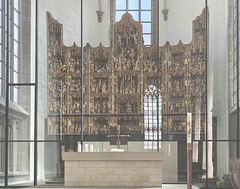
At 5.65 meters high and 7.40 meters wide with the double doors open, the Dortmund carved altar, the "Goldenes Wunder von Westfalen", is considered the largest surviving Antwerp altarpiece. The retable features two pairs of wings, the interior of which is also sculpturally carved.
The altar was originally commissioned by the Dortmund Franciscans from Jan Gillisz Wrage in Antwerp for their monastery church. After the monastery was dissolved during secularization, the St. Peter's congregation acquired the altar and brought it to their church. During World War II, the altar was removed and returned to Dortmund in 1954. It was restored in St. Peter's Church from the early 1960s onwards and reinstalled in 1985.
The winged altar is opened differently throughout the church year, revealing different images on the front.
From Thanksgiving to Holy Week and from Easter to Pentecost, the actual gilded carved altar with 36 compartments and a total of 633 gilded figures can be seen inside. It depicts the detailed story of Jesus' Passion, with the crucifixion at its center.
Dortmund - Petrikirche
| 15 Jul 2025 |
|
|
Petrikirche is a hall church in the High Gothic style, which approximates the ideal type of this church form. The building has a nearly square floor plan with a comparatively short choir.
St. Peter's Church, along with St. Reinoldi's Church and St. Mary's Church, is another medieval church located directly on Westenhellweg in Dortmund's city center. The three-bay structure was begun in 1322 and is made of sandstone. In its present form, the church once again displays the original, medieval form of the transverse gabled roofs above the side aisles. The elevated tower is striking; after its collapse in 1752, it was not seen in this form for a long time and was only rebuilt to its historic height in 1981, after the destruction of the Second World War.
Antwerp retable is the name given to a type of winged altarpiece produced for export, particularly in Antwerp workshops during the first third of the 16th century. Antwerp retables are generally characterized by their intricately detailed carvings, but also by certain standardizations, such as their dimensions and the frequent repetition of certain groups of figures. Over 200 examples are still preserved today in churches and museums in various European countries.
At 5.65 meters high and 7.40 meters wide with the double doors open, the Dortmund carved altar, the "Goldenes Wunder von Westfalen", is considered the largest surviving Antwerp altarpiece. The retable features two pairs of wings, the interior of which is also sculpturally carved.
The altar was originally commissioned by the Dortmund Franciscans from Jan Gillisz Wrage in Antwerp for their monastery church. After the monastery was dissolved during secularization, the St. Peter's congregation acquired the altar and brought it to their church. During World War II, the altar was removed and returned to Dortmund in 1954. It was restored in St. Peter's Church from the early 1960s onwards and reinstalled in 1985.
The winged altar is opened differently throughout the church year, revealing different images on the front.
From Thanksgiving to Holy Week and from Easter to Pentecost, the actual gilded carved altar with 36 compartments and a total of 633 gilded figures can be seen inside. It depicts the detailed story of Jesus' Passion, with the crucifixion at its center.
Unfortunately, it is behind highly reflective safety glass.

Dortmund - Petrikirche
| 15 Jul 2025 |
|
|
|
Petrikirche is a hall church in the High Gothic style, which approximates the ideal type of this church form. The building has a nearly square floor plan with a comparatively short choir.
St. Peter's Church, along with St. Reinoldi's Church and St. Mary's Church, is another medieval church located directly on Westenhellweg in Dortmund's city center. The three-bay structure was begun in 1322 and is made of sandstone. In its present form, the church once again displays the original, medieval form of the transverse gabled roofs above the side aisles. The elevated tower is striking; after its collapse in 1752, it was not seen in this form for a long time and was only rebuilt to its historic height in 1981, after the destruction of the Second World War.
Inside the church is the "Golden Wonder of Westphalia", a magnificent carved altarpiece.
Jump to top
RSS feed- Martin M. Miles' latest photos with "Antwerpener Retabel" - Photos
- ipernity © 2007-2026
- Help & Contact
|
Club news
|
About ipernity
|
History |
ipernity Club & Prices |
Guide of good conduct
Donate | Group guidelines | Privacy policy | Terms of use | Statutes | In memoria -
Facebook
X
