
Martin M. Miles' photos with the keyword: demon
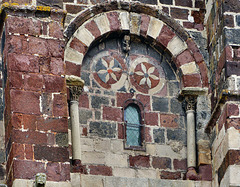
Le Monastier-sur-Gazeille - Saint Chaffre
| 01 Mar 2018 |
|
|
|
Legends tell, that a small community of hermits lived here in the 6th century. A century later the group was led by (Saint) Eudes and after him by Eudes´ nephew (Saint) Theofrede. Theofrede got killed by the locals - and so he became a martyr named Saint Chaffre.
The monastery adopted the Benedictine rule in 817 and found support from Louis the Pious. In the following two centuries three churches were erected here. All collapsed due to the unstable ground. The current, former abbey church was built from 1074 on.
The monastery (and the relics of Saint Chaffre) were just a day´s walk from Le Puy, where the Via Podiensis started and many pilgrims gathered. It may well be, that the wealthiness of the abbey, was related to the pilgrim-business.
The former abbey church has a polychrome facade with a unique frieze (under the roof). Integrated into the walls are some smaller carvings.
In the center, above the two (flower) circles is a demon or devil (?) with the head of a cat (?) sucking its tail.
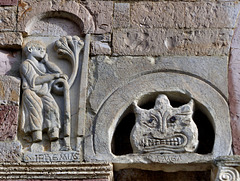
Castel Ritaldi - San Gregorio
| 22 Aug 2016 |
|
|
San Gregorio, located outside a hamlet, that meanwhile is part of Castel Ritaldi, is decorated with some extraordinary carvings. Seen here is a detail of the upper part of the facade. For am overview see the previous uploads.
"IRREMIAS", leaning on a very elastic, fruit bearing tree and next to the head of the demon "PAMEA", who displays pretty threatening front teeth.
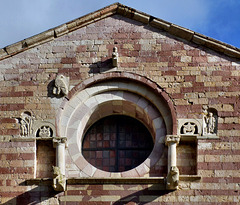
Castel Ritaldi - San Gregorio
| 22 Aug 2016 |
|
San Gregorio, located outside a hamlet, that meanwhile is part of Castel Ritaldi, is decorated with some extraordinary carvings. Seen here is the upper part of the facade. Most interesting are the figures and the demons, as there are inscriptions below.
On the very left is "IRREMIAS" next to the head of the demon "PAMEA". The (teethless) deamon to the right is named "GENOFALUS INFERUS", next to him is "GESECHIEL P"(rophet= ?).
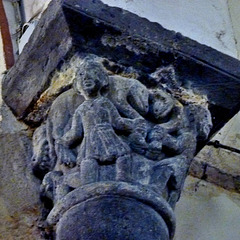
Volvic - Saint-Priest
| 04 Nov 2011 |
|
There are two products, this small town, near Riom is pretty famous for.
There are the black stones from Volvic, used all over the Auvergne. The gothic cathedral in Clermont-Ferrand is built from the black stones, coming from Volvic.
The younger product is the "Volvic" mineral water. Zillions of plastic bottles, filled with Volvic-water leave this place every week or month.
Long time before Danone (Evian, Badoit, La Salvetat....) entered the stage in Volvic, this place was owned by St. Priest (aka Priest de Clermont, aka Saint Praejectus), bishop of Clermont. St. Priest was stabbed to death here in 676 and immediately was venerated as a martyr. His sucessor Avitor founded an abbey here, that later was depending from Mozac (1169).
The capitals in St. Priest do not have the wonderful, sleek elegance of the carvings seen in the former abbey church in Mozac (5kms east) or Notre-Dame-Du-Port in Clermont-Ferrand (15kms south), but they use the same "icons", that are so typical all over the Auvergne: sirens, griffons, eagles..
Another of these familar sights: The shepherds. Probably referring to the "Parable of the Lost Sheep" (Matthew, 18:12-14 / Luke 18:12-14). This shepherd-theme ("Pastor Bonus") can be found all over the Auvergne (Issoire, Biozat, Thuret..).
Here are two shepherds, on their knees. The sheep they have on their shoulders are pretty large - and have strange faces. On the very left the head of the demon/wolf can be seen, showing a row of scaring shark-like teeth.
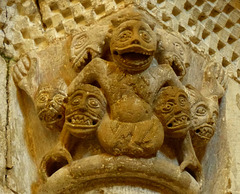
Aulnay - Saint-Pierre
| 15 Feb 2016 |
|
"Saint-Pierre d'Aulnay" is a church outside of Aulnay, in the center of an old graveyard. The setting has not changed for centuries. For the pilgrims of the 12th century this church was a major halt - and it still is for all the tourists...
A predecessing church „Saint-Pierre-de-la-Tour“ had been here, that, when the pilgrimage to Santiago de Compostella got more and more popular, was obviously too small, as Aulnay was conveniently situated between Poitiers and Saintes on the Via Turonensis. A new, larger church was needed, so the place was handed over to the chapter of the cathedral in Poitiers. The canons then probably planned this church, that was erected from about 1130/1140 on.
"Saint-Pierre d'Aulnay" (here seen from east) is a gem of the "style saintongeais". For Peter Strafford ("Romanesque Churches Of France") this is "one of the best examples of late Romanesque architecture in what used to be Aquitaine".
-
A seven-headed devil.
-
I have uploaded many photos already taken during previous visits. So I will now add only a few.
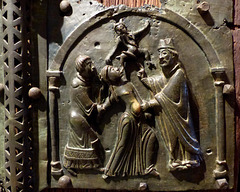
Verona - Basilica di San Zeno
| 29 Oct 2015 |
|
|
Already Theodoric the Great, King of the Ostrogoths, may have funded a church, erected over the tomb of Saint Zeno, who, following the legends, was born in Mauretania and died around 380 in Verona.
The erection of the present church began in the 9th century. Soon after San Zeno´s relics were translated into the new church. At that time Charlemagne´s son Pepin (aka "Pepin of Italy") resided in Verona and a large Benedictine monastery grew all around the church.
When the Magyars invaded Italy in the early 10th century, the church got severely damaged, but the relics were not harmed, as they had been taken out and were hidden. In 967, a new church was built with the patronage of Otto I.
On January 3, 1117, the church was damaged by an earthquake, that ruined so many buildings in Northern Italy. The church was restored and got enlarged in 1138.
It may well be, that soon after panels of a bronze door from another (destroyed?, damaged?) church were transferred to San Zeno - and so got reused here. Today the famous bronze door consists out of two panels on which the plates are fixed. The older ones (~ 1100) are often compared with the bronze works in Hildesheim, and Saxon Masters may have worked here. The younger ones (1200) are "smoother" and some scholars connect them to Benedetto Antelami, who worked in Parma 1178 ("Deposition").
Unfortunately the room is so small, that I was unable to take an "overview", so I could only take photos of panels and details.
Some of the panels depict scenes of legends around San Zeno. One legend tells that he exorcised a demon from the body of the daughter of the Emperor Gallienus.
Lucca - Duomo di Lucca
| 27 Aug 2015 |
|
Lucca existed already in Etruscan times and became a Roman colony in 180 BC. The Diocese of Lucca dates back to the first century, legends tell, that St. Paulinus, a disciple of St. Peter, was the first Bishop of Lucca. In medieval times Lucca was the residence of the Margraves of Tuscany. After the death of Matilda of Tuscany (1115), Lucca constituted itself as an independent republic. Actually the "Republic of Lucca" existed from 1160 to 1805.
The Cathedral of Saint Martin is the seat of the Archbishop of Lucca. The construction of the cathedral started in 1063, when Anselm (later Pope Alexander II) was bishop here.
The western facade was begun in 1204 by Guido Bigarelli, who later sculpted (and signed!) the the octogonal baptismal font in the center of the Pisan Baptistery. He is one of the many gifted artists, that came from the area around the Lake Como and are known as "Comacine masters".
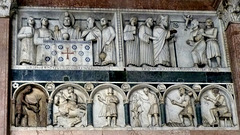
The main theme of the reliefs of cathedral´s western wall, inside the portico, is the life of Saint Martin. Here are two episodes.
The left inscription reads "Ignis Adest Capiti Martino Sacra Litanti" (~ a flame appears on the head of Martin during the holy sacrifice (?)). The right inscription reads "Demone vexatum salvas Martine beate" (~ Blessed Martin saves a man chased by a devil).
Below these reliefs are the "Monthly Labors" including the zodiacs. Seen here are
JUNIUS, MAGIUS, APRILIS, MARTIUS, FEBRUARIUS, JANUARIUS
Villers-Saint-Paul - Saint-Pierre-et-Saint-Paul
| 23 Feb 2015 |
|
|
|
"Saint-Pierre-et-Saint-Paul" is not mentioned in any written document before the 13th century. Most historians agree, that the church was built not earlier than in the first half of the 12th century. About a century later, the Romanesque transept and choir got demolished - and replaced by the large Gothic structure, seen here. The tower was erected within the 13th century.
The church was added to the list of "monuments historique" already in 1862, but the restoration process started end of the 19th century.
The church was added to the list of "monuments historique" already in 1862, but the restoration process started end of the 19th century. Of course a church like this needs perpetual care.
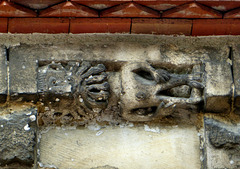
The walls of the nave are well conserved. They are decorated between the corbels with very unusual reliefs. These carvings were well protected under the roof and are not weathered. Some of them are fantastic and very mysterious.
This bearded man looks similar to one found on one of the portal´s capital. But here is the complete body of the devil - with claws!
There are more than 50 of these reliefs all around the old nave.
I have uploaded 15 of them - and now will continue my travel.
Villers-Saint-Paul - Saint-Pierre-et-Saint-Paul
| 23 Feb 2015 |
|
"Saint-Pierre-et-Saint-Paul" is not mentioned in any written document before the 13th century. Most historians agree, that the church was built not earlier than in the first half of the 12th century. About a century later, the Romanesque transept and choir got demolished - and replaced by the large Gothic structure, seen here. The tower was erected within the 13th century.
The church was added to the list of "monuments historique" already in 1862, but the restoration process started end of the 19th century.
The church was added to the list of "monuments historique" already in 1862, but the restoration process started end of the 19th century. Of course a church like this needs perpetual care.
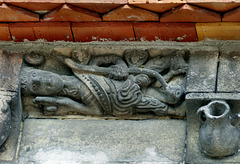
The walls of the nave are well conserved. They are decorated between the corbels with very unusual reliefs. These carvings were well protected under the roof and are not weathered. Some of them are fantastic and very mysterious.
A walking abbot/bishop with a crozier (but no mitra). He seems to bless the onlooker, while he is killing a small, evil creature (the devil!) with his crozier.
Villers-Saint-Paul - Saint-Pierre-et-Saint-Paul
| 23 Feb 2015 |
|
|
"Saint-Pierre-et-Saint-Paul" is not mentioned in any written document before the 13th century. Most historians agree, that the church was built not earlier than in the first half of the 12th century. About a century later, the Romanesque transept and choir got demolished - and replaced by the large Gothic structure, seen here. The tower was erected within the 13th century.
The church was added to the list of "monuments historique" already in 1862, but the restoration process started end of the 19th century.
The church was added to the list of "monuments historique" already in 1862, but the restoration process started end of the 19th century. Of course a church like this needs perpetual care.
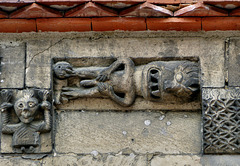
The walls of the nave are well conserved. They are decorated between the corbels with very unusual reliefs. These carvings were well protected under the roof and are not weathered. Some of them are fantastic and very mysterious.
The devil looks like an identical twin of the creature just seen (previous upload), but this demon is not shy and does not hide his genitals. He has no "human" feet, but claws, that hold a little baby. Maybe a poor soul.
The short legged guy on the corbel has a pair of very strange arms.
Saint-Chamant - Saint-Amant
| 03 Apr 2014 |
|
When the church, dedicated to Saint Amans de Rodez, got erected within the 12th century, it was dependent from the abbey Saint-Martin in Tulle (20kms north). It is known, that Humbaud, bishop of Limoges, consecrated a church here in 1094, but at that time the structure cannot have been completed
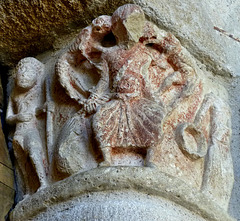
The portal of Saint-Chamant is extraordenary (for a village church). While the tympanum over the doors is undamaged, all capitals are damaged. After the French Revolution some small vandals used their hammers.
A well dressed miser with a huge sack (full of gold and silver) badly adviced by two ugly envoys of the evil not to share his wealth with the skinny beggars, that flank him.
Vigeois - Saint-Pierre
| 01 Apr 2014 |
|
|
The parish church of Vigois is the last structure of the former "Abbaye Saint-Pierre", founded here by Yrieix du Limousin (aka "St. Yriex", "Aredius") within the 6th century. So the "Abbaye Saint-Pierre" was one of the oldest convents within the Limousin.
In the 9th century the Normans (Vikings) looted and ruined the abbey. After some decades, the abbey recovered and got rebuilt. In 1070 it burnt down. Since 1082 it was dependent from Cluniac Saint-Martial Abbey in Limoges and prospered during the 12th century.
Destroyed again during the Hundred Years War, rebuilt again by the Bishop of Limoges. During the Wars of Religions Huguenot troops burnt down the nave of the church and vandalized many of the carvings. Another fire hit the church in 1705, when it fell into disrepair.
All buildings of the convent got demolished after the French Revolution, only the Saint-Pierre, now the parish church, survived the times. The renovation of the nave was completed in the 1860s. Apse and crossing, seen here, got restored early 20th century. The large apse never got severely damaged. Only some carvings are mutilated, but most of the capitals, dating back to the 12th-century, are still in situ.
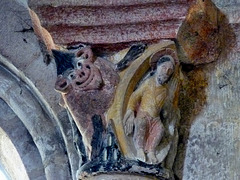
Here is a capital, that may depict the "Temptation of Christ". A really horrible huge devil cannot frighten Christ, seated in a mandorla.
Artaiz - San Martin
| 04 Feb 2014 |
|
|
This church, dedicated to Saint Martin of Tours, was a real surprise to me. The single nave structure was probably erected within the 12th century. It was built in a "walking distance" off the pilgrim routes (like "San Pedro de Echano"), as the hamlet Artaiz is just about 10kms north of the "Camino Aragonés". San Martin will have been for sure a stopover for pilgrims, who had visited the tomb of Saint Martin of Tours, following the "Via Turonensis".
The masterly composed and carved portal of Saint Martin is extraordinary in the specific iconography, that in parts may reflect the relations to the Islamic neighbours (Reconquista). Here is a script by German arthistorian Hedda Finke about this subject.
art.unt.edu/medieval-symposium/presenter.php?year=2009&am...
Between the seven corbels under the portal´s roof are six reliefs.
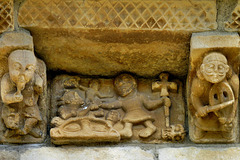
This one depicts the "Harrowing of Hell".
In the time between Crucifixion and the Resurrection Christ (here without a nimbus!) descended into hell, bringing salvation to the righteous, who had died since the beginning (mostly symbolized by Adam and Eve). Here the giant mouth of the hell is open. Christ spears a beast with a cross, that reminds on a processional cross or a pilgrim's staff.
The corbels depict a flautist (left) and a musician with a vielle.
Tudela - Catedral de Santa Maria
| 16 Jan 2014 |
|
|
The Catedral de Santa Maria in Tudela was erected late 12th century on the place, where the Great Mosque of Tudela (9th c.) had stood before. The cathedral is really large (65m x 52m) but unfortunately was closed, so I could not see the well known cloister.
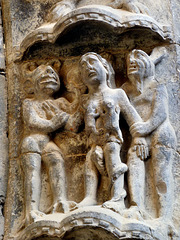
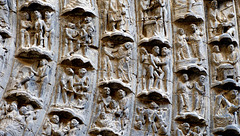
I was very impressed by the late-Romanesque "Puerta del Juicio". The slightly pointed portal, created wirthin the 13th century, has eight archivolts and 122 different icons. On the left side is an insight view into hell, demons and devils at work.
Two evil-looking devils hold a Luxuria. The left (horned?) devil holds a round object behind the Luxuria´s head. Maybe a mirror, symbol of vanity.
Tudela - Catedral de Santa Maria
| 16 Jan 2014 |
|
|
The Catedral de Santa Maria in Tudela was erected late 12th century on the place, where the Great Mosque of Tudela (9th c.) had stood before. The cathedral is really large (65m x 52m) but unfortunately was closed, so I could not see the well known cloister.
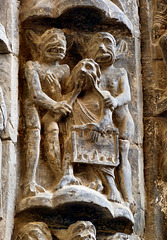
I was very impressed by the late-Romanesque "Puerta del Juicio". The slightly pointed portal, created wirthin the 13th century, has eight archivolts and 122 different icons. On the left side is an insight view into hell, demons and devils at work.
Two tall devils torture a small guy with two-pronged forks. The person is holding a rectangular object in his hand, what could be a (damaged) Roman abacus. In case this is right, the scene depicts, what fraudulent mathematicians have to expect.
Here is what Wiki knows about the Roman abacus:
en.wikipedia.org/wiki/Roman_abacus
Tudela - Catedral de Santa Maria
| 16 Jan 2014 |
|
|
The Catedral de Santa Maria in Tudela was erected late 12th century on the place, where the Great Mosque of Tudela (9th c.) had stood before. The cathedral is really large (65m x 52m) but unfortunately was closed, so I could not see the well known cloister.
I was very impressed by the late-Romanesque "Puerta del Juicio". The slightly pointed portal, created wirthin the 13th century, has eight archivolts and 122 different icons. Here on the right side an insight view into hell. Demons and devils at work.
Brioude - Saint-Julien
| 09 Dec 2011 |
|
The Basilica Saint-Julien in Brioude was a collegiate church constructed between 1060 - 1200. The architectoral structure is influenced by great romanesque churches like "Notre-Dame-Du-Port" in Clermont-Ferrand (70kms north) or "Saint-Austremoine" in Issoire (30kms north), planned and constructed within the same century. Three or four very skilled architects worked here over the century, all witrh a different touch. So Saint-Julien is really special, as it differs from the other great churches of the Auvergne.
Brioude was a center of pilgrimage very early, as already within the 4th century a "martyrion" existed over the grave of St. Julien. This building was replaced by an early basilica, financed by Victorius, a "comes" (count), installed by the Visigothic king Eurich after he had seized the Auvergne. Gregory of Tours (538-594 visited and described it, when he about a pilgrimage to Saint-Julien undertaken yearly from Avernis (= Clermont-Ferrand) to Brioude. Within the 10th century William I, Duke of Aquitaine, (aka "Guillaume Le Pieux" - "William the Pious") funded the building of a larger church here. He got buried in this church in 917. Around 1060, works on the church still seen today started with the narthex. It took about 140 years, to complete it - and was a stopover at that time for many pilgrims to Santiago, only two days (60kms) away from Le Puy (Via Podensis).
There are about 125 capitals and carvings inside Saint-Julien and they all differ in artistic style and quality. Bernard Craplet has found six (!) different workshops, what is not that surprising taking in account that it took more than a century to finish this building. None of the capitals of the nave depicts a biblical theme.
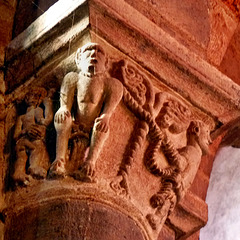
Another "ape/man/rope" capital, but this differs from all the other seen so far within the Auvergne (Droiturier, Besse, Issoire, Thuret, Saint-Nectaire, Clermont-Ferrand, Mozac...). Not the ape on the rope, called "singe cordé" in French, is so much different, but everything around adds some new spice.
Left to the ape stands a man, described by B. Craplet having a "praying gesture". I think, this is a more like a greeting gesture ("Hi").
It is a rough carving, this person may be naked, his legs may be swollen, as if he would suffer from elephantiasis (not a medieval but a tropical disease). I see kind of a cripple, displayed in public (later done in "Freakshows"). I may be wrong, and B. Craplet is right, who wrote, that this capital is from mediocre workmanship.
Any way, there is the ape on the rope - and a "strange person" on the left. To the right a very decorative tree, but taking a closer look makes clear, these are two trees. Futher right the man holding the rope, probably the owner of the "beast" - and further right, the "show" goes on...
Jump to top
RSS feed- Martin M. Miles' latest photos with "demon" - Photos
- ipernity © 2007-2026
- Help & Contact
|
Club news
|
About ipernity
|
History |
ipernity Club & Prices |
Guide of good conduct
Donate | Group guidelines | Privacy policy | Terms of use | Statutes | In memoria -
Facebook
X
