

Martin M. Miles' photos with the keyword: triconchos

Saint-Martin-de-Londres - Saint Martin (PiP)
| 17 Oct 2025 |
|
|
In 1088, the existing parish was transferred to the nearby Benedictine monastery of Gellone (= Saint-Guilhem-le-Désert), which built a priory church here, probably consecrated around 1100.
The Church of St. Martin is one of the few buildings in Europe with triconch or trefoil plan, consisting of three apses around the crossing. Other examples can be found in Cologne, Müstair and Germigny-des-Prés.
Neuss - Quirinus-Münster
| 19 Jun 2018 |
|
A settlement developed around a Roman miltary camp, built up 16BC and named "Novaesium". Where the church is now was a Roman graveyard in the early times. When the Normans raided Neuss in 866 a convent existed already in Neuss.
A church is mentioned here in 1043, legends tell, that Abbess Gepa, the sister of Pope Leo IX, brought the relics of Saint Quirinus (now "Saint Quirinus of Neuss") a 2nd century-martyr, from Rome to Neuss, what brought pilgrims to the growing town.
The monastery, now under the patronage of Saint Quirinus, was a house of noble canonesses mid 12th century.
The construction of today´s church started in 1209 in late Romanesque style. There was clear influence from nearby Cologne, as just like the older St. Maria im Kapitol ("St. Mary in the Capitol") this church has a trefoil choir ("triconchos"). The church was completed already in 1230 - and then the tower grew up to nearly 100 metres.
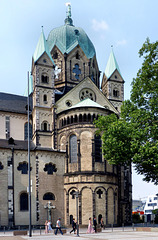
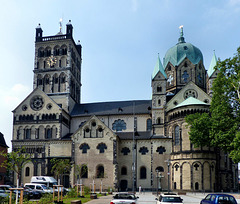
In 1741, the church was badly damaged by lightning and The gothic helmets of the west and east towers over the crossing. Instead, the building got a Baroque dome with the statue of Quirinus and a flat pyramid roof on the main tower.
After the French Revolution the church goot looted and then served as a storage room. The monastery buildings were demolished at that time.
In 1944 the church got damaged by a bomb attack. Meanwhile the building is in good condition.
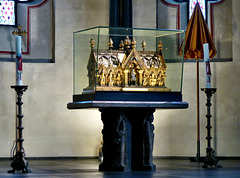
The golden shrine holding the relics of Saint Quirinus was created in the 19th century. It replaced one, that mow is kept in the museum. Since 2009 the Quirinus-Münster is a "Basilica minor". The symbol for this honor is the umbraculum, the umbrella behind the shrine.

Neuss - Quirinus-Münster
| 18 Jun 2018 |
|
A settlement developed around a Roman miltary camp, built up 16BC and named "Novaesium". Where the church is now was a Roman graveyard in the early times. When the Normans raided Neuss in 866 a convent existed already in Neuss.
A church is mentioned here in 1043, legends tell, that Abbess Gepa, the sister of Pope Leo IX, brought the relics of Saint Quirinus (now "Saint Quirinus of Neuss") a 2nd century-martyr, from Rome to Neuss, what brought pilgrims to the growing town.
The monastery, now under the patronage of Saint Quirinus, was a house of noble canonesses mid 12th century.
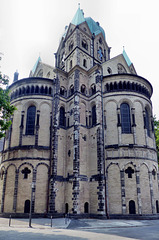
The construction of today´s church started in 1209 in late Romanesque style. There was clear influence from nearby Cologne, as just like the older St. Maria im Kapitol ("St. Mary in the Capitol") this church has a trefoil choir ("triconchos"). The church was completed already in 1230 - and then the tower grew up to nearly 100 metres.
In 1741, the church was badly damaged by lightning and The gothic helmets of the west and east towers over the crossing. Instead, the building got a Baroque dome with the statue of Quirinus and a flat pyramid roof on the main tower.
After the French Revolution the church goot looted and then served as a storage room. The monastery buildings were demolished at that time.
In 1944 the church got damaged by a bomb attack. Meanwhile the building is in good condition.
Standing in the nave, facing east. In the center of the choir is the golden shrine holding the relics of Saint Quirinus.
Neuss - Quirinus-Münster
| 18 Jun 2018 |
|
A settlement developed around a Roman miltary camp, built up 16BC and named "Novaesium". Where the church is now was a Roman graveyard in the early times. When the Normans raided Neuss in 866 a convent existed already in Neuss.
A church is mentioned here in 1043, legends tell, that Abbess Gepa, the sister of Pope Leo IX, brought the relics of Saint Quirinus (now "Saint Quirinus of Neuss") a 2nd century-martyr, from Rome to Neuss, what brought pilgrims to the growing town.
The monastery, now under the patronage of Saint Quirinus, was a house of noble canonesses mid 12th century.
The construction of today´s church started in 1209 in late Romanesque style. There was clear influence from nearby Cologne, as just like the older St. Maria im Kapitol ("St. Mary in the Capitol") this church has a trefoil choir ("triconchos"). The church was completed already in 1230 - and then the tower grew up to nearly 100 metres.
In 1741, the church was badly damaged by lightning and The gothic helmets of the west and east towers over the crossing. Instead, the building got a Baroque dome with the statue of Quirinus and a flat pyramid roof on the main tower.
After the French Revolution the church goot looted and then served as a storage room. The monastery buildings were demolished at that time.
In 1944 the church got damaged by a bomb attack. Meanwhile the building is in good condition.
Here are two (of the three) conches of the choir.
Neuss - Quirinus-Münster
| 18 Jun 2018 |
|
A settlement developed around a Roman miltary camp, built up 16BC and named "Novaesium". Where the church is now was a Roman graveyard in the early times. When the Normans raided Neuss in 866 a convent existed already in Neuss.
A church is mentioned here in 1043, legends tell, that Abbess Gepa, the sister of Pope Leo IX, brought the relics of Saint Quirinus (now "Saint Quirinus of Neuss") a 2nd century-martyr, from Rome to Neuss, what brought pilgrims to the growing town.
The monastery, now under the patronage of Saint Quirinus, was a house of noble canonesses mid 12th century.
The construction of today´s church started in 1209 in late Romanesque style. There was clear influence from nearby Cologne, as just like the older St. Maria im Kapitol ("St. Mary in the Capitol") this church has a trefoil choir ("triconchos"). The church was completed already in 1230 - and then the tower grew up to nearly 100 metres.
In 1741, the church was badly damaged by lightning and The gothic helmets of the west and east towers over the crossing. Instead, the building got a Baroque dome with the statue of Quirinus and a flat pyramid roof on the main tower.
After the French Revolution the church goot looted and then served as a storage room. The monastery buildings were demolished at that time.
In 1944 the church got damaged by a bomb attack. Meanwhile the building is in good condition.
May and June are great months to marry. Here is another wedding!
Neuss - Quirinus-Münster
| 18 Jun 2018 |
|
|
|
A settlement developed around a Roman miltary camp, built up 16BC and named "Novaesium". Where the church is now was a Roman graveyard in the early times. When the Normans raided Neuss in 866 a convent existed already in Neuss.
A church is mentioned here in 1043, legends tell, that Abbess Gepa, the sister of Pope Leo IX, brought the relics of Saint Quirinus (now "Saint Quirinus of Neuss") a 2nd century-martyr, from Rome to Neuss, what brought pilgrims to the growing town.
The monastery, now under the patronage of Saint Quirinus, was a house of noble canonesses mid 12th century.
The construction of today´s church started in 1209 in late Romanesque style. There was clear influence from nearby Cologne, as just like the older St. Maria im Kapitol ("St. Mary in the Capitol") this church has a trefoil choir ("triconchos"). The church was completed already in 1230 - and then the tower grew up to nearly 100 metres.
In 1741, the church was badly damaged by lightning and The gothic helmets of the west and east towers over the crossing. Instead, the building got a Baroque dome with the statue of Quirinus and a flat pyramid roof on the main tower.
After the French Revolution the church goot looted and then served as a storage room. The monastery buildings were demolished at that time.
In 1944 the church got damaged by a bomb attack. Meanwhile the building is in good condition. The tower - seen here - has round and pointed arches, standing for the Romanesque and Gothic style.
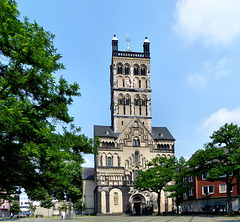
Neuss - Quirinus-Münster
| 18 Jun 2018 |
|
|
A settlement developed around a Roman miltary camp, built up 16BC and named "Novaesium". Where the church is now was a Roman graveyard in the early times. When the Normans raided Neuss in 866 a convent existed already in Neuss.
A church is mentioned here in 1043, legends tell, that Abbess Gepa, the sister of Pope Leo IX, brought the relics of Saint Quirinus (now "Saint Quirinus of Neuss") a 2nd century-martyr, from Rome to Neuss, what brought pilgrims to the growing town.
The monastery, now under the patronage of Saint Quirinus, was a house of noble canonesses mid 12th century.
The construction of today´s church started in 1209 in late Romanesque style. There was clear influence from nearby Cologne, as just like the older St. Maria im Kapitol ("St. Mary in the Capitol") this church has a trefoil choir ("triconchos"). The church was completed already in 1230 - and then the tower grew up to nearly 100 metres.
In 1741, the church was badly damaged by lightning and The gothic helmets of the west and east towers over the crossing. Instead, the building got a Baroque dome with the statue of Quirinus and a flat pyramid roof on the main tower.
After the French Revolution the church goot looted and then served as a storage room. The monastery buildings were demolished at that time.
In 1944 the church got damaged by a bomb attack. Meanwhile the building is in good condition. The tower - seen here - has round and pointed arches, standing for the Romanesque and Gothic style.
Gravedona - S. Maria del Tiglio
| 15 Nov 2015 |
|
|
It is believed, that this place was a "sacred ground" already in pagan times. Santa Maria del Tiglio (Tiglio = lime tree) was erected within the 11th or 12th century on foundations of a baptistry, dedicated to John the Baptist, that may date back to the 5th or 6th century.
This baptistery had been built on the plan of a "triconchos", it had three apses in clover-leaf shape (see: "Como - San Fedele").
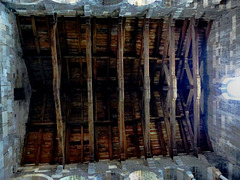
Santa Maria del Tiglio was erected on the same design, it is as well a "triconchos". S. Maria del Tiglio is small, here is the wooden ceiling of the "nave".
Gravedona - S. Maria del Tiglio
| 14 Nov 2015 |
|
|
|
It is believed, that this place was a "sacred ground" already in pagan times. Santa Maria del Tiglio (Tiglio = lime tree) was erected within the 11th or 12th century on foundations of a baptistry, dedicated to John the Baptist, that may date back to the 5th or 6th century.
This baptistery had been built on the plan of a "triconchos", it had three apses in clover-leaf shape (see: "Como - San Fedele").
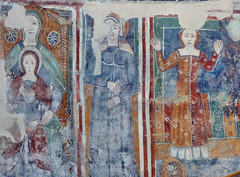
Santa Maria del Tiglio was erected on the same design, it is as well a "triconchos". The walls were probably covered with frescoes, some of the can still be seen, after the baroque interior had been removed during the restoration of the church. The frescoes were created in different times - and so they differ in style. These ladies were probably painted early 13th century.
Gravedona - S. Maria del Tiglio
| 14 Nov 2015 |
|
|
It is believed, that this place was a "sacred ground" already in pagan times. Santa Maria del Tiglio (Tiglio = lime tree) was erected within the 11th or 12th century on foundations of a baptistry, dedicated to John the Baptist, that may date back to the 5th or 6th century.
This baptistery had been built on the plan of a "triconchos", it had three apses in clover-leaf shape (see: "Como - San Fedele").
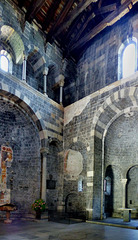
Santa Maria del Tiglio was erected on the same design, it is as well a "triconchos". The walls were probably covered with frescoes, some of the can still be seen, after the baroque interior had been removed during the restoration of the church.
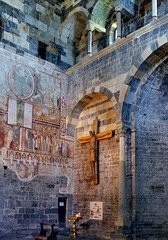
Gravedona - S. Maria del Tiglio
| 14 Nov 2015 |
|
|
It is believed, that this place was a "sacred ground" already in pagan times. Santa Maria del Tiglio (Tiglio = lime tree) was erected within the 11th or 12th century on foundations of a baptistry, dedicated to John the Baptist, that may date back to the 5th or 6th century.
This baptistery had been built on the plan of a "triconchos", it had three apses in clover-leaf shape (see: "Como - San Fedele").
Santa Maria del Tiglio was erected on the same design, it is as well a "triconchos". The walls were probably covered with frescoes, some of the can still be seen, after the baroque interior had been removed during the restoration of the church.
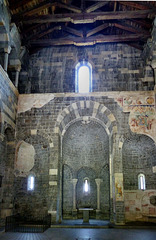
Gravedona - S. Maria del Tiglio
| 13 Nov 2015 |
|
|
It is believed, that this place was a "sacred ground" already in pagan times. Santa Maria del Tiglio (Tiglio = lime tree) was erected within the 11th or 12th century on foundations of a baptistry, dedicated to John the Baptist, that may date back to the 5th or 6th century.
This baptistery had been built on the plan of a "triconchos", it had three apses in clover-leaf shape (see: "Como - San Fedele").
Santa Maria del Tiglio was erected on the same design, it is as well a "triconchos". The walls were probably covered with frescoes, some of the can still be seen, after the baroque interior had been removed during the restoration of the church.
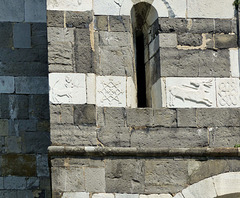
Gravedona - S. Maria del Tiglio
| 13 Nov 2015 |
|
|
It is believed, that this place was a "sacred ground" already in pagan times. Santa Maria del Tiglio (Tiglio = lime tree) was erected within the 11th or 12th century on foundations of a baptistry, dedicated to John the Baptist, that may date back to the 5th or 6th century.
This baptistery had been built on the plan of a "triconchos", it had three apses in clover-leaf shape (see: "Como - San Fedele").
Santa Maria del Tiglio was erected on the same design, it is as well a "triconchos". The facade of the church has some carvings, that seem the be older than 12th century. The deer hunting centaur is a frequent icon. Centaurs either hunt deers - or mermaids.
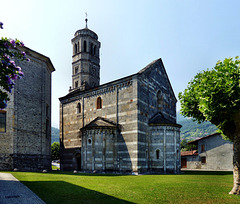
Gravedona - S. Maria del Tiglio
| 13 Nov 2015 |
|
|
|
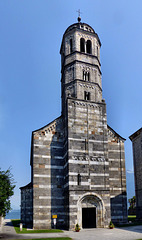
It is believed, that this place was a "sacred ground" already in pagan times. Santa Maria del Tiglio (Tiglio = lime tree) was erected within the 11th or 12th century on foundations of a baptistry, dedicated to John the Baptist, that may date back to the 5th or 6th century.
This baptistery had been built on the plan of a "triconchos", it had three apses in clover-leaf shape (see: "Como - San Fedele").
Santa Maria del Tiglio was erected on the same design, it is as well a "triconchos".
Gravedona - S. Maria del Tiglio
| 13 Nov 2015 |
|
|
It is believed, that this place was a "sacred ground" already in pagan times. Santa Maria del Tiglio (Tiglio = lime tree) was erected within the 11th or 12th century on foundations of a baptistry, dedicated to John the Baptist, that may date back to the 5th or 6th century.
This baptistery had been built on the plan of a "triconchos", it had three apses in clover-leaf shape (see: "Como - San Fedele").
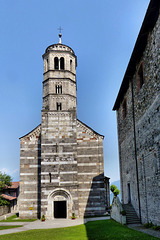
Santa Maria del Tiglio was erected on the same design, it is as well a "triconchos". One of the apses can be seen to the right.
Neighbouring to the right is the parish church S. Vincenzo (right), that is probably as old, but got modified around 1600 - and now has a Baroque interior.
Gravedona - S. Maria del Tiglio
| 12 Nov 2015 |
|
|
It is believed, that this place was a "sacred ground" already in pagan times. Santa Maria del Tiglio (Tiglio = lime tree) was erected within the 11th or 12th century on foundations of a baptistry, dedicated to John the Baptist, that may date back to the 5th or 6th century.
This baptistery had been built on the plan of a "triconchos", it had three apses in clover-leaf shape (see: "Como - San Fedele").
Santa Maria del Tiglio was erected on the same design, it is as well a "triconchos". It neighbours the parish church S. Vincenzo (right), that is probably as old, but got modified around 1600 - and now has a Baroque interior.
Como - San Fedele
| 10 Nov 2015 |
|
|
San Fedele, the ancient Cathedral of Como, has paleochristian origins. The present church dates from 1120.
San Fedele´s unusual floor plan cannot be seen. There is a wide nave, two aisles and three apses in clover-leaf shape, a "triconchos", similar to "St. Maria im Kapitol" (Cologne), the "Chapel of the Cross" (Muestair) and "Germigny-des-Prés".
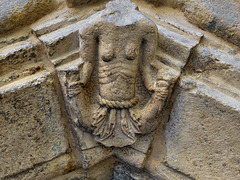
This is the the center of the ancient pointed portal.
A mutilated mermaid!
Como - San Fedele
| 10 Nov 2015 |
|
|
San Fedele, the ancient Cathedral of Como, has paleochristian origins. The present church dates from 1120.
San Fedele´s unusual floor plan cannot be seen. There is a wide nave, two aisles and three apses in clover-leaf shape, a "triconchos", similar to "St. Maria im Kapitol" (Cologne), the "Chapel of the Cross" (Muestair) and "Germigny-des-Prés".
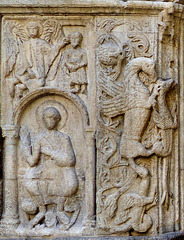
This is the left side of the ancient portal (prev. upload).
It is claimed, that the relief depicts Habakkuk with a basket of food transported by an angel from Judaea to Babylon. He is on his way to Daniel, who is seen below on the throne in the lions den.
Apocrypha 14
"Now the prophet Habakkuk was in Judea. He had boiled pottage and had broken bread into a bowl, and was going into the field to take it to the reapers. But the angel of the Lord said to Habakkuk, "Take the dinner which you have to Babylon, to Daniel, in the lions' den." Habakkuk said, "Sir, I have never seen Babylon, and I know nothing about the den." Then the angel of the Lord took him by the crown of his head, and lifted him by his hair and set him down in Babylon, right over the den, with the rushing sound of the wind itself."
Jump to top
RSS feed- Martin M. Miles' latest photos with "triconchos" - Photos
- ipernity © 2007-2026
- Help & Contact
|
Club news
|
About ipernity
|
History |
ipernity Club & Prices |
Guide of good conduct
Donate | Group guidelines | Privacy policy | Terms of use | Statutes | In memoria -
Facebook
X
