

Martin M. Miles' photos with the keyword: Holy Lance
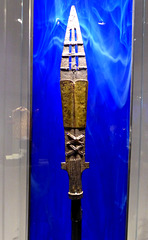
Kraków - Katedra Wawelska
| 30 Apr 2022 |
|
|
A legend attributes Kraków's founding to the mythical ruler Krakus, who built it above a cave occupied by a dragon, Smok Wawelski. The first written record dates to 965, when Kraków was described as a notable commercial center captured by a Bohemian duke Boleslaus I in 955. The first ruler of Poland, Mieszko I, took Kraków from the Bohemians.
In 1038, Kraków became the seat of the Polish government. By the end of the 10th century, the city was a center of trade. Brick buildings were constructed, including the Royal Wawel Castle. The city was sacked and burned during the Mongol invasion of 1241. It was rebuilt and incorporated in 1257 by Bolesław V the Chaste who introduced city rights. In 1259, the city was again ravaged by the Mongols. The third attack in 1287 was repelled thanks in part to the newly built fortifications.
The city rose to prominence in 1364, when Casimir III founded the University of Kraków, the second oldest university in central Europe. But after Casimir´s death in 1370 the campus did not get completed.
As the capital of the Kingdom of Poland and a member of the Hanseatic League, the city attracted craftsmen from abroad, guilds as science and the arts began to flourish. The 15th and 16th centuries are known as Poland's "Złoty Wiek" (Golden Age).
After childless King Sigismund II had died in 1572, the Polish throne passed to Henry III of France and then to other foreign-based rulers in rapid succession, causing a decline in the city's importance that was worsened by pillaging during the Swedish invasion and by an outbreak of bubonic plague that left 20,000 of the city's residents dead. In 1596, Sigismund III of the House of Vasa moved the capital of the Polish–Lithuanian Commonwealth from Kraków to Warsaw.
-
The Wawel Hill has been the seat of secular and ecclesiastical power since the early Middle Ages. Mieszko I the first historical ruler and creator of the Polish state, chose the hill as the site of one of his residences. His baptism in 966 brought Poland into the orbit of Western culture.
The Wawel Cathedral (officialy "Bazylika archikatedralna św. Stanisława i św. Wacława w Krakowie") is for about 1000 years part of the Wawel Castle Complex. The current Gothic cathedral is the third edifice on this site, the Cathedral of St. Wenceslas from 1020 was destroyed in 1038 by the Czech prince Břetislav, the Romanesque cathedral, consecrated in 1142, with the tomb of the holy Stanislaus, burnt down in 1305.
A few years later the construction of a Gothic cathedral, started. This was completed in 1346. Since Krakow was Poland's capital until 1609 and the royal castle stood on Wawel Hill, the cathedral also served as the court church, and Poland's kings were buried in the crypt.
The Sigismund Bell Tower, built in the second half of the 14th century as part of the fortifications, houses the most venerable bell in Poland, called "Sigismundus". Poland's holy queen Jadwiga (Hedwig of Poland) was buried in the cathedral in 1399.
After the Middle Ages, several chapels were added to the cathedral. There are examples of Romanesque, Gothic, Romanesque, Baroque, Neoclassical, and Neogothic elements in the Cathedral's façade and interior.
The Congress of Gniezno ("Akt von Gnesen") was a meeting between Mieszko I´s son Bolesław I the Brave and Emperor Otto III, which took place at Gniezno in Poland in March 1000.
After 997 Adalbert of Prague had been killed by pagan Prussian tribes, Adalbert was quickly canonized by the common effort of Bolesław I and Emperor Otto III. Thus, Adalbert became the first Slavic bishop to become a saint. His body was put into a tomb at Gniezno Cathedral, which became the ecclesiastical center of Poland.
Otto III, who had been a friend of Adalbert committed to a pilgrimage from Italy to St. Adalbert's tomb in Gniezno; in his attempt to extend the influence of Christianity in Central and Eastern Europe.
During the Congress of Gniezno Otto invested Bolesław with the title "Frater et cooperator Imperii" ("Brother and Partner of the Empire").
Otto III gave Bolesław a replica of his Holy Lance, part of the Imperial Regalia, and Bolesław presented the Emperor with a relic, an arm of St. Adalbert in exchange.
The Holy Lance is kept in the treasury of the cathedral, but - strange - it is "named "Spear of St. Maurice".
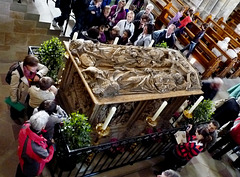
Bamberg - Cathedral
| 31 Jan 2013 |
|
Since 1007, when Holy Roman Emperor Heinrich II (Henry II) made Bamberg the seat of a diocese, the Bamberg Cathedral ("Bamberger Dom St. Peter und St. Georg") is the seat of the Archbishop of Bamberg.
The first cathedral on this place, founded in 1004 by Heinrich II and named "Heinrichsdom", got consecrated already in 1012. This building got destroyed by fire in 1085. Around 1215 the construction of the building seen here started. It was commisioned by Bishop Eckbert von Andechs-Meranien, brother of Hedwig von Andechs (aka Hedwig of Silesia). The new cathedral consecrated in 1237.
The tomb of Holy Roman Emperor Heinrich II and Empress Kunigunde is one of the main attractions for the visitors. It was created around 1500 by Tilman Riemenschneider, the most gifted and prolific German sculptor of his time.
Heinrich II was the last of the Ottonians on the throne. He was the son of Heinrich der Zaenker ("Henry the Wrangler"), following his second cousin Emperor Otto III, Theophanu´s son. As there were more hopeful aspirants, after Otto III sudden death (only 21 years old!), Heinrich travelled to Bavaria, where he stopped the funeral procession on the way to Aachen.
In the village of Polling Heinrich forced Archbishop Heribert of Cologne to hand out the imperial regalia. But Heribert, favoring his relative Herman II of Swabia as the next king, had sent the Holy Lance, most important part of the regalia, ahead.
So Heinrich imprisoned the Archbishop and later as well his brother, the Bishop of Wuerzburg. It took months for them to come free, but finally in July 1002, Bernard I, Duke of Saxony, handed the Holy Lance over to Heinrich II, who had been anointed and crowned a month before in Mainz. His wife Kunigunde was crowned as Queen in Paderborn in August 1002.
In 1146 Heinrich II was canonized and since then was known as "Sankt Heinrich". A legend tells, that he felt very lonely and was very happy, when in 1200 his wife Kunigunde was canonised as well - and since then is "Sankt Kunigunde".
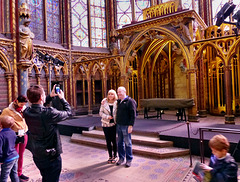
Paris - Sainte-Chapelle
| 05 Mar 2015 |
|
The Sainte-Chapelle ("Holy Chapel") was part of the Palais de la Cité, residence of the French Royals between 10th and 14th century. The chapel was built, to house Louis IX's vast collection of relics, including the Crown of Thorns, the Image of Edessa and the point of the "Holy Lance" - and many more prominent relics.
Saint Louis (aka Louis IX) had purchased the "Passion Relics" from Baldwin II, unfortunate emperor of the Latin Empire of Constantinople, for 135,000 livres. The money was actually paid to the Venetians, to whom the relics had been pawned.
Begun around 1239 and consecrated in 1248, the Sainte-Chapelle is considered among the highest achievements of the Gothic architecture.
A fire damaged the chapel 1630, that got restored after that. The chapel suffered its most grievous destruction during the French Revolution, when the steeple got removed and many of the precious reliquaries were melted down.
Reconstruction and restoration was done in the 1840s/1850s.
Here are more than 600m² of stained glass, about 1/3 was destroyed and had to be replaced within the 19th century. The light is breathtaking! The sights are neck breaking. This is a fantastic place. This was a sensation. Absolutely impressing, when it was completed - and it still is.
The Sainte-Chapelle is one of the main tourists attractions. At the Louvre, the Eiffel-Tower or the Cathedral Notre Dame people pose outside, here they do that inside. I do not blame them, but I would pay a hefty extra fee to be inside the chapel alone or with only a few others - for just ten minutes.
sainte-chapelle.monuments-nationaux.fr/
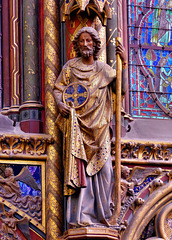
Paris - Sainte-Chapelle
| 05 Mar 2015 |
|
|
The Sainte-Chapelle ("Holy Chapel") was part of the Palais de la Cité, residence of the French Royals between 10th and 14th century. The chapel was built, to house Louis IX's vast collection of relics, including the Crown of Thorns, the Image of Edessa and the point of the "Holy Lance" - and many more prominent relics.
Saint Louis (aka Louis IX) had purchased the "Passion Relics" from Baldwin II, unfortunate emperor of the Latin Empire of Constantinople, for 135,000 livres. The money was actually paid to the Venetians, to whom the relics had been pawned.
Begun around 1239 and consecrated in 1248, the Sainte-Chapelle is considered among the highest achievements of the Gothic architecture.
A fire damaged the chapel 1630, that got restored after that. The chapel suffered its most grievous destruction during the French Revolution, when the steeple got removed and many of the precious reliquaries were melted down.
Reconstruction and restoration was done in the 1840s/1850s.
Here are more than 600m² of stained glass, about 1/3 was destroyed and had to be replaced within the 19th century. The light is breathtaking! The sights are neck breaking. This is a fantastic place. This was a sensation. Absolutely impressing, when it was completed - and it still is.
I doubt, that the life-size statues of the apostles survived the vandalism of the French Revolution unharmed. So at least the mint condition of this apostle probably results from the restoration.
Actually the Sainte-Chapelle is constantly under renovation and restoration since some decades, as the pollution had started to destroy the stained windows.
sainte-chapelle.monuments-nationaux.fr/
Paris - Sainte-Chapelle
| 05 Mar 2015 |
|
The Sainte-Chapelle ("Holy Chapel") was part of the Palais de la Cité, residence of the French Royals between 10th and 14th century. The chapel was built, to house Louis IX's vast collection of relics, including the Crown of Thorns, the Image of Edessa and the point of the "Holy Lance" - and many more prominent relics.
Saint Louis (aka Louis IX) had purchased the "Passion Relics" from Baldwin II, unfortunate emperor of the Latin Empire of Constantinople, for 135,000 livres. The money was actually paid to the Venetians, to whom the relics had been pawned.
Begun around 1239 and consecrated in 1248, the Sainte-Chapelle is considered among the highest achievements of the Gothic architecture.
A fire damaged the chapel 1630, that got restored after that. The chapel suffered its most grievous destruction during the French Revolution, when the steeple got removed and many of the precious reliquaries were melted down.
Reconstruction and restoration was done in the 1840s/1850s.
Here are more than 600m² of stained glass, about 1/3 was destroyed and had to be replaced within the 19th century. The light is breathtaking! The sights are neck breaking. This is a fantastic place. This was a sensation. Absolutely impressing, when it was completed - and it still is.
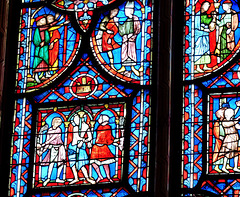
The Flagellation of Christ.
sainte-chapelle.monuments-nationaux.fr/
Paris - Sainte-Chapelle
| 05 Mar 2015 |
|
The Sainte-Chapelle ("Holy Chapel") was part of the Palais de la Cité, residence of the French Royals between 10th and 14th century. The chapel was built, to house Louis IX's vast collection of relics, including the Crown of Thorns, the Image of Edessa and the point of the "Holy Lance" - and many more prominent relics.
Saint Louis (aka Louis IX) had purchased the "Passion Relics" from Baldwin II, unfortunate emperor of the Latin Empire of Constantinople, for 135,000 livres. The money was actually paid to the Venetians, to whom the relics had been pawned.
Begun around 1239 and consecrated in 1248, the Sainte-Chapelle is considered among the highest achievements of the Gothic architecture.
A fire damaged the chapel 1630, that got restored after that. The chapel suffered its most grievous destruction during the French Revolution, when the steeple got removed and many of the precious reliquaries were melted down.
Reconstruction and restoration was done in the 1840s/1850s.
Here are more than 600m² of stained glass, about 1/3 was destroyed and had to be replaced within the 19th century. The light is breathtaking! The sights are neck breaking. This is a fantastic place. This was a sensation. Absolutely impressing, when it was completed - and it still is.
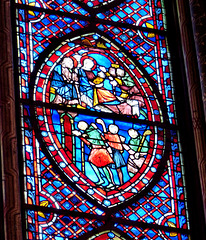
Here is a small detail.
Luke 2:15-20
"When the angels returned to heaven, the shepherds said to each other, "Let’s go right now to Bethlehem and see what’s happened. Let’s confirm what the Lord has revealed to us." They went quickly and found Mary and Joseph, and the baby lying in the manger. When they saw this, they reported what they had been told about this child. Everyone who heard it was amazed at what the shepherds told them. Mary committed these things to memory and considered them carefully. The shepherds returned home, glorifying and praising God for all they had heard and seen. Everything happened just as they had been told."
sainte-chapelle.monuments-nationaux.fr/
Paris - Sainte-Chapelle
| 05 Mar 2015 |
|
The Sainte-Chapelle ("Holy Chapel") was part of the Palais de la Cité, residence of the French Royals between 10th and 14th century. The chapel was built, to house Louis IX's vast collection of relics, including the Crown of Thorns, the Image of Edessa and the point of the "Holy Lance" - and many more prominent relics.
Saint Louis (aka Louis IX) had purchased the "Passion Relics" from Baldwin II, unfortunate emperor of the Latin Empire of Constantinople, for 135,000 livres. The money was actually paid to the Venetians, to whom the relics had been pawned.
Begun around 1239 and consecrated in 1248, the Sainte-Chapelle is considered among the highest achievements of the Gothic architecture.
A fire damaged the chapel 1630, that got restored after that. The chapel suffered its most grievous destruction during the French Revolution, when the steeple got removed and many of the precious reliquaries were melted down.
Reconstruction and restoration was done in the 1840s/1850s.
Here are more than 600m² of stained glass, about 1/3 was destroyed and had to be replaced within the 19th century. The light is breathtaking! The sights are neck breaking. This is a fantastic place. This was a sensation. Absolutely impressing, when it was completed - and it still is.
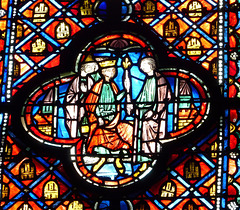
Here is a small detail.
A King, seated on a throne, listens to a visitor. The King´s advisor stands behind him and looks over his shoulder. The king holds a scepter - with a Fleur-de-Lys.
The Fleur-de-Lys, legendary connected to Clovis I, the first King of the Franks stood as a symbol of the King's divinely approved right to rule. Since Robert II (aka "Robert the Pious") it was used by all Kings from the House of Capet. Louis IX was one of them.
sainte-chapelle.monuments-nationaux.fr/
Paris - Sainte-Chapelle
| 05 Mar 2015 |
|
The Sainte-Chapelle ("Holy Chapel") was part of the Palais de la Cité, residence of the French Royals between 10th and 14th century. The chapel was built, to house Louis IX's vast collection of relics, including the Crown of Thorns, the Image of Edessa and the point of the "Holy Lance" - and many more prominent relics.
Saint Louis (aka Louis IX) had purchased the "Passion Relics" from Baldwin II, unfortunate emperor of the Latin Empire of Constantinople, for 135,000 livres. The money was actually paid to the Venetians, to whom the relics had been pawned.
Begun around 1239 and consecrated in 1248, the Sainte-Chapelle is considered among the highest achievements of the Gothic architecture.
A fire damaged the chapel 1630, that got restored after that. The chapel suffered its most grievous destruction during the French Revolution, when the steeple got removed and many of the precious reliquaries were melted down.
Reconstruction and restoration was done in the 1840s/1850s.
Here are more than 600m² of stained glass, about 1/3 was destroyed and had to be replaced within the 19th century. The light is breathtaking! The sights are neck breaking. This is a fantastic place. This was a sensation. Absolutely impressing, when it was completed - and it still is.
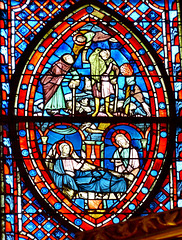
Here is a small detail.
The Nativity - and the Annunciation to the shepherds..
sainte-chapelle.monuments-nationaux.fr/
Paris - Sainte-Chapelle
| 04 Mar 2015 |
|
The Sainte-Chapelle ("Holy Chapel") was part of the Palais de la Cité, residence of the French Royals between 10th and 14th century. The chapel was built, to house Louis IX's vast collection of relics, including the Crown of Thorns, the Image of Edessa and the point of the "Holy Lance" - and many more prominent relics.
Saint Louis (aka Louis IX) had purchased the "Passion Relics" from Baldwin II, unfortunate emperor of the Latin Empire of Constantinople, for 135,000 livres. The money was actually paid to the Venetians, to whom the relics had been pawned.
Begun around 1239 and consecrated in 1248, the Sainte-Chapelle is considered among the highest achievements of the Gothic architecture.
A fire damaged the chapel 1630, that got restored after that. The chapel suffered its most grievous destruction during the French Revolution, when the steeple got removed and many of the precious reliquaries were melted down.
Reconstruction and restoration was done in the 1840s/1850s.
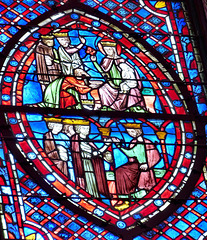
Here are more than 600m² of stained glass, about 1/3 was destroyed and had to be replaced within the 19th century. The light is breathtaking! The sights are neck breaking. This is a fantastic place. This was a sensation. Absolutely impressing, when it was completed - and it still is.
Here is a small detail.
The Magi departing from Herod in Jerusalem- and the Adoration in Bethlehem..
sainte-chapelle.monuments-nationaux.fr/
Paris - Sainte-Chapelle
| 04 Mar 2015 |
|
|
|
The Sainte-Chapelle ("Holy Chapel") was part of the Palais de la Cité, residence of the French Royals between 10th and 14th century. The chapel was built, to house Louis IX's vast collection of relics, including the Crown of Thorns, the Image of Edessa and the point of the "Holy Lance" - and many more prominent relics.
Saint Louis (aka Louis IX) had purchased the "Passion Relics" from Baldwin II, unfortunate emperor of the Latin Empire of Constantinople, for 135,000 livres. The money was actually paid to the Venetians, to whom the relics had been pawned.
Begun around 1239 and consecrated in 1248, the Sainte-Chapelle is considered among the highest achievements of the Gothic architecture.
A fire damaged the chapel 1630, that got restored after that. The chapel suffered its most grievous destruction during the French Revolution, when the steeple got removed and many of the precious reliquaries were melted down.
Reconstruction and restoration was done in the 1840s/1850s.
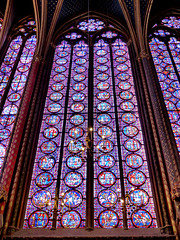
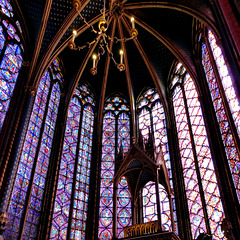
Here are more than 600m² of stained glass, about 1/3 was destroyed and had to be replaced within the 19th century. The light is breathtaking! The sights are neck breaking. This is a fantastic place. This was a sensation, absolutely impressing, when it was completed around 800 years ago - and it still is.
sainte-chapelle.monuments-nationaux.fr/
Paris - Sainte-Chapelle
| 04 Mar 2015 |
|
The Sainte-Chapelle ("Holy Chapel") was part of the Palais de la Cité, residence of the French Royals between 10th and 14th century. The chapel was built, to house Louis IX's vast collection of relics, including the Crown of Thorns, the Image of Edessa and the point of the "Holy Lance" - and many more prominent relics.
Saint Louis (aka Louis IX) had purchased the "Passion Relics" from Baldwin II, unfortunate emperor of the Latin Empire of Constantinople, for 135,000 livres. The money was actually paid to the Venetians, to whom the relics had been pawned.
Begun around 1239 and consecrated in 1248, the Sainte-Chapelle is considered among the highest achievements of the Gothic architecture.
A fire damaged the chapel 1630, that got restored after that. The chapel suffered its most grievous destruction during the French Revolution, when the steeple got removed and many of the precious reliquaries were melted down.
Reconstruction and restoration was done in the 1840s/1850s.
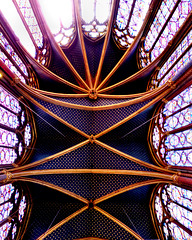
Here are more than 600m² of stained glass, about 1/3 was destroyed and had to be replaced within the 19th century. The light is breathtaking! The sights are neck breaking. This is a fantastic place. This was a sensation, absolutely impressing, when it was completed around 800 years ago - and it still is.
sainte-chapelle.monuments-nationaux.fr/
Paris - Sainte-Chapelle
| 04 Mar 2015 |
|
The Sainte-Chapelle ("Holy Chapel") was part of the Palais de la Cité, residence of the French Royals between 10th and 14th century. The chapel was built, to house Louis IX's vast collection of relics, including the Crown of Thorns, the Image of Edessa and the point of the "Holy Lance" - and many more prominent relics.
Saint Louis (aka Louis IX) had purchased the "Passion Relics" from Baldwin II, unfortunate emperor of the Latin Empire of Constantinople, for 135,000 livres. The money was actually paid to the Venetians, to whom the relics had been pawned.
Begun around 1239 and consecrated in 1248, the Sainte-Chapelle is considered among the highest achievements of the Gothic architecture.
A fire damaged the chapel 1630, that got restored after that. The chapel suffered its most grievous destruction during the French Revolution, when the steeple got removed and many of the precious reliquaries were melted down.
Reconstruction and restoration was done in the 1840s/1850s.
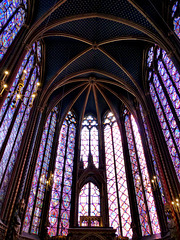
Here are more than 600m² of stained glass, about 1/3 was destroyed and had to be replaced within the 19th century. The light is breathtaking! The sights are neck breaking. This is a fantastic place. This was a sensation, absolutely impressing, when it was completed around 800 years ago - and it still is.
sainte-chapelle.monuments-nationaux.fr/
Paris - Sainte-Chapelle
| 04 Mar 2015 |
|
|
|
The Sainte-Chapelle ("Holy Chapel") was part of the Palais de la Cité, residence of the French Royals between 10th and 14th century. The chapel was built, to house Louis IX's vast collection of relics, including the Crown of Thorns, the Image of Edessa and the point of the "Holy Lance" - and many more prominent relics.
Saint Louis (aka Louis IX) had purchased the "Passion Relics" from Baldwin II, unfortunate emperor of the Latin Empire of Constantinople, for 135,000 livres. The money was actually paid to the Venetians, to whom the relics had been pawned.
Begun around 1239 and consecrated in 1248, the Sainte-Chapelle is considered among the highest achievements of the Gothic architecture.
A fire damaged the chapel 1630, that got restored after that. The chapel suffered its most grievous destruction during the French Revolution, when the steeple got removed and many of the precious reliquaries were melted down.
Reconstruction and restoration was done in the 1840s/1850s.
Here are more than 600m² of stained glass, about 1/3 was destroyed and had to be replaced within the 19th century. The light is breathtaking! The sights are neck breaking. This is a fantastic place. This was a sensation, absolutely impressing, when it was completed around 800 years ago - and it still is.
sainte-chapelle.monuments-nationaux.fr/
Paris - Sainte-Chapelle
| 04 Mar 2015 |
|
The Sainte-Chapelle ("Holy Chapel") was part of the Palais de la Cité, residence of the French Royals between 10th and 14th century. The chapel was built, to house Louis IX's vast collection of relics, including the Crown of Thorns, the Image of Edessa and the point of the "Holy Lance" - and many more prominent relics.
Saint Louis (aka Louis IX) had purchased the "Passion Relics" from Baldwin II, unfortunate emperor of the Latin Empire of Constantinople, for 135,000 livres. The money was actually paid to the Venetians, to whom the relics had been pawned.
Begun around 1239 and consecrated in 1248, the Sainte-Chapelle is considered among the highest achievements of the Gothic architecture.
A fire damaged the chapel 1630, that got restored after that. The chapel suffered its most grievous destruction during the French Revolution, when the steeple got removed and many of the precious reliquaries were melted down. Later the revolutionists tried to sell the ruined building. It was even discussed to knock it down.
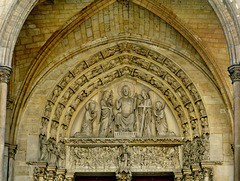
Reconstruction and restoration was done in the 1840s/1850s. The chapel has two floors, both have a portal. Seen here is the larger one.
"The Last Judgement" is a "traditional" theme for 1240. The graves open, a psychostasia in the center between them. The hell is to the right, the heaven to the left. Christ, seated on a throne, flanked by two angels, who held the Crown of Thorns, the "Holy Lance" and the "True Cross".
sainte-chapelle.monuments-nationaux.fr/
Paris - Sainte-Chapelle
| 03 Mar 2015 |
|
The Sainte-Chapelle ("Holy Chapel") was part of the Palais de la Cité, residence of the French Royals between 10th and 14th century. The chapel was built, to house Louis IX's vast collection of relics, including the Crown of Thorns, the Image of Edessa and the point of the "Holy Lance" - and many more prominent relics.
Saint Louis (aka Louis IX) had purchased the "Passion Relics" from Baldwin II, unfortunate emperor of the Latin Empire of Constantinople, for 135,000 livres. The money was actually paid to the Venetians, to whom the relics had been pawned.
Begun around 1239 and consecrated in 1248, the Sainte-Chapelle is considered among the highest achievements of the Gothic architecture.
A fire damaged the chapel 1630, that got restored after that. The chapel suffered its most grievous destruction during the French Revolution, when the steeple got removed and many of the precious reliquaries were melted down. Later the revolutionists tried to sell the ruined building. It was even discussed to knock it down.
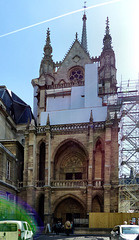
The reconstruction and restoration was done in the 1840s/1850s. The chapel has two levels, both have a portal, seen here. The tympana are results of the reconstruction, as most statues here had been vandalized.
sainte-chapelle.monuments-nationaux.fr/
Paris - Sainte-Chapelle
| 03 Mar 2015 |
|
|
The Sainte-Chapelle ("Holy Chapel") was part of the Palais de la Cité, residence of the French Royals between 10th and 14th century. The chapel was built, to house Louis IX's vast collection of relics, including the Crown of Thorns, the Image of Edessa and the point of the "Holy Lance" - and many more prominent relics.
Begun around 1239 and consecrated in 1248, the Sainte-Chapelle is considered among the highest achievements of the Gothic architecture.
The Sainte-Chapelle and the Conciergerie are the last remaining structures of the former Palais de la Cité. After the Royals moved out, the buildings were used for the administration. Between 1793 and 1795 the offices of the "Tribunal révolutionnaire" were here. In the Conciergerie, then a prison, Marie Antoinette, Danton, de Robespierre waited to ascend the scaffold.
Today the buildings around the Sainte-Chapelle form the "Palais de Justice".
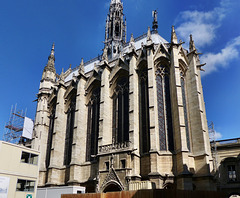
The chapel, once a huge reliquary for Louis IX's collection, was under renovation. Saint Louis (aka Louis IX) had purchased the "Passion Relics" from Baldwin II, unfortunate emperor of the Latin Empire of Constantinople, for 135,000 livres. The money was actually paid to the Venetians, to whom the relics had been pawned. As this did not solve the financial straits completly fro Baldwin II, he later pawned his only son to the Venetians.
The relics arrived in Paris in August 1239, - and some of them are now in the treasury of nearby Notre-Dame Cathedral.
sainte-chapelle.monuments-nationaux.fr
Paris - Sainte-Chapelle
| 03 Mar 2015 |
|
The Sainte-Chapelle ("Holy Chapel") was part of the Palais de la Cité, residence of the French Royals between 10th and 14th century. The chapel was built, to house Louis IX's vast collection of relics, including the Crown of Thorns, the Image of Edessa and the point of the "Holy Lance" - and many more prominent relics.
Begun around 1239 and consecrated on 26 April 1248, the Sainte-Chapelle is considered among the highest achievements of the Gothic architecture.
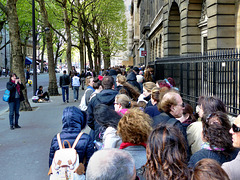
The Sainte-Chapelle and the Conciergerie are the last remaining structures of the former Palais de la Cité. After the Royals moved out, the buildings were used for the kingdom´s administration. A blaze destroyed most of it in 1776. Between 1793 and 1795 the members of the Revolutionary Tribunal ("Tribunal révolutionnaire") met here. During this "Reign of Terror" about 2700 people were sentenced to death by the tribunal. Marie Antoinette, Georges Danton, Maximilien de Robespierre and many others were imprisoned here, waiting to ascend the scaffold.
Today this is the Palais de Justice (and there is still a prison!), so the security checks are time consuming and many tourists stand in line, to get in.
sainte-chapelle.monuments-nationaux.fr
Paris - Sainte-Chapelle
| 02 Mar 2015 |
|
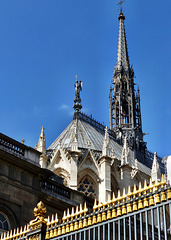
The Sainte-Chapelle ("Holy Chapel") was part of the Palais de la Cité, residence of the French Royals between 10th and 14th century. The chapel was built, to house Louis IX's vast collection of relics, including the Crown of Thorns, the Image of Edessa and the point of the "Holy Lance" - and many more prominent relics.
Begun around 1239 and consecrated on 26 April 1248, the Sainte-Chapelle is considered among the highest achievements of the Gothic architecture.
sainte-chapelle.monuments-nationaux.fr
Jump to top
RSS feed- Martin M. Miles' latest photos with "Holy Lance" - Photos
- ipernity © 2007-2026
- Help & Contact
|
Club news
|
About ipernity
|
History |
ipernity Club & Prices |
Guide of good conduct
Donate | Group guidelines | Privacy policy | Terms of use | Statutes | In memoria -
Facebook
X
