

Martin M. Miles' photos with the keyword: Saint Thomas of Canterbury
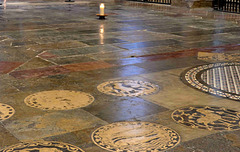
Canterbury - Cathedral
| 15 Nov 2024 |
|
|
According to legend, Canterbury was founded by Rudilibas in 900 BC and called Caerkent by the ancient Britons. From 43 AD, the Roman Durovernum Cantiacorum was built here and developed into an administrative centre. From 200 AD, the city was surrounded by city walls. Æthelberht of Kent, who ruled from 568 AD, made Canterbury his residence.
After the Anglo-Saxons converted to Christianity, the city became the seat of the archbishop. In 842 and 851, Canterbury suffered great loss of life in Danish raids. In 1011, the city was besieged by a Viking army, culminating in the sack of the city.
The people of Canterbury remembered this destruction and offered no resistance to the invasion of William the Conqueror in 1066.
In 1363, during the Hundred Years' War, a commission found that the Roman wall had eroded due to dilapidation, stone theft and ditch filling. Between 1378 and 1402, the wall was virtually rebuilt and new wall towers added. In 1448, Canterbury was granted city charter, which gave the city a mayor and high sheriff.
In the mid-16th century, many Huguenots, facing persecution fled and resettled. The first Huguenot church in Canterbury was founded around 1548. With the accession of Mary I, the Huguenot inhabitants of Canterbury were forced to flee in 1553, but after the accession of Elizabeth I, a number of Huguenots returned. In the 17th century, French-speaking Huguenots made up two-fifths of Canterbury's population.
Canterbury was not only the starting point of the historic Via Francigena, which leads to Rome, but also the destination of many pilgrimages. One of these is described by Geoffrey Chaucer, author of "The Canterbury Tales".
The cathedral towers over all the buildings in the city and can be seen from everywhere.
In 597, missionaries led by the monk Augustine arrived in Canterbury. Remains of this first cathedral were found under the removed floor slabs during renovation work in 1993, including remains from Roman times. . In 950, the building was renovated by Archbishop Bodo. The church burnt down shortly after the Norman conquest in 1067. Begun under Lanfrank, a confidant of William the Conqueror, it then took several centuries to create what can be seen today: a very complicated and extensive spatial structure with Romanesque, early Gothic and late Gothic sections.
The candle marks the spot where Thomas Becket (also known as Saint Thomas of Canterbury) was murdered by supporters of King Henry II of England on 29 December 1170. Shortly after his death, he was canonised by Pope Alexander III.
He is honoured as a saint and martyr by the Catholic Church and the Anglican community.

Saint-Gabriel-Brécy - Saint Thomas of Canterbury
| 10 Sep 2014 |
|
|
The church, dating back to the 12th century, is dedicated to Saint Thomas of Canterbury (aka "Thomas Becket"), what may have been a "political statement", against the House of Plantagenet.
Thomas of Canterbury had been Henry II´s Lord Chancellor, but later he engaged in conflict with Henry II over the rights and privileges of the Church. In 1170 he was murdered by followers of the king in Canterbury Cathedral. He was canonized already three years later.
Jump to top
RSS feed- Martin M. Miles' latest photos with "Saint Thomas of Canterbury" - Photos
- ipernity © 2007-2026
- Help & Contact
|
Club news
|
About ipernity
|
History |
ipernity Club & Prices |
Guide of good conduct
Donate | Group guidelines | Privacy policy | Terms of use | Statutes | In memoria -
Facebook
X
