

Martin M. Miles' photos with the keyword: Dream of the Magi
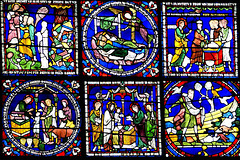
Canterbury - Cathedral
| 16 Nov 2024 |
|
|
According to legend, Canterbury was founded by Rudilibas in 900 BC and called Caerkent by the ancient Britons. From 43 AD, the Roman Durovernum Cantiacorum was built here and developed into an administrative centre. From 200 AD, the city was surrounded by city walls. Æthelberht of Kent, who ruled from 568 AD, made Canterbury his residence.
After the Anglo-Saxons converted to Christianity, the city became the seat of the archbishop. In 842 and 851, Canterbury suffered great loss of life in Danish raids. In 1011, the city was besieged by a Viking army, culminating in the sack of the city.
The people of Canterbury remembered this destruction and offered no resistance to the invasion of William the Conqueror in 1066.
In 1363, during the Hundred Years' War, a commission found that the Roman wall had eroded due to dilapidation, stone theft and ditch filling. Between 1378 and 1402, the wall was virtually rebuilt and new wall towers added. In 1448, Canterbury was granted city charter, which gave the city a mayor and high sheriff.
In the mid-16th century, many Huguenots, facing persecution fled and resettled. The first Huguenot church in Canterbury was founded around 1548. With the accession of Mary I, the Huguenot inhabitants of Canterbury were forced to flee in 1553, but after the accession of Elizabeth I, a number of Huguenots returned. In the 17th century, French-speaking Huguenots made up two-fifths of Canterbury's population.
Canterbury was not only the starting point of the historic Via Francigena, which leads to Rome, but also the destination of many pilgrimages. One of these is described by Geoffrey Chaucer, author of "The Canterbury Tales".
The cathedral towers over all the buildings in the city and can be seen from everywhere.
In 597, missionaries led by the monk Augustine arrived in Canterbury. Remains of this first cathedral were found under the removed floor slabs during renovation work in 1993, including remains from Roman times. . In 950, the building was renovated by Archbishop Bodo. The church burnt down shortly after the Norman conquest in 1067. Begun under Lanfrank, a confidant of William the Conqueror, it then took several centuries to create what can be seen today: a very complicated and extensive spatial structure with Romanesque, early Gothic and late Gothic sections.
The earliest coloured glass windows date from the late 12th century.
The dream of the Magi
Toledo - Catedral de Toledo
| 25 Oct 2023 |
|
|
In 192 BC, the Romans conquered the area and founded the outpost Toletum. Due to its iron ore deposits, Toledo developed into an important settlement. Since the first barbarian invasions, the ancient walls were reinforced. In 411 the Alans and later the Visigoths conquered the city. Toledo was the capital of the Visigoths' empire from about 531 to 711.
The Moors conquered the place in 712. Toledo experienced its heyday during the period of Moorish rule as Ṭulayṭula during the Caliphate of Córdoba until its conquest by Alfonso VI in 1085, after a four-year siege. In 1088, only a few years after the conquest, Archbishop Bernard of Toledo obtained confirmation from Pope Urban II that Toledo should hold the "primatus in totis Hispaniarum regnis" (primacy in all the kingdoms of the Iberian dominions). The Archbishop of Toledo is still today the Primate of the Catholic Church of Spain.
In the 12th and 13th centuries, the Toledo school of translators translated ancient philosophical writings (Plato, Aristotle) that had been translated from Greek into Arabic, but also genuinely Arabic writings from the fields of astronomy, mathematics, Islamic religion and theology into Latin.
After the conquest by Alfonso VI, Toledo became the residence of the Kingdom of Castile in 1087 and remained the capital of Spain until 1561.
The cathedral was founded in 1226. Ferdinand III (aka “the Saint”) laid the first stone in 1227 after he had the old Visigothic church demolished. This had previously been converted into a mosque by the Moors and they wanted to radically remove this influence. The first architect, named “Master Martín” is mentioned in 1227. He either was French or had worked there before, as this building was clearly modeled after the Bourges Cathedral. It is widely believed to be one of the most important Gothic churches in Spain.
It measures 120 meters in length by 59 meters in width and 44.5 meters high. It consists of five naves with a transept and double ambulatory.
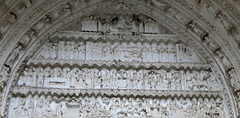
The story, the tympanum tells, starts on the left side of the bottom row:
Annunciation - Visitation - Nativity - Annunciation to the Shepherds - The Magi leaving Herod - The Adoration of the Magi - The Dream of the Magi - Massacre of the Innocents
It continues from right to left, starting with the Flight into Egypt
Ávila - Basílica de San Vicente
| 08 Oct 2023 |
|
|
Under the Visigoths, Ávila was one of the most important cities in the kingdom due to its proximity to the capital Toledo. From the 8th to the 11th centuries, Ávila was Moorish. The situation in the contested borderland between the Muslim and Christian worlds prevented prosperity, which only began in the 15th century when the fighting moved further south. The city experienced its heyday in the 16th century. The plague, the expulsion of the Moriscos (baptized Moors), and the emigration of many people to America caused Ávila's gradual decline, from which the city has only slowly recovered since the 19th century. Today the population is around 60,000.
San Vicente is on the Latin cross plan, with a nave and two aisles ending in semicircular apses.
According to legend, martyrs Vicente, Sabina and Cristeta were martyred during the rule of Diocletian. Their corpses were buried and later a basilica was built over their tombs. In 1062 their remains were moved to Burgos, but in 1175 they were returned to Ávila, and the construction of a new basilica was started. Construction was finally finished in the 14th century.
Cenotafio de los Santos Hermanos Mártires
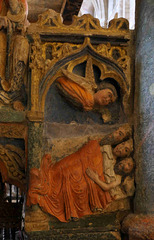
The Cenotaph of the Holy Martyrs is a large funerary monument with an architectural and sculptural structure dating from the second half of the 12th century and a canopy added in the 15th century.
The cenotaph stands on a platform supported by double columns. The capitals are carved with acanthus leaves and form groups of four columns in the corners. There are further arches above the capitals and below them the reliefs of the apostles, the evangelists and other people.
At the beginning of the 21st century, a restoration was carried out that included the restoration of polychromy.
The Dream of the Magi - The dreaming Magi are warned by an angel about the intentions of Herod.
Lyon - Musée des Beaux-Arts
| 03 May 2023 |
|
|
Colonia Copia Claudia Augusta Lugdunum (now Lyon) was an important Roman city in Gaul. It was the capital of the Roman province of Gallia Lugdunensis. The Christianization took place very early.
In 177, the Christian community sent a letter naming 48 of their number who had been martyred. In 843 it was ceded to Lorraine and then passed to the Kingdom of Burgundy, whose dominion was entrusted to the Archbishop of Lyon by Frederick Barbarossa in 1157. In 1312 Philip the Fair incorporated Lyon into the kingdom of France.
Lyon was the scene of an urban revolt in 1436 when Charles VII increased taxation. The uprising, mainly of small merchants, lasted a total of two months. During the reign of Louis XI. Four fairs were set up, attracting merchants from all over Europe, especially Italy. Lyon became an important center for the spice trade and, more importantly, the silk trade after François I granted the weaving rights, which until then had been an Italian monopoly. Florentine immigrants also made Lyon a financial center for banking and insurance.
-
It is often said that the most beautiful cities are located on rivers. Lyon is situated on two rivers, the Rhone and the Saone, which meet in the south of the city.
-
Until 1792, the Museum of Fine Arts building was an abbey whose abbesses came from high French nobility. Because of the abbey's importance, Louis XIV funded major renovations in the 17th and 18th centuries. As a result of the French Revolution, the nuns were expelled from the abbey, and in 1860, the Palais des Arts was established. The collection was greatly expanded. At the beginning of the 20th century, the collection became larger and more diverse.
-
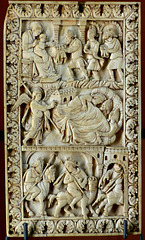
Diptych part, ivory, 9th/10th Century. Following the description it was either carved in Constantinople or in Metz.. ??
From bottom to top
The Magi traveling
The Dream of the Magi,
The Magi adorating
Rostock - Kulturhistorisches Museum
| 29 Oct 2021 |
|
|
With more than 200.000 inhabitants Rostock is the largest city in the state of Mecklenburg-Western Pomerania.
Small Slavic settlements existed already in the 8th century. A settlement named Roztok was founded in the 11th century by Polabian Slavs. This town was burnt down by troops of the Danish king Valdemar I in 1161. Afterwards the place was settled by German traders.
After 1226 Rostock became the seat of the Lordship of Rostock.
In the 1250s the city became a member of the Hanseatic League. In the 14th century it was a powerful seaport town with 12,000 inhabitants and the largest city in Mecklenburg. Ships for cruising the Baltic Sea were constructed in Rostock. Until the last Hansa Convention in 1669, Rostock took a leading role in the Baltic Sea behind Lübeck.
-
The museum, founded mid 19th century, is hosted in the "Kloster zum Heiligen Kreuz", that got finally dissolved in 1920. The conversion into a museum began already in 1976, but the restoration of the buildings remained incomplete until 1997.
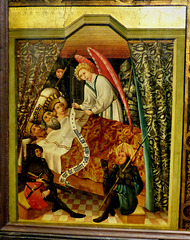
The "Dreikönigsaltar" (Magis´ Altar) is the former high altar of
of the church of the Rostock´s "St. Johanneskloster", a monastery of the Dominicans.
The winged altar dates from around 1425 and was donated to the Dominicans by the "Fraternitas Trium Regum", the "Brotherhood of the Three Kings".
It originally had two pairs of wings. Two of them are in a Berlin museum, while two are still here.
The wings depict different scenes from the Magi legend.
The "Dream of the Magi"
Pistoia - Sant'Andrea
| 07 Sep 2016 |
|
|
Sant'Andrea, believed to have been Pistoia´s ancient cathedral, is thought to date back to the period of Lombard domination. The present day church dates to the mid 12th century.
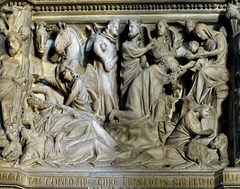
Inside Sant'Andrea is this masterpiece of Giovanni Pisani, who created this great marble pulpit created 1298 - 1301.
It is sometimes compared to the pulpits sculpted by Giovanni's father Nicola in the Baptistery of Pisa and the Duomo of Siena, which Giovanni had assisted with. The Pisanis´ works are often described as "proto-Renaissance".
There is an inscription here, telling that the work was commissioned by Arnoldus and supervised by Andrea Vitelli and Tino di Vitale. It continues ".. Giovanni carved it (...), the son of Nicola, and blessed with higher skill.."
The pulpit has a hexagonal plan with seven columns (one in the middle) and five parapets.
Depicted on one of the parapets is in the left corner the "Dream of the Magi" - an angel tells them not to return to Jerusalem. Above them are their horses. Further right the "Adoration of the Magi". Two angels are watching, one is the "Star of Bethlehem". In the right corner is the dream of Joseph. He learns from the angel, that he now should migrate to Egypt with Mary and little Jesus. This dream starts the "Flight to Egypt".
Arles - Saint-Trophime
| 03 Jun 2012 |
|
In 2010 I had started to walk the Via Tolosana here, in front of Saint-Trophime. The (maybe) oldest known tourist guidebook "Codex Calixtinus", written by Aimeric Picaud, an account of his journey to Santiago de Compostella around 1140, describes two point to be visited in Arles: Alyscamps, the necropolis around Saint Honoratus, and Saint-Trophime.
At that time the facade of Saint-Trophime was not existing, as it was added to the building 1170-1180 after a long renovation of the church. The architects of the facade, that is a kind of narthex, may have known the (still standing) triumphal arch of the Roman settlement of Glanum (today Saint Rémy-de-Provence, 25kms northeast).
Everything was brandnew, when end of July 1178 Frederick I Barbarossa walked through this portal and was crowned here "King of Burgundy".
During the French Revolution this church served the revolutionists as a "Temple of Reason", but even the delicate carvings of the facade were not damaged, other as in nearby Saint-Gilles.
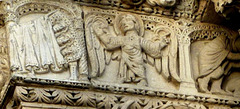
One of the many details, that I overlooked before, is this "Dream of the Magi".
Como - Sant'Abbondio
| 11 Nov 2015 |
|
Already within the 5th century existed a church here, at that time far out of the city walls of Como. It served at the bishop´s seat upto 1007, when Bishop Alberico moved the seat into the town - and the church entrusted to the Benedictines. The monks, with strong support of Henry II (aka "Saint Henry") rebuilt the basilica between 1022 and 1095.
Pope Urban II consecrated the new basilica in June 1095, about 6 months before he preached the First Crusade on the Council of Clermont.
There are parallels between Sant'Abbondio and cathedrals erected the same time north of the Alps. Henry II was the last emperor of the Ottonian dynasty, who have been powerful sponsors for many churches within the Holy Roman Empire.
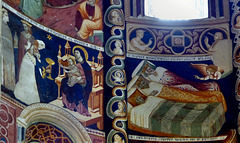
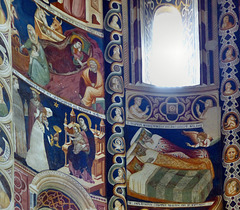
The extraordinary frescoes of the apse are attributed to an otherwise unknown "Master of Sant'Abbondio". They are dated 1315 - 1324.
Here are on the left the "Adoration of the Magi" and on the right
the "Sleeping Magi". An angel warns them not to return to Herod.
Como - Sant'Abbondio
| 11 Nov 2015 |
|
Already within the 5th century existed a church here, at that time far out of the city walls of Como. It served at the bishop´s seat upto 1007, when Bishop Alberico moved the seat into the town - and the church entrusted to the Benedictines. The monks, with strong support of Henry II (aka "Saint Henry") rebuilt the basilica between 1022 and 1095.
Pope Urban II consecrated the new basilica in June 1095, about 6 months before he preached the First Crusade on the Council of Clermont.
There are parallels between Sant'Abbondio and cathedrals erected the same time north of the Alps. Henry II was the last emperor of the Ottonian dynasty, who have been powerful sponsors for many churches within the Holy Roman Empire.
The extraordinary frescoes of the apse are attributed to an otherwise unknown "Master of Sant'Abbondio". They are dated 1315 - 1324.
Here are
Nativity and "First Bath",
Adoration of the Magi,
the "Sleeping Magi"
Pisa - Duomo di Santa Maria Assunta
| 25 Jun 2015 |
|
The construction of the "Duomo" began in 1064 by the architect Busketo, who with this structure set the model for the distinctive Pisan Romanesque style of architecture.
When the construction of this cathedral started, Pisa was on a height of political (and financial) power. Pisa was an important commercial centre controlling large parts of the Mediterranean merchant fleet and navy.
In 1017 Pisa had militarily supported the Sardinian "Giudicati" (regional kings) to defeat Saracen troops in the north of Sardinia. Between 1030 and 1035, Pisa defeated rival towns in Sicily. In 1051–1052 admiral Jacopo Ciurini conquered Corsica. In 1063 admiral Giovanni Orlando, coming to the aid of the Norman Roger I, took Palermo from the Saracen. The gold treasure taken from the Saracens in Palermo allowed the Pisans to start the building of the cathedral.
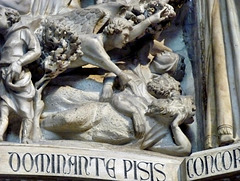
The elaborately carved pulpit was carved by Giovanni Pisano (1302–1310) probably in cooperation with his father Nicola, who created the pulpit in the neighbouring baptistry. The hexagonal pulpit survived the fire, that severely damaged the cathedrale in 1595. It was packed away during the renovation.
After centuries it got rediscovered and is back in the cathedral since 1926. It is a masterwork. Influenced by French Gothic and Ancient Roman art, Pisano and his father are precursors of the Italian Renaissance.
One of the pulpit´s nine large reliefs depicts the Magi.
Here is a detail of the relief - the "Dream of the Magi".
Tours - Cathédrale Saint-Gatien
| 28 Apr 2015 |
|
The first church, dedicated to Saint Maurice, was built here on order of Lidoire, bishop of Tours from 337 to 371 (preceding Saint Martin). This church burnt down 561, it was restored by Gregory of Tours in 590. This church then got replaced by a Romanesque structure, that again burnt in 1166 during the conflict between Louis VII of France and Henry II of England, who as well was Count of Anjou.
The erection of the present cathedral started around 1170
The chancel was built 1236 to 1279, but the nave took longer to build. It was completed end of the 14th century, before the Gothic facade was finished about 100 years later.
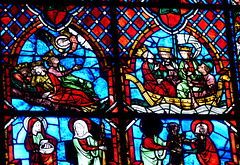
In 1562 Huguenot iconoclasts created great damages here, but they did not destroy the 13th century stained glass windows of the choir. Here is a detail from the "nativity window".
The "Dream of the Magi" and the Magi on their way home.
For many pilgrims on their way to Santiago, the Magi were ideals, as they took a long way as well. So it is no surprise, that the Magi can be found frequently along the "chemin".
Chartres - Cathédrale Notre-Dame
| 29 Jan 2015 |
|
There have been five cathedrals on this site. One was destroyed by Visigothic troops mid of the 8th century. The successive cathedral was burnt down by Vikings ("Danes") in 858. The carolingian structure that was erected within the next decades was burnt down in 962 by troops led by Richard I of Normandy (aka "Richard the Fearless", "Richard Sans-Peur").
The rebuilding started again, but whatever was completed got destroyed by a fire, caused accidently, in 1020. The erection of a Romanesque cathedral started and most of the still existing crypt dates back to that building.
In 1134, another fire damaged the town and large parts of the cathedral. The towers got repaired and rebuilt and the portal between them got created. Another blaze hit the town in June 1194. The cathedral was burnt down. Construction works started the same year. The western towers and the undamaged western portal ("Portail Royal") got integrated into the new building.
The nave was already vaulted in 1220, the transept and the stained windows were completed in 1260. On 24 October 1260, only 66 years after the start of construction, the Cathédrale Notre-Dame was consecrated in the presence of Louis IX of France (aka "Saint Louis", "le Prudhomme").
Since Charles the Bald, Louis the Pious´ son, had given the "Sancta Camisia" to the cathedral in 876. Because of this "Veil of the Virgin" Chartres developed into a very important Marian pilgrimage center in medieval times.
The cathedral has been fortunate in being spared the damage suffered by so many during the Wars of Religion, the Revolution and even WWII. In 1939, just before the German army invaded France, all medieval galls windows were removed, so the 176 medieval windows stayed intact.
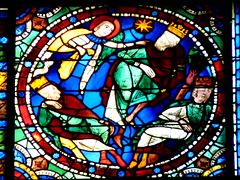
The oldest of these windows date back to ab 1150. They had been installed already the preceding cathedral, that burnt down. The most stained glass windows seen here were created between 1215 and 1240.
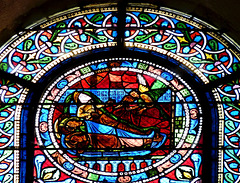
The Dream of the Magi.
The dreaming Magi are warned by an angel about the intentions of Herod.
Matthew 2:11-12
"On coming to the house, they saw the child with his mother Mary, and they bowed down and worshipped him. Then they opened their treasures and presented him with gifts of gold and of incense and of myrrh.
And having been warned in a dream not to go back to Herod, they returned to their country by another route"
Le Mans - Saint-Julien du Mans
| 24 Jan 2015 |
|
An existing celtic settlement was conquered by the Romans 56bC and named Suindinum. Saint Julien du Mans, to whom the cathedral is dedicated, was the first bishop here upto 348. He was followed by Saint Liborius du Mans, who died here in 397 and was buried next to his predecessor inside the existing cathedral.
In 835 Saint Liborius´s relics were exhumed and - on order of Emperor Louis the Pious - transferred to Paderborn (900kms northeast), where Louis´ father Emperor Charlemagne had founded a diocese in 799. This young diocese suffered, as it had no saint of its own.
From this "translation" arose a "brotherhood" between Le Mans and Paderborn, considered to be the oldest "twinning contract" still in force.
The "Cathédrale Saint-Julien du Mans" was erected over a very long period. It has a Romanesque nave and a Gothic choir. The first nave of the cathedral was erected from 1100 on. Following a fire in 1134, a rebuilding programme was begun, following a different, more complex blueprint. This was partly funded by Henry II of England (aka "Henry Plantagenet", "Henry Curtmantle"), whose father, Geoffroy of Anjou (aka "the Handsome", "le Bel") was buried here in 1151.
The construction of the Gothic ambulatory choir started in 1217. The choir, that is about as long as the nave, was consecrated on April 24, 1254.
The oldest stained glass windows here date back to 1230/1240. Here is the Dream of the Magi.
Amiens - Cathedral
| 07 Jul 2014 |
|
The construction of the "Cathédrale Notre-Dame d'Amiens" started in 1220, after a predecessor Romanesque church burnt down two years earlier. Unusual for medieval structures, the first architects are known here. Robert de Luzarches was the architect until 1228. He was followed by Thomas de Cormont until 1258. His son, Renaud de Cormont, acted as the architect until 1288.
Today Amiens Cathedral is the largest existing Gothic cathedral in France. There was a lot of competition between the cities and towns about the largest nave, the highest vaults. The long and relatively peaceful reign of Louis IX (aka "Saint Louis") brought prosperity to the region, so that Amiens could afford such a structure. The cathedral is 145m long (interior length 133,50m). The volume of the structure is about 200.000m³, Notre Dame de Paris has only about 100.000m³
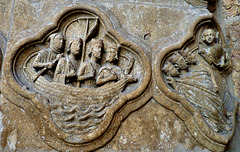
The western facade is dotted with lots of bas-relief medallions. Here are two of them. To the left the "Dream of the Magi", to the right the Magi in a ship. I have never seen them sailing, all icons I saw so far, they were riding horses.
Thanks to "tereliyesajjan", I found this impressive and highly interesting websites:
www.medievalart.org.uk/Amiens/Amiens_default.htm
Laon - Cathedral
| 02 Jul 2014 |
|
In Laon, placed on a ridge and overlooking the flat Picardy plain, St. Remi founded a bishopric in 487. Laon was a very important place in the kingdom of the Franks.
A Carolingian cathedral, consecrated in 800 in the presence of Charlemagne, existed here. The Carolingian structure got replaced two centuries later by a Romanesque structure, consecrated in 1071.
This cathedral was torched by the citizens during the Easter Insurrection on 25 April 1112. Bishop Waldric (aka "Gaudry"), who had served as Lord Chancellor and Lord Keeper of England, from 1103 to 1107 (and described as greedy and very violent) was killed during the uproar. The cathedral got repaired, but in the end demolished to give room for the present cathedral.
The construction began about 1160. The nave was completed after 1205. The "Cathédrale Notre-Dame de Laon", towering over the town, is a wonderful, early example of the Gothic style that developed in Northern France.
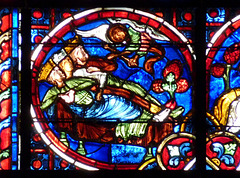
Stained glass can be found in nearly all Gothic cathedrals in France. Techniques for the production of colored glass and for the manufacturing of large windows out of it, was fast developing during the 11 th century. The "Dream of the Magi". The angel awakes one of the Magi to tell him, not to return to Herod.
Laon - Cathedral
| 02 Jul 2014 |
|
In Laon, placed on a ridge and overlooking the flat Picardy plain, St. Remi founded a bishopric in 487. Laon was a very important place in the kingdom of the Franks.
A Carolingian cathedral, consecrated in 800 in the presence of Charlemagne, existed here. The Carolingian structure got replaced two centuries later by a Romanesque structure, consecrated in 1071.
This cathedral was torched by the citizens during the Easter Insurrection on 25 April 1112. Bishop Waldric (aka "Gaudry"), who had served as Lord Chancellor and Lord Keeper of England, from 1103 to 1107 (and described as greedy and very violent) was killed during the uproar. The cathedral got repaired, but in the end demolished to give room for the present cathedral.
The construction began about 1160. The nave was completed after 1205. The "Cathédrale Notre-Dame de Laon", towering over the town, is a wonderful, early example of the Gothic style that developed in Northern France.
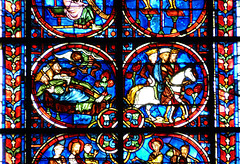
Stained glass can be found in nearly all Gothic cathedrals in France. Techniques for the production of colored glass and for the manufacturing of large windows out of it, was fast developing during the 11 th century. The dream of the Magi and the Magi travelling to Bethlehem. I'll upload more details photos next.
Jump to top
RSS feed- Martin M. Miles' latest photos with "Dream of the Magi" - Photos
- ipernity © 2007-2026
- Help & Contact
|
Club news
|
About ipernity
|
History |
ipernity Club & Prices |
Guide of good conduct
Donate | Group guidelines | Privacy policy | Terms of use | Statutes | In memoria -
Facebook
X
