

Martin M. Miles' photos with the keyword: Nikolaus von Kues
Bernkastel-Kues
| 21 Feb 2013 |
|
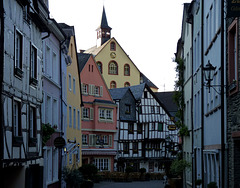
Evening in Bernkastel-Kues. To be more precise, this is in Bernkastel near the market place.
Kues is on the left side of the River Moselle and "joined" Bernkastel in 1905. A bridge connects both settlements since 1872.
Famous Nikolaus von Kues (aka "Nicholas of Cusa", "Nicolaus Cusanus") was born in Kues in 1401. He was an important philosopher, theologian, mathematician and astronomer. He was a Papal legate, cardinal and Prince-Bishop during his career.
Bernkastel is best known for the "Bernkastel Doctor", a vinyard, that rises just behind Bernkastel on a steep slope. The Rieslings from this vinyard (only 3,25ha = 32500m²) rank among the best white wines - worldwide. Depending from the vintage, prices may easily reach 200 Euros per 0.375l.
Huesca - San Pedro el Viejo
| 17 Mar 2014 |
|
The Monasterio de San Pedro el Viejo ("Saint Peter the Old") is a former Benedictine monastery built within the 12th century. A church had existed here (built on the place of a Roman temple) since Visigothic times and even, when the Moors hold Huesca, this church was in use.
Christian troops conquered Huesca in 1096 and from 1117 on Benedictines with obvious ties to Cluny reconstructed the church and erected a monasterio here.
Of course the Benedictian monastery needed a decent cloister. This got erected adjoining the church around 1140. Many of the capitals, carved in the style of the "Master of Agüero" (aka "Master of San Juan de la Peña"), are creations done during the renovation of San Pedro el Viejo end of the 19th century.
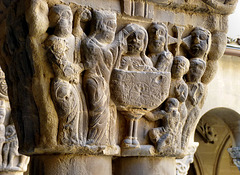
Here is one of the old, weathered carvings. From information given in Huesca I learned, that this may be connected to legend of Pope Sylvester I. This was later added by Jacobus de Voragine to the "Legenda Aurea", a medieval bestseller.
As seen on the previous upload, Pope Sylvester I, seated on the cart, was on his way to Rome. When he had reached Rome, he healed (following the Legenda Aurea) Constantine the Great from leprosy. Constantine then, seen here, got baptized by Sylvester. The emperor was so grateful, that he did the "Donation of Constantine", transferring the authority over Rome and a part of the Roman Empire to the Pope. This is the begin of what is now known as "Vatican City", an independent state, ruled by the Pope.
Already in 1433 Nicholas of Cusa identified the "Donation of Constantine" as a fake. The document was actually fabricated within the eighth century.
Jump to top
RSS feed- Martin M. Miles' latest photos with "Nikolaus von Kues" - Photos
- ipernity © 2007-2026
- Help & Contact
|
Club news
|
About ipernity
|
History |
ipernity Club & Prices |
Guide of good conduct
Donate | Group guidelines | Privacy policy | Terms of use | Statutes | In memoria -
Facebook
X
