

Martin M. Miles' photos with the keyword: octopus

Patras - Archaeological Museum
| 30 Aug 2026 |
|
|
|
The Archaeological Museum of Patras is the largest archaeological museum in Greece after the Acropolis Museum in Athens. The modern new building, designed by architect Theofanis Bobotis, was officially opened in 2009.
It houses collections about the history of Patras and the surrounding area from prehistory to the end of Roman times.
Burial larnax
that resembles the Minoan equivalent.
The decorations with the octopus and the fish are Minoan style
Terracotta, 13th c. BC
Mycenae - Archaeological Museum
| 25 Jun 2026 |
|
|
|
Mycene was inhabited already during neolithic and the early Bronze period. During the pre-classical period Mycenae was one of the most important cities in Greece. The Mycenaean culture (c. 1600 BC to c. 1100 BC) was named after it.
Over the centuries the population density increased, and by 1350 BC the citadel and the lower town had a population of 30,000 and covered an area of 32 hectares. At that time the fortifications on the acropolis and other surrounding hills were rebuilt in a style known as Cyclopean because the blocks of stone used were so massive that they were thought in later ages to be the work of the Cyclopes.
Within these walls successive monumental palaces were built. The final palace dates to the start of ca. 1390–1300 BC. Earlier palaces must have existed but they had been cleared away or built over. From 1200 BC onwards, Mycenae began to decline and lost its dominant position. Like all the palaces in southern Greece, the palace at Mycenae was destroyed. The settlement shrank, but the citadel and the lower town remained inhabited. During the Archaic period, a temple to Hera was built on the highest point.
In 480 BC 80 Mycenaeans took part in the Battle of Thermopylae. In 468 BC the Argives conquered Mycenae, deported the inhabitants and razed the walls. During the Hellenistic period, the city was resettled and a theatre was built. After that, the site was only resettled for a short time. In the 3rd century BC Mycenae was abandoned.
The excavations, which were begun in the 1870s by Heinrich Schliemann and Panagiotis Stamatakis, yielded incredible finds, particularly within the grave circles. The most spectacular of which are now housed in Athens, however, the exhibits on display at the Archaeological Museum, which forms part of the site, are also breathtaking.
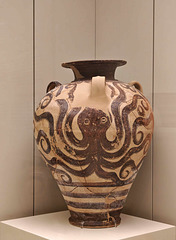
Octopus Jug
1500 - 1450 BC

Ierapetra - Archaeological Collection
| 10 Jun 2026 |
|
|
Ierapetra is the southernmost city in Europe (excluding Cyprus) and the fourth-largest city in Crete.
In ancient times, the city was called Hierapytna. The earliest remains of the city date back to the fifth century BC. It was an important Dorian city in eastern Crete. The city of Gortyn surpassed Hierapytna's importance as an independent state when Hierapytna was conquered by the Romans in 67 BC. The city was severely damaged during the Arab conquest in 824 but was subsequently rebuilt. It experienced a new period of prosperity during the Venetian period from the 13th to the 17th centuries.
The Archaeological Collection is housed in the building of an Ottoman School that was built in 1899.
Minoan Larnax
known as the Episkopi Larnax (named after the find spot).
It appears as though all the human figures are descendants of the Cyclopes. A chariot race is visible on the left, above the octopus. Shepherds appear at the bottom right and top left, and ibexes at the top right.
13th c BC.

Larnaca - Archaeological Museum
| 06 Mar 2026 |
|
|
With a population of over 50,000, Larnaca is one of the largest cities in Cyprus.
The Larnaca District Archaeological Museum displays the development of the city of Kition up to Roman times, as well as finds from the Neolithic settlement of Chirokitia. It is one of two archaeological museums in Larnaca.
Amphoroid krater decorated with a painted octopus.
Imported from the Aegan / 14th - 13th c BC

Larnaca - Archaeological Museum
| 06 Mar 2026 |
|
|
With a population of over 50,000, Larnaca is one of the largest cities in Cyprus.
The Larnaca District Archaeological Museum displays the development of the city of Kition up to Roman times, as well as finds from the Neolithic settlement of Chirokitia. It is one of two archaeological museums in Larnaca.
Large pithoid amphora, imported from Crete, and decorated with an octopus decor
13th c BC
Chania - 50/50 Mezedopolio

Athens - Market Hall
| 31 May 2025 |
|
Athens, the southernmost capital on the European mainland, is one of the world's oldest cities, with its recorded history spanning over 3,400 years. According to Greek mythology the city was named after Athena, the ancient Greek goddess of wisdom. Classical Athens was one of the most powerful city-states in ancient Greece. It was a centre for democracy, the arts, education and philosophy, and was highly influential throughout the European continent, particularly in Ancient Rome. For this reason it is often regarded as the cradle of Western civilisation and the birthplace of democracy.
Construction of the market hall, which was intended to replace the old bazaar from the Turkish period on the site of Hadrian's Library, began in 1878. After a major fire destroyed the old market in 1884, the building was inaugurated in 1886.
Until the 1970s, the market hall was an important trading center for the wholesale and retail trade in food. This importance shifted in the retail trade to large supermarkets. Nevertheless, the market remains well attended.
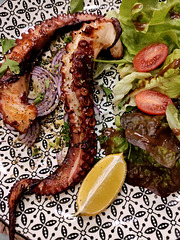
Octopus and calamari

Heraklion - Archaeological Museum
| 21 May 2025 |
|
|
|
Crete is the largest and most populous of the Greek islands, is located about 100 km south of the Peloponnese. Crete was the center of Europe's first advanced civilization, the Minoans, from 3000 to 1400 BC. The Minoan civilization was overrun by the Mycenaean civilization from mainland Greece. Crete was later ruled by Rome, then successively by the Byzantine Empire, Andalusian Arabs, the Byzantine Empire again, the Venetian Republic, and the Ottoman Empire. In 1898 Crete, whose people had for some time wanted to join the Greek state, achieved independence from the Ottomans, formally becoming the Cretan State. Crete became part of Greece in December 1913.
Heraklion is the largest city and the administrative capital of the island of Crete. With a municipal population of about 180.000 it is the fourth largest city in Greece. The greater area of Heraklion has been continuously inhabited since at least 7000 BCE, making it one of the oldest inhabited regions in Europe. As a major center of the Minoan civilization it often considered Europe's oldest city.
The Heraklion Archaeological Museum is one of the largest museums in Greeceand the best in the world for Minoan art, as it contains by far the most important and complete collection of artefacts of the Minoan civilization of Crete.
The museum began in 1883 as a simple collection of antiquities; it was about the time when the Minoan civilization was beginning to be rediscovered, and shortly before the first excavations using proper scientific methods. It was also during the period when Crete was a virtually autonomous part of the Ottoman Empire, after the Pact of Halepa of 1878, later followed by the independent Cretan State (1898-1913). The political situation helped to keep Cretan finds on the island during a crucial period of discoveries.
The museum is located in the town centre. It was built between 1937 and 1940 on a site previously occupied by the Roman Catholic monastery of Saint-Francis which was destroyed by earthquake in 1856.
Clay flask, decorated in "marine style".
I really like these "octopus vessels" with the particular naturalism. The tentacles writhe around the body of the vase.
Palaikastro, 1500 - 1450 BC

Agios Nikolaos - Archaeological Museum
| 14 May 2025 |
|
Agios Nikolaos was settled in the late Bronze Age by Dorian occupants of Lato under the name Lato pros Kamara, often simply Kamara. It was the port of Lato for a long time. In the 2nd century BC, Lato was abandoned, and many citizens settled in Kamara. The name of the present-day town comes from the church of Agios Nikolaos, which dates back to the 9th or 10th century and is one of the oldest intact churches in Crete.
In 1970, the Archaeological Museum was opened to house finds from Eastern Crete that had previously been housed in Heraklion
Another stylized octopus on this vessel

Agios Nikolaos - Archaeological Museum
| 14 May 2025 |
|
|
|
Agios Nikolaos was settled in the late Bronze Age by Dorian occupants of Lato under the name Lato pros Kamara, often simply Kamara. It was the port of Lato for a long time. In the 2nd century BC, Lato was abandoned, and many citizens settled in Kamara. The name of the present-day town comes from the church of Agios Nikolaos, which dates back to the 9th or 10th century and is one of the oldest intact churches in Crete.
In 1970, the Archaeological Museum was opened to house finds from Eastern Crete that had previously been housed in Heraklion
The jar, decorated with a stylized octopus, comes from a workshop in West Crete. Dated to the post palatial period - 1450 - 1150 BCE
Sitia - Archaeological Museum
| 07 May 2025 |
|
Settlement in the city area dates back to the pre-Minoan period. Architectural remains have been found from the end of the Neolithic period to the Bronze Age.
The city flourished during the Classical, Hellenistic, Roman and Byzantine periods as one of the island's most important ports. During Venetian times, the city was destroyed three times: first by an earthquake in 1508, then by Turkish pirates in 1538, and finally by the Venetians themselves in 1651. This last destruction occurred during the Cretan War. Lacking the resources to withstand a prolonged siege by the Turks, the Venetians destroyed the fortifications and relocated the garrison to Heraklion. The inhabitants migrated west, and the town remained deserted for the next 200 years of Turkish rule. The city was rebuilt after the Cretan Revolt until 1870. Today it has almost 20,000 inhabitants.
The Archaeological Museum features finds from the wider area, dating back to the period between 3500 BC and 500 AD.
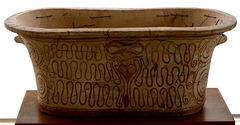
A Minoan tomb, decorated with the octopus pattern.
Rethymnon - Rakodikio
Heraklion - Archaeological Museum
| 02 Apr 2025 |
|
Crete, the largest and most populous of the Greek islands, is located about 100 km south of the Peloponnese. Crete was the center of Europe's first advanced civilization, the Minoans, from 3000 to 1400 BC. The Minoan civilization was overrun by the Mycenaean civilization from mainland Greece. Crete was later ruled by Rome, then successively by the Byzantine Empire, Andalusian Arabs, the Byzantine Empire again, the Venetian Republic, and the Ottoman Empire. In 1898 Crete, whose people had for some time wanted to join the Greek state, achieved independence from the Ottomans, formally becoming the Cretan State. Crete became part of Greece in December 1913.
Heraklion is the largest city and the administrative capital of the island of Crete. With a municipal population of about 180.000 it is the fourth largest city in Greece. The greater area of Heraklion has been continuously inhabited since at least 7000 BCE, making it one of the oldest inhabited regions in Europe. As a major center of the Minoan civilization it often considered Europe's oldest city.
The Heraklion Archaeological Museum is one of the largest museums in Greeceand the best in the world for Minoan art, as it contains by far the most important and complete collection of artefacts of the Minoan civilization of Crete.
The museum began in 1883 as a simple collection of antiquities; it was about the time when the Minoan civilization was beginning to be rediscovered, and shortly before the first excavations using proper scientific methods. It was also during the period when Crete was a virtually autonomous part of the Ottoman Empire, after the Pact of Halepa of 1878, later followed by the independent Cretan State (1898-1913). The political situation helped to keep Cretan finds on the island during a crucial period of discoveries.
The museum is located in the town centre. It was built between 1937 and 1940 on a site previously occupied by the Roman Catholic monastery of Saint-Francis which was destroyed by earthquake in 1856.
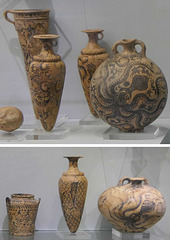
Clay vessels decorated in "marine style"
1500 - 1450 BC
Torre dell'Orso - Hotel Belvedere Salento
| 29 Sep 2020 |
|
|
The Hotel Belvedere Salento is located right on the sea and offers great views especially from the pool on the roof. The hotel has as well a very recommendable restaurant for the evening dinner.
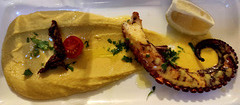
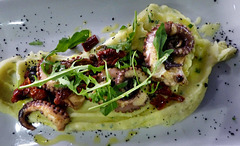
Grilled octopus on mashed potatoes.
Bari - Black & White
| 18 Sep 2020 |
|
Bari is a place for seafood. "Black & White" is an elegant restaurant located on the Piazza Mercantile in Bari. Great food and fine dining!
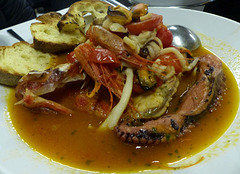
A bowl of fish soup - for two!
www.blackandwhiteristorante.it/
Bari - Black & White
| 18 Sep 2020 |
|
|
Bari is a place for seafood. "Black & White" is an elegant restaurant located on the Piazza Mercantile in Bari. Great food and fine dining!
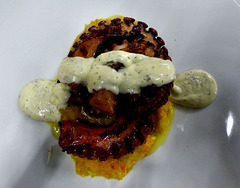
Octopus
www.blackandwhiteristorante.it/
Bari - Cattedrale di San Sabino
| 08 Sep 2020 |
|
|
Bari was an early settlement and passed under Roman rule in the 3rd century BC. It developed strategic significance as the point of junction between the coast road and the Via Traiana and as a port for eastward trade. The first bishop of Bari was Gervasius who is known from the Council of Sardica in 347.
After the decline of the Roman Empire, the town was devasted and taken by Alaric´s Visigothic troops, then was under Lombardian rule, before the Byzantines took over. In 755 it was conquered by Pepin the Short (Charlemagne´s father) and from 847 on it was an Islamic Emirate. The Byzantine fleet returned in 871 and since 885 Bari was the residence of the local Byzantine governor.
Following a three-year siege, Bari was captured by Robert Guiscard in 1071. After the relics of Saint Nicholas, which were surreptitiously brought from Myra in Lycia (Byzantine territory), arrived in Bari, the Basilica di San Nicola was founded in 1087. This attracted pilgrims, whose encouragement and care became central to the economy of Bari. Pope Urban II consecrated the Basilica in 1089. In 1096 a crusader army embarked in the port of Bari for the First Crusade.
After the murder of archbishop Griso in 1117 a civil war broke our and the control was seized by Grimoald Alferanites, a native Lombard, in opposition to the Normans. He later did homage to Roger II of Sicily, but rebelled and was defeated in 1132.
The Castello Normanno-Svevo (aka "Castello di Bari") was probably built around 1132 by Norman King Roger II. When in 1155 the Baresi rebelled against the Normans, the castle got destroyed, so as a retaliatory action, William I of Sicily (aka "William the Wicked") had the city destroyed except for the cathedral and the Basilica of St. Nicola.
Bari recovered and had its heydays under Frederick II. When he returned from his crusade after 1229, the city gates were locked so he had to use force to gain entry. Therefore, he probably had the fort built in 1233 to keep the city in check. On the other hand, he granted the city generous trade privileges and left it the leading role in the region.
-
The construction of the "Cattedrale di San Sabino" (aka "Bari Cathedral" started around 1170 on. The cathedral is the seat of the Archbishop of Bari-Bitonto. It is dedicated to Saint Sabinus, a bishop of Canosa, whose relics were brought here in the 9th century.
It was erected on the site of the ruins of the Imperial Byzantine cathedral, destroyed in 1156 by William I of Sicily with the rest of the city.
For the reconstruction of the cathedral materials from the preceding church and other destroyed buildings got reused. During the 18th century the façade, the nave and aisles and the crypt were refurbished in Baroque style. The building later underwent a series of refurbishments, demolitions and extensions. The original Romanesque appearance of the interior was restored in the 1950s.
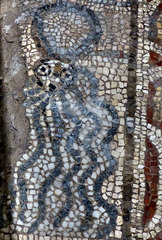
The Cathedral was erected on the ruins of the ancient Byzantine Cathedral, destroyed by William the Wicked. This "succorpo" was partly known over the century and used as an ossuary. The main parts were excavated in the 1960s century and can be visited by tourists nowadays.
Even some parts of the Byzantine mosaics survived the destruction. Here is a little octopus.
Giovinazzo - Osteria Scvnazz
| 06 Jun 2020 |
|
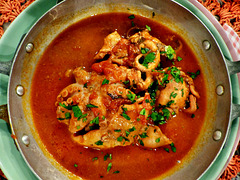
We were told by experienced travellers, that the local cuisine would be kind of "cucina povera". Well it may have its roots there, but we were surprised, how tasteful dishes and interesting recipes we found. The Osteria Scvnazz is a nice place, with polyglot waiters, but no written menu. What is fresh on the (fish) market in the morning will be offered here in the evening. Octopus is a very common dish in Apulia.
Polpo in umido
Jump to top
RSS feed- Martin M. Miles' latest photos with "octopus" - Photos
- ipernity © 2007-2026
- Help & Contact
|
Club news
|
About ipernity
|
History |
ipernity Club & Prices |
Guide of good conduct
Donate | Group guidelines | Privacy policy | Terms of use | Statutes | In memoria -
Facebook
X
