

Martin M. Miles' photos with the keyword: Horus
Berlin - Bode-Museum
| 20 Jun 2025 |
|
The Bode Museum (formerly called "Kaiser-Friedrich-Museum), is a building on the Museum Island. It was built from 1898 to 1904 by order of German Emperor William II according to plans by Ernst von Ihne in Baroque Revival style.
During WWII the building suffered comparatively the least damage on Museum Island, but it was not until 1951 that it received a temporary roof. After the end of the war, the new Berlin city administration had all references to former rulers removed and in 1956, Johannes R. Becher, then Minister of Culture of the GDR, ceremoniously renamed the Kaiser Friedrich Museum the Bode Museum.
As part of the Museum Island complex, the Bode-Museum was inscribed on the UNESCO World Heritage List in 1999.
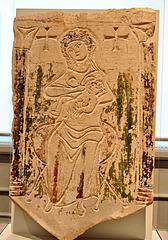
Tomb stele of a young woman
Breastfeeding Isis
Egypt / 4th - 5th c.
Berlin - Bode-Museum
| 20 Jun 2025 |
|
The Bode Museum (formerly called "Kaiser-Friedrich-Museum), is a building on the Museum Island. It was built from 1898 to 1904 by order of German Emperor William II according to plans by Ernst von Ihne in Baroque Revival style.
During WWII the building suffered comparatively the least damage on Museum Island, but it was not until 1951 that it received a temporary roof. After the end of the war, the new Berlin city administration had all references to former rulers removed and in 1956, Johannes R. Becher, then Minister of Culture of the GDR, ceremoniously renamed the Kaiser Friedrich Museum the Bode Museum.
As part of the Museum Island complex, the Bode-Museum was inscribed on the UNESCO World Heritage List in 1999.
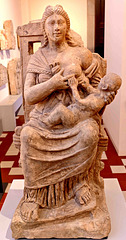
The statue originally depicted Isis breastfeeding her son Horus. After its discovery and probably because its fragmentary state of preservation it was reworked into a suppoosedly into a breastdeeding Mary with Jesus (Maria lactans).
Egypt / 2nd - 3rd c.
Benevento - Museo Arcos
| 18 Oct 2022 |
|
Due to its location and importance, Benevento was an important base for Roman rule in southern Italy for centuries. After the expansion of the Lombards, Benevento became the seat of Lombard dukes but repeatedly fell into dependence on the Franks and the German emperors. In 840, Benevento was occupied by the Muslims for a few years. The city has been the seat of the Archbishopric of Benevento since 969. In 1047 it fell into the hands of Norman princes with the exception of the city, which Emperor Henry III gave to Leo IX in 1053. In the 11th and 12th centuries, four councils were held in Benevento.
On February 26, 1266, in the Battle of Benevento, the Hohenstaufen Manfred, natural son of the Holy Roman Emperor Frederick II, was defeated by Charles of Anjou, after which the latter seized Apulia, Sicily, and Tuscia.
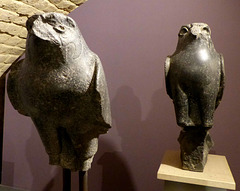
In the 2nd century BC, the cult of Isis became popular in Egypt and spread throughout the Roman Empire. A center of the cult developed in Benevento. Already in the 19th century Egyptian artifacts were found several times. In 1903, several statues of Isis were found at the foot of a Longobard wall, which had been used as fill material for the wall's foundation. Even after 2000, more Egyptian artifacts were found during construction work.
This is how the Egyptian section of the Museo del Sannio was founded. It is located in the Arcos Museum.
Jump to top
RSS feed- Martin M. Miles' latest photos with "Horus" - Photos
- ipernity © 2007-2025
- Help & Contact
|
Club news
|
About ipernity
|
History |
ipernity Club & Prices |
Guide of good conduct
Donate | Group guidelines | Privacy policy | Terms of use | Statutes | In memoria -
Facebook
X
