
Martin M. Miles' photos with the keyword: Orange-Nassau
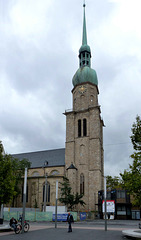
Dortmund - St. Reinoldi
| 09 Jul 2022 |
|
|
Local tradition knows that Dortmund was founded by Charlemagne in the course of the Saxon Wars. The first written mention of "Throtmanni" dates back to 882.
In 1152, a court day was held in Dortmund under King Frederick Barbarossa. Craftsmen and merchants settled and so Dortmund developed into city. A fire in 1232 almost completely destroyed the town. The fire also caused the loss of the town's archives and with them all documents from the time before the fire. Dortmund's privileges, which had been lost in the fire, were renewed by Frederick II in 1236.
In 1293 the city was granted the brewing right and unprecedented development of the beer industry within the city began. In 1389, Dortmund survived the "Great Dortmund Feud" against the Count of the Mark and the Archbishop of Cologne. However, an economic decline was initiated. This process was continued and intensified by the Thirty Years' War and led to the city's decline, with the population falling to 4500 by 1793. Dortmund became an exclave of the Principality of Orange-Nassau. In 1808 Dortmund became part of the Napoleonic Grand Duchy of Berg. After the Prussian victory over Napoleon, Dortmund fell to the Prussian province of Westphalia in 1815. From the mid of 19th century, Dortmund's renewed rise and transformation into an industrial city began due to coal mining and steel processing. Since the opening of the railroad in 1847, Dortmund became a transportation hub in the Ruhr region. Another contribution to development came in 1899 with the opening of the Dortmund-Ems Canal. This infrastructure paved Dortmund's way to becoming a major city. The city grew beyond the narrow confines of the medieval ramparts.
By the outbreak of WWII, the townscape had changed from a farming town to a metropolitan appearance. During WWII, more than 100 air raids destroyed more than 90 percent of the city, including its historic churches. Reconstruction proceeded quickly, and by 1950 the city had 500,000 inhabitants.
Today, with about 590,000 inhabitants, Dortmund is part of the "Ruhr district", a polycentric urban area. With a population of over 5 million, it is the largest urban area in Germany.
-
There is evidence of a palatine church from the Ottonian period, which was destroyed during war unrest around 1060 and then rebuilt with a new outer crypt to house the St. Reinoldus relics, which may have been brought to Dortmund in 1065. St. Reinholdus (aka "Renaud de Montauban") is since Dortmund´s patron saint
This church was probably destroyed again during fighting between 1113 and 1115 and then rebuilt. The fire of 1232 destroyed the church a third time. It was built from 1250 to 1270, and is located at the crossing of the Hellweg (a historic trade route) and the historic road from Cologne to Bremen. From 1421 to 1450, the large council chancel was built.. After its completion of the tower in 1454, it was 112 m tall and was referred to as the "Miracle of Westphalia".
The furnishings of St. Reinoldi make it clear that an essential function of the building was the representation of Dortmund's imperial freedom.
In 1562 the congregations of Dortmund confirmed their adoption of Lutheranism in St. Reinold's Church. In 1661, the tower collapsed after being damaged during an earthquake. The foundation for the new tower was laid in 1662, and the building was completed in 1701, with a baroque ornament on the top.
The church was heavily damaged in WW II. The reconstruction, partly financed by donations, began in 1950 and lasted six years. In June 1956, consecration was celebrated in the rebuilt church.

Siegen - Martinikirche
| 08 Jun 2018 |
|
The city of Siegen (pop. 100.000) got its name probably from the
river name Sieg. The city´s history is connected to mining, some mines date back to the late Iron Age.
In 1224 the "Oberes Schloss" ("upper castle") existed already was already standing at this time, in 1303, the town was granted town rights.
In the 16th century, the town was surrounded by walls with 16 towers and three town gates. After the Refomarmation Protestands (Calvinists) and Catholics lived here side by side. A sometimes violent neighborhood. Mid 18th century the wealthy area was part of the Principality of Orange-Nassau, ruled by William I, who was Prince of Orange-Nassau, Prince of Orange and the first King of the Netherlands.
In 1815 Siegen was assigned to the Prussian Province of Westphalia.
In 1577, Peter Paul Rubens, the the best known son of the city, was born here to the Calvinists Jan Rubens and Maria Pypelincks, who had fled Antwerp.
Archeologists have proven, that already during the 8th century a building was here, overlooking and so securing a ford below. In the 11th century a collegiate church existed here, that got destroyed end of the 12th century. It got rebuilt around 1230 and modificated 1511-1516. The park, that surrounds the church, once was the medieval graveyard.
Siegen - Nikolaikirche
| 08 Jun 2018 |
|
The city of Siegen (pop. 100.000) got its name probably from the
river name Sieg. The city´s history is connected to mining, some mines date back to the late Iron Age.
In 1224 the "Oberes Schloss" ("upper castle") existed already was already standing at this time, in 1303, the town was granted town rights.
In the 16th century, the town was surrounded by walls with 16 towers and three town gates. After the Refomarmation Protestands (Calvinists) and Catholics lived here side by side. A sometimes violent neighborhood. Mid 18th century the wealthy area was part of the Principality of Orange-Nassau, ruled by William I, who was Prince of Orange-Nassau, Prince of Orange and the first King of the Netherlands.
In 1815 Siegen was assigned to the Prussian Province of Westphalia.
In 1577, Peter Paul Rubens, the the best known son of the city, was born here to the Calvinists Jan Rubens and Maria Pypelincks, who had fled Antwerp.
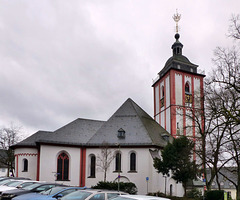
The Nikolaikirche was erected in the center of the medieval town within the 13th century. It was obviously not possible to built a "traditional" church with a long nave on the hilly ground, so the church was erected as a complex, but compact hexagon.
On top of the tower is a golden Crown, called the "Krönchen", Siegen´s landmark. The crown was presented to the citizens of Siegen in 1652 by Johann Moritz zu Nassau-Siegen, after his ennoblement.
The crown is about 1,90 m high and has a diameter of about 1,35 m. Seen on top of the tower is meanwhile a copy. The original from 1652 is kept inside the church.
Siegen - Nikolaikirche
| 07 Jun 2018 |
|
The city of Siegen (pop. 100.000) got its name probably from the
river name Sieg. The city´s history is connected to mining, some mines date back to the late Iron Age.
In 1224 the "Oberes Schloss" ("upper castle") existed already was already standing at this time, in 1303, the town was granted town rights.
In the 16th century, the town was surrounded by walls with 16 towers and three town gates. After the Refomarmation Protestands (Calvinists) and Catholics lived here side by side. A sometimes violent neighborhood. Mid 18th century the wealthy area was part of the Principality of Orange-Nassau, ruled by William I, who was Prince of Orange-Nassau, Prince of Orange and the first King of the Netherlands.
In 1815 Siegen was assigned to the Prussian Province of Westphalia.
In 1577, Peter Paul Rubens, the the best known son of the city, was born here to the Calvinists Jan Rubens and Maria Pypelincks, who had fled Antwerp.
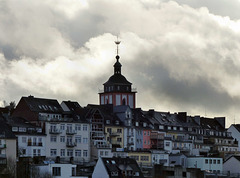
The tower of the Nikolaikirche. On top of the tower is a golden Crown, called the "Krönchen", Siegen´s landmark. The crown was presented to the citizens of Siegen in 1652 by Johann Moritz zu Nassau-Siegen, after his ennoblement.
The crown is about 1,90 m high and has a diameter of about 1,35 m. Seen on top of the tower is meanwhile a copy. The original from 1652 is kept inside the church.
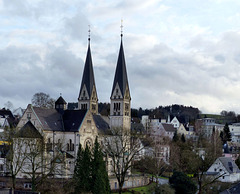
Siegen - St. Michael
| 07 Jun 2018 |
|
The city of Siegen (pop. 100.000) got its name probably from the
river name Sieg. The city´s history is connected to mining, some mines date back to the late Iron Age.
In 1224 the "Oberes Schloss" ("upper castle") existed already was already standing at this time, in 1303, the town was granted town rights.
In the 16th century, the town was surrounded by walls with 16 towers and three town gates. After the Refomarmation Protestands (Calvinists) and Catholics lived here side by side. A sometimes violent neighborhood. Mid 18th century the wealthy area was part of the Principality of Orange-Nassau, ruled by William I, who was Prince of Orange-Nassau, Prince of Orange and the first King of the Netherlands.
In 1815 Siegen was assigned to the Prussian Province of Westphalia.
In 1577, Peter Paul Rubens, the the best known son of the city, was born here to the Calvinists Jan Rubens and Maria Pypelincks, who had fled Antwerp.
The Catholic parish church St. Michael is pretty young. Built 1903-1906 in Neo-Romanic style, it does look older.
Jump to top
RSS feed- Martin M. Miles' latest photos with "Orange-Nassau" - Photos
- ipernity © 2007-2026
- Help & Contact
|
Club news
|
About ipernity
|
History |
ipernity Club & Prices |
Guide of good conduct
Donate | Group guidelines | Privacy policy | Terms of use | Statutes | In memoria -
Facebook
X
