

Martin M. Miles' photos with the keyword: Pietà

Le Monastier-sur-Gazeille – "Les Trésors du Monas…
| 15 Dec 2025 |
|
|
Legends tell, that a small community of hermits lived here in the 6th century. A century later the group was led by (Saint) Eudes and after him by Eudes´ nephew (Saint) Theofrede. Theofrede got killed by the locals - and so he became a martyr named Saint Chaffre.
The monastery adopted the Benedictine rule in 817 and found support from Louis the Pious. In the following two centuries three churches were erected here. All collapsed due to the unstable ground. The current, former abbey church was built from 1074 on.
The monastery (and the relics of Saint Chaffre) were just a day´s walk from Le Puy, where the Via Podiensis started and many pilgrims gathered. It may well be, that the wealthiness of the abbey, was related to the pilgrim-business.
The museum "Les Trésors du Monastier" centers around the Benedictine abbey, that was so important for the region over many centuries.
Pietà
wood / 15th century
The depiction of the grieving Mary with the dead Jesus has been known since the 13th/14th century.
Saint-Aignan - Saint-Aignan
| 06 Jun 2015 |
|
The former collegiate church Saint-Aignan was built from the early 11th to the early 13th century, so there is a transition from Romanesque to early Gothic style. The church replaced a chapel from the 9th century and was a center of pilgrimage, as the relics of Saint Aignan of Orlean (+ 453) were venerated here.
The church was ruined for a long time and got renovated and restored during the 19th century. During the renovation of the nave at least some parts got recreated.
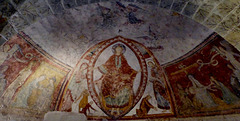
Fortunately the ambulatory crypt, the oldest part of the collegiate church Saint-Aignan, got not renovated like the nave. It stayed pretty much intact and has frescoes dating back to the 12th and 13th century.
The large fresco under the apse again (see previous uploads).
The Pantocrator in the mandorla is flanked by angels. Down below the scene with the pilgrims (previous upload). To the left are two scenes. Maybe these are the "Annunciation" and the "Visitation". On the right side of the center is the "Descent from the Cross" - and a "Pietà", Mary cradling the dead body of Jesus.
This would mean, that the fresco was probably created not before 1300, when the first Pietàs were carved in Germany.
Jump to top
RSS feed- Martin M. Miles' latest photos with "Pietà" - Photos
- ipernity © 2007-2026
- Help & Contact
|
Club news
|
About ipernity
|
History |
ipernity Club & Prices |
Guide of good conduct
Donate | Group guidelines | Privacy policy | Terms of use | Statutes | In memoria -
Facebook
X
