

Martin M. Miles' photos with the keyword: Assier
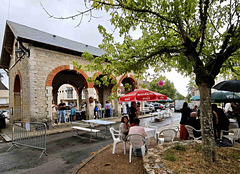
Assier - La halle
| 08 Nov 2025 |
|
|
If there is a birthday party in town and the restaurant is too small to seat all the guests, many guests dine in the market hall, constructed in 1884.
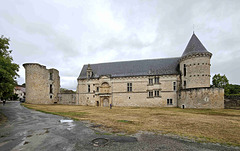
Assier - Château d’Assier
| 08 Nov 2025 |
|
|
|
Built by Jacques Ricard de Gourdon de Genouillac, known as Galiot de Genouillac, by 1535, the castle was one of the masterpieces of the early French Renaissance and also the most important Renaissance building in Quercy.T
he castle remained uninhabited for a long time afterwards and fell into disrepair. In 1868, three of the four wings of the castle, which had become dilapidated, were sold to contractors for demolition. This happened even though Prosper Mérimée had already included the castle in the list of Monuments historiques in 1841. Only the west wing was excluded from the sale.Since 1934, the building has been owned by the French state. It has been restored and opened to the public.
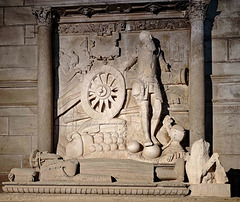
Assier - St. Pierre
| 08 Nov 2025 |
|
|
The church of Saint-Pierre is one of the most unusual church buildings in southern France.
The church was commissioned in 1540 by Galiot de Genouillac (1465–1546), who was born in Assier and was one of France's highest dignitaries. He designated it as his burial place. One of his many titles and duties was that of ‘Grand Master of Artillery of France’.
The church was completed three years after his death. No alterations or extensions were made to the original church building, making the church in Assier a unique example of the transitional style from late Gothic to Renaissance.
Galiot de Genouillace´s effigy - the ‘Grand Master of Artillery of France’.
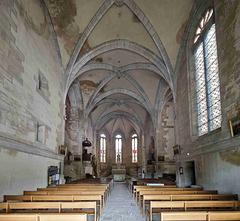
Assier - St. Pierre
| 08 Nov 2025 |
|
|
The church of Saint-Pierre is one of the most unusual church buildings in southern France.
The church was commissioned in 1540 by Galiot de Genouillac (1465–1546), who was born in Assier and was one of France's highest dignitaries. He designated it as his burial place. One of his many titles and duties was that of ‘Grand Master of Artillery of France’.
The church was completed three years after his death. No alterations or extensions were made to the original church building, making the church in Assier a unique example of the transitional style from late Gothic to Renaissance.
Assier - St. Pierre
| 07 Nov 2025 |
|
|
The church of Saint-Pierre is one of the most unusual church buildings in southern France.
The church was commissioned in 1540 by Galiot de Genouillac (1465–1546), who was born in Assier and was one of France's highest dignitaries. He designated it as his burial place. One of his many titles and duties was that of ‘Grand Master of Artillery of France’.
The church was completed three years after his death. No alterations or extensions were made to the original church building, making the church in Assier a unique example of the transitional style from late Gothic to Renaissance.
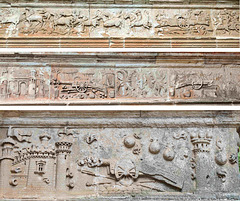
An approximately 100 meter long relief frieze depicting various scenes from the life of Galiot de Genouillac encircles the entire exterior of the church. The scenes show the military exploits of the builder: sieges of cities and fortresses, as well as battles and cannons.
Assier - St. Pierre
| 07 Nov 2025 |
|
|
The church of Saint-Pierre is one of the most unusual church buildings in southern France.
The church was commissioned in 1540 by Galiot de Genouillac (1465–1546), who was born in Assier and was one of France's highest dignitaries. He designated it as his burial place. One of his many titles and duties was that of ‘Grand Master of Artillery of France’.
The church was completed three years after his death. No alterations or extensions were made to the original church building, making the church in Assier a unique example of the transitional style from late Gothic to Renaissance.
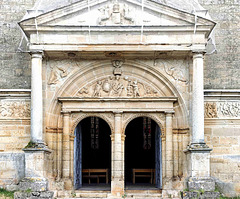
The portal
Assier - St. Pierre
| 07 Nov 2025 |
|
|
|
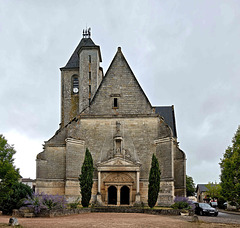
The church of Saint-Pierre is one of the most unusual church buildings in southern France.
The church was commissioned in 1540 by Galiot de Genouillac (1465–1546), who was born in Assier and was one of France's highest dignitaries. He designated it as his burial place. One of his many titles and duties was that of ‘Grand Master of Artillery of France’.
The church was completed three years after his death. No alterations or extensions were made to the original church building, making the church in Assier a unique example of the transitional style from late Gothic to Renaissance.
Assier - Dolmen de Garivals
| 06 Nov 2025 |
|
|
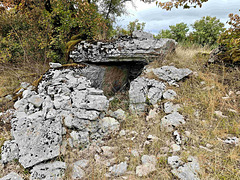
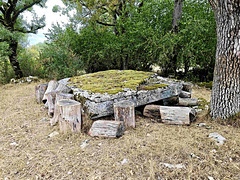
The chamber of the Dolmen de Garivals measures approximately 3.0 m × 1.5 m, and the only surviving capstone is approximately 2.3 m long, 2.0 m wide, and 0.3 m thick. It covers only half of the chamber. It rests on two orthostats.
Assier - Dolmen du Bois des Boeufs
| 06 Nov 2025 |
|
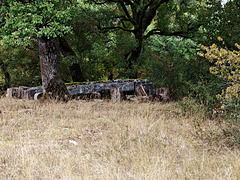
The dolmen in the "Bois des Boeufs" is still almost completely covered by its approximately 20.0-meter-wide round mound. Only the capstone, measuring 3.7 meters long, 2.6 meters wide, and 0.3 meters thick and weighing about 8 tons, protrudes from the surface of the tumulus. This stone rests on two orthostats, each approximately 3.0 meters long and 0.6 meters high.
Assier - Dolmen du Bois des Boeufs
| 06 Nov 2025 |
|
|
The dolmen in the "Bois des Boeufs" is still almost completely covered by its approximately 20.0-meter-wide round mound. Only the capstone, measuring 3.7 meters long, 2.6 meters wide, and 0.3 meters thick and weighing about 8 tons, protrudes from the surface of the tumulus. This stone rests on two orthostats, each approximately 3.0 meters long and 0.6 meters high.
Livernon - Table de Roux
| 06 Nov 2025 |
|
|
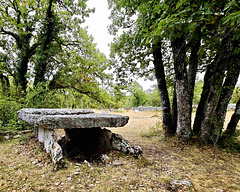
The dolmen called the Table de Roux is also known as Pierre de Roux or Dolmen du Rouss, as the stone is slightly reddish.
The capstone of this dolmen is supported by two orthostats, each 4 meters long. The capstone is 3.30 meters long, 2.50 meters wide, and 0.30 meters thick.
Livernon - Table de Roux
| 06 Nov 2025 |
|
|
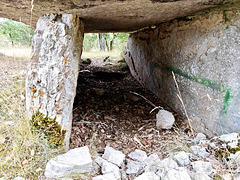
The dolmen called the Table de Roux is also known as Pierre de Roux or Dolmen du Rouss, as the stone is slightly reddish.
The capstone of this dolmen is supported by two orthostats, each 4 meters long. The capstone is 3.30 meters long, 2.50 meters wide, and 0.30 meters thick.

Livernon - Table de Roux
| 06 Nov 2025 |
|
|
The dolmen called the Table de Roux is also known as Pierre de Roux or Dolmen du Rouss, as the stone is slightly reddish.
The capstone of this dolmen is supported by two orthostats, each 4 meters long. The capstone is 3.30 meters long, 2.50 meters wide, and 0.30 meters thick.
Jump to top
RSS feed- Martin M. Miles' latest photos with "Assier" - Photos
- ipernity © 2007-2026
- Help & Contact
|
Club news
|
About ipernity
|
History |
ipernity Club & Prices |
Guide of good conduct
Donate | Group guidelines | Privacy policy | Terms of use | Statutes | In memoria -
Facebook
X
