

Martin M. Miles' photos with the keyword: Unicorn

Paris - Musée de Cluny
| 11 Jan 2026 |
|
|
The Hôtel de Cluny was built in the late 15th century on the site of an older building constructed after the Abbey of Cluny acquired the ancient Roman baths in 1340.
The manor house was rebuilt under Jacques d’Amboise, Abbot Commander of Cluny (1485–1510). In the 18th century, the tower of the Hôtel de Cluny served as an observatory for the astronomers Joseph-Nicolas Delisle, Jérôme Lalande, and Charles Messier. During the French Revolution in 1789, the manor house was confiscated.
In 1832, the archaeologist and art collector Alexandre Du Sommerard acquired the Hôtel de Cluny and used it to display his extensive collection of medieval artifacts. After his death, the collection became the property of the French state. The building opened as a museum in 1843.
The museum underwent a complete renovation over three years and reopened in 2022.
Aquamanile
Unicorn
Brass, Nuremberg, about 1400
Burgos - Catedral de Burgos
| 03 Sep 2023 |
|
|
In the 7th/8th century, the area was reconquered from the hands of the Moors by the kings of Asturias. A castle was built in 884 on the orders of King Alfonso III. Burgos became the coronation city of the kings of Castile in the 11th century, which underlines its special importance. After the conquest of Toledo by Alfonso VI. (1085). The city became the see of a Diocese and was a major stop for pilgrims to Santiago de Compostela. Burgos lost its importance a little, but the city remained an important economic, cultural, and political center in northern Spain. The Convento de San Pablo was a Dominican monastery founded in 1224 that existed until 1835.
The construction of the cathedral was ordered by King Ferdinand III of Castile and the Bishop of Burgos. Ferdinand had just married Barbarossa´s granddaughter Beatrice of Swabia (aka "Elisabeth of Swabia") and wanted a cathedral, reflecting his new role in the European power game.
The former Romanesque cathedral was demolished in 1221, and the construction of the new Gothic started under the guidance of a French architect. After nine years, the chevet was completed and the high altar was consecrated. Then the construction stopped for about 200 years.
Attending the Council of Basel (aka "Council of Florence") in 1435 bishop Alfonso de Cartagena saw the elegant towers of the Basel Minster. When he returned to Burgos he was accompanied by German architect Johannes von Köln (aka "Juan de Colonia"), who probably knew the blueprints of the towers, planned for the Cathedral of Cologne. Under his guidance, the towers of the Cathedral were completed in open tracery. He was followed on the construction site by his son Simon de Colonia. Francisco de Colonia, Simon's son, continued the work and created the Pellejería-Portal. This was a family business.
As I have uploaded many photos of the cathedral before, I will only add a few for now.
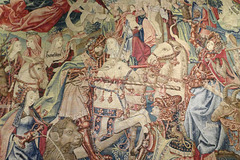
A unicorn! Depicted on a Flemish tapestry
Jump to top
RSS feed- Martin M. Miles' latest photos with "Unicorn" - Photos
- ipernity © 2007-2026
- Help & Contact
|
Club news
|
About ipernity
|
History |
ipernity Club & Prices |
Guide of good conduct
Donate | Group guidelines | Privacy policy | Terms of use | Statutes | In memoria -
Facebook
X
