
Martin M. Miles' photos with the keyword: falcon
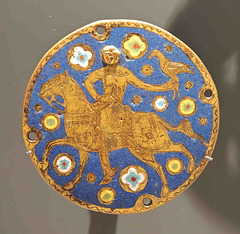
Paris - Musée de Cluny
| 06 Jan 2026 |
|
|
The Hôtel de Cluny was built in the late 15th century on the site of an older building constructed after the Abbey of Cluny acquired the ancient Roman baths in 1340.
The manor house was rebuilt under Jacques d’Amboise, Abbot Commander of Cluny (1485–1510). In the 18th century, the tower of the Hôtel de Cluny served as an observatory for the astronomers Joseph-Nicolas Delisle, Jérôme Lalande, and Charles Messier. During the French Revolution in 1789, the manor house was confiscated.
In 1832, the archaeologist and art collector Alexandre Du Sommerard acquired the Hôtel de Cluny and used it to display his extensive collection of medieval artifacts. After his death, the collection became the property of the French state. The building opened as a museum in 1843.
The museum underwent a complete renovation over three years and reopened in 2022.
Medaillon
Horseman with falcon
Limoges, 1200 - 1210
Dortmund - Petrikirche
| 20 Jul 2025 |
|
|
|
Petrikirche is a hall church in the High Gothic style, which approximates the ideal type of this church form. The building has a nearly square floor plan with a comparatively short choir.
St. Peter's Church, along with St. Reinoldi's Church and St. Mary's Church, is another medieval church located directly on Westenhellweg. The three-bay structure was begun in 1322 and is made of sandstone.
Antwerp retable is the name given to a type of winged altarpiece produced for export, particularly in Antwerp workshops during the first third of the 16th century. Antwerp retables are generally characterized by their intricately detailed carvings, but also by certain standardizations, such as their dimensions and the frequent repetition of certain groups of figures. Over 200 examples are still preserved today in churches and museums in various European countries.
At 5.65 meters high and 7.40 meters wide with the double doors open, the Dortmund carved altar, the "Goldenes Wunder von Westfalen", is considered the largest surviving Antwerp altarpiece. The retable features two pairs of wings, the interior of which is also sculpturally carved.
The altar was originally commissioned by the Dortmund Franciscans from Jan Gillisz Wrage in Antwerp for their monastery church. After the monastery was dissolved during secularization, the St. Peter's congregation acquired the altar and brought it to their church. During World War II, the altar was removed and returned to Dortmund in 1954. It was restored in St. Peter's Church from the early 1960s onwards and reinstalled in 1985.
The winged altar is opened differently throughout the church year, revealing different images on the front.
From Thanksgiving to Holy Week and from Easter to Pentecost, the actual gilded carved altar with 36 compartments and a total of 633 gilded figures can be seen inside. It depicts the detailed story of Jesus' Passion, with the crucifixion at its center.
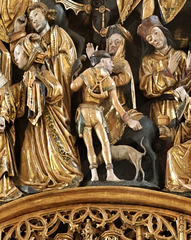
Detail of the Crucifixion (previous upload)
This little hunter with a hunting horn, hunting dog, and falcon seems to have wandered here without knowing what was happening.
Bari - Cattedrale di San Sabino
| 05 Sep 2020 |
|
|
Bari was an early settlement and passed under Roman rule in the 3rd century BC. It developed strategic significance as the point of junction between the coast road and the Via Traiana and as a port for eastward trade. The first bishop of Bari was Gervasius who is known from the Council of Sardica in 347.
After the decline of the Roman Empire, the town was devasted and taken by Alaric´s Visigothic troops, then was under Lombardian rule, before the Byzantines took over. In 755 it was conquered by Pepin the Short (Charlemagne´s father) and from 847 on it was an Islamic Emirate. The Byzantine fleet returned in 871 and since 885 Bari ws the residence of the local Byzantine governor.
Following a three-year siege, Bari was captured by Robert Guiscard in 1071. After the relics of Saint Nicholas, which were surreptitiously brought from Myra in Lycia (Byzantine territory), arrived in Bari, the Basilica di San Nicola was founded in 1087. This attracted pilgrims, whose encouragement and care became central to the economy of Bari. Pope Urban II consecrated the Basilica in 1089. In 1096 a crusader army embarked in the port of Bari for the First Crusade.
After the murder of archbishop Griso in 1117 a civil war broke our and the control was seized by Grimoald Alferanites, a native Lombard, in opposition to the Normans. He later did homage to Roger II of Sicily, but rebelled and was defeated in 1132.
The Castello Normanno-Svevo (aka "Castello di Bari") was probably built around 1132 by Norman King Roger II. When in 1155 the Baresi rebelled against the Normans, the castle got destroyed, so as a retaliatory action, William I of Sicily (aka William the Wicked") had the city destroyed except for the cathedral and the Basilica of St. Nicola.
Bari recovered and had its heydays under Frederick II. When he returned from his crusade after 1229, the city gates were locked so he had to use force to gain entry. Therefore, he probably had the fort built in 1233 to keep the city in check. On the other hand, he granted the city generous trade privileges and left it the leading role in the region.
-
The construction of the "Cattedrale di San Sabino" (aka "Bari Cathedral" started around 1170 on. The cathedral is the seat of the Archbishop of Bari-Bitonto. It is dedicated to Saint Sabinus, a bishop of Canosa, whose relics were brought here in the 9th century.
It was erected on the site of the ruins of the Imperial Byzantine cathedral, destroyed in 1156 by William I of Sicily with the rest of the city.
For the reconstruction of the cathedral materials from the preceding church and other destroyed buildings got reused. During the 18th century the façade, the nave and aisles and the crypt were refurbished in Baroque style. The building later underwent a series of refurbishments, demolitions and extensions. The original Romanesque appearance of the interior was restored in the 1950s.
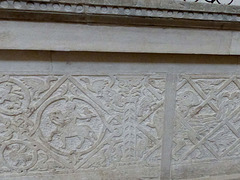
The chancel screen does not longer exist, but there are some remains like this relief, signed by the artist "Peregrinus stirpe Salerni". Seen here is a falconer.
Emperor Frederick II is the author of the first treatise on the subject of falconry. It is titled "De Arte Venandi cum Avibus" ( = "The Art of Hunting with Birds") and was written in the 1240s.
Albugnano - Abbazia di Vezzolano
| 07 Dec 2019 |
|
Legends connect the foundation of the Abbazia Santa Maria di Vezzolano to Charlemagne. It does date back to the eighth century and got destroyed in the 10th century by the Saracens.
The complex was rebuilt until 1189 and is documented as an Augustinian monastery from 1095. It was the seat of a community until the 19th century when it was suppressed during the Napoleonic invasion of Italy.
-
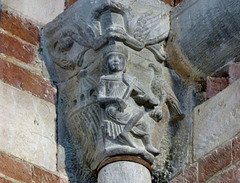
Along the nave are some nicely carved capitals. Depicted here is Solomon playing a vielle, acommpanied by a falcon.
Parthenay-le-Vieux - Saint-Pierre
| 06 Oct 2013 |
|
|
Gédouin and Ebo, Seigneurs of Parthenay, invited the monks from "La Chaise-Dieu" in the Auvergne (some 500kms south east), to establish a priory here in 1092. The parish church, that had existed here already before, got replaced then by the church seen now in the early 11th century. Despite the monks roots in the Auvergne the facade is done in the style, common to the area, so they obviously employed master builders with regional experiences.
Meanwhile the priory is out of existence since centuries. The church and the remaining buildings are privately owned, but the church is not locked! Merci beaucoup!
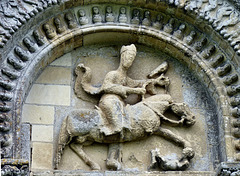
The right blind arch of the facade.
A closer look onto the equestrian statue.
The Poitou has an astonishing number of these large carvings (eg Melle, Surgeres, Airvolt), that can not found often elsewhere.
On all places, a small person is sitting on the ground and is trampled over. Most historians see Constantine the Great, triumphing over heathenism. Here, the statue has an even more imperial attitude, as the (crowned) rider holds a falcon, a clear attribute of rank and nobility.
The inner archivolt depicts ladies in bathtubes. - These ladies may refer to Mélusine, a legendary water nymph, connected to the House of Lusignan. The oral myth about water-nymphs as very old, but this specific story, centered in the Poitou (around Parthenay) story was written down first time by Jean d'Arras. It got translated - and spread all over Europe.
Wikpedia:
en.wikipedia.org/wiki/Jean_d%27Arras
Parthenay-le-Vieux - Saint-Pierre
| 02 Oct 2013 |
|
|
Gédouin and Ebo, Seigneurs of Parthenay, invited the monks from "La Chaise-Dieu" in the Auvergne (some 500kms south east), to establish a priory here in 1092. The parish church, that had existed here already before, got replaced then by the church seen now in the early 11th century. Despite the monks roots in the Auvergne the facade is done in the style, common to the area, so they obviously employed master builders with regional experiences.
Meanwhile the priory is out of existence since centuries. The church and the remaining buildings are privately owned, but the church is not locked! Merci beaucoup!
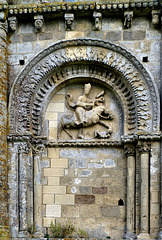
The right blind arch of the facade.
An equestrian statue.
The Poitou has an astonishing number of these large carvings (eg Melle, Surgeres, Airvolt), that can not found often elsewhere.
On all places, a small person is sitting on the ground and is trampled over. Most historians see Constantine the Great, triumphing over heathenism. Here, the statue has an even more imperial attitude, as the (crowned) rider holds a falcon, a clear attribute of rank and nobility.
The outer archivolt has griffons all around (similar to Sainte-Croix, Parhenay), while the inner archivolt depicts ladies in bathtubes (?), what may connect to another story. Maybe..
Jump to top
RSS feed- Martin M. Miles' latest photos with "falcon" - Photos
- ipernity © 2007-2026
- Help & Contact
|
Club news
|
About ipernity
|
History |
ipernity Club & Prices |
Guide of good conduct
Donate | Group guidelines | Privacy policy | Terms of use | Statutes | In memoria -
Facebook
X
