

Martin M. Miles' photos with the keyword: Ourense

Ourense - Sombrerería La Lucha
| 13 Mar 2024 |
|
|
The Romans were already here and utilised the hot springs. They built a bridge over the river, the Ponte romana, creating an important communication route, which was of course secured by fortifications.
In the 5th century, Ourense became the seat of a bishopric. As the capital of the kingdom of the Suebi, Ourense flourished in the 5th and 6th centuries. The Suebi king Teodomiro († 570) built the first cathedral in Ourense after converting from Arianism to Catholicism.
Constant raids by the Moorish conquerors and the Normans devastated the city to such an extent that it remained almost uninhabited for several centuries. It was rebuilt in 1071 under King Sancho II of Castile. In the following centuries, the city gained importance as a bishop's see, but also as a trading centre. In the 13th century, Ourense was an important trading centre in Galicia due to its geographical location and its large Jewish community. The economic decline began after the expulsion of Ourense's Jews in 1492 by the Catholic Monarchs. In the centuries that followed, Ourense's importance steadily declined.
Sombrerería La Lucha is the leading place for hats since 1917.
Ourense - Santa Eufemia
| 13 Mar 2024 |
|
|
The Romans were already here and utilised the hot springs. They built a bridge over the river, the Ponte romana, creating an important communication route, which was of course secured by fortifications.
In the 5th century, Ourense became the seat of a bishopric. As the capital of the kingdom of the Suebi, Ourense flourished in the 5th and 6th centuries. The Suebi king Teodomiro († 570) built the first cathedral in Ourense after converting from Arianism to Catholicism.
Constant raids by the Moorish conquerors and the Normans devastated the city to such an extent that it remained almost uninhabited for several centuries. It was rebuilt in 1071 under King Sancho II of Castile. In the following centuries, the city gained importance as a bishop's see, but also as a trading centre. In the 13th century, Ourense was an important trading centre in Galicia due to its geographical location and its large Jewish community. The economic decline began after the expulsion of Ourense's Jews in 1492 by the Catholic Monarchs. In the centuries that followed, Ourense's importance steadily declined.
The Church of Santa Eufemia is a Baroque church just a few metres from the Cathedral of Ourense
St Euphemia is a saint who was martyred at the time of Emperor Hadrian. In 1060, a shepherdess in Campelo discovered a grave from which a hand with a golden ring on one finger protruded. The woman took it and lost her speech. She was only able to regain it after returning the ring to the hand that had it. According to legend, a voice was then heard saying that the tomb of St Eufemia was there.
The mortal remains were buried under the altar of a hermitage between Braga and Orense. In 1159, the bishop of Orense tried to transfer the saint's body to the city cathedral but this was rejected by the parishioners of Braga, which led to a dispute. It was decided to place the body of the saint in a cart pulled by oxen and to bury her remains in the place where the animals went.
The church of Santa Eufemia was built in 1653 as part of a Jesuit college thanks to the Order of the Society of Jesus and was converted into a parish church of the diocese of Ourense in 1767.
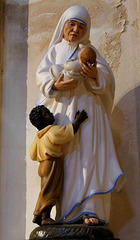
Mother Teresa / Exotism
Ourense - Santa Eufemia
| 13 Mar 2024 |
|
|
The Romans were already here and utilised the hot springs. They built a bridge over the river, the Ponte romana, creating an important communication route, which was of course secured by fortifications.
In the 5th century, Ourense became the seat of a bishopric. As the capital of the kingdom of the Suebi, Ourense flourished in the 5th and 6th centuries. The Suebi king Teodomiro († 570) built the first cathedral in Ourense after converting from Arianism to Catholicism.
Constant raids by the Moorish conquerors and the Normans devastated the city to such an extent that it remained almost uninhabited for several centuries. It was rebuilt in 1071 under King Sancho II of Castile. In the following centuries, the city gained importance as a bishop's see, but also as a trading centre. In the 13th century, Ourense was an important trading centre in Galicia due to its geographical location and its large Jewish community. The economic decline began after the expulsion of Ourense's Jews in 1492 by the Catholic Monarchs. In the centuries that followed, Ourense's importance steadily declined.
The Church of Santa Eufemia is a Baroque church just a few metres from the Cathedral of Ourense
St Euphemia is a saint who was martyred at the time of Emperor Hadrian. In 1060, a shepherdess in Campelo discovered a grave from which a hand with a golden ring on one finger protruded. The woman took it and lost her speech. She was only able to regain it after returning the ring to the hand that had it. According to legend, a voice was then heard saying that the tomb of St Eufemia was there.
The mortal remains were buried under the altar of a hermitage between Braga and Orense. In 1159, the bishop of Orense tried to transfer the saint's body to the city cathedral but this was rejected by the parishioners of Braga, which led to a dispute. It was decided to place the body of the saint in a cart pulled by oxen and to bury her remains in the place where the animals went.
The church of Santa Eufemia was built in 1653 as part of a Jesuit college thanks to the Order of the Society of Jesus and was converted into a parish church of the diocese of Ourense in 1767.
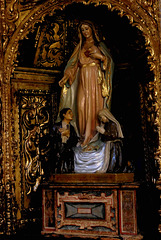
An apparition of the Virgin Mary
Ourense - Santa Eufemia
| 13 Mar 2024 |
|
|
The Romans were already here and utilised the hot springs. They built a bridge over the river, the Ponte romana, creating an important communication route, which was of course secured by fortifications.
In the 5th century, Ourense became the seat of a bishopric. As the capital of the kingdom of the Suebi, Ourense flourished in the 5th and 6th centuries. The Suebi king Teodomiro († 570) built the first cathedral in Ourense after converting from Arianism to Catholicism.
Constant raids by the Moorish conquerors and the Normans devastated the city to such an extent that it remained almost uninhabited for several centuries. It was rebuilt in 1071 under King Sancho II of Castile. In the following centuries, the city gained importance as a bishop's see, but also as a trading centre. In the 13th century, Ourense was an important trading centre in Galicia due to its geographical location and its large Jewish community. The economic decline began after the expulsion of Ourense's Jews in 1492 by the Catholic Monarchs. In the centuries that followed, Ourense's importance steadily declined.
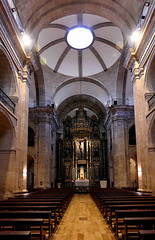
The Church of Santa Eufemia is a Baroque church just a few metres from the Cathedral of Ourense
St Euphemia is a saint who was martyred at the time of Emperor Hadrian. In 1060, a shepherdess in Campelo discovered a grave from which a hand with a golden ring on one finger protruded. The woman took it and lost her speech. She was only able to regain it after returning the ring to the hand that had it. According to legend, a voice was then heard saying that the tomb of St Eufemia was there.
The mortal remains were buried under the altar of a hermitage between Braga and Orense. In 1159, the bishop of Orense tried to transfer the saint's body to the city cathedral but this was rejected by the parishioners of Braga, which led to a dispute. It was decided to place the body of the saint in a cart pulled by oxen and to bury her remains in the place where the animals went.
The church of Santa Eufemia was built in 1653 as part of a Jesuit college thanks to the Order of the Society of Jesus and was converted into a parish church of the diocese of Ourense in 1767.

Ourense - Santa Eufemia
| 01 Mar 2024 |
|
The Romans were already here and utilised the hot springs. They built a bridge over the river, the Ponte romana, creating an important communication route, which was of course secured by fortifications.
In the 5th century, Ourense became the seat of a bishopric. As the capital of the kingdom of the Suebi, Ourense flourished in the 5th and 6th centuries. The Suebi king Teodomiro († 570) built the first cathedral in Ourense after converting from Arianism to Catholicism.
Constant raids by the Moorish conquerors and the Normans devastated the city to such an extent that it remained almost uninhabited for several centuries. It was rebuilt in 1071 under King Sancho II of Castile. In the following centuries, the city gained importance as a bishop's see, but also as a trading centre. In the 13th century, Ourense was an important trading centre in Galicia due to its geographical location and its large Jewish community. The economic decline began after the expulsion of Ourense's Jews in 1492 by the Catholic Monarchs. In the centuries that followed, Ourense's importance steadily declined.
The Church of Santa Eufemia is a Baroque church just a few metres from the Cathedral of Ourense
St Euphemia is a saint who was martyred at the time of Emperor Hadrian. In 1060, a shepherdess in Campelo discovered a grave from which a hand with a golden ring on one finger protruded. The woman took it and lost her speech. She was only able to regain it after returning the ring to the hand that had it. According to legend, a voice was then heard saying that the tomb of St Eufemia was there.
The mortal remains were buried under the altar of a hermitage between Braga and Orense. In 1159, the bishop of Orense tried to transfer the saint's body to the city cathedral but this was rejected by the parishioners of Braga, which led to a dispute. It was decided to place the body of the saint in a cart pulled by oxen and to bury her remains in the place where the animals went.
The church of Santa Eufemia was built in 1653 as part of a Jesuit college thanks to the Order of the Society of Jesus and was converted into a parish church of the diocese of Ourense in 1767.
Ourense - Santa Eufemia
| 13 Mar 2024 |
|
|
The Romans were already here and utilised the hot springs. They built a bridge over the river, the Ponte romana, creating an important communication route, which was of course secured by fortifications.
In the 5th century, Ourense became the seat of a bishopric. As the capital of the kingdom of the Suebi, Ourense flourished in the 5th and 6th centuries. The Suebi king Teodomiro († 570) built the first cathedral in Ourense after converting from Arianism to Catholicism.
Constant raids by the Moorish conquerors and the Normans devastated the city to such an extent that it remained almost uninhabited for several centuries. It was rebuilt in 1071 under King Sancho II of Castile. In the following centuries, the city gained importance as a bishop's see, but also as a trading centre. In the 13th century, Ourense was an important trading centre in Galicia due to its geographical location and its large Jewish community. The economic decline began after the expulsion of Ourense's Jews in 1492 by the Catholic Monarchs. In the centuries that followed, Ourense's importance steadily declined.
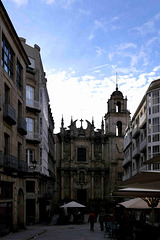
The Church of Santa Eufemia is a Baroque church just a few metres from the Cathedral of Ourense
St Euphemia is a saint who was martyred at the time of Emperor Hadrian. In 1060, a shepherdess in Campelo discovered a grave from which a hand with a golden ring on one finger protruded. The woman took it and lost her speech. She was only able to regain it after returning the ring to the hand that had it. According to legend, a voice was then heard saying that the tomb of St Eufemia was there.
The mortal remains were buried under the altar of a hermitage between Braga and Orense. In 1159, the bishop of Orense tried to transfer the saint's body to the city cathedral but this was rejected by the parishioners of Braga, which led to a dispute. It was decided to place the body of the saint in a cart pulled by oxen and to bury her remains in the place where the animals went.
The church of Santa Eufemia was built in 1653 as part of a Jesuit college thanks to the Order of the Society of Jesus and was converted into a parish church of the diocese of Ourense in 1767.
Ourense - Catedral de Ourense
| 13 Mar 2024 |
|
|
The Romans were already here and utilised the hot springs. They built a bridge over the river, the Ponte romana, creating an important communication route, which was of course secured by fortifications.
In the 5th century, Ourense became the seat of a bishopric. As the capital of the kingdom of the Suebi, Ourense flourished in the 5th and 6th centuries. The Suebi king Teodomiro († 570) built the first cathedral in Ourense after converting from Arianism to Catholicism.
Constant raids by the Moorish conquerors and the Normans devastated the city to such an extent that it remained almost uninhabited for several centuries. It was rebuilt in 1071 under King Sancho II of Castile. In the following centuries, the city gained importance as a bishop's see, but also as a trading centre. In the 13th century, Ourense was an important trading centre in Galicia due to its geographical location and its large Jewish community. The economic decline began after the expulsion of Ourense's Jews in 1492 by the Catholic Monarchs. In the centuries that followed, Ourense's importance steadily declined.
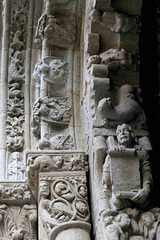
The earliest cathedral appears to have been a church dedicated to Santa María la Madre. In 550, the Suevian king Chararic built a second church here dedicated to St Martin of Tour. The cathedral was however repeatedly destroyed over the centuries by the Moors and the Northmen who invaded the city. Today's building was constructed as a Romanesque church in the 12th and 13th centuries. Gothic additions followed until the early 16th century. The consecration of the high altar was already in 1188.
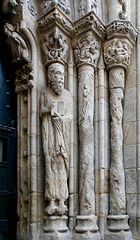
The Romanesque portal of the northern transept was altered in the 15th century following damage. Two figures on the walls, interpreted as a prophet (left) and an apostle (right), are still preserved from the Romanesque portal. Part of the archivolts.
Ourense - Catedral de Ourense
| 13 Mar 2024 |
|
|
The Romans were already here and utilised the hot springs. They built a bridge over the river, the Ponte romana, creating an important communication route, which was of course secured by fortifications.
In the 5th century, Ourense became the seat of a bishopric. As the capital of the kingdom of the Suebi, Ourense flourished in the 5th and 6th centuries. The Suebi king Teodomiro († 570) built the first cathedral in Ourense after converting from Arianism to Catholicism.
Constant raids by the Moorish conquerors and the Normans devastated the city to such an extent that it remained almost uninhabited for several centuries. It was rebuilt in 1071 under King Sancho II of Castile. In the following centuries, the city gained importance as a bishop's see, but also as a trading centre. In the 13th century, Ourense was an important trading centre in Galicia due to its geographical location and its large Jewish community. The economic decline began after the expulsion of Ourense's Jews in 1492 by the Catholic Monarchs. In the centuries that followed, Ourense's importance steadily declined.
The earliest cathedral appears to have been a church dedicated to Santa María la Madre. In 550, the Suevian king Chararic built a second church here dedicated to St Martin of Tour. The cathedral was however repeatedly destroyed over the centuries by the Moors and the Northmen who invaded the city. Today's building was constructed as a Romanesque church in the 12th and 13th centuries. Gothic additions followed until the early 16th century. The consecration of the high altar was already in 1188.
The Romanesque portal of the northern transept was altered in the 15th century following damage. Two figures on the walls, interpreted as a prophet (left) and an apostle (right), are still preserved from the Romanesque portal.
Ourense - Catedral de Orense
| 12 Mar 2024 |
|
|
The Romans were already here and utilised the hot springs. They built a bridge over the river, the Ponte romana, creating an important communication route, which was of course secured by fortifications.
In the 5th century, Ourense became the seat of a bishopric. As the capital of the kingdom of the Suebi, Ourense flourished in the 5th and 6th centuries. The Suebi king Teodomiro († 570) built the first cathedral in Ourense after converting from Arianism to Catholicism.
Constant raids by the Moorish conquerors and the Normans devastated the city to such an extent that it remained almost uninhabited for several centuries. It was rebuilt in 1071 under King Sancho II of Castile. In the following centuries, the city gained importance as a bishop's see, but also as a trading centre. In the 13th century, Ourense was an important trading centre in Galicia due to its geographical location and its large Jewish community. The economic decline began after the expulsion of Ourense's Jews in 1492 by the Catholic Monarchs. In the centuries that followed, Ourense's importance steadily declined.
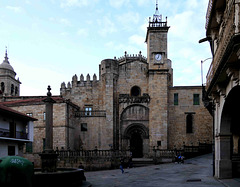
The earliest cathedral appears to have been a church dedicated to Santa María la Madre. In 550, the Suevian king Chararic built a second church here dedicated to St Martin of Tour. The cathedral was however repeatedly destroyed over the centuries by the Moors and the Northmen who invaded the city. Today's building was constructed as a Romanesque church in the 12th and 13th centuries. Gothic additions followed until the early 16th century. The consecration of the high altar was already in 1188.
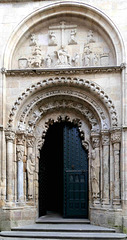
The Romanesque portal of the northern transept was altered in the 15th century following damage. Two figures on the walls, interpreted as a prophet (left) and an apostle (right), are still preserved from the Romanesque portal. Above the portal is a 15th century depiction set in a round arch. Beneath a cross, angels hold the instruments of suffering and chalices for the blood of Christ. In the centre sits Mary. To her right is St John with a book in his hand, next to him is St Martin, the patron saint of the cathedral, who is sitting on a horse and sharing his cloak with a beggar. To Mary's left are Mary Magdalene, St James the Apostle, dressed as a pilgrim, and St Peter with two large keys in his hand.
Ourense - Catedral de Orense
| 12 Mar 2024 |
|
|
The Romans were already here and utilised the hot springs. They built a bridge over the river, the Ponte romana, creating an important communication route, which was of course secured by fortifications.
In the 5th century, Ourense became the seat of a bishopric. As the capital of the kingdom of the Suebi, Ourense flourished in the 5th and 6th centuries. The Suebi king Teodomiro († 570) built the first cathedral in Ourense after converting from Arianism to Catholicism.
Constant raids by the Moorish conquerors and the Normans devastated the city to such an extent that it remained almost uninhabited for several centuries. It was rebuilt in 1071 under King Sancho II of Castile. In the following centuries, the city gained importance as a bishop's see, but also as a trading centre. In the 13th century, Ourense was an important trading centre in Galicia due to its geographical location and its large Jewish community. The economic decline began after the expulsion of Ourense's Jews in 1492 by the Catholic Monarchs. In the centuries that followed, Ourense's importance steadily declined.
The earliest cathedral appears to have been a church dedicated to Santa María la Madre. In 550, the Suevian king Chararic built a second church here dedicated to St Martin of Tour. The cathedral was however repeatedly destroyed over the centuries by the Moors and the Northmen who invaded the city. Today's building was constructed as a Romanesque church in the 12th and 13th centuries. Gothic additions followed until the early 16th century. The consecration of the high altar was already in 1188.

Ourense - LAVABLUE
| 11 Mar 2024 |
|
|
The Romans were already here and utilised the hot springs. They built a bridge over the river, the Ponte romana, creating an important communication route, which was of course secured by fortifications.
In the 5th century, Ourense became the seat of a bishopric. As the capital of the kingdom of the Suebi, Ourense flourished in the 5th and 6th centuries. The Suebi king Teodomiro († 570) built the first cathedral in Ourense after converting from Arianism to Catholicism.
Constant raids by the Moorish conquerors and the Normans devastated the city to such an extent that it remained almost uninhabited for several centuries. It was rebuilt in 1071 under King Sancho II of Castile. In the following centuries, the city gained importance as a bishop's see, but also as a trading centre. In the 13th century, Ourense was an important trading centre in Galicia due to its geographical location and its large Jewish community. The economic decline began after the expulsion of Ourense's Jews in 1492 by the Catholic Monarchs. In the centuries that followed, Ourense's importance steadily declined.
LAVABLUE operates five or six small launderettes in Ourense.
Jump to top
RSS feed- Martin M. Miles' latest photos with "Ourense" - Photos
- ipernity © 2007-2026
- Help & Contact
|
Club news
|
About ipernity
|
History |
ipernity Club & Prices |
Guide of good conduct
Donate | Group guidelines | Privacy policy | Terms of use | Statutes | In memoria -
Facebook
X
