

Martin M. Miles' photos with the keyword: Lyonel Feininger

Münster - LWL Museum für Kunst und Kultur
| 18 Feb 2026 |
|
|
Muenster, the cultural centre of Westphalia, is a city with a population of more than 250.000 of which nearly 50.000 are students at the University of Muenster. This surely helped Muenster to gain the status of the "bicycle capital of Germany".
The "Westphalian State Museum of Art and Cultural History" dates back to the 19th century and owes its existence largely to the contributions of local art associations. The Westphalian Art Association, founded in 1831, played a crucial role in collecting and preserving regional art. The museum has undergone several renovations, including the construction of a new building, which opened in September 2014. The museum displays artworks from the early Middle Ages to the present day. Its collection comprises more than 300,000 exhibits.
Lyonel Feininger ( 1871 - 1956 )
Düne am Abend / Dunes in the Evening / 1927

Wuppertal - Von der Heydt-Museum
| 10 Feb 2026 |
|
|
Wuppertal, a city with around 360,000 inhabitants, is located south of the Ruhr area. Wuppertal was one of the first highly industrialized regions in Germany.
The cityscape is dominated by the valley of the Wupper River which winds its way through the city for around 20 km. The "Schwebebahn", a suspension railway, in operation since 1901, is the city's landmark and most famous attraction. It is the oldest suspension railway still in operation. Most of the13km- route runs above the Wupper River.
The Von der Heydt Museum was founded in 1902 as a municipal museum. Since 1961, it has borne the name von der Heydt in memory of the banking family that played an important role in promoting the museum. During the Nazi era, numerous works in the Von der Heydt Museum were confiscated as “degenerate art” and subsequently sold or destroyed.
Lyonel Feininger ( 1871 - 1956 )
Yachtrennen / Yacht race / 1925

Wuppertal - Von der Heydt-Museum
| 10 Feb 2026 |
|
|
Wuppertal, a city with around 360,000 inhabitants, is located south of the Ruhr area. Wuppertal was one of the first highly industrialized regions in Germany.
The cityscape is dominated by the valley of the Wupper River which winds its way through the city for around 20 km. The "Schwebebahn", a suspension railway, in operation since 1901, is the city's landmark and most famous attraction. It is the oldest suspension railway still in operation. Most of the13km- route runs above the Wupper River.
The Von der Heydt Museum was founded in 1902 as a municipal museum. Since 1961, it has borne the name von der Heydt in memory of the banking family that played an important role in promoting the museum. During the Nazi era, numerous works in the Von der Heydt Museum were confiscated as “degenerate art” and subsequently sold or destroyed.
Lyonel Feininger ( 1871 - 1956 )
Die Marktkirche in Halle / The Market Church in Halle / 1931

Wiesbaden - Museum Wiesbaden
| 24 Jan 2026 |
|
|
|
The founding of the original three museums dates back to the citizens of the city and to Johann Wolfgang von Goethe, who stayed in Wiesbaden in 1814/1815 and persuaded two Frankfurt collectors to donate their extensive collections of artworks and antiques to the Duchy of Nassau in exchange for the payment of a lifelong pension.
The museum's art collection dates back to the former collection of on of them, Johann Isaak von Gerning. Through purchases, donations, and loans, the art collection has become one of the most important in Germany, especially in the area of the 19th and 20th centuries.
The museum, which celebrated its 200th anniversary in 2025, opened the exhibition “Feininger, Münter, Modersohn-Becker...” in September. The subtitle was “How does art get into the museum?” and referred to the many donations that made this exhibition possible.
Lyonel Feininger ( 1871 - 1956 )
Karavellen / Caravells / 1933

Wiesbaden - Museum Wiesbaden
| 24 Jan 2026 |
|
|
The founding of the original three museums dates back to the citizens of the city and to Johann Wolfgang von Goethe, who stayed in Wiesbaden in 1814/1815 and persuaded two Frankfurt collectors to donate their extensive collections of artworks and antiques to the Duchy of Nassau in exchange for the payment of a lifelong pension.
The museum's art collection dates back to the former collection of on of them, Johann Isaak von Gerning. Through purchases, donations, and loans, the art collection has become one of the most important in Germany, especially in the area of the 19th and 20th centuries.
The museum, which celebrated its 200th anniversary in 2025, opened the exhibition “Feininger, Münter, Modersohn-Becker...” in September. The subtitle was “How does art get into the museum?” and referred to the many donations that made this exhibition possible.
Lyonel Feininger ( 1871 - 1956 )
Marine / Navy / 1920

Wiesbaden - Museum Wiesbaden
| 24 Jan 2026 |
|
|
The founding of the original three museums dates back to the citizens of the city and to Johann Wolfgang von Goethe, who stayed in Wiesbaden in 1814/1815 and persuaded two Frankfurt collectors to donate their extensive collections of artworks and antiques to the Duchy of Nassau in exchange for the payment of a lifelong pension.
The museum's art collection dates back to the former collection of on of them, Johann Isaak von Gerning. Through purchases, donations, and loans, the art collection has become one of the most important in Germany, especially in the area of the 19th and 20th centuries.
The museum, which celebrated its 200th anniversary in 2025, opened the exhibition “Feininger, Münter, Modersohn-Becker...” in September. The subtitle was “How does art get into the museum?” and referred to the many donations that made this exhibition possible.
Lyonel Feininger ( 1871 - 1956 )
Ghosties / 1955
Season´s greetings

Wiesbaden - Museum Wiesbaden
| 24 Jan 2026 |
|
|
The founding of the original three museums dates back to the citizens of the city and to Johann Wolfgang von Goethe, who stayed in Wiesbaden in 1814/1815 and persuaded two Frankfurt collectors to donate their extensive collections of artworks and antiques to the Duchy of Nassau in exchange for the payment of a lifelong pension.
The museum's art collection dates back to the former collection of on of them, Johann Isaak von Gerning. Through purchases, donations, and loans, the art collection has become one of the most important in Germany, especially in the area of the 19th and 20th centuries.
The museum, which celebrated its 200th anniversary in 2025, opened the exhibition “Feininger, Münter, Modersohn-Becker...” in September. The subtitle was “How does art get into the museum?” and referred to the many donations that made this exhibition possible.
Lyonel Feininger ( 1871 - 1956 )
Viermastbark / Four Masted Barque / 1933

Wiesbaden - Museum Wiesbaden
| 24 Jan 2026 |
|
|
The founding of the original three museums dates back to the citizens of the city and to Johann Wolfgang von Goethe, who stayed in Wiesbaden in 1814/1815 and persuaded two Frankfurt collectors to donate their extensive collections of artworks and antiques to the Duchy of Nassau in exchange for the payment of a lifelong pension.
The museum's art collection dates back to the former collection of on of them, Johann Isaak von Gerning. Through purchases, donations, and loans, the art collection has become one of the most important in Germany, especially in the area of the 19th and 20th centuries.
The museum, which celebrated its 200th anniversary in 2025, opened the exhibition “Feininger, Münter, Modersohn-Becker...” in September. The subtitle was “How does art get into the museum?” and referred to the many donations that made this exhibition possible.
Lyonel Feininger ( 1871 - 1956 )
Ostsee Strand / Baltic Sea Beach / 1924
Written in the right corner
"For Mama from Leoboy for her birthday 25. Dec. 1924

Essen - Museum Folkwang
| 30 Jul 2025 |
|
Essen is the central and, after Dortmund, second-largest city of the Ruhr district, the largest urban area in Germany. Because of its central location, Essen is often regarded as the Ruhr's "secret capital".
The city dates back to the Essen women's monastery founded before 850. In addition to this monastery, Werden Monastery, founded by Liudger around 800, was a center of late antique and early Christian textual tradition. Elevated to the status of a free imperial city by Emperor Charles IV in the 14th century, Essen had been an arms manufacturer since the late Middle Ages and, with industrialization, rose to become one of the most important centers of the mining industry. After a massive decline in heavy industry from the mid-1960s onwards, Essen developed a strong service sector as part of structural change.
With the Museum Folkwang, Essen boasts a renowned collection of modern art. It was opened in Hagen in 1902 by Karl Ernst Osthaus under the name Folkwang Museum and long played a pioneering role in the field of modern art. After Osthaus's death in 1921, his collection was sold to Essen. The collection has been housed there ever since. During the Nazi era, the museum lost 1,400 works, including significant parts of its collection, in the "Degenerate Art" campaign. After the war, these losses were largely replaced through repurchases or new acquisitions.
Lyonel Feininger (1871 – 1956)
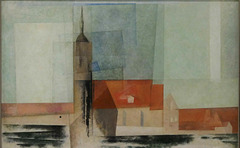
Gelmenroda IX / 1926
Hannover - Sprengel Museum
| 25 Mar 2025 |
|
With more than 500.000 inhabitants Hannover is the capital and largest city of the German state of Lower Saxony.
Hannover was founded in medieval times on the east bank of the River Leine. It was a small village of ferrymen and fishermen. It became a comparatively large town in the 13th century, receiving town privileges in 1241, owing to its position at a natural crossroads. It was connected to the Hanseatic League city of Bremen by the Leine and was situated north-west of the Harz mountains so that east-west traffic passed through it.
Between 1714 and 1837 three kings of Great Britain were concurrently also Electoral Princes of Hanover.
As an important railway and road junction and production centre, Hannover was a major target for strategic bombing during WW II. More than 90% of the city centre was destroyed in a total of 88 bombing raids. So today Hannover lacks it´s medieval heart.
The Sprengel Museum is a museum of modern art and houses one of the most important collections of modern art in Germany. It is located in a building directly on the Maschsee lake. The museum opened in 1979. Bernhard Sprengel, owner of a well-known local chocolate factory, donated his extensive collection of modern art to the city of Hanover in 1969 and financially supported the construction of the museum. The city of Hanover and the state of Lower Saxony agreed to jointly manage the museum. In addition to the works donated by Sprengel, the museum also houses 20th-century works of art from Lower Saxony and Hannover.
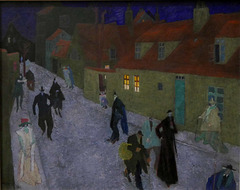
Lyonel Feininger (1871 - 1956) / Oberreißen / 1924
Hannover - Sprengel Museum
| 25 Mar 2025 |
|
With more than 500.000 inhabitants Hannover is the capital and largest city of the German state of Lower Saxony.
Hannover was founded in medieval times on the east bank of the River Leine. It was a small village of ferrymen and fishermen. It became a comparatively large town in the 13th century, receiving town privileges in 1241, owing to its position at a natural crossroads. It was connected to the Hanseatic League city of Bremen by the Leine and was situated north-west of the Harz mountains so that east-west traffic passed through it.
Between 1714 and 1837 three kings of Great Britain were concurrently also Electoral Princes of Hanover.
As an important railway and road junction and production centre, Hannover was a major target for strategic bombing during WW II. More than 90% of the city centre was destroyed in a total of 88 bombing raids. So today Hannover lacks it´s medieval heart.
The Sprengel Museum is a museum of modern art and houses one of the most important collections of modern art in Germany. It is located in a building directly on the Maschsee lake. The museum opened in 1979. Bernhard Sprengel, owner of a well-known local chocolate factory, donated his extensive collection of modern art to the city of Hanover in 1969 and financially supported the construction of the museum. The city of Hanover and the state of Lower Saxony agreed to jointly manage the museum. In addition to the works donated by Sprengel, the museum also houses 20th-century works of art from Lower Saxony and Hannover.
Lyonel Feininger (1871 - 1956)
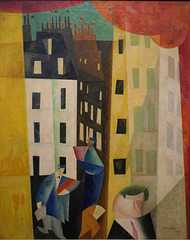
Straßen im Dämmern / Roads at Dusk / 1910
Madrid - Museo Thyssen-Bornemisza
| 02 Nov 2023 |
|
Madrid is the capital and most populous city of Spain. The city has almost 3.4 million inhabitants and a metropolitan area population of approximately 6.7 million. Madrid is part of the historical landscape of Castile and is located in the middle of the Meseta, the plateau of Castile.
The site has been occupied since prehistoric times. The first document about the existence of an established settlement in Madrid dates from the Muslim age. In the second half of the 9th century Umayyad Emir Muhammad I built a fortress here. In 1083, Madrid was conquered by the Kingdom of Castile. In 1309, under Fernando IV, the Assembly of Estates (Cortes) of the Kingdom of Castile was convened for the first time in Madrid.
In 1561, Philip II moved the royal court from Valladolid to Madrid. It became the de facto capital of Spain, which it remains to this day. The War of the Spanish Succession ended in 1714 with the Bourbons taking over the Spanish throne. Today's royal palace was built under their rule. Particularly during the reign of Charles III the city's public infrastructure was modernized and numerous public buildings were built.
Museo Thyssen-Bornemisza
The museum is named after its founder, Baron Heinrich Thyssen-Bornemisza. With over 1,600 paintings, it was once the second-largest private collection in the world.
After Baron Thyssen, having unsuccessfully sought permission to enlarge his museum in Lugano, searched for a better-suited location elsewhere in Europe end of the 1980s. In 1985, the Baron had married Carmen "Tita" Cervera and introduced her to art collecting. Cervera's influence was decisive in persuading the Baron to relocate the core of his collection to Spain where the local government had a building available next to the Prado. The Thyssen-Bornemisza Museum officially opened in 1992, showing 715 works of art. A year later, the Spanish Government bought 775 works for $350 million.These pieces are now in the purpose-built museum in Madrid. After the museum opened, in 1999, Cervera loaned 429 works of her own art collection to the museum for 11 years. The loan was renewed annually for free from 2012.
Lyonel Feininger / 1871 - 1956 /
Architecture II / 1921 /
Madrid - Museo Thyssen-Bornemisza
| 31 Oct 2023 |
|
|
Madrid is the capital and most populous city of Spain. The city has almost 3.4 million inhabitants and a metropolitan area population of approximately 6.7 million. Madrid is part of the historical landscape of Castile and is located in the middle of the Meseta, the plateau of Castile.
The site has been occupied since prehistoric times. The first document about the existence of an established settlement in Madrid dates from the Muslim age. In the second half of the 9th century Umayyad Emir Muhammad I built a fortress here. In 1083, Madrid was conquered by the Kingdom of Castile. In 1309, under Fernando IV, the Assembly of Estates (Cortes) of the Kingdom of Castile was convened for the first time in Madrid.
In 1561, Philip II moved the royal court from Valladolid to Madrid. It became the de facto capital of Spain, which it remains to this day. The War of the Spanish Succession ended in 1714 with the Bourbons taking over the Spanish throne. Today's royal palace was built under their rule. Particularly during the reign of Charles III the city's public infrastructure was modernized and numerous public buildings were built.
Museo Thyssen-Bornemisza
The museum is named after its founder, Baron Heinrich Thyssen-Bornemisza. With over 1,600 paintings, it was once the second-largest private collection in the world.
After Baron Thyssen, having unsuccessfully sought permission to enlarge his museum in Lugano, searched for a better-suited location elsewhere in Europe end of the 1980s. In 1985, the Baron had married Carmen "Tita" Cervera and introduced her to art collecting. Cervera's influence was decisive in persuading the Baron to relocate the core of his collection to Spain where the local government had a building available next to the Prado. The Thyssen-Bornemisza Museum officially opened in 1992, showing 715 works of art. A year later, the Spanish Government bought 775 works for $350 million.These pieces are now in the purpose-built museum in Madrid. After the museum opened, in 1999, Cervera loaned 429 works of her own art collection to the museum for 11 years. The loan was renewed annually for free from 2012.
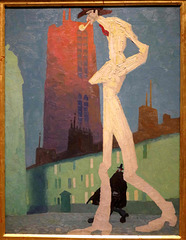
Lyonel Feininger / 1871 - 1956 /
The White Man / 1907 /
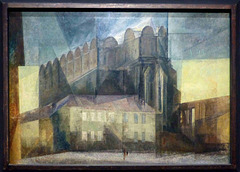
Halle - Moritzburg
| 29 Jun 2023 |
|
The Moritzburg is a ruined castle that has been reconstructed as a museum. In 1484 the foundation stone was laid for what later became the residence of the archbishops of Magdeburg. It was built in the late Gothic style and now houses an art museum.
Der Dom in Halle / The Cathedral in Halle / 1931
Lyonel Feininger (1871 - 1956)
Jump to top
RSS feed- Martin M. Miles' latest photos with "Lyonel Feininger" - Photos
- ipernity © 2007-2026
- Help & Contact
|
Club news
|
About ipernity
|
History |
ipernity Club & Prices |
Guide of good conduct
Donate | Group guidelines | Privacy policy | Terms of use | Statutes | In memoria -
Facebook
X
