
Martin M. Miles' photos with the keyword: birth
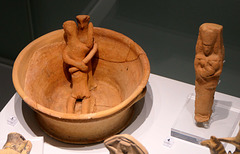
Heraklion - Archaeological Museum
| 06 Apr 2025 |
|
Crete, the largest and most populous of the Greek islands, is located about 100 km south of the Peloponnese. Crete was the center of Europe's first advanced civilization, the Minoans, from 3000 to 1400 BC. The Minoan civilization was overrun by the Mycenaean civilization from mainland Greece. Crete was later ruled by Rome, then successively by the Byzantine Empire, Andalusian Arabs, the Byzantine Empire again, the Venetian Republic, and the Ottoman Empire. In 1898 Crete, whose people had for some time wanted to join the Greek state, achieved independence from the Ottomans, formally becoming the Cretan State. Crete became part of Greece in December 1913.
Heraklion is the largest city and the administrative capital of the island of Crete. With a municipal population of about 180.000 it is the fourth largest city in Greece. The greater area of Heraklion has been continuously inhabited since at least 7000 BCE, making it one of the oldest inhabited regions in Europe. As a major center of the Minoan civilization it often considered Europe's oldest city.
The Heraklion Archaeological Museum is one of the largest museums in Greeceand the best in the world for Minoan art, as it contains by far the most important and complete collection of artefacts of the Minoan civilization of Crete.
The museum began in 1883 as a simple collection of antiquities; it was about the time when the Minoan civilization was beginning to be rediscovered, and shortly before the first excavations using proper scientific methods. It was also during the period when Crete was a virtually autonomous part of the Ottoman Empire, after the Pact of Halepa of 1878, later followed by the independent Cretan State (1898-1913). The political situation helped to keep Cretan finds on the island during a crucial period of discoveries.
The museum is located in the town centre. It was built between 1937 and 1940 on a site previously occupied by the Roman Catholic monastery of Saint-Francis which was destroyed by earthquake in 1856.
Vase with childbed scene.
The pregnant woman is supported by a woman assisting her
Inatos 750 BC
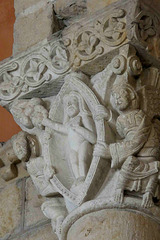
León - Basílica de San Isidoro
| 12 Sep 2023 |
|
|
León was founded in 68 AD for a Roman legion from which they were supposed to pacify the rebellious mountain dwellers of Asturias and Cantabria. The name of the settlement that was then developed is based on a refined form of the Latin word "legio".
After the end of the Roman Empire, the city was conquered by the Visigoths and in 712 by the Moors. In 856, after the reconquest under King Ordoño I of Asturias, the city was repopulated. Ordoño II made León the capital of his kingdom of León in 914. Sacked by Almanzor in about 987, the city was reconstructed and repopulated by Alfonso V,
León was an important stop on the Way of St. James to Santiago de Compostela. Traders and artisans settled in the suburbs and had a strong influence on the development of the city from the 13th century onwards. In the early Middle Ages, the city became prosperous through the cattle trade. However, from the 16th century until the 19th century, the economy and population declined.
The Basílica de San Isidoro de León is located on the site of an ancient temple to the Roman god Mercury. In the 10th century, the kings of León established a community of Benedictine sisters on the site.
Following the conquest of the area by Al-Mansur (938–1002), the church was destroyed and the area devastated. León was repopulated and a new church and monastery established in the 11th century by Alfonso V of León.
In 1063 the basilica was dedicated to Saint Isidore of Seville. Isidore was the archbishop of Seville and the most celebrated academic of Visigothic Spain in the period preceding the Arab invasions. With the agreement of the Muslim ruler of Seville, Isidore's relics were brought to Leon where they could be interred on Christian soil.
The church benefited from its position on the pilgrimage route to Santiago de Compostella. Sculptors, stonemasons, and artists from across Europe gathered to work on the monastery.
There are interesting capitals along the nave.
In the centre of the mandorla is a naked person holding a kind of pomegranate. Is he shaking hands with God on the left?
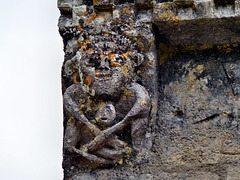
Saint-Quantin-de-Rançanne - Saint-Quantin
| 06 Apr 2017 |
|
The single nave church was erected within the 12th century. The church got damaged during the Wars of Religions, when the bell tower, that stood above the choir, was completely destroyed.
The facade has some extraordinary carvings. There are 23 roughly carved horse's heads. There are complex capitals - and above - a row of very fanciful corbels. I will uploud a few photos.
Is this a mother trying to protect her child? Is this a mother following childbirth? There are so many sexually connoted carvings around... I remember having seen a corbel depicting a birth in Artaiz (Spain), but that was different...
Maybe just a mother giving her baby a cuddle.
Artaiz - San Martin
| 05 Feb 2014 |
|
|
This church, dedicated to Saint Martin of Tours, was a real surprise to me. The single nave structure was probably erected within the 12th century. It was built in a "walking distance" off the pilgrim routes (like "San Pedro de Echano"), as the hamlet Artaiz is just about 10kms north of the "Camino Aragonés". San Martin will have been for sure a stopover for pilgrims, who had visited the tomb of Saint Martin of Tours, following the "Via Turonensis".
The masterly composed and carved portal of Saint Martin is extraordinary in the specific iconography, that in parts may reflect the relations to the Islamic neighbours (Reconquista). Here is a script by German arthistorian Hedda Finke about this subject.
art.unt.edu/medieval-symposium/presenter.php?year=2009&am...
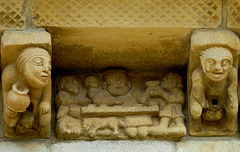
Between the seven corbels under the portal´s roof are six reliefs.
This one depicts the parable of the "Rich Man and Lazarus".
Luke 16:19-21
"There was a certain rich man who clothed himself in purple and fine linen, and who feasted luxuriously every day. At his gate lay a certain poor man named Lazarus who was covered with sores. Lazarus longed to eat the crumbs that fell from the rich man’s table. Instead, dogs would come and lick his sores."
I stumbled about a book by German author Meinolf Schumacher, about the "icon" of licking dogs in european literature. This may be interesting for German readers.
Meinolf Schumacher, Ärzte mit der Zunge - Leckende Hunde in der europäischen Literatur
The left corbel has the lady giving birth to a child (again). I am not sure about the figure to the right. For a while I saw a miser with a moneybag, or maybe even a coin- box. Then I found a theory, that he and the lady to the right should be seen as a couple. So the right corbel depicts the male part - and a phallus once was affixed, where we now see a hole.
Artaiz - San Martin
| 04 Feb 2014 |
|
|
This church, dedicated to Saint Martin of Tours, was a real surprise to me. The single nave structure was probably erected within the 12th century. It was built in a "walking distance" off the pilgrim routes (like "San Pedro de Echano"), as the hamlet Artaiz is just about 10kms north of the "Camino Aragonés". San Martin will have been for sure a stopover for pilgrims, who had visited the tomb of Saint Martin of Tours, following the "Via Turonensis".
The masterly composed and carved portal of Saint Martin is extraordinary in the specific iconography, that in parts may reflect the relations to the Islamic neighbours (Reconquista). Here is a script by German arthistorian Hedda Finke about this subject.
art.unt.edu/medieval-symposium/presenter.php?year=2009&am...
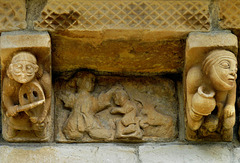
Between the seven corbels under the portal´s roof are six reliefs.
This one depicts the "Sacrifice of Isaac".
Genesis 22:10 - 13
".. Abraham stretched forth his hand, and took the knife to slay his son. And the angel of the Lord called unto him out of heaven, and said, Abraham, Abraham: and he said, Here am I. And he said, Lay not thine hand upon the lad, neither do thou any thing unto him: for now I know that thou fearest God, seeing thou hast not withheld thy son, thine only son from me. And Abraham lifted up his eyes, and looked, and behold behind him a ram caught in a thicket by his horns.."
The left corbel depicts the musician with a vielle, seen already before. The right one is interesting. Either the elegant lady, holding a vessel, gives birth - or hides a small child between her feet. The first corbel without "music and dance".
Jump to top
RSS feed- Martin M. Miles' latest photos with "birth" - Photos
- ipernity © 2007-2026
- Help & Contact
|
Club news
|
About ipernity
|
History |
ipernity Club & Prices |
Guide of good conduct
Donate | Group guidelines | Privacy policy | Terms of use | Statutes | In memoria -
Facebook
X
