

Martin M. Miles' photos with the keyword: Victor Hugo
Arkadi Monastery
| 09 Apr 2025 |
|
According to tradition, the Arkadi Monastery was built in the 5th century by the Byzantine Emperor Arcadius. However, scholars believe that it was founded by a monk of the same name. The two-aisled basilica was built in 1587 during the Venetian rule over Crete and is the reconstruction of an earlier church. The monastery experienced its spiritual and cultural heyday until the 17th century. After Crete was completely conquered by the Ottoman Empire in 1669 the monastery was plundered. After persuading the Pasha the monks obtained permission to return to Arkadi. The monastery was renovated and rebuilt.
After part of present-day Greece was granted independence from the Ottoman Empire in 1830, resistance to the Ottoman rule intensified on Crete. In 1866, a revolutionary committee was formed at the Arkadi Monastery. Gabriel Marinakis, Abbot of Arkadi, was elected chairman of the committee responsible for the Rethymno region. In September 1866, General Panos Koronaios, sent from the Greek mainland, was appointed military commander of the uprising. Koronaios judged the monastery indefensible, but was unable to prevail with this view against the majority of the revolutionary committee. The general then left the monastery with his men.
On the night of November 7-8, 1866, an Ottoman army of 15,000 men attacked the monastery, which housed 964 people, including 325 fit men. After two days of hopeless resistance, the besieged decided they did not want to fall into the enemy's hands alive. When the fighting moved to the monastery's inner courtyard on November 9, most of the survivors, including women and children, retreated to the powder magazine, which was blown up by one of the fighters. The violent explosion killed everyone inside except for one surviving girl, as well as dozens of invading Turkish soldiers. It is said that 1,500 attackers died during the siege of Arkadi Monastery.
The Ottomans considered the capture of Arkadi a great victory. However, the events in Arkadi provoked outrage in the rest of the world. The tragedy changed world opinion about the conflict. Victor Hugo and Giuseppe Garibaldi, among others, assured the Cretans of their solidarity. But Crete did not gain de facto independence until 1897, and it was united with Greece in 1913. Arkadi Monastery is the most important national monument on the island.
Only a few monks live in the monastery, so there is space for a museum.
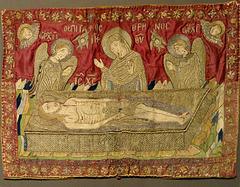
Over at least two centuries the monastery run a gold-embroidered vestment workshop.
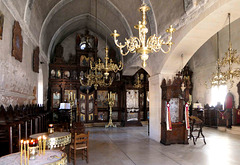
This work is from 1738
Arkadi Monastery
| 09 Apr 2025 |
|
According to tradition, the Arkadi Monastery was built in the 5th century by the Byzantine Emperor Arcadius. However, scholars believe that it was founded by a monk of the same name. The two-aisled basilica was built in 1587 during the Venetian rule over Crete and is the reconstruction of an earlier church. The monastery experienced its spiritual and cultural heyday until the 17th century. After Crete was completely conquered by the Ottoman Empire in 1669 the monastery was plundered. After persuading the Pasha the monks obtained permission to return to Arkadi. The monastery was renovated and rebuilt.
After part of present-day Greece was granted independence from the Ottoman Empire in 1830, resistance to the Ottoman rule intensified on Crete. In 1866, a revolutionary committee was formed at the Arkadi Monastery. Gabriel Marinakis, Abbot of Arkadi, was elected chairman of the committee responsible for the Rethymno region. In September 1866, General Panos Koronaios, sent from the Greek mainland, was appointed military commander of the uprising. Koronaios judged the monastery indefensible, but was unable to prevail with this view against the majority of the revolutionary committee. The general then left the monastery with his men.
On the night of November 7-8, 1866, an Ottoman army of 15,000 men attacked the monastery, which housed 964 people, including 325 fit men. After two days of hopeless resistance, the besieged decided they did not want to fall into the enemy's hands alive. When the fighting moved to the monastery's inner courtyard on November 9, most of the survivors, including women and children, retreated to the powder magazine, which was blown up by one of the fighters. The violent explosion killed everyone inside except for one surviving girl, as well as dozens of invading Turkish soldiers. It is said that 1,500 attackers died during the siege of Arkadi Monastery.
The Ottomans considered the capture of Arkadi a great victory. However, the events in Arkadi provoked outrage in the rest of the world. The tragedy changed world opinion about the conflict. Victor Hugo and Giuseppe Garibaldi, among others, assured the Cretans of their solidarity. But Crete did not gain de facto independence until 1897, and it was united with Greece in 1913. Arkadi Monastery is the most important national monument on the island.
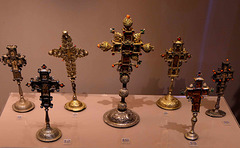
Only a few monks live in the monastery, so there is space for a museum.
Sanctification crosses from the 18th and 19th centuries
Arkadi Monastery
| 09 Apr 2025 |
|
According to tradition, the Arkadi Monastery was built in the 5th century by the Byzantine Emperor Arcadius. However, scholars believe that it was founded by a monk of the same name. The two-aisled basilica was built in 1587 during the Venetian rule over Crete and is the reconstruction of an earlier church. The monastery experienced its spiritual and cultural heyday until the 17th century. After Crete was completely conquered by the Ottoman Empire in 1669 the monastery was plundered. After persuading the Pasha the monks obtained permission to return to Arkadi. The monastery was renovated and rebuilt.
After part of present-day Greece was granted independence from the Ottoman Empire in 1830, resistance to the Ottoman rule intensified on Crete. In 1866, a revolutionary committee was formed at the Arkadi Monastery. Gabriel Marinakis, Abbot of Arkadi, was elected chairman of the committee responsible for the Rethymno region. In September 1866, General Panos Koronaios, sent from the Greek mainland, was appointed military commander of the uprising. Koronaios judged the monastery indefensible, but was unable to prevail with this view against the majority of the revolutionary committee. The general then left the monastery with his men.
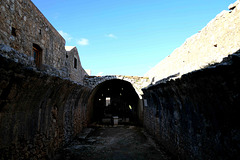
On the night of November 7-8, 1866, an Ottoman army of 15,000 men attacked the monastery, which housed 964 people, including 325 fit men. After two days of hopeless resistance, the besieged decided they did not want to fall into the enemy's hands alive. When the fighting moved to the monastery's inner courtyard on November 9, most of the survivors, including women and children, retreated to the powder magazine, which was blown up by one of the fighters. The violent explosion killed everyone inside except for one surviving girl, as well as dozens of invading Turkish soldiers. It is said that 1,500 attackers died during the siege of Arkadi Monastery.
The Ottomans considered the capture of Arkadi a great victory. However, the events in Arkadi provoked outrage in the rest of the world. The tragedy changed world opinion about the conflict. Victor Hugo and Giuseppe Garibaldi, among others, assured the Cretans of their solidarity. But Crete did not gain de facto independence until 1897, and it was united with Greece in 1913.
Arkadi Monastery is the most important national monument on the island.
The ruins of the gunpowder magazine
Arkadi Monastery
| 08 Apr 2025 |
|
|
According to tradition, the Arkadi Monastery was built in the 5th century by the Byzantine Emperor Arcadius. However, scholars believe that it was founded by a monk of the same name. The two-aisled basilica was built in 1587 during the Venetian rule over Crete and is the reconstruction of an earlier church. The monastery experienced its spiritual and cultural heyday until the 17th century. After Crete was completely conquered by the Ottoman Empire in 1669 the monastery was plundered. After persuading the Pasha the monks obtained permission to return to Arkadi. The monastery was renovated and rebuilt.
After part of present-day Greece was granted independence from the Ottoman Empire in 1830, resistance to the Ottoman rule intensified on Crete. In 1866, a revolutionary committee was formed at the Arkadi Monastery. Gabriel Marinakis, Abbot of Arkadi, was elected chairman of the committee responsible for the Rethymno region. In September 1866, General Panos Koronaios, sent from the Greek mainland, was appointed military commander of the uprising. Koronaios judged the monastery indefensible, but was unable to prevail with this view against the majority of the revolutionary committee. The general then left the monastery with his men.
On the night of November 7-8, 1866, an Ottoman army of 15,000 men attacked the monastery, which housed 964 people, including 325 fit men. After two days of hopeless resistance, the besieged decided they did not want to fall into the enemy's hands alive. When the fighting moved to the monastery's inner courtyard on November 9, most of the survivors, including women and children, retreated to the powder magazine, which was blown up by one of the fighters. The violent explosion killed everyone inside except for one surviving girl, as well as dozens of invading Turkish soldiers. It is said that 1,500 attackers died during the siege of Arkadi Monastery.
The Ottomans considered the capture of Arkadi a great victory. However, the events in Arkadi provoked outrage in the rest of the world. The tragedy changed world opinion about the conflict. Victor Hugo and Giuseppe Garibaldi, among others, assured the Cretans of their solidarity. But Crete did not gain de facto independence until 1897, and it was united with Greece in 1913.
Arkadi Monastery is the most important national monument on the island.
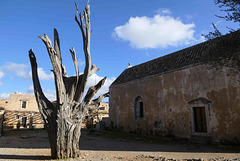
In the dead tree next to the basilica there are still bullets from the battle of 1866
Arkadi Monastery
| 08 Apr 2025 |
|
According to tradition, the Arkadi Monastery was built in the 5th century by the Byzantine Emperor Arcadius. However, scholars believe that it was founded by a monk of the same name. The two-aisled basilica was built in 1587 during the Venetian rule over Crete and is the reconstruction of an earlier church. The monastery experienced its spiritual and cultural heyday until the 17th century. After Crete was completely conquered by the Ottoman Empire in 1669 the monastery was plundered. After persuading the Pasha the monks obtained permission to return to Arkadi. The monastery was renovated and rebuilt.
After part of present-day Greece was granted independence from the Ottoman Empire in 1830, resistance to the Ottoman rule intensified on Crete. In 1866, a revolutionary committee was formed at the Arkadi Monastery. Gabriel Marinakis, Abbot of Arkadi, was elected chairman of the committee responsible for the Rethymno region. In September 1866, General Panos Koronaios, sent from the Greek mainland, was appointed military commander of the uprising. Koronaios judged the monastery indefensible, but was unable to prevail with this view against the majority of the revolutionary committee. The general then left the monastery with his men.
On the night of November 7-8, 1866, an Ottoman army of 15,000 men attacked the monastery, which housed 964 people, including 325 fit men. After two days of hopeless resistance, the besieged decided they did not want to fall into the enemy's hands alive. When the fighting moved to the monastery's inner courtyard on November 9, most of the survivors, including women and children, retreated to the powder magazine, which was blown up by one of the fighters. The violent explosion killed everyone inside except for one surviving girl, as well as dozens of invading Turkish soldiers. It is said that 1,500 attackers died during the siege of Arkadi Monastery.
The Ottomans considered the capture of Arkadi a great victory. However, the events in Arkadi provoked outrage in the rest of the world. The tragedy changed world opinion about the conflict. Victor Hugo and Giuseppe Garibaldi, among others, assured the Cretans of their solidarity. But Crete did not gain de facto independence until 1897, and it was united with Greece in 1913.
Arkadi Monastery is the most important national monument on the island.
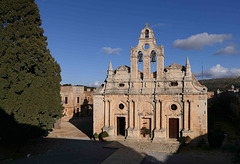
The basilica in the center of the monastery has Renaissance elements
Arkadi Monastery
| 08 Apr 2025 |
|
|
|
According to tradition, the Arkadi Monastery was built in the 5th century by the Byzantine Emperor Arcadius. However, scholars believe that it was founded by a monk of the same name. The two-aisled basilica was built in 1587 during the Venetian rule over Crete and is the reconstruction of an earlier church. The monastery experienced its spiritual and cultural heyday until the 17th century. After Crete was completely conquered by the Ottoman Empire in 1669 the monastery was plundered. After persuading the Pasha the monks obtained permission to return to Arkadi. The monastery was renovated and rebuilt.
After part of present-day Greece was granted independence from the Ottoman Empire in 1830, resistance to the Ottoman rule intensified on Crete. In 1866, a revolutionary committee was formed at the Arkadi Monastery. Gabriel Marinakis, Abbot of Arkadi, was elected chairman of the committee responsible for the Rethymno region. In September 1866, General Panos Koronaios, sent from the Greek mainland, was appointed military commander of the uprising. Koronaios judged the monastery indefensible, but was unable to prevail with this view against the majority of the revolutionary committee. The general then left the monastery with his men.
On the night of November 7-8, 1866, an Ottoman army of 15,000 men attacked the monastery, which housed 964 people, including 325 fit men. After two days of hopeless resistance, the besieged decided they did not want to fall into the enemy's hands alive. When the fighting moved to the monastery's inner courtyard on November 9, most of the survivors, including women and children, retreated to the powder magazine, which was blown up by one of the fighters. The violent explosion killed everyone inside except for one surviving girl, as well as dozens of invading Turkish soldiers. It is said that 1,500 attackers died during the siege of Arkadi Monastery.
The Ottomans considered the capture of Arkadi a great victory. However, the events in Arkadi provoked outrage in the rest of the world. The tragedy changed world opinion about the conflict. Victor Hugo and Giuseppe Garibaldi, among others, assured the Cretans of their solidarity. But Crete did not gain de facto independence until 1897, and it was united with Greece in 1913.
Arkadi Monastery is the most important national monument on the island.
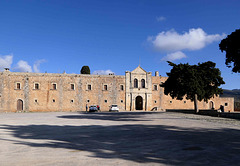
The basilica in the center of the monastery has Renaissance elements
Arkadi Monastery
| 08 Apr 2025 |
|
According to tradition, the Arkadi Monastery was built in the 5th century by the Byzantine Emperor Arcadius. However, scholars believe that it was founded by a monk of the same name. The two-aisled basilica was built in 1587 during the Venetian rule over Crete and is the reconstruction of an earlier church. The monastery experienced its spiritual and cultural heyday until the 17th century. After Crete was completely conquered by the Ottoman Empire in 1669 the monastery was plundered. After persuading the Pasha the monks obtained permission to return to Arkadi. The monastery was renovated and rebuilt.
After part of present-day Greece was granted independence from the Ottoman Empire in 1830, resistance to the Ottoman rule intensified on Crete. In 1866, a revolutionary committee was formed at the Arkadi Monastery. Gabriel Marinakis, Abbot of Arkadi, was elected chairman of the committee responsible for the Rethymno region. In September 1866, General Panos Koronaios, sent from the Greek mainland, was appointed military commander of the uprising. Koronaios judged the monastery indefensible, but was unable to prevail with this view against the majority of the revolutionary committee. The general then left the monastery with his men.
On the night of November 7-8, 1866, an Ottoman army of 15,000 men attacked the monastery, which housed 964 people, including 325 fit men. After two days of hopeless resistance, the besieged decided they did not want to fall into the enemy's hands alive. When the fighting moved to the monastery's inner courtyard on November 9, most of the survivors, including women and children, retreated to the powder magazine, which was blown up by one of the fighters. The violent explosion killed everyone inside except for one surviving girl, as well as dozens of invading Turkish soldiers. It is said that 1,500 attackers died during the siege of Arkadi Monastery.
The Ottomans considered the capture of Arkadi a great victory. However, the events in Arkadi provoked outrage in the rest of the world. The tragedy changed world opinion about the conflict. Victor Hugo and Giuseppe Garibaldi, among others, assured the Cretans of their solidarity. But Crete did not gain de facto independence until 1897, and it was united with Greece in 1913.
Arkadi Monastery is the most important national monument on the island.
Paris - Cathédrale Notre-Dame
| 05 Mar 2015 |
|
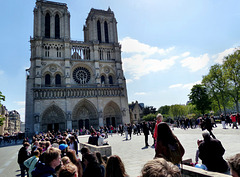
Waiting in line again in front of the western facade of Notre Dame. The cathedral had been erected between 1163 and 1250. Then the transepts seemed old fashioned and got rebuilt. This was finally done in 1363.
This facade had been completed in 1225, the towers and the rose window in 1250. At that time Saint Denis was already 60 years old - elegant Laon about 10 years.
I remember, that when I was here as a student, I had to count all squares I could detect on this facade. I have been here quite often and I have uploaded photos from Notre Dame already. So, I´ll cut the story short this time.
Note the "Galerie des Rois" running across the facade. There are 28 huge statues of the biblical Kings of Judah. Since medieval times, the Parisians saw them as French Kings. During the French Revolution sans-culottes climbed up and beheaded them. The heads crashed to to the ground. 22 of the damaged heads were found during an excavation campaign in 1977 - and can now be seen in the "Musée de Cluny". The statues seen here date to back to the 19th century and there are rumours, that one of the "new kings" looks like the famous architect Viollet-le-Duc.
In 1793 the cathedral was dedicated to the Cult of Reason, later to the Cult of the Supreme Being, before is was just used as a warehouse for the storage of food.
When I was waiting I tried to see Quasimodo up there. Yes, he still lives there. I know this, as Mr. Hugo, one of Quasimodo´s few friends, told me that some years ago.
Jump to top
RSS feed- Martin M. Miles' latest photos with "Victor Hugo" - Photos
- ipernity © 2007-2026
- Help & Contact
|
Club news
|
About ipernity
|
History |
ipernity Club & Prices |
Guide of good conduct
Donate | Group guidelines | Privacy policy | Terms of use | Statutes | In memoria -
Facebook
X
