

Martin M. Miles' photos with the keyword: Nero
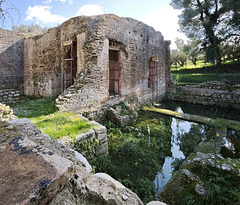
Olympia
| 15 Aug 2026 |
|
|
|
Olympia was the sanctuary of Zeus in the northwest of the Peloponnese. It was the site of the ancient Olympic Games. The excavation site is vast and complex. The ancient author Pausanias mentions about seventy temples, some of which have been reconstructed.
The Roman Emperor Nero visited Olympia in 67 AD during his tour of Greece. He used his imperial power to specifically postpone the ancient Olympic Games—which were actually supposed to take place in 65 AD—by two years. Nero forced the organizers to introduce events such as singing, lyre playing, and poetry—which had not previously been part of the Olympic Games—simply because he considered himself a (stable!) artistic genius.
During the chariot race, he fell from the chariot and was unable to reach the finish line at all. The frightened and bribed judges nevertheless declared him the Olympic champion, arguing that he would certainly have won the race had he not fallen. In the end, Nero won every single competition he entered. No one dared to defeat the emperor. After Nero's death, the Greek authorities declared all of his victories invalid.
These are the ruins of the “Octogon,” the residence that Nero had built for his stay in Olympia.

Olympia - Archaeological Museum
| 10 Aug 2026 |
|
|
Olympia was the sanctuary of Zeus in the northwest of the Peloponnese. It was the site of the ancient Olympic Games.
The modern town of Archaia Olympia is located on the outskirts of the ancient sanctuary.
The excavation site is vast and complex. The ancient author Pausanias mentions about seventy temples, some of which have been reconstructed. Much of what the archaeologists have found is on display at the Archaeological Museum.
Statue (probably) of
Poppaea Sabina, second wife of Nero
as a priestess
1st c AD

Corinth - Archaeological Museum of Ancient Corinth
| 21 Jun 2026 |
|
|
Corinth was founded in the Neolithic period, around 5000 BC.
It possessed a unique strategic position on the narrow Isthmus and so the city controlled trade routes between mainland Greece and Peloponnese. Powerful colonies like Syracuse and Corcyra were established across the sea. After a paved ship trackway was built, ships could cross the land, avoiding dangerous capes. In the 5th century BC, it fought against Persian invasion forces. During the Peloponnesian War Corinth joined Sparta to defeat Athens and so protect its economic dominance. Later, the city fought Sparta during the Corinthian War. In 146 BC, Roman commander Lucius Mummius attacked the defiant city. The Roman army completely destroyed Corinth and enslaved its citizens. For a century, the historic site remained a desolated ghost town. Julius Caesar refounded it as a Roman colony in 44 BC. Barbarian tribes looted Corinth later on. Under Byzantine rule, it served as a strong military center. The Ottoman Empire captured the city's fortress in 1458. A catastrophic earthquake completely ruined Old Corinth in the year 1858. Modern Corinth was successfully rebuilt six kilometers away from the ruins.
The Archaeological Museum of Ancient Corinth is located within the archaeological site of Ancient Corinth.
Portrait of Emperor Nero
marble, ca 60 AD
Poitiers - Cathedral
| 20 May 2015 |
|
|
On the ruins of a older basilica begann, just next to the Baptistère Saint-Jean the construction of large Cathédrale Saint-Pierre in 1162. The building, the new the seat of the Archbishop of Poitiers, was greatly funded by Henry II of England (aka "Henri II Plantagenêt") and Eleanor of Aquitaine.
The construction started as usual in the east and was completed with the western facade end of the 13th century.
The cathedral is best known for the wonderful stained glass windows. The three windows around the choir date back to the 12th century and may be the oldest in France.
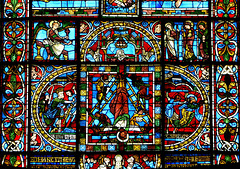
The central window (previous uploads) is very large (8,35ms x 3,10ms). A crucifixion scene is in the center of this window, the Ascension is seen above the crucifixion. Here is, what is seen below.
The top tier has the empty tomb (with two sleeping soldiers), the angel waiting to the left and the three "Myrrhbearers" approaching from the the right.
Matthew 28:1
"After the Sabbath, at dawn on the first day of the week, Mary Magdalene and the other Mary went to look at the tomb."
The center tier has (left) "NERO IMPERAT(OR)" with a blue devil on his shoulder. He just sentences to death: "STS PETRUS" gets crucified upside down and (right) blindfolded "STS PAULUS" gets decapitated.
Under the head of Saint Peter the sponsors of this church "Henry II of England" and "Eleanor of Aquitaine" watch the scenes.
I cannot read all the words there, but the the restaurators from 188x left their "signature".
Olite - Iglesia de San Pedro
| 17 Jan 2014 |
|
|
A settlement may have existed here during Roman times, later the Visigoths "refounded" the place. In 1147 Olite was given a "Fuero de los francos de Estella". Obviously the Franks, that had settled in Estella (40kms northwest) to kick-start the pilgrim-business, had the jurisdication right here. The church of San Pedro is the oldest in town.
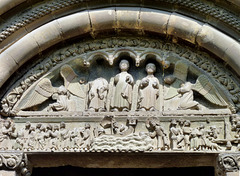
Here is the very delicately carved tympanum. As the church was dedicated to St. Peter since the early times, I think that the center figure is St. Peter, the hand holding the keys got lost. To the left may be a evangelist (head got lost), as there is a kind of scroll in his hand. Does the right one hold a book? Then he should be an evangelist as well. The trio is flanked by two censer swinging (very damaged) angels. One of the censers is still visible.
The lintel is very interesting. On the left Jesus hands over the keys to St. Peter, who is accompanied by a group of apostles (incl. St. John the Baptist, wearing a roughly woven coat). In the center St. Peter, sailing the Sea of Galilee, while Jesus smoothens the waves. The martyrdom of St. Peter to the right. He is sentenced to death by a crowned King (Nero? with a fleur-de-lis??) and then crucified head downwards.
Jump to top
RSS feed- Martin M. Miles' latest photos with "Nero" - Photos
- ipernity © 2007-2026
- Help & Contact
|
Club news
|
About ipernity
|
History |
ipernity Club & Prices |
Guide of good conduct
Donate | Group guidelines | Privacy policy | Terms of use | Statutes | In memoria -
Facebook
X
