

Martin M. Miles' photos with the keyword: Lazarus

Mystras - Hagia Sophia
| 12 Jul 2026 |
|
|
|
Mystras is a Byzantine ruined city near the village of the same name, northwest of Sparta.
The history of Mystras begins with the Fourth Crusade. When the Crusaders conquered the Peloponnese in 1206/1207, Godfrey I of Villehardouin became Prince of Achaea. His son, William II, conquered the rest of Laconia and in 1249 built a strong hilltop fortress in Mystras, which had previously been uninhabited.
In 1259, William II was captured by the troops of the Byzantine Emperor and secured his release by surrendering Mystras. The Greek inhabitants of Sparta, weary of Crusader rule, settled in Mystras, located just three kilometers away. A flourishing city grew up below the castle, eventually boasting a population of tens of thousands.
Mystras was conquered by the Ottomans in 1460. Minarets began to appear alongside churches and monasteries. The city came under Venetian control in 1687, but fell back to the Ottoman Turks as early as 1715.
In 1770, during a Russo-Turkish war, troops from the Balkans, who had invaded the Peloponnese on Ottoman orders, devastated the city. This marked the end of Mystras's heyday. During the Greek War of Independence, the city was subsequently so severely destroyed that plans for its reconstruction were abandoned. Instead, a short time later, Sparta, which had been abandoned centuries earlier, was rebuilt.
Mystras has been a UNESCO World Heritage Site since 1988.
Hagia Sophia was built in the 14th century by Manuel Kantakouzenos, the first despot of Mystras.
Built within the palace complex, it functioned as the royal palace church. The church became the catholicon of the men's monastery, as can be seen from the seal of the Patriarch Philotheus, from the year 1365, with which it was converted into a monastery at the request of the founder himself.
During Ottoman period, Hagia Sophia was converted into a mosque.
The Raising of Lazarus (?)

Timios Stavros tou Agiasmati
| 21 Apr 2026 |
|
|
The single-nave Church of the Holy Cross in Agiasmati was once part of a monastery that was abandoned already in the mid-18th century. Although the exact date of the church's construction is unknown, it is generally agreed that the decorations were completed in 1494.
From the outside, the church appears very simple and resembles a barn. The wooden roof rests on a wall surrounding the church, creating a four sided portico, a covered kind of cloister around the church itself. An insciption above the south door tells, that the church was erected through a donation of a priest named Peter and his wife Pepani.
Another inscription mentions Phillip Goul, a hellenised Syrian Orthodox, as the painter of the church. A master whose work reflects the continued vitality of Orthodox artistic traditions under Venetian rule.
The church is completey inside the walls and the roof built around.
Above the Holy Men
Baptism of Jesus, Raising of Lazarus, Palm Sunday, Resurrection of Jesus
On the right
St. Mammes of Caesarea riding a lion
Since 1985 Timios Stavros tou Agiasmati is part of the UNESCO World Heritage Site "Painted Churches in the Troodos Region".

Timios Stavros tou Agiasmati
| 20 Apr 2026 |
|
|
The single-nave Church of the Holy Cross in Agiasmati was once part of a monastery that was abandoned already in the mid-18th century. Although the exact date of the church's construction is unknown, it is generally agreed that the decorations were completed in 1494.
From the outside, the church appears very simple and resembles a barn. The wooden roof rests on a wall surrounding the church, creating a four sided portico, a covered kind of cloister around the church itself. An insciption above the south door tells, that the church was erected through a donation of a priest named Peter and his wife Pepani.
Another inscription mentions Phillip Goul, a hellenised Syrian Orthodox, as the painter of the church. A master whose work reflects the continued vitality of Orthodox artistic traditions under Venetian rule.
The church is completey inside the walls and the roof built around.
Jesus Raises Lazarus From the Dead
John 11:43-44
"When he had said this, Jesus called in a loud voice, “Lazarus, come out!” The dead man came out, his hands and feet wrapped with strips of linen, and a cloth around his face. Jesus said to them, “Take off the grave clothes and let him go.”
Since 1985 Timios Stavros tou Agiasmati is part of the UNESCO World Heritage Site "Painted Churches in the Troodos Region".

Kykkos Monastery
| 10 Apr 2026 |
|
|
The Holy Monastery of the Virgin of Kykkos was founded at the end of the 11th century by the Byzantine emperor Alexios I Komnenos (1081–1118). The monastery lies at an altitude of 1,318 m on the north west face of the Troodos Mountains.
According to legend the hermit monk Isaiah was disturbed in his solitude by the governor of Cyprus, who had strayed from the path while hunting. The monk was maltreated when he refused to show him the way. Upon his return home, the governor, who had fallen ill, begged the monk's forgiveness. The monk healed him at the behest of the Virgin Mary, who appeared to him in a dream, and in return received a miracolous Marian icon, belonging to the Emperor of Constantinople. Over the centuries, the monastery was repeatedly destroyed by fires and earthquakes, so the current complex dates from the 19th and 20th centuries.
For centuries, the locals venerated the icon of the Virgin Mary, that according to Orthodox tradition was painted on a wooden panel by the Evangelist Luke during the Virgin's lifetime. Many miracles are attributed to it and it served as a model for countlessr Madonna images in the Eastern Church. It is covered with silver and gold and set in a precious frame. The always veiled image of Mary cannot be viewed nowadays.
The monastery corridors are decorated with frescoes and mosaics created in the 1990s.
Rich man and Lazarus
Luke 16,19-31
There was a rich man who was dressed in purple and fine linen and lived in luxury every day. At his gate was laid a beggar named Lazarus, covered with sores and longing to eat what fell from the rich man’s table. Even the dogs came and licked his sores.

Cahors - Musée Henri-Martin
| 31 Oct 2025 |
|
|
The museum was foriginally ounded in 1833. Initially a departmental museum, it was transformed into a municipal museum in 1841. When the current building was made available to the museum in 1929, it occupied the central part of the building. With the acquisition of works by Henri Martin, a renowned Neo-Impressionist painter, in 1970, the museum was not only renamed but also renovated and expanded. The museum's collection also includes many medieval treasures.
The Priory of Saint-Jean de Catus, located about 20 km from Cahors, was first mentioned in 1095 as a dependency of the Abbey of Saint Michael of Cluse in Italy. The Hundred Years' War led to its decline. The priory was abandoned at the end of the 14th century. It was sold as national property between 1792 and 1796. The priory church still serves the parish. All the capitals come from the former priory.
Capital, limestone, 1120/30
The Raising of Lazarus

Liège - Cathédrale Saint-Paul
| 18 Aug 2025 |
|
|
Liège is the center of the largest Walloon agglomeration, and the cultural center of the Walloon region of Belgium. The city, with a population of about 200.000, is located at the confluence of the Ourthe and Meuse rivers.
Around 705, Saint Lambert of Maastricht is credited with completing the Christianization of the region, but conversion may still not have been quite universal, since Lambert was murdered in Liège. To enshrine his relics, the successor, Hubertus (later St. Hubert), built a basilica which became the nucleus of the city.
In 1468, following an uprising of the inhabitants against Burgundian rule, xof Burgundy had the city plundered and systematically destroyed. The few survivors who had fled into the forests—Charles the Bold allegedly had more than 5,000 inhabitants murdered—were only able to return to the city for reconstruction after seven years.
In 1789, partly in connection with the French Revolution, the Liège Revolution occurred. It was directed against the absolutist rule of the Prince-Bishop and was crushed in early 1791 by troops commissioned by the Holy Roman Empire. In 1795, Liège was occupied by French troops and became part of the First French Republic. The Congress of Vienna annexed it to the Kingdom of the Netherlands, which in 1830 became the Kingdom of Belgium, to which Liège has belonged ever since.
Bishop Ebrachar founded a collegiate here in 966 on what was then an island between two branches of the Meuse.
Construction of the present church began in 1240. The first phase included the choir, the transept, and the two bays of the eastern nave. The church was consecrated in1289. The second, High Gothic construction phase began after 1333 and included the four western bays of the nave, the side portal, the chapels of the side aisles, the polygonal apse, and finally the tower. At the beginning of the 16th century, the west portal was added next to the tower.
In 1794, during the French Revolution, the demolition of the huge St. Lambert's Cathedral began. Under the supervision of a "Commission destructive de la cathédrale". In 1803, the two towers on the facade were destroyed. By 1827, almost the entire complex had been leveled.
After the revolution subsided, the population sought a replacement and chose the Collegiate Church as the church closest to the city center. After the church was elevated to cathedral status in 1804, the tower was raised by a bell tower and a spire; The western towers of the destroyed St. Lambert's Cathedral served as a model. A comprehensive restoration in the Neo-Gothic style took place between 1850 and 1875. The choir received two additional side aisles, and the entire exterior façade was decorated with statues and ornamental elements.
The cathedral has an extensive collection in the treasury
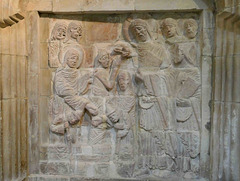
The Three Resurrections
The daughter of Jairus,
The son of the widow of Nain,
Lazarus
Ivory, Meuse area, c 1030
Chichester - Chichester Cathedral
| 09 Apr 2024 |
|
Chichester was a Roman and Anglo-Saxon settlement and a major market town from those times through Norman and medieval times.
In the 9th century Alfred the Great set about building a system of fortified towns or forts in response to the Viking threat. This included old Roman settlements where the walls could be rebuilt and strengthened. Chichester was one of these and was rebuilt probably between 878–879.
Following the Norman conquest, the cathedral that had been founded in 681 at Selsey was moved to Chichester. When the Domesday Book was compiled, Cicestre comprised 300 dwellings which held a population of 1,500 people. After the Battle of Hastings the township of Chichester was handed to Roger de Mongomerie, 1st Earl of Shrewsbury, for courageous efforts in the battle. Shortly after 1066 Chichester Castle was built by Roger de Mongomerie to consolidate Norman power. In around 1143 the title Earl of Arundel was created and became the dominant local landowner. In 1216, Chichester Castle was captured by the French, but regained the following year.
After the bishop's see was moved here from Selsey to Chichester in 1075, Chichester Cathedral was built on the foundations of a Roman basilica. Bishop Ralph de Luffa consecrated the cathedral to the Holy Trinity in 1108. In 1187, a fire destroyed the eastern part of the cathedral and the wooden roof truss, which was replaced by a stone vault. The construction of a new retro choir and the addition of numerous side chapels in the 13th century made the church one of the most extensive in England.
In 1262 Pope Urban IV canonised Bishop Richard of Chichester, who had died only nine years earlier. His tomb was an important pilgrimage sites in England until it was destroyed in 1538 by order of Henry VIII.
In the 14th century, the cathedral was given New Model Armee crossing tower and a chapel dedicated to the Virgin Mary. In the 15th century, the addition of cloisters, which enclosed the southern transept, changed the external appearance of the cathedral.
The destructive fury and vandalism during the Reformation caused considerable damage to the cathedral. Carvings and sculptures were damaged and the medieval stained glass windows were completely destroyed.
The church suffered further damage when Cromwell´s New Model Army occupied the city in 1642. Over the next two centuries, the cathedral was neglected and fell into disrepair.
It was not until the 1840s that restoration work began. However, these suffered a setback when the crossing tower collapsed in 1861. It was rebuilt in 1866 and was given its current high spire.
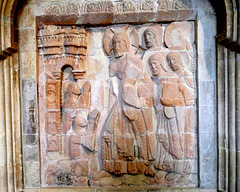
Two Romanesque sandstone reliefs can be seen in the south aisle of the choir: "The Raising of Lazarus" and "Christ on his arrival in Bethany".
Dating the reliefs was ended in a long cotroversal. Professor George Zarnecki of the Courtauld Institute made a detailed analysis and concluded they were made in the second quarter of the 12th century. Most scholars now agree with him that the Reliefs are Anglo-Saxon in origin, though others see them at least a century older.
The raising of Lazarus
Chichester - Chichester Cathedral
| 09 Apr 2024 |
|
Chichester was a Roman and Anglo-Saxon settlement and a major market town from those times through Norman and medieval times.
In the 9th century Alfred the Great set about building a system of fortified towns or forts in response to the Viking threat. This included old Roman settlements where the walls could be rebuilt and strengthened. Chichester was one of these and was rebuilt probably between 878–879.
Following the Norman conquest, the cathedral that had been founded in 681 at Selsey was moved to Chichester. When the Domesday Book was compiled, Cicestre comprised 300 dwellings which held a population of 1,500 people. After the Battle of Hastings the township of Chichester was handed to Roger de Mongomerie, 1st Earl of Shrewsbury, for courageous efforts in the battle. Shortly after 1066 Chichester Castle was built by Roger de Mongomerie to consolidate Norman power. In around 1143 the title Earl of Arundel was created and became the dominant local landowner. In 1216, Chichester Castle was captured by the French, but regained the following year.
After the bishop's see was moved here from Selsey to Chichester in 1075, Chichester Cathedral was built on the foundations of a Roman basilica. Bishop Ralph de Luffa consecrated the cathedral to the Holy Trinity in 1108. In 1187, a fire destroyed the eastern part of the cathedral and the wooden roof truss, which was replaced by a stone vault. The construction of a new retro choir and the addition of numerous side chapels in the 13th century made the church one of the most extensive in England.
In 1262 Pope Urban IV canonised Bishop Richard of Chichester, who had died only nine years earlier. His tomb was an important pilgrimage sites in England until it was destroyed in 1538 by order of Henry VIII.
In the 14th century, the cathedral was given New Model Armee crossing tower and a chapel dedicated to the Virgin Mary. In the 15th century, the addition of cloisters, which enclosed the southern transept, changed the external appearance of the cathedral.
The destructive fury and vandalism during the Reformation caused considerable damage to the cathedral. Carvings and sculptures were damaged and the medieval stained glass windows were completely destroyed.
The church suffered further damage when Cromwell´s New Model Army occupied the city in 1642. Over the next two centuries, the cathedral was neglected and fell into disrepair.
It was not until the 1840s that restoration work began. However, these suffered a setback when the crossing tower collapsed in 1861. It was rebuilt in 1866 and was given its current high spire.
Two Romanesque sandstone reliefs can be seen in the south aisle of the choir: "The Raising of Lazarus" and "Christ on his arrival in Bethany".
Dating the reliefs was ended in a long cotroversal. Professor George Zarnecki of the Courtauld Institute made a detailed analysis and concluded they were made in the second quarter of the 12th century. Most scholars now agree with him that the Reliefs are Anglo-Saxon in origin, though others see them at least a century older.
Christ arriving in Bethany
Altamura - Cattedrale di Santa Maria Assunta
| 02 Nov 2022 |
|
The area around the modern Altamura (pop 70.000) was inhabited in early times. There are Bronze Age tumuli and between the 6th and the 3rd century BC, a massive line of megalithic walls was erected. This (later Roman) city was inhabited until the 10th century when it was reportedly looted by Saracens. A couple of centuries after Altamura was reportedly looted by the Saracens, it started to be inhabited again as Emperor Frederick II refounded the city (1232) and ordered the construction of the large Altamura Cathedral, which became one of the most venerated sanctuaries in Apulia.
Altamura was ruled by various feudal families, including the Orsini del Balzo and the Farnese (1538–1734), the latter responsible for the construction of numerous palaces and churches. In the past, Altamura also had a large castle, whose construction dated back to the 11th-13th century, which has been completely demolished.
Altamura Cathedral (Cattedrale di Santa Maria Assunta) is probably the only church that was ever founded by Frederick II. In 1248, under pressure from Frederick, Pope Innocent IV declared Altamura exempt from the jurisdiction of the bishop of Bari, making it a "palatine church", that is the equivalent of a palace chapel. After heavy damage caused by an earthquake in 1316, it was renovated by Robert of Anjou.
Major changes were made to the cathedral in 1534, including switching the front and back around! The cathedral's main facade originally faced west but it now faces east.
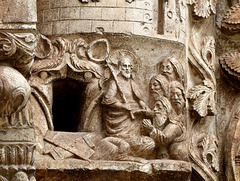
The (breathtaking) attraction of Altamura Cathedral is its main portal, which has been dated to the 14th and 15th centuries. It is Gothic, but in an unusual local style with Byzantine and strong Romanesque influences. I would even see this as "Romanesque/Gothic". It is remarkable for its wealth of details and a large number of biblical scenes.
John 11 38-44
Jesus Raises Lazarus From the Dead
"Jesus, once more deeply moved, came to the tomb. It was a cave with a stone laid across the entrance. “Take away the stone,” he said. “But, Lord,” said Martha, the sister of the dead man, “by this time there is a bad odor, for he has been there four days.” Then Jesus said, “Did I not tell you that if you believe, you will see the glory of God?” So they took away the stone. Then Jesus looked up and said, “Father, I thank you that you have heard me. I knew that you always hear me, but I said this for the benefit of the people standing here, that they may believe that you sent me.” When he had said this, Jesus called in a loud voice, “Lazarus, come out!” The dead man came out, his hands and feet wrapped with strips of linen, and a cloth around his face."
Since I have already uploaded many photos taken here during previous trips, I will only add a few now.
If you would like to see more photos from Altamura, click here:
www.ipernity.com/doc/323415/album/1334214
Bourges - Cathédrale Saint-Étienne
| 10 May 2020 |
|
|
|
The "Cathédrale Saint-Étienne de Bourges" was erected as a replacement for an 11th-century structure. The construction started probably in the last quarter of the 12th century, around the same time when the builders and bricklayers started in Chartres. The choir of the cathedral was in use by 1214, the nave was finished 1255. The cathedral was consecrated in 1324.
The cathedral covers a surface of 5,900 m². The nave is 15 metres wide and 37 metres high, the inner aisle is 21.3 metres high. There are no transepts, but two aisles on either side forming a double ambulatory around the choir.
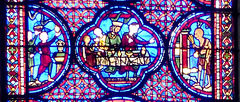
The cathedral retains many of its original stained-glass windows, which dates from about 1215.
A detail of the window depicting the parable of the rich man and Lazarus.

Monreale - Duomo di Monreale
| 26 Sep 2019 |
|
Sicily, the largest Mediterranean island, has a long history, that starts around 8000 BC, but later there were Phoenician, Carthaginian, Greek and Roman periods. After the Roman Empire had fallen apart the Vandals tried to take over the island but failed. Finally, the Ostrogoths took possession.
Mid of the 6th century Sicily was conquered by troops of the Byzantine Empire. After the advent of Islam, Sicily got attacked by the Arab forces. Raids seeking loot continued until the mid-8th century.
A Muslim army was sent to the island in 827 but met with much resistance. So it took a century to conquer it and even later revolts constantly occurred
In 1038 the Byzantines invaded the island supported by Norman mercenaries, led by Roger. In 1072, after the siege of Palermo, most of Sicily was under Norman control. Roger´s son Roger II raised the status +of the island to a kingdom in 1130. During this period, the Kingdom of Sicily was prosperous and powerful,
The court of Roger II became melting out of culture from Europe and the Middle East. This attracted scholars, scientists, artists, and artisans. Muslims, Jews, Greeks, Lombards, and Normans cooperated and created some extraordinary buildings.
In 1186 the last descendant of Roger, Constance of Sicily married Emperor Henry VI, the second son of Barbarossa. So the crown of Sicily was passed on to the Hohenstaufen Dynasty. Frederick II, the only son of Constance, was crowned King of Sicily at the age of four in 1198. He became "Stupor Mundi", one of the greatest and most cultured men of the Middle Ages.
-
William II of Sicily built from 1172 here a fort-like complex of buildings, which included a cathedral, an archepiscopal palace, a royal palace and a Benedictine monastery. In 1183 the monastery became the seat of the archdiocese of Monreale. The town then developed around this complex.
According to a legend, William fell asleep while hunting. The Holy Virgin appeared to him in a dream, suggesting him to build a church here. After removing a tree, a treasure was found, whose coins were used to finance the construction. Well, it is much more likely that Monreale was founded in competition with the bishop of Palermo, who had commissioned the large Cathedral of Palermo.
This would explain the vast dimensions and the splendour of the "Duomo di Monreale" and the adjoining cloister, the only structures of the large complex, that survived the times. The cloister (completed ~ 1200) measures 47x47 metres. Each side has 26 arches resting on columns.
The carvings of the capitals (and the columns) are very detailed and complex, the themes vary and some capitals are "hard to read" and interpret.
The Rich Man and Lazarus
Luke 16:22-24
"The time came when the beggar died and the angels carried him to Abraham’s side. The rich man also died and was buried. In Hades, where he was in torment, he looked up and saw Abraham far away, with Lazarus by his side. So he called to him, ‘Father Abraham, have pity on me and send Lazarus to dip the tip of his finger in water and cool my tongue, because I am in agony in this fire.’"

Monreale - Duomo di Monreale
| 26 Sep 2019 |
|
Sicily, the largest Mediterranean island, has a long history, that starts around 8000 BC, but later there were Phoenician, Carthaginian, Greek and Roman periods. After the Roman Empire had fallen apart the Vandals tried to take over the island but failed. Finally, the Ostrogoths took possession.
Mid of the 6th century Sicily was conquered by troops of the Byzantine Empire. After the advent of Islam, Sicily got attacked by the Arab forces. Raids seeking loot continued until the mid-8th century.
A Muslim army was sent to the island in 827 but met with much resistance. So it took a century to conquer it and even later revolts constantly occurred
In 1038 the Byzantines invaded the island supported by Norman mercenaries, led by Roger. In 1072, after the siege of Palermo, most of Sicily was under Norman control. Roger´s son Roger II raised the status +of the island to a kingdom in 1130. During this period, the Kingdom of Sicily was prosperous and powerful,
The court of Roger II became melting out of culture from Europe and the Middle East. This attracted scholars, scientists, artists, and artisans. Muslims, Jews, Greeks, Lombards, and Normans cooperated and created some extraordinary buildings.
In 1186 the last descendant of Roger, Constance of Sicily married Emperor Henry VI, the second son of Barbarossa. So the crown of Sicily was passed on to the Hohenstaufen Dynasty. Frederick II, the only son of Constance, was crowned King of Sicily at the age of four in 1198. He became "Stupor Mundi", one of the greatest and most cultured men of the Middle Ages.
-
William II of Sicily built from 1172 here a fort-like complex of buildings, which included a cathedral, an archepiscopal palace, a royal palace and a Benedictine monastery. In 1183 the monastery became the seat of the archdiocese of Monreale. The town then developed around this complex.
According to a legend, William fell asleep while hunting. The Holy Virgin appeared to him in a dream, suggesting him to build a church here. After removing a tree, a treasure was found, whose coins were used to finance the construction. Well, it is much more likely that Monreale was founded in competition with the bishop of Palermo, who had commissioned the large Cathedral of Palermo.
This would explain the vast dimensions and the splendour of the "Duomo di Monreale" and the adjoining cloister, the only structures of the large complex, that survived the times. The cloister (completed ~ 1200) measures 47x47 metres. Each side has 26 arches resting on columns.
The carvings of the capitals (and the columns) are very detailed and complex, the themes vary and some capitals are "hard to read" and interpret.
The Rich Man and Lazarus
Luke 16:19-21
"There was a rich man who was dressed in purple and fine linen and lived in luxury every day. At his gate was laid a beggar named Lazarus, covered with sores and longing to eat what fell from the rich man’s table. Even the dogs came and licked his sores."
(on the left the Rich Man is on his deathbed)
Monreale - Duomo di Monreale
| 17 Sep 2019 |
|
Sicily, the largest Mediterranean island, has a long history, that starts around 8000 BC, but later there were Phoenician, Carthaginian, Greek and Roman periods. After the Roman Empire had fallen apart the Vandals tried to take over the island but failed. Finally, the Ostrogoths took possession.
Mid of the 6th century Sicily was conquered by troops of the Byzantine Empire. After the advent of Islam, Sicily got attacked by the Arab forces. Raids seeking loot continued until the mid-8th century.
A Muslim army was sent to the island in 827 but met with much resistance. So it took a century to conquer it and even later revolts constantly occurred
In 1038 the Byzantines invaded the island supported by Norman mercenaries, led by Roger. In 1072, after the siege of Palermo, most of Sicily was under Norman control. Roger´s son Roger II raised the status +of the island to a kingdom in 1130. During this period, the Kingdom of Sicily was prosperous and powerful,
The court of Roger II became melting out of culture from Europe and the Middle East. This attracted scholars, scientists, artists, and artisans. Muslims, Jews, Greeks, Lombards, and Normans cooperated and created some extraordinary buildings.
In 1186 the last descendant of Roger, Constance of Sicily married Emperor Henry VI, the second son of Barbarossa. So the crown of Sicily was passed on to the Hohenstaufen Dynasty. Frederick II, the only son of Constance, was crowned King of Sicily at the age of four in 1198. He became "Stupor Mundi", one of the greatest and most cultured men of the Middle Ages.
-
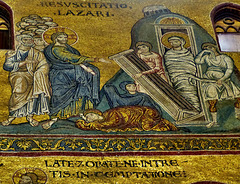
William II of Sicily built from 1172 here a fort-like complex of buildings, which included a cathedral, an archiepiscopal palace, a royal palace and a Benedictine monastery. In 1183 the monastery became the seat of the archdiocese of Monreale. The town then developed around this complex.
According to a legend, William fell asleep while hunting. The Holy Virgin appeared to him in a dream, suggesting him to build a church here. After removing a tree, a treasure was found, whose coins were used to finance the construction. Well, it is much more likely that Monreale was founded in competition with the bishop of Palermo, who had commissioned the large Cathedral of Palermo.
This would explain the vast dimensions and the splendour of the "Duomo di Monreale" (= "Cattedrale di Santa Maria Nuova"), that with the cloister, is the only building that survived the times.
The interior is breathtaking, but as the cathedral is about 100 m long, there are distances here, not like inside the "Capella Palatina", where all the mosaics are so "near" - plus the visitors can sit down here - and gaze. It is overwhelming. Here are more than 6000m² of byzantine mosaics. The sides of the nave show many very strong parallels to the Cappella Palatina. Here and there probably the same workshop. Probably a large, maybe even a generation-spanning studio of Byzantine artists.
Lazarus
John 11.38-44
"Jesus, once more deeply moved, came to the tomb. It was a cave with a stone laid across the entrance. "Take away the stone, he said.
"But, Lord," said Martha, the sister of the dead man, "by this time there is a bad odor, for he has been there four days."
Then Jesus said, "Did I not tell you that if you believe, you will see the glory of God?"
So they took away the stone. Then Jesus looked up and said, "Father, I thank you that you have heard me. I knew that you always hear me, but I said this for the benefit of the people standing here, that they may believe that you sent me."
When he had said this, Jesus called in a loud voice, "Lazarus, come out!" The dead man came out, his hands and feet wrapped with strips of linen, and a cloth around his face."
Jesus said to them, “Take off the grave clothes and let him go.”
Autun - Cathédrale Saint-Lazare
| 23 May 2017 |
|
|
Augustodunum (today Autun) was founded during the reign of Augustus, after whom it was named. It was an important settlement, the Roman theather, partly unearthed, could seat about 15.000 people, there is a Roman temple, walls...
But it is the Cathédrale Saint-Lazare and the wonderful carvings,
that made me return again and again.
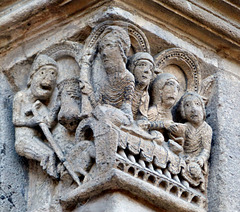
There had been a church here earlier, that was just too small, when Autun became a center of pilgrimage, after relics of St. Lazarus were kept here since about 970. Just like Vezelay, 90kms north, where the relics of St. Lazarus´ sister St. Maria Magdalena were kept at that time.
In 1120 it was decided to construct this larger and more suitable cathedral. At that time this construction was influenced by Cluny III, that was a little older. The cathedral ("Latin Cross") was completed in 1146, only the porch which was added some years later
After severe damage in 1376, during the Hundred Years' War, rebuilding and remodeling the romanesque structure started within the 15th century. At that time Gothic chapels were added and a massive crossing tower was built.
Even outside are some of the extraordinary capitals, this church is known for. Here is "The Rich Man and Lazarus".
Luke 16:19-21
"There was a rich man who was dressed in purple and fine linen and lived in luxury every day. At his gate was laid a beggar named Lazarus, covered with sores and longing to eat what fell from the rich man´s table. Even the dogs came and licked his sores."
Ravenna - Sant’Apollinare Nuovo
| 29 Sep 2016 |
|
|
The Basilica of Sant'Apollinare Nuovo was built by Ostrogoth King Theodoric the Great as his palace chapel. The Arian church was originally dedicated in 504 AD to "Christ the Redeemer".
After Byzantine troops had conquered Ravenna the basilica was converted into a Catholic church and reconsecrated in 561 AD. It was now dedicated to Saint Martin of Tours, a foe of Arianism.
The dedication was changed again in the 9th century to St. Apollinare, first bishop of Ravenna, when the saint's relics were moved here.
The interior measures 35 x 21 meters. The walls of the nave and clerestory are covered mosaics from the 6th century. Some of them date from the Arian period under King Theodoric the Great (496-526).
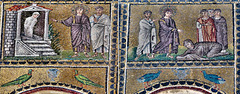
On the left (north) side is a procession of the 22 virgin martyrs, above them are Apostles and Prophets. On the upper band are small mosaics, depicting Jesus' miracles and parables. See previous upload.
Here are two of the small mosaics of the upper band. Again here Jesus is young and beardless.
To the left "The Raising of Lazarus"
John 11:43-44
"When he had said this, Jesus called in a loud voice, "Lazarus, come out!" The dead man came out, his hands and feet wrapped with strips of linen, and a cloth around his face. Jesus said to them, "Take off the grave clothes and let him go.""
To the right "Jesus healing the bleeding woman"
Mark 5:25-29
"And a woman was there who had been subject to bleeding for twelve years. She had suffered a great deal under the care of many doctors and had spent all she had, yet instead of getting better she grew worse. When she heard about Jesus, she came up behind him in the crowd and touched his cloak, because she thought, "If I just touch his clothes, I will be healed." Immediately her bleeding stopped and she felt in her body that she was freed from her suffering."

Bourges Cathedral
| 28 May 2014 |
|
|
The "Cathédrale Saint-Étienne de Bourges" was erected as a replacement for a 11th-century structure. The construction started probably in the last quarter of the 12th century, around the same time, when the builders and bricklayers started in Chartres. The choir of the cathedral was in use by 1214, the nave was finished 1255. The cathedral was consecrated in 1324.
With the completion of the choir of the cathedral , the first stained glass windows got installed. Most of the windows around the choir, created 1220/1230, survived the times. The wonderful "vitraux" here may even be a bit older than the more famous ones in Chartres.
The parable of the rich man and Lazarus
Luke 16 : 22
"The poor man died and was carried by angels to Abraham’s side. The rich man also died and was buried."
The rich man´s soul leaves the body and is immidiatly grabbed by the devil. The fork, the right devil uses, can often be seen as an evil tool.

Bourges Cathedral
| 28 May 2014 |
|
|
The "Cathédrale Saint-Étienne de Bourges" was erected as a replacement for a 11th-century structure. The construction started probably in the last quarter of the 12th century, around the same time, when the builders and bricklayers started in Chartres. The choir of the cathedral was in use by 1214, the nave was finished 1255. The cathedral was consecrated in 1324.
With the completion of the choir of the cathedral , the first stained glass windows got installed. Most of the windows around the choir, created 1220/1230, survived the times. The wonderful "vitraux" here may even be a bit older than the more famous ones in Chartres.
The parable of the rich man and Lazarus
"HIC EST DIVES", the rich man is often named "Dives".
Luke 16 : 19-21
"There was a certain rich man who clothed himself in purple and fine linen, and who feasted luxuriously every day. At his gate lay a certain poor man named Lazarus who was covered with sores. Lazarus longed to eat the crumbs that fell from the rich man’s table. Instead, dogs would come and lick his sores."
Vigeois - Saint-Pierre
| 01 Apr 2014 |
|
The parish church of Vigois is the last structure of the former "Abbaye Saint-Pierre", founded here by Yrieix du Limousin (aka "St. Yriex", "Aredius") within the 6th century.
So the "Abbaye Saint-Pierre" was one of the oldest convents within the Limousin.
In the 9th century the Normans (Vikings) looted and ruined the abbey. After some decades, the abbey recovered and got rebuilt. In 1070 it burnt down. Since 1082 it was dependent from Cluniac Saint-Martial Abbey in Limoges and prospered during the 12th century.
Destroyed again during the Hundred Years War, rebuilt again by the Bishop of Limoges. During the Wars of Religions Huguenot troops burnt down the nave of the church and vandalized many of the carvings. Another fire hit the church in 1705, when it fell into disrepair.
All buildings of the convent got demolished after the French Revolution, only the Saint-Pierre, now the parish church, survived the times. The renovation of the nave was completed in the 1860s. Apse and crossing, seen here, got restored early 20th century. The large apse never got severely damaged. Only some carvings are mutilated, but most of the capitals, dating back to the 12th-century, are still in situ.
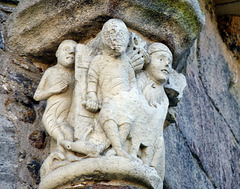
Around the apse are some interesting capitals.
As the person to the very left can only be Lazarus, the couple in front can only be the rich man and his wife. Actually this capital may correspond to the rich man´s death (previous uplaod).
Luke 16:19-21
"There was a certain rich man who clothed himself in purple and fine linen, and who feasted luxuriously every day. At his gate lay a certain poor man named Lazarus who was covered with sores. Lazarus longed to eat the crumbs that fell from the rich man’s table. Instead, dogs would come and lick his sores."
Jump to top
RSS feed- Martin M. Miles' latest photos with "Lazarus" - Photos
- ipernity © 2007-2026
- Help & Contact
|
Club news
|
About ipernity
|
History |
ipernity Club & Prices |
Guide of good conduct
Donate | Group guidelines | Privacy policy | Terms of use | Statutes | In memoria -
Facebook
X
