

Martin M. Miles' photos with the keyword: Persephone
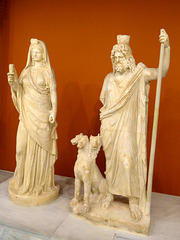
Heraklion - Archaeological Museum
| 06 Apr 2025 |
|
|
|
Crete, the largest and most populous of the Greek islands, is located about 100 km south of the Peloponnese. Crete was the center of Europe's first advanced civilization, the Minoans, from 3000 to 1400 BC. The Minoan civilization was overrun by the Mycenaean civilization from mainland Greece. Crete was later ruled by Rome, then successively by the Byzantine Empire, Andalusian Arabs, the Byzantine Empire again, the Venetian Republic, and the Ottoman Empire. In 1898 Crete, whose people had for some time wanted to join the Greek state, achieved independence from the Ottomans, formally becoming the Cretan State. Crete became part of Greece in December 1913.
Heraklion is the largest city and the administrative capital of the island of Crete. With a municipal population of about 180.000 it is the fourth largest city in Greece. The greater area of Heraklion has been continuously inhabited since at least 7000 BCE, making it one of the oldest inhabited regions in Europe. As a major center of the Minoan civilization it often considered Europe's oldest city.
In the first century BC, the Romans began to take more serious action against the pirates in the Aegean. In 69 BC, Quintus Caecilius Metellus was commissioned by the Senate to conquer Crete. He successfully conquered one Cretan city after another, while Pompey fought the pirates at sea.
The Cretans accepted Roman rule without resistance. The island became one of the most peaceful provinces in the entire empire. Under Emperor Augustus, it was united with areas in Libya to form the province of Creta et Cyrenaica. Emperor Diocletian separated the two areas in 298 AD and formed a separate province of Crete. Christianity spread to the island in the 3rd and 4th centuries.
Pluto and Persephone, depicted as the Egyptian deities Sarapis and Isis. She is holding a sistrum, an Egyptian musical percussion instrument. The inclusion of Cerberus, the guardian of the underworld, in the group defines the two deities as Pluto and Persephone the gods of the underworld.
2nd centrury AD
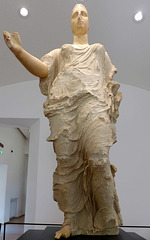
Aidone - Museo archeologico di Aidone
| 15 Nov 2022 |
|
According to some scholars, Aidone was founded at the end of the 11th century by the Normans during the conquest of Sicily and the expulsion of the Arabs, but it is more likely that the Normans confined themselves to refounding and repopulating a pre-existing village snatched from the Saracens.
At the time of Frederick II Aidone most probably belonged to the direct possession of the king The Emperor allowed some soldiers from Piacenza to settle in Aidone-
In 1229 the Knights Templar were allowed to build the church of San Giovanni. After the death of Frederick II in 1255, Aidone declared itself a free commune and was able to resist the attack of the Count of Catanzaro, who acted in the name of King Manfredi. However, in 1257 it was taken and plundered by the Swabian army led by Federico Lancia. Aidone took part in the revolt of the Sicilian Vespers and expelled the French garrison
The ancient city of Morgantina was located in the territory of the present municipality. In the 6th century, BC Greeks settled on the citadel hill and lived peacefully with the locals. In 459 BC Morgantina was conquered by the Sicilian king Ducetius, who destroyed the Greek settlement. Duktios is credited with the rectangular layout of the city. Around 450 BC, the city was conquered by Akragas and became the property of Syracuse. At the time of the Greek politician Timoleon (~ 450 BC) the city experienced an upswing, as archaeological finds prove. However, Morgantina experienced its greatest prosperity in the time of the Syracuse King Timoleon (~ 280 BC). During the 2nd Punic War Morgantina was conquered by the Romans.
Since about 1955 archaeologists have been excavating the ancient city. Their findings can be seen in the local museum, housed in a former Capuchin monastery.
The statue of the goddess is 2.24m high and was sculpted in Sicily in the 5th century BC. The statue was stolen from the archaeological site of Morgantina in the second half of the 20th century. Das Paul Getty Museum bought it for 10.000.000 Euros from a London company and exhibited it in 1988.
In 2001, the Court of Enna sentenced a fence to two years in prison and a fine of 40 billion lire (more than 2 million Euros). it was the first case in Italian law in which such a sanction was imposed on the clandestine export of an archaeological find.
On 17 March 2011, on the 150th anniversary of national unity, the "Goddess of Morgantina" was returned to Italy.
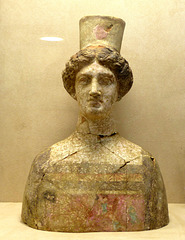
Aidone - Museo archeologico di Aidone
| 15 Nov 2022 |
|
|
According to some scholars, Aidone was founded at the end of the 11th century by the Normans during the conquest of Sicily and the expulsion of the Arabs, but it is more likely that the Normans confined themselves to refounding and repopulating a pre-existing village snatched from the Saracens.
At the time of Frederick II Aidone most probably belonged to the direct possession of the king The Emperor allowed some soldiers from Piacenza to settle in Aidone-
In 1229 the Knights Templar were allowed to build the church of San Giovanni. After the death of Frederick II in 1255, Aidone declared itself a free commune and was able to resist the attack of the Count of Catanzaro, who acted in the name of King Manfredi. However, in 1257 it was taken and plundered by the Swabian army led by Federico Lancia. Aidone took part in the revolt of the Sicilian Vespers and expelled the French garrison
The ancient city of Morgantina was located in the territory of the present municipality. In the 6th century, BC Greeks settled on the citadel hill and lived peacefully with the locals. In 459 BC Morgantina was conquered by the Sicilian king Ducetius, who destroyed the Greek settlement. Duktios is credited with the rectangular layout of the city. Around 450 BC, the city was conquered by Akragas and became the property of Syracuse. At the time of the Greek politician Timoleon (~ 450 BC) the city experienced an upswing, as archaeological finds prove. However, Morgantina experienced its greatest prosperity in the time of the Syracuse King Timoleon (~ 280 BC). During the 2nd Punic War Morgantina was conquered by the Romans.
Since about 1955 archaeologists have been excavating the ancient city. Their findings can be seen in the local museum, housed in a former Capuchin monastery.
The "Morgantina treasure" is a set of Greek silverware dating from the 3rd century BC, illegally excavated from Morgantina. It includes two large bowls, a cup with two handles, plates, and several drinking utensils. It was probably excavated around 1978 and was bought by the Metropolitan Museum of Art in New York in 1981 and 1982. After protracted pressure, in 2010, the treasure was transferred from the Metropolitan to Rome, before returning to Sicily.
The treasure was deposited in an ancient building of Morgantina, perhaps hidden there at the sack of the city in 211 BC. The creation of the objects is dated to around 240 BC.
Bust of Persephone with remains of painting - 3rd century BC.
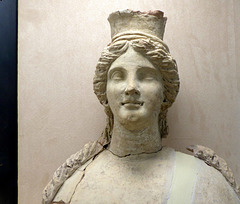
Aidone - Museo archeologico di Aidone
| 14 Nov 2022 |
|
According to some scholars, Aidone was founded at the end of the 11th century by the Normans during the conquest of Sicily and the expulsion of the Arabs, but it is more likely that the Normans confined themselves to refounding and repopulating a pre-existing village snatched from the Saracens.
At the time of Frederick II Aidone most probably belonged to the direct possession of the king The Emperor allowed some soldiers from Piacenza to settle in Aidone-
In 1229 the Knights Templar were allowed to build the church of San Giovanni. After the death of Frederick II in 1255, Aidone declared itself a free commune and was able to resist the attack of the Count of Catanzaro, who acted in the name of King Manfredi. However, in 1257 it was taken and plundered by the Swabian army led by Federico Lancia. Aidone took part in the revolt of the Sicilian Vespers and expelled the French garrison
The ancient city of Morgantina was located in the territory of the present municipality. In the 6th century, BC Greeks settled on the citadel hill and lived peacefully with the locals. In 459 BC Morgantina was conquered by the Sicilian king Ducetius, who destroyed the Greek settlement. Duktios is credited with the rectangular layout of the city. Around 450 BC, the city was conquered by Akragas and became the property of Syracuse. At the time of the Greek politician Timoleon (~ 450 BC) the city experienced an upswing, as archaeological finds prove. However, Morgantina experienced its greatest prosperity in the time of the Syracuse King Timoleon (~ 280 BC). During the 2nd Punic War Morgantina was conquered by the Romans.
Since about 1955 archaeologists have been excavating the ancient city. Their findings can be seen in the local museum, housed in a former Capuchin monastery.
Bust of Persephone. 3rd century BC.
Jump to top
RSS feed- Martin M. Miles' latest photos with "Persephone" - Photos
- ipernity © 2007-2026
- Help & Contact
|
Club news
|
About ipernity
|
History |
ipernity Club & Prices |
Guide of good conduct
Donate | Group guidelines | Privacy policy | Terms of use | Statutes | In memoria -
Facebook
X
