

Martin M. Miles' photos with the keyword: Iconoclasm
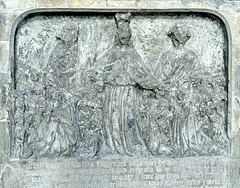
Tournai - Saint Quentin
| 17 Sep 2025 |
|
Tournai lies on the site of the Roman Turnacum and is, after Tongeren, the oldest city in Belgium. This was the site of a ford on the Scheldt River, where the connection between Boulogne-sur-Mer and Cologne, which had been expanded into a fortified Roman road, crossed the Scheldt. The Roman camp was plundered by the Franks and Chauci, but survived until 406, when the Vandals attacked and destroyed it.
The city became a Merovingian seat of power in the mid-5th century, from which King Childeric I also operated. In 486, Clovis moved the center of power to Paris. In 862, Charles the Bald, first king of Western Francia and still to become Holy Roman Emperor, would make Tournai the seat of the County of Flanders.
The city participated in 11th-century rise of towns in the Low Countries, with a woollen cloth industry, which made it attractive to merchants. The commune's drive for independence from the local counts succeeded in 1187, and the city was henceforth directly subordinated to the French Crown. During the 15th century, the city became an important supplier of tapestry. It was captured in 1513 by Henry VIII of England and was handed back to French rule in 1519.
The church is mentioned already during the 10th century. It is located at the Grand-Place, where a large Gallo-Roman cemetery was once located. The current building dates from c. 1200. It originally consisted of a nave, a transept and a chancel with four side chapels. The church has however been altered several times. Already in the 13th century, the chancel and the transept arms were vaulted. In the 1460s, the chancel was remade and an ambulatorywas created. This reconstruction, made in a Flamboyant Gothic style. During World War II, the church was heavily damaged by German bombing in 1940. Restoration works continued until 1968.
The Iconoclasm of Tournai was part of the religious riots in 1566, during which Protestant iconoclasts destroyed churches considered idolatrous.
A scar of the iconoclasm can be seen here.
Lichtervelde - Sint-Jacobus-de-Meerderekerk
| 04 Sep 2025 |
|
Sint-Jacobuskerk was built in 1876-79, replacing an older church. The first church here was probably a wooden one, founded by the Lords of Lichtervelde. Later, a Romanesque church was built. The patron saints were Margaret and James the Greater. James the Greater was chosen because Lichtervelde was a transit point on the pilgrims' route to Santiago de Compostela.
During the Second Iconoclasm in 1584, the church was destroyed except for its Romanesque tower. It was rebuilt around 1620. It was damaged during the Franco-Spanish Wars and the War of the Spanish Succession, which ended in 1713. Between 1876 and 1879, it was deemed too small and demolished to make room for the present neo-Gothic church, which was built between 1878 and 1880. In 1918, the church was bombed during the German retreat, but was rebuilt in the neo-Gothic style in 1922/23.
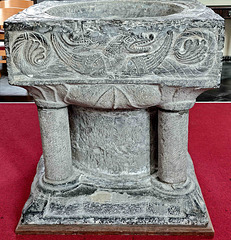
The baptismal font, dated to the 11th and 12th century, was created from Tournai blue ston. It is 80x80 cm and 23 cm thick. The tub rests on a firm cylindrical pillar, surrounded by four round small columns. On the side walls are dragon motives.
In 1918, the font was buried under the debris of the tower. After a restoration it was again placed in the church.

Germigny-des-Prés - Oratory
| 06 Feb 2015 |
|
This small church in a Germigny des Pres (pop. 750), was built to serve as the private chapel of Bishop Theodulf of Orléans, who had a sumptuous "villa" here.
Theodulf, one of Charlemagne's important counselors, had written the Libri Carolini (aka "Opus Caroli regis contra synodum") at Charles´ request, before Charlemagne appointed him Bishop of Orléans as well as abbot of Fleury Abbey (= "St-Benoit-sur-Loire"), just 7kms east.
All the remains of the residence are gone. The "oratorium", that has many parallels to Charlemagne´s palace chapel in Aachen ("Aix-la-Chapelle"), is the last remaining structure. It was consecrated on January 3, 806.
In 817, three years after Charlemagne had died, Theodulf was accused of treason and imprisoned in Angers until he died in 821.
The church was used by the parish since mid 11th century, when the western wall and apse were removed to make way for a traditional Latin nave. That Romanesque nave was in turn replaced by the present larger one in the 15th or 16th century.
The renovation, that was completed end of the 19th century, was not done with much "respect": much of the Carolingian masonry was replaced, two flanking apsidioles were removed, the crossing tower was shortened, most capitals were replaced. But this is still a wonderful carolingian chapel and one of the oldest still existing in France.
A magnificent apse mosaic was hidden under whitewash (what may have saved it during the French Revolution). It got discovered in 1840, after local kids played with coloured glass cubes - of unknown origin.
This great work of medieval art has no parallel in France and was surely done by an artist from the East. At the time this mosaic was created, the controvery over Iconoclasm was still going on in the Byzantine Empire. All forms of religious imagery were banned in the East - and many gifted artists fled to the West. Maybe the artist, who worked here, was one of them.
Here is an inscription on one of the four pillars:
III:NO:IAN:DEDICATIO - HUIUS ECCLESIAE
This church was dedicated on the third of January
There is another inscription adding information about the year (806) and the dedication (Genevieve and Germain), but it is thought that this is a 19th century copy.

Germigny-des-Prés - Oratory
| 06 Feb 2015 |
|
This small church in a Germigny des Pres (pop. 750), was built to serve as the private chapel of Bishop Theodulf of Orléans, who had a sumptuous "villa" here.
Theodulf, one of Charlemagne's important counselors, had written the Libri Carolini (aka "Opus Caroli regis contra synodum") at Charles´ request, before Charlemagne appointed him Bishop of Orléans as well as abbot of Fleury Abbey (= "St-Benoit-sur-Loire"), just 7kms east.
All the remains of the residence are gone. The "oratorium", that has many parallels to Charlemagne´s palace chapel in Aachen ("Aix-la-Chapelle"), is the last remaining structure. It was consecrated on January 3, 806.
In 817, three years after Charlemagne had died, Theodulf was accused of treason and imprisoned in Anger until he died in 821.
The church became part of a priory and was used by the parish since the 13th century when the western wall and apse were removed to make way for a traditional Latin nave. That Romanesque nave was in turn replaced by the present larger one in the 15th or 16th century.
The renovation, that was completed end of the 19th century, was not done with much "respect": much of the Carolingian masonry was replaced, two flanking apsidioles were removed, the crossing tower was shortened, most capitals were replaced. But this is still a wonderful carolingian chapel and one of the oldest still existing in France.
A magnificent apse mosaic was hidden under whitewash (what may have saved it during the French Revolution). It got discovered in 1840, after local kids played with coloured glass cubes - of unknown origin.
This great work of medieval art has no parallel in France and was surely done by an artist from the East. At the time this mosaic was created, the controvery over Iconoclasm was still going on in the Byzantine Empire. All forms of religious imagery were banned in the East - and many gifted artists fled to the West. Maybe the artist, who worked here, was one of them.
The mosaic, made of glass and coloured stone, is symmetrical, centring on the Ark of the Covenant.
This was not the only mosaic when the church was completed. Traces of frescoes and mosaics were found all over the apse´s walls.
Germigny-des-Prés - Oratory
| 06 Feb 2015 |
|
This small church in a Germigny des Pres (pop. 750), was built to serve as the private chapel of Bishop Theodulf of Orléans, who had a sumptuous "villa" here.
Theodulf, one of Charlemagne's important counselors, had written the Libri Carolini (aka "Opus Caroli regis contra synodum") at Charles´ request, before Charlemagne appointed him Bishop of Orléans as well as abbot of Fleury Abbey (= "St-Benoit-sur-Loire"), just 7kms east.
All the remains of the residence are gone. The "oratorium", that has many parallels to Charlemagne´s palace chapel in Aachen ("Aix-la-Chapelle"), is the last remaining structure. It was consecrated on January 3, 806.
In 817, three years after Charlemagne had died, Theodulf was accused of treason and imprisoned in Angers until he died in 821.
The church became part of a priory and was used by the parish since the 13th century, when the western wall and apse were removed to make way for a traditional Latin nave. That Romanesque nave was in turn replaced by the present larger one in the 15th or 16th century.
The renovation, that was completed end of the 19th century, was not done with much "respect": much of the Carolingian masonry was replaced, two flanking apsidioles were removed, the crossing tower was shortened, most capitals were replaced. But this is still a wonderful carolingian chapel and one of the oldest still existing in France.
This magnificent apse mosaic was hidden under whitewash (what may have saved it during the French Revolution). It got discovered in 1840, after local kids played with coloured glass cubes - of unknown origin.
This great work of medieval art has no parallel in France and was surely done by an artist from the East. At the time this mosaic was created, the controvery over Iconoclasm was still going on in the Byzantine Empire. All forms of religious imagery were banned in the East - and many gifted artists fled to the West. Maybe the artist, who worked here, was one of them.
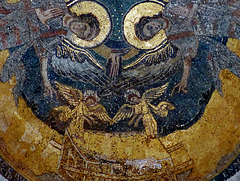
The mosaic, made of glass and colored stone, is symmetrical, centering on the Ark of the Covenant. In a small area of starry sky the Hand of God descends. Two angels flank the scene. They enclose the sky with their wings and look down at the Ark. Two smaller angels stand atop the Ark, reaching down to it. The Ark of the Covenant is shown as a gold box with side rails for carrying.
Along the bottom of the mosaic is a Latin text, which reads:
ORACLUM SCM ET CERUBIN HIC ASPICE SPECTANS ET TESTAMENTI MICAT ARCA DEI HAEC CERNENS PRECIBUSQUE STUDENS PULSARE TONANTEM THEODULFUM VOTIS IUNGITO QUAESO TUIS
"As you gaze upon the holy propitiatorium and Cherubim, beholder,
and see the shimmering of the Ark of God's covenant, perceiving these things, and prepared to beset the Thunderer with prayers, add, I beg you, Theodulf's name to your invocations." (transation from Wikpedia)
For a total of the mosaic see the previous uploads. Here is a detail ..
Germigny-des-Prés - Oratory
| 06 Feb 2015 |
|
This small church in a Germigny des Pres (pop. 750), was built to serve as the private chapel of Bishop Theodulf of Orléans, who had a sumptuous "villa" here.
Theodulf, one of Charlemagne's important counselors, had written the Libri Carolini (aka "Opus Caroli regis contra synodum") at Charles´ request, before Charlemagne appointed him Bishop of Orléans as well as abbot of Fleury Abbey (= "St-Benoit-sur-Loire"), just 7kms east.
All the remains of the residence are gone. The "oratorium", that has many parallels to Charlemagne´s palace chapel in Aachen ("Aix-la-Chapelle"), is the last remaining structure. It was consecrated on January 3, 806.
In 817, three years after Charlemagne had died, Theodulf was accused of treason and imprisoned in Angers until he died in 821.
The church became part of a priory and was used by the parish since the 13th century, when the western wall and apse were removed to make way for a traditional Latin nave. That Romanesque nave was in turn replaced by the present larger one in the 15th or 16th century.
The renovation, that was completed end of the 19th century, was not done with much "respect": much of the Carolingian masonry was replaced, two flanking apsidioles were removed, the crossing tower was shortened, most capitals were replaced. But this is still a wonderful carolingian chapel and one of the oldest still existing in France.
This magnificent apse mosaic was hidden under whitewash (what may have saved it during the French Revolution). It got discovered in 1840, after local kids played with coloured glass cubes - of unknown origin.
This great work of medieval art has no parallel in France and was surely done by an artist from the East. At the time this mosaic was created, the controvery over Iconoclasm was still going on in the Byzantine Empire. All forms of religious imagery were banned in the East - and many gifted artists fled to the West. Maybe the artist, who worked here, was one of them.
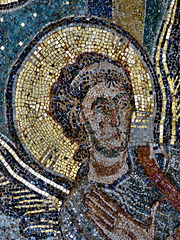
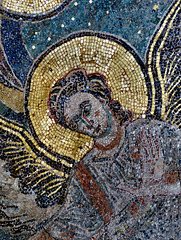
The mosaic, made of glass and colored stone, is symmetrical, centering on the Ark of the Covenant. In a small area of starry sky the Hand of God descends. Two angels flank the scene. They enclose the sky with their wings and look down at the Ark. Two smaller angels stand atop the Ark, reaching down to it. The Ark of the Covenant is shown as a gold box with side rails for carrying.
Along the bottom of the mosaic is a Latin text, which reads:
ORACLUM SCM ET CERUBIN HIC ASPICE SPECTANS ET TESTAMENTI MICAT ARCA DEI HAEC CERNENS PRECIBUSQUE STUDENS PULSARE TONANTEM THEODULFUM VOTIS IUNGITO QUAESO TUIS
"As you gaze upon the holy propitiatorium and Cherubim, beholder,
and see the shimmering of the Ark of God's covenant, perceiving these things, and prepared to beset the Thunderer with prayers, add, I beg you, Theodulf's name to your invocations." (transation from Wikpedia)
For a total of the mosaic see the previous uploads. Here is a detail (rotated).
Germigny-des-Prés - Oratory
| 05 Feb 2015 |
|
This small church in a Germigny des Pres (pop. 750), was built to serve as the private chapel of Bishop Theodulf of Orléans, who had a sumptuous "villa" here.
Theodulf, one of Charlemagne's important counselors, had written the Libri Carolini (aka "Opus Caroli regis contra synodum") at Charles´ request, before Charlemagne appointed him Bishop of Orléans as well as abbot of Fleury Abbey (= "St-Benoit-sur-Loire"), just 7kms east.
All the remains of the residence are gone. The "oratorium", that has many parallels to Charlemagne´s palace chapel in Aachen ("Aix-la-Chapelle"), is the last remaining structure. It was consecrated on January 3, 806.
In 817, three years after Charlemagne had died, Theodulf was accused of treason and imprisoned in Angers until he died in 821.
The church became part of a priory and was used by the parish since the 13th century, when the western wall and apse were removed to make way for a traditional Latin nave. That Romanesque nave was in turn replaced by the present larger one in the 15th or 16th century.
The renovation, that was completed end of the 19th century, was not done with much "respect": much of the Carolingian masonry was replaced, two flanking apsidioles were removed, the crossing tower was shortened, most capitals were replaced. But this is still a wonderful carolingian chapel and one of the oldest still existing in France.
This magnificent apse mosaic was hidden under whitewash (what may have saved it during the French Revolution). It got discovered in 1840, after local kids played with coloured glass cubes - of unknown origin.
This great work of medieval art has no parallel in France and was surely done by an artist from the East. At the time this mosaic was created, the controvery over Iconoclasm was still going on in the Byzantine Empire. All forms of religious imagery were banned in the East - and many gifted artists fled to the West. Maybe the artist, who worked here, was one of them.
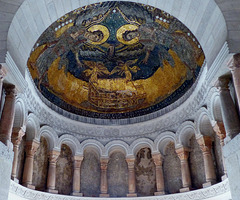
The mosaic, made of glass and colored stone, is symmetrical, centering on the Ark of the Covenant. In a small area of starry sky the Hand of God descends. Two angels flank the scene. They enclose the sky with their wings and look down at the Ark. Two smaller angels stand atop the Ark, reaching down to it. The Ark of the Covenant is shown as a gold box with side rails for carrying.
Along the bottom of the mosaic is a Latin text, which reads:
ORACLUM SCM ET CERUBIN HIC ASPICE SPECTANS ET TESTAMENTI MICAT ARCA DEI HAEC CERNENS PRECIBUSQUE STUDENS PULSARE TONANTEM THEODULFUM VOTIS IUNGITO QUAESO TUIS
"As you gaze upon the holy propitiatorium and Cherubim, beholder,
and see the shimmering of the Ark of God's covenant, perceiving these things, and prepared to beset the Thunderer with prayers, add, I beg you, Theodulf's name to your invocations." (transation from Wikpedia)
For a total of the mosaic see the previous uploads. Here is a detail (rotated).
Germigny-des-Prés - Oratory
| 05 Feb 2015 |
|
|
|
This small church in a Germigny des Pres (pop. 750), was built to serve as the private chapel of Bishop Theodulf of Orléans, who had a sumptuous "villa" here.
Theodulf, one of Charlemagne's important counselors, had written the Libri Carolini (aka "Opus Caroli regis contra synodum") at Charles´ request, before Charlemagne appointed him Bishop of Orléans as well as abbot of Fleury Abbey (= "St-Benoit-sur-Loire"), just 7kms east.
All the remains of the residence are gone. The "oratorium", that has many parallels to Charlemagne´s palace chapel in Aachen ("Aix-la-Chapelle"), is the last remaining structure. It was consecrated on January 3, 806.
In 817, three years after Charlemagne had died, Theodulf was accused of treason and imprisoned in Angers until he died in 821.
The church became part of a priory and was used by the parish since the 13th century, when the western wall and apse were removed to make way for a traditional Latin nave. That Romanesque nave was in turn replaced by the present larger one in the 15th or 16th century.
The renovation, that was completed end of the 19th century, was not done with much "respect": much of the Carolingian masonry was replaced, two flanking apsidioles were removed, the crossing tower was shortened, most capitals were replaced. But this is still a wonderful carolingian chapel and one of the oldest still existing in France.
This magnificent apse mosaic was hidden under whitewash (what may have saved it during the French Revolution). It got discovered in 1840, after local kids played with coloured glass cubes - of unknown origin.
This great work of medieval art has no parallel in France and was surely done by an artist from the East. At the time this mosaic was created, the controvery over Iconoclasm was still going on in the Byzantine Empire. All forms of religious imagery were banned in the East - and many gifted artists fled to the West. Maybe the artist, who worked here, was one of them.
The mosaic, made of glass and colored stone, is symmetrical, centering on the Ark of the Covenant. In a small area of starry sky the Hand of God descends. Two angels flank the scene. They enclose the sky with their wings and look down at the Ark. Two smaller angels stand atop the Ark, reaching down to it. The Ark of the Covenant is shown as a gold box with side rails for carrying.
Along the bottom of the mosaic is a Latin text, which reads:
ORACLUM SCM ET CERUBIN HIC ASPICE SPECTANS ET TESTAMENTI MICAT ARCA DEI HAEC CERNENS PRECIBUSQUE STUDENS PULSARE TONANTEM THEODULFUM VOTIS IUNGITO QUAESO TUIS
"As you gaze upon the holy propitiatorium and Cherubim, beholder, and see the shimmering of the Ark of God's covenant, perceiving these things, and prepared to beset the Thunderer with prayers, add, I beg you, Theodulf's name to your invocations." (transation from Wikpedia)
Jump to top
RSS feed- Martin M. Miles' latest photos with "Iconoclasm" - Photos
- ipernity © 2007-2026
- Help & Contact
|
Club news
|
About ipernity
|
History |
ipernity Club & Prices |
Guide of good conduct
Donate | Group guidelines | Privacy policy | Terms of use | Statutes | In memoria -
Facebook
X
