

Martin M. Miles' photos with the keyword: Gard

Nîmes – Cathedral of Our Lady and Saint Castor
| 16 Oct 2025 |
|
|
Nîmes Cathedral is the result of a long and complex history. In 1096, a cathedral was consecrated here by Pope Urban II. However, in the following century, the cathedral was rebuilt or even rebuilt. The most significant reconstruction took place in the 17th century, after the cathedral was severely damaged during the Wars of Religion, as Nîmes had been a Huguenot stronghold.
Unfortunately, the facade was hidden behind scaffolding in 2025.

Nîmes
| 16 Oct 2025 |
|
|
A marvellous carousel, named "Ville de Nîmes" waiting for little customers on a sunny afternoon.

Uzès
| 16 Oct 2025 |
|
|
Uzès was a small Gallo-Roman oppidum near the huge Roman aqueduct, today named Pont du Gard. In the early 8th century, Uzès was a fortified civitas and bishopric under the Archbishop of Narbonne. During the Saracen invasion, Uzès became a stronghold of the Saracens and in 736 Charles Martel besieged Uzès, but it remained in Saracen hands up to 752. A year later the former stronghold rebelled against the Franks - unsuccessfully.
Today's Uzès preserves traces of its walls as a circuit of boulevards, It is the perfect place to take a break and sit in the shade on the large market square - like many other tourists.
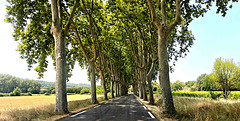
Tree avenue
| 15 Oct 2025 |
|
|
|
I rarely use the major highways in France.
I prefer the smaller roads, especially tree avenues.
Under the shade of the large plane trees, you might travel slower, but it's much more relaxing.
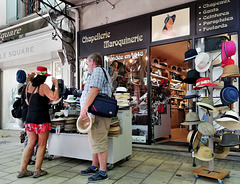
Uzès - Chapellerie
| 22 Mar 2021 |
|
Uzès was a small Gallo-Roman oppidum near the huge Roman aqueduct, today named Pont du Gard. In the early 8th century, Uzès was a fortified civitas and bishopric under the Archbishop of Narbonne. During the Saracen invasion, Uzès became a stronghold of the Saracens and in 736 Charles Martel besieged the, but it remained in Saracen hands up to 752. A year later the former stronghold rebelled against the Franks - unsuccessfully.
Today Uzès is a hotspot for tourists with nice places under shady trees to have a drink. And nice shops to buy a hat.
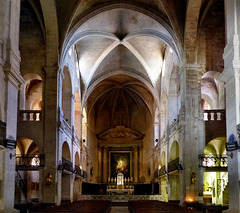
Uzès - St.-Théodorit
| 22 Mar 2021 |
|
Uzès was a small Gallo-Roman oppidum near the huge Roman aqueduct, today named Pont du Gard.
In the early 8th century, Uzès was a fortified civitas and bishopric under the Archbishop of Narbonne. During the Saracen invasion, Uzès became a stronghold of the Saracens and in 736 Charles Martel besieged the, but it remained in Saracen hands up to 752. A year later the former stronghold rebelled against the Franks - unsuccessfully.
The romanesque cathedral Saint-Théodorit was destroyed within the Cathar Crusade, was rebuilt but destroyed again during the Wars of Religion. The church of today was constructed within the 17th century. J
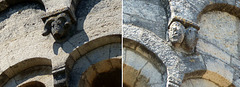
Uzès - St.-Théodorit
| 22 Mar 2021 |
|
Uzès was a small Gallo-Roman oppidum near the huge Roman aqueduct, today named Pont du Gard.
In the early 8th century, Uzès was a fortified civitas and bishopric under the Archbishop of Narbonne. During the Saracen invasion, Uzès became a stronghold of the Saracens and in 736 Charles Martel besieged the, but it remained in Saracen hands up to 752. A year later the former stronghold rebelled against the Franks - unsuccessfully.
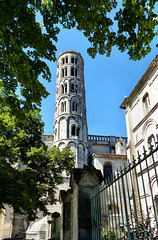
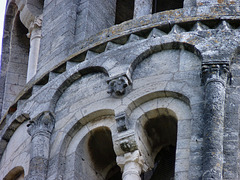
The romanesque cathedral Saint-Théodorit was destroyed within the Cathar Crusade, was rebuilt but destroyed again during the Wars of Religion. The church of today was constructed within the 17th century. Just the 12th-century bell-tower, named today "Tour Fenestrelle" survived the centuries (though "reconstructed" in the higher levels). The tower is round - and seems to be a very close cousin of the Italian campaniles. There are many carvings around the tower - here are two of them.
Uzès - St.-Théodorit
| 21 Mar 2021 |
|
|
|
Uzès was a small Gallo-Roman oppidum near the huge Roman aqueduct, today named Pont du Gard.
In the early 8th century, Uzès was a fortified civitas and bishopric under the Archbishop of Narbonne. During the Saracen invasion, Uzès became a stronghold of the Saracens and in 736 Charles Martel besieged the, but it remained in Saracen hands up to 752. A year later the former stronghold rebelled against the Franks - unsuccessfully.
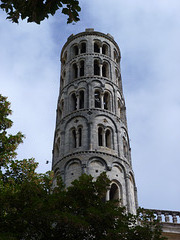
The romanesque cathedral Saint-Théodorit was destroyed within the Cathar Crusade, was rebuilt but destroyed again during the Wars of Religion. The church of today was constructed within the 17th century. Just the 12th-century bell-tower, named today "Tour Fenestrelle" survived the centuries (though "reconstructed" in the higher levels). The tower is round - and seems to be a very close cousin of the Italian campaniles.
Uzès - St.-Théodorit
| 23 Oct 2010 |
|
The romanesque cathedral Saint-Théodorit destroyed within the Cathar Cruisade, was rebuilt but destroyed again during the Wars of Religion. The church of today was constructed within the 17th century. Just the 12th century bell-tower, named today "Tour Fenestrelle" survived the centuries.
The structure of the round bell-tower is pretty complex, as to be seen here. In the middle the head of a ram, very common within that time. Below over the pillar a human face.
Uzès - St.-Théodorit
| 23 Oct 2010 |
|
The romanesque cathedral Saint-Théodorit destroyed within the Cathar Cruisade, was rebuilt but destroyed again during the Wars of Religion. The church of today was constructed within the 17th century. Just the 12th century bell-tower, named today "Tour Fenestrelle" survived the centuries (though "reconstructed" in the higher levels). The tower is round - and seems to be a very close cousin of the italian campaniles.
Pont du Gard - Valliguières
| 24 Oct 2010 |
|
The roman "Pont du Gard", more than 2000 years old, is not only one of the main touristic
attractions, it is brilliant example of the abilities, the antique engineers had. The aqueduct
was constructed to get fresh water from Uzès to Nîmes, a distance of only about 20kms,
but full of obstacles like the valley of the Gardon.
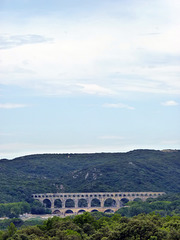
Here the Pont du Gard is seen from the beautiful village of Valliguières, about 8kms beeline away from the aqueduct.
Pont du Gard
| 19 Nov 2017 |
|
Pont du Gard is a Roman aqueduct that crosses the Gardon River. It is one of the best preserved aqueducts and part of the Nîmes aqueduct, a 50-kilometre system built in the first century AD to carry water from a spring t Uzès to Nîmes, a Roman colony named Nemausus.
After the Roman Empire collapsed, the aqueduct fell into disuse. The Pont du Gard remained largely intact, due to the importance of its secondary function. It was used as a toll bridge, so for centuries the local lords and bishops were responsible for its upkeep.
Starting in the 18th century the Pont du Gard became a tourist destination. Today it is one of France's most popular tourist attractions with about 1.4 million visitors per year, who all take photos...
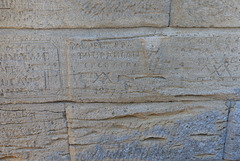
For centuries, Pont du Gard was a huge, unattended structure, so it is no surprise, that it is covered by graffiti. Most date from the 19th century, when tourists came here, and "left" names and dates.
More guild-symbols (maybe!), just like the three hammers (previous upload), here is another hammer (left). In the center is a hammer and two compasses. "Hammer and compass" was the guild symbol of bricklayers. It could as well be a Masonic symbol. The graffito is too old to stand for the national emblem of "East Germany" (GDR).
In medieval times the "journeymen" had to travel - and learn for years, before they were allowed to settle down. Some such guilds still exist.
"Die Freien Vogtländer" is a German guild
www.freie-vogtlaender.eu/de/
This guild is a member of the
"Conféderation Compagnonnages Europäische Gesellenzünfte"
cceg.eu/?lang=en
Pont du Gard
| 19 Nov 2017 |
|
Pont du Gard is a Roman aqueduct that crosses the Gardon River. It is one of the best preserved aqueducts and part of the Nîmes aqueduct, a 50-kilometre system built in the first century AD to carry water from a spring at Uzès to Nîmes, a Roman colony named Nemausus.
After the Roman Empire collapsed, the aqueduct fell into disuse. The Pont du Gard remained largely intact, due to the importance of its secondary function. It was used as a toll bridge, so for centuries the local lords and bishops were responsible for its upkeep.
Starting in the 18th century the Pont du Gard became a tourist destination. Today it is one of France's most popular tourist attractions with about 1.4 million visitors per year, who all take photos...
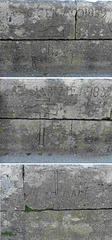
For centuries, Pont du Gard was a huge, unattended structure, so it is no surprise, that it is covered by graffiti. Most date from the 19th century, when tourists came here, and "left" names and dates. Here are three, that may have been carved by travelling smiths or roofers, as both guilds used a hammer as their symbol.
In medieval times the "journeymen" had to travel - and learn for years, before they were allowed to settle down. Some such guilds still exist.
"Die Freien Vogtländer" is a German guild
www.freie-vogtlaender.eu/de/
This guild is a member of the
"Conféderation Compagnonnages Europäische Gesellenzünfte"
cceg.eu/?lang=en
Pont du Gard
| 18 Nov 2017 |
|
Pont du Gard is a Roman aqueduct that crosses the Gardon River. It is one of the best preserved aqueducts and part of the Nîmes aqueduct, a 50-kilometre system built in the first century AD to carry water from a spring at Uzès to Nîmes, a Roman colony named Nemausus.
After the Roman Empire collapsed, the aqueduct fell into disuse. The Pont du Gard remained largely intact, due to the importance of its secondary function. It was used as a toll bridge, so for centuries the local lords and bishops were responsible for its upkeep.
Starting in the 18th century the Pont du Gard became a tourist destination. Today it is one of France's most popular tourist attractions with about 1.4 million visitors per year, who all take photos...
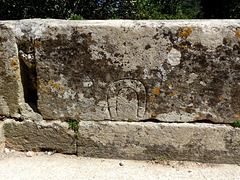
For centuries, Pont du Gard was a huge, unattended structure, so it is no surprise, that it is covered by graffiti. Most date from the 19th century, when tourists came here, and "left" names and dates. This "horseshoe" may be older, as this kind of graffiti was in medieval times often carved in by pilgrims.
Pont du Gard
| 17 Nov 2017 |
|
|
|
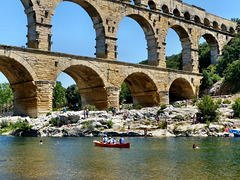
Pont du Gard is a Roman aqueduct that crosses the Gardon River. It is one of the best preserved aqueducts and part of the Nîmes aqueduct, a 50-kilometre system built in the first century AD to carry water from a spring at Uzès to Nîmes, a Roman colony named Nemausus.
After the Roman Empire collapsed, the aqueduct fell into disuse. The Pont du Gard remained largely intact, due to the importance of its secondary function. It was used as a toll bridge, so for centuries the local lords and bishops were responsible for its upkeep.
Starting in the 18th century the Pont du Gard became a tourist destination. Today it is one of France's most popular tourist attractions with about 1.4 million visitors per year, who all take photos...
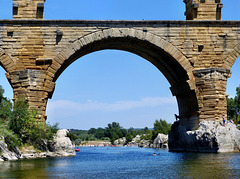
After I had swum through the Pont d'Arc the day before, I decided to do that again here - and it is possible. Easy!
Pont du Gard
| 17 Nov 2017 |
|
|
|
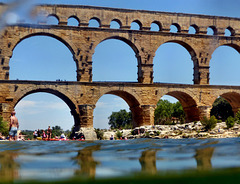
Pont du Gard is a Roman aqueduct that crosses the Gardon River. It is one of the best preserved aqueducts and part of the Nîmes aqueduct, a 50-kilometre system built in the first century AD to carry water from a spring at Uzès to Nîmes, a Roman colony named Nemausus.
After the Roman Empire collapsed, the aqueduct fell into disuse. The Pont du Gard remained largely intact, due to the importance of its secondary function. It was used as a toll bridge, so for centuries the local lords and bishops were responsible for its upkeep.
Starting in the 18th century the Pont du Gard became a tourist destination. Today it is one of France's most popular tourist attractions with about 1.4 million visitors per year, who all take photos...
After I had swum through the Pont d'Arc the day before, I decided to do that again here - and it is possible. Easy!
Pont du Gard
| 17 Nov 2017 |
|
|
Pont du Gard is a Roman aqueduct that crosses the Gardon River. It is one of the best preserved aqueducts and part of the Nîmes aqueduct, a 50-kilometre system built in the first century AD to carry water from a spring at Uzès to Nîmes, a Roman colony named Nemausus.
After the Roman Empire collapsed, the aqueduct fell into disuse. The Pont du Gard remained largely intact, due to the importance of its secondary function. It was used as a toll bridge, so for centuries the local lords and bishops were responsible for its upkeep.
Starting in the 18th century the Pont du Gard became a tourist destination. Today it is one of France's most popular tourist attractions with about 1.4 million visitors per year, who all take photos...
After I had swum through the Pont d'Arc the day before, I decided to do that again here - and it is possible. Easy!
St. Gilles-du-Gard - Abbey
| 30 Sep 2010 |
|
The monastery St. Gilles, founded within the 7th century. A hermit lived here - with a hind. After Visigothic King Wamba had injured this hind during a hunt, he founded a monastry. St. Gilles was the first abbot there. St. Gilles was one of the most popular saints in medieval times,
pilgrims flocked to his tomb in the crypt - and continued to Santiago from here. St. Gilles today is still one of the Fourteen Holy Helpers.
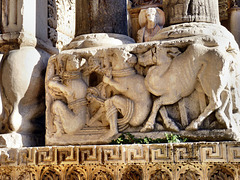
During the Wars of Religion the abbey and the church were totally destroyed and burnt down, what was in 1562. 1622 the campanile got demolished. After that only the crypt, part of the clocher, some eastern walls of the choir existed.
The portal, which reminds on roman Triumph-arches, got demolished after the french revolution, - but puzzled together again within the 19th century, with material found all around. The precise knowledge about many details was lost, so in some parts it still is an unfinshed puzzle.
For sure some parts are still missing - and this is visible. Probably different masters have worked here, as there are different styles in carving on this portal.
Here some pretty exotic animals.
A skinny dromedary to the right and two monkeys in chains on the left. The carver had a very creative idea: one leg of the monkey in the middle reaches over the frame.
Behind them (this is a "3D-puzzle") a bust sculpture of a saint. Maybe this is only the top part of a "full" figure - and the second part is lost. It is placed so far in the background, that I do not believe, that this is the original place. Though there are letters on the nimbus, I could not find out the name of the saint.
Jump to top
RSS feed- Martin M. Miles' latest photos with "Gard" - Photos
- ipernity © 2007-2026
- Help & Contact
|
Club news
|
About ipernity
|
History |
ipernity Club & Prices |
Guide of good conduct
Donate | Group guidelines | Privacy policy | Terms of use | Statutes | In memoria -
Facebook
X
