

Martin M. Miles' photos with the keyword: Temple of Hephaestus
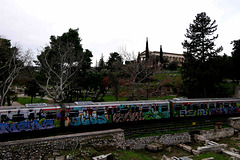
Athens - Agora
| 25 May 2025 |
|
Athens, the southernmost capital on the European mainland, is one of the world's oldest cities, with its recorded history spanning over 3,400 years. According to Greek mythology the city was named after Athena, the ancient Greek goddess of wisdom. Classical Athens was one of the most powerful city-states in ancient Greece. It was a centre for democracy, the arts, education and philosophy, and was highly influential throughout the European continent, particularly in Ancient Rome. For this reason it is often regarded as the cradle of Western civilisation and the birthplace of democracy.
The ancient Agora of Athens was a meeting place of the polis, used for military, judicial, and popular assemblies of free citizens. It has existed since around the 5th century BC and contrasts with the cultic and political center of power of the archaic fortress (the Acropolis up in the knoll). Therefore, the agora represents a significant step in the development of Athenian democracy.
In 480 BC, the Persians conquered Athens, destroying much of the city and the agora. Sooin after the reconstruction began. Therefore, many new buildings were built during this period.
In the 2nd century BC, Athens increasingly became the spiritual center of the Mediterranean world. Rulers of various countries began to demonstrate their power and culture by constructing buildings in Athens. As a result, construction activity in the agora increased enormously. It was during this time that the large, imposing stoa were built. It wasn't until the second half of the 2nd century that the agora was completely surrounded by buildings.
In 146 BC Greece was declared a Roman province. At the beginning of the 1st century BC, Athens turned against Rome, leading to a siege of the city in 86 BC, during which, the Agora was partly damaged. By the middle of the century, the Romans were showing greater interest in Athens. This again led to increased construction activity. A new marketplace, the Roman Agora, was built about 150 meters east of the Agora, largely depriving the Agora of this function.
The reign of Trajan (98–117) and Hadrian (117–138) ushered in a final period of prosperity for the Agora. After the Heruli stormed Athens in 267, destroying most of the Agora's buildings, the Agora never again became the important center it had been in previous centuries.
Railway tracks cut through the area and sometimes you can see a rather colorful train passing by in front of the Temple of Hephaestus.

Athens - Temple of Hephaestus
| 23 May 2025 |
|
Athens, the southernmost capital on the European mainland, is one of the world's oldest cities, with its recorded history spanning over 3,400 years. According to Greek mythology the city was named after Athena, the ancient Greek goddess of wisdom. Classical Athens was one of the most powerful city-states in ancient Greece. It was a centre for democracy, the arts, education and philosophy, and was highly influential throughout the European continent, particularly in Ancient Rome. For this reason it is often regarded as the cradle of Western civilisation and the birthplace of democracy.
The Temple of Hephaestus is a well-preserved Greek temple dedicated to Hephaestus, the patron god of metal working, craftsmanship, and fire.
Construction of the temple began around 449 BC. By 430 BC, the temple was largely complete; only the roof and the cult image group were still missing. The temple was probably consecrated in 415 BC. It was located on what was then the western city limits of Athens and later became "Agora of Athens".
The temple is built of marble, excepting the bottom step of the krepis or platform. The dimensions of the temple are 13.71 m north to south and 31.78 m east to west, with six columns on the short east and west sides and thirteen columns along the longer north and south sides.
Unlike the Parthenon, the Hephaesteion still has all its columns, and even the roof is largely intact. However, the friezes and other decorations have been severely damaged by iconoclasts, art lovers, and looters over the centuries.
From the 7th century until 1834, it served as the Greek Orthodox church of Saint George Akamates. The building's condition has been maintained due to its history of varied use.
During the Ottoman rule in Greece, the temple remained a Greek Orthodox church. When the first king of independent Greece, King Otto of Greece, son of King Ludwig I of Bavaria, entered Athens in 1834, the welcoming mass was held here.
A frieze runs all around the temple

Athens - Temple of Hephaestus
| 23 May 2025 |
|
Athens, the southernmost capital on the European mainland, is one of the world's oldest cities, with its recorded history spanning over 3,400 years. According to Greek mythology the city was named after Athena, the ancient Greek goddess of wisdom. Classical Athens was one of the most powerful city-states in ancient Greece. It was a centre for democracy, the arts, education and philosophy, and was highly influential throughout the European continent, particularly in Ancient Rome. For this reason it is often regarded as the cradle of Western civilisation and the birthplace of democracy.
The Temple of Hephaestus is a well-preserved Greek temple dedicated to Hephaestus, the patron god of metal working, craftsmanship, and fire.
Construction of the temple began around 449 BC. By 430 BC, the temple was largely complete; only the roof and the cult image group were still missing. The temple was probably consecrated in 415 BC. It was located on what was then the western city limits of Athens and later became "Agora of Athens".
The temple is built of marble, excepting the bottom step of the krepis or platform. The dimensions of the temple are 13.71 m north to south and 31.78 m east to west, with six columns on the short east and west sides and thirteen columns along the longer north and south sides.
Unlike the Parthenon, the Hephaesteion still has all its columns, and even the roof is largely intact. However, the friezes and other decorations have been severely damaged by iconoclasts, art lovers, and looters over the centuries.
From the 7th century until 1834, it served as the Greek Orthodox church of Saint George Akamates. The building's condition has been maintained due to its history of varied use.
During the Ottoman rule in Greece, the temple remained a Greek Orthodox church. When the first king of independent Greece, King Otto of Greece, son of King Ludwig I of Bavaria, entered Athens in 1834, the welcoming mass was held here.
A frieze runs all around the temple

Athens - Temple of Hephaestus
| 23 May 2025 |
|
Athens, the southernmost capital on the European mainland, is one of the world's oldest cities, with its recorded history spanning over 3,400 years. According to Greek mythology the city was named after Athena, the ancient Greek goddess of wisdom. Classical Athens was one of the most powerful city-states in ancient Greece. It was a centre for democracy, the arts, education and philosophy, and was highly influential throughout the European continent, particularly in Ancient Rome. For this reason it is often regarded as the cradle of Western civilisation and the birthplace of democracy.
The Temple of Hephaestus is a well-preserved Greek temple dedicated to Hephaestus, the patron god of metal working, craftsmanship, and fire.
Construction of the temple began around 449 BC. By 430 BC, the temple was largely complete; only the roof and the cult image group were still missing. The temple was probably consecrated in 415 BC. It was located on what was then the western city limits of Athens and later became "Agora of Athens".
The temple is built of marble, excepting the bottom step of the krepis or platform. The dimensions of the temple are 13.71 m north to south and 31.78 m east to west, with six columns on the short east and west sides and thirteen columns along the longer north and south sides.
Unlike the Parthenon, the Hephaesteion still has all its columns, and even the roof is largely intact. However, the friezes and other decorations have been severely damaged by iconoclasts, art lovers, and looters over the centuries.
From the 7th century until 1834, it served as the Greek Orthodox church of Saint George Akamates. The building's condition has been maintained due to its history of varied use.
During the Ottoman rule in Greece, the temple remained a Greek Orthodox church. When the first king of independent Greece, King Otto of Greece, son of King Ludwig I of Bavaria, entered Athens in 1834, the welcoming mass was held here.

Athens - Temple of Hephaestus
| 22 May 2025 |
|
|
|
Athens, the southernmost capital on the European mainland, is one of the world's oldest cities, with its recorded history spanning over 3,400 years. According to Greek mythology the city was named after Athena, the ancient Greek goddess of wisdom. Classical Athens was one of the most powerful city-states in ancient Greece. It was a centre for democracy, the arts, education and philosophy, and was highly influential throughout the European continent, particularly in Ancient Rome. For this reason it is often regarded as the cradle of Western civilisation and the birthplace of democracy.
The Temple of Hephaestus is a well-preserved Greek temple dedicated to Hephaestus, the patron god of metal working, craftsmanship, and fire.
Construction of the temple began around 449 BC. By 430 BC, the temple was largely complete; only the roof and the cult image group were still missing. The temple was probably consecrated in 415 BC. It was located on what was then the western city limits of Athens and later became "Agora of Athens".
The temple is built of marble, excepting the bottom step of the krepis or platform. The dimensions of the temple are 13.71 m north to south and 31.78 m east to west, with six columns on the short east and west sides and thirteen columns along the longer north and south sides.
Unlike the Parthenon, the Hephaesteion still has all its columns, and even the roof is largely intact. However, the friezes and other decorations have been severely damaged by iconoclasts, art lovers, and looters over the centuries.
From the 7th century until 1834, it served as the Greek Orthodox church of Saint George Akamates. The building's condition has been maintained due to its history of varied use.
During the Ottoman rule in Greece, the temple remained a Greek Orthodox church. When the first king of independent Greece, King Otto of Greece, son of King Ludwig I of Bavaria, entered Athens in 1834, the welcoming mass was held here.

Athens - Temple of Hephaestus
| 22 May 2025 |
|
|
Athens, the southernmost capital on the European mainland, is one of the world's oldest cities, with its recorded history spanning over 3,400 years. According to Greek mythology the city was named after Athena, the ancient Greek goddess of wisdom. Classical Athens was one of the most powerful city-states in ancient Greece. It was a centre for democracy, the arts, education and philosophy, and was highly influential throughout the European continent, particularly in Ancient Rome. For this reason it is often regarded as the cradle of Western civilisation and the birthplace of democracy.
The Temple of Hephaestus is a well-preserved Greek temple dedicated to Hephaestus, the patron god of metal working, craftsmanship, and fire.
Construction of the temple began around 449 BC. By 430 BC, the temple was largely complete; only the roof and the cult image group were still missing. The temple was probably consecrated in 415 BC. It was located on what was then the western city limits of Athens and later became "Agora of Athens".
The temple is built of marble, excepting the bottom step of the krepis or platform. The dimensions of the temple are 13.71 m north to south and 31.78 m east to west, with six columns on the short east and west sides and thirteen columns along the longer north and south sides.
Unlike the Parthenon, the Hephaesteion still has all its columns, and even the roof is largely intact. However, the friezes and other decorations have been severely damaged by iconoclasts, art lovers, and looters over the centuries.
From the 7th century until 1834, it served as the Greek Orthodox church of Saint George Akamates. The building's condition has been maintained due to its history of varied use.
During the Ottoman rule in Greece, the temple remained a Greek Orthodox church. When the first king of independent Greece, King Otto of Greece, son of King Ludwig I of Bavaria, entered Athens in 1834, the welcoming mass was held here.
Jump to top
RSS feed- Martin M. Miles' latest photos with "Temple of Hephaestus" - Photos
- ipernity © 2007-2026
- Help & Contact
|
Club news
|
About ipernity
|
History |
ipernity Club & Prices |
Guide of good conduct
Donate | Group guidelines | Privacy policy | Terms of use | Statutes | In memoria -
Facebook
X
