

Martin M. Miles' photos with the keyword: Clermont-Ferrand
Clermont-Ferrand - Cathédrale Notre-Dame-de-l'Asso…
| 29 Dec 2010 |
|
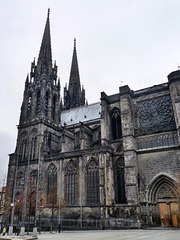
The "Cathédrale Notre-Dame-de-l'Assomption" stands on that place, where during the "Council of Clermont" in November 1095 Pope Urban II launched the first cruisade. The war-cry "Deus lo vult" was heard here for the first time.
The construction of the cathedral began as early as 1248 in the then new, gothic style. The black, vulcanic stones used from the beginning give the cathedral its dark colour. The choir, the transept and the start of the nave were finished about 50 years later, but it took upto the late 19th century, to finish the huge building, with its 96m high spires.
Clermont-Ferrand - Cathédrale Notre-Dame-de-l'Asso…
| 05 Nov 2011 |
|
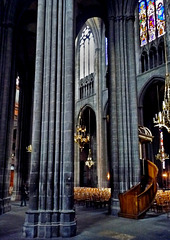
The first cathedral on this place was built already within the 5th century. This church was destroyed by Pepin the Short, who a couple of years later financed the reconstruction.
This second structure here was destroyed by the Normans in 915. The third (romanesque) cathedral, was consecrated in 946. This building probably served as the model and prototype for many churches in the Auvergne.
After a trip to Paris, the bishop was so enthusiastic about the the new gothic cathedrals being built in the north, that he had the romanesque cathedral was demolished - and in 1248 the construction of this cathedral started.
It took hundreds of years - and actually never got completed. During the French Revolution the revolutionaries wanted to tear down the church, but they could be persuaded to use it as a gathering place. So only some the transept towers and the complete furniture and interior decoration got lost. Finally in 1866 the completion works began. In 1884, the western façade with its spires and the last span of the nave were finally completed.
There are two aisles on both sides. Standing in the second southern aisle facing north/west. After having been in so many small romanesque churches over the last weeks, the sheer volume of the cathedral was breathtaking. The tiny person, seen on the left, is a fully grown adult.
Clermont-Ferrand - Cathédrale Notre-Dame-de-l'Asso…
| 29 Dec 2010 |
|
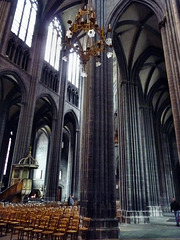
The construction of the cathedral began as early as 1248 in the then very new, gothic style. The black, vulcanic stones used from the beginning give the cathedral its dark colour. As these black stones are very strong it was possible for the architects to create very high and elegant pillars.
The choir, the transept and the start of the nave were finished about 50 years later, but it took upto the late 19th century, to finish the huge building, that was fortunately not dismantled during the French Revolution.
Clermont-Ferrand - Cathédrale Notre-Dame-de-l'Asso…
| 29 Dec 2010 |
|
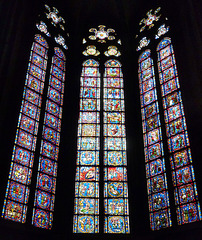
The construction of the cathedral began as early as 1248 in the then very new, gothic style. The black, vulcanic stones used from the beginning give the cathedral its dark colour. As these black stones are very strong it was possible for the architects to create very elegant pillars - and all around the large choir space for these fantastic stained glass windows.
Louis IX´s son (the future Philip III) married Isabella of Aragon in this choir in May 1262. At this occasion the king may have financed a part of the stained glass windows that seem to be from the same workshop as those in Sainte-Chapelle on the Île de la Cité in Paris.
Clermont-Ferrand - Cathédrale Notre-Dame-de-l'Asso…
| 05 Nov 2011 |
|
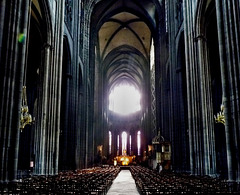
The first cathedral on this place was built already within the 5th century. This church was destroyed by Pepin the Short, who a couple of years later financed the reconstruction.
This second structure here was destroyed by the Normans in 915. The third (romanesque) cathedral, was consecrated in 946. This building probably served as the model and prototype for many churches in the Auvergne.
After a trip to Paris, the bishop was so enthusiastic about the the new gothic cathedrals being built in the north, that he had the romanesque cathedral was demolished - and in 1248 the construction of this cathedral started.
It took hundreds of years - and actually never got completed. During the French Revolution the revolutionaries wanted to tear down the church, but they could be persuaded to use it as a gathering place. So only some the transept towers and the complete furniture and interior decoration got lost. Finally in 1866 the completion works began. In 1884, the western façade with its spires and the last span of the nave were finally completed.
Standing in the nave, facing east to the choir, where the bright morning light bursts in. The cathedral is nearly 100 meters long. The choir was finished in 1287. When Louis IX of France (aka "Louis the Saint") came to Clermont marry his son Philipp (later Philipp III, aka "Philipp the Bold") to Isabella of Aragon. Probably taking this occasion the king financed part of the stained glass windows that may be from the same workshop as those in Sainte-Chapelle.
Under the choir is a crypt, that dates back into the 10th century. The crypt is made up of an ambulatory and radiating chapels. It was this crypt, that I wanted to visit, as I had read, that it was a kind of model for other crypts in the Auvergne. I had been here before, but then the crypt was closed. It was not my lucky day - it was closed again.
Clermont-Ferrand - Cathédrale Notre-Dame-de-l'Asso…
| 04 Nov 2011 |
|
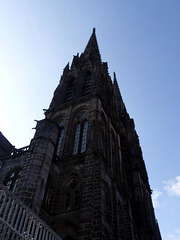
Early morning light on the two black spires of the Clermont-Ferrand cathedral. The spires are more than 100 meters high and black, like the entire cathedral, as the entire structure is built from the vulcanic rock from Volvic.
The first cathedral on this place was built already within the 5th century. This church was destroyed by Pepin the Short, who a couple of years later financed the reconstruction.
This second structure here was destroyed by the Normans in 915. The third (romanesque) cathedral, was consecrated in 946. This building probably served as the model and prototype for many churches in the Auvergne.
After a trip to Paris, the bishop was so enthusiastic about the the new gothic cathedrals being built in the north, that he had the romanesque cathedral was demolished - and in 1248 the construction of this cathedral started.
It took hundreds of years - and actually never got completed. During the French Revolution the revolutionaries wanted to tear down the church, but they could be persuaded to use it as a gathering place. So only some the transept towers and the complete furniture and interior decoration got lost. Finally in 1866 the completion works began. In 1884, the western façade with its spires and the last span of the nave were finally completed. So what you see here - is pretty recent.
Clermont-Ferrand
| 06 Jul 2010 |
|
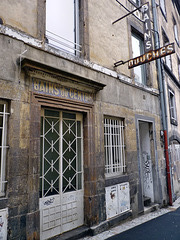
Unfortunately the "Bains du Central" were closed. when I found the
place. I would have loved, to see the interior of the bulilding.
Clermont-Ferrand - Basilica Notre-Dame-du-Port
| 07 Jan 2011 |
|
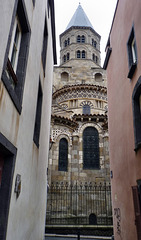
Notre-Dame-du-Port is in the middle of Clermont-Ferrand, just southeast of the
gothic cathedral. Approaching the Basilica through a narrow road.
Clermont-Ferrand - Notre-Dame-Du-Port
| 10 Jan 2011 |
|
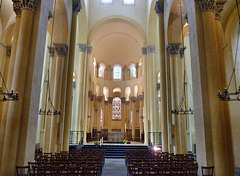
Notre-Dame-Du-Port constructed during the 12th century (on older foundations). Here the central nave of the basilica, having two lower aisles. Looking to the choir. Though the 18 meters high nave does not have a clerestory, it seems flooded with light after the recent renovation. Please note the carved capitals.
Clermont-Ferrand - Notre-Dame-Du-Port
| 10 Jan 2011 |
|
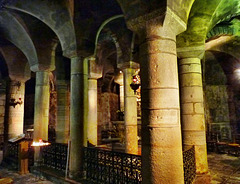
The crypt of Notre-Dame-Du-Port may be the oldest existing part of the basilica. It is rather large and not yet renovated. In medieaval times pilgrim walked in a procession around the ambulatory and then crossed the crypt, where the relics were stored. In front of the altar in this crypt exists a small well.
Clermont-Ferrand - Notre-Dame-Du-Port
| 10 Jan 2011 |
|
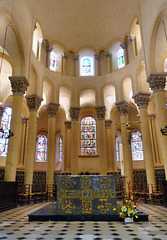
Like many basilicas and churches of that time, that were on a pilgrim´s way, Notre-Dame-Du-Port has a semicircular ambulatory, that enabled the pilgrims to undertake a procession around the altar (and through the crypt).
The decoration of the choir is much richer, that that of the nave. All capitals are elaborately carved on all sides. The central arcade is clearly wider than the other.
Clermont-Ferrand - Notre-Dame-Du-Port
| 10 Jan 2011 |
|
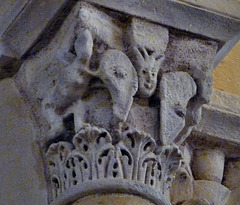
The capitals in the Basilica Notre-Dame-Du-Port are very elaborate. This one differs from the most. The carving style is - compared to the Rotbertus works - quite simple and it is very weathered. Maybe it has been on an outside wall for upto the great restauration during the 19th century.
I see two men fighting, holding up their shields - and inbetween the head of a devil, with the typical evil hairstyle. Well, from the right knight, only the shield (note the shield boss) and a part of the arm is to be seen - but he is there. Just around the edge.
Clermont-Ferrand - Notre-Dame-Du-Port
| 11 Jan 2011 |
|
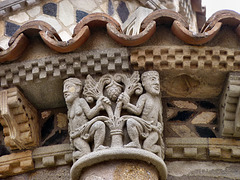
This carved capital is place outside under the roof of one of the the radiating chapels of Notre-Du-Port.
I am sure, that this capital is directly connected to one carved by ROTBERTUS, placed on one of the pillars at the choir inside. Both have the same theme - and a very similar style!
Depicted here are "Adam and Eve" in the Garden of Eden. They are both young, pretty and innocent. They are kneeling, holding a grape - perfectly symmetrically. They seem to pose. No snake - no danger. Just "another day in paradies".
Please not the black and white mosaics.
Clermont-Ferrand - Notre-Dame-Du-Port
| 07 Jan 2011 |
|
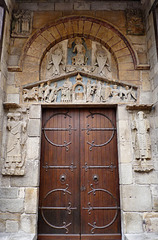
Notre-Dame-Du-Port constructed probably during the 12th century (on older foundations) and once a stopover on the pilgrim´s way to Santiago, got vandalized during the French Revolution. The furnishings got burned and some carvings on the outside of the church got partly destroyed. Here the southern portal, that got damaged (all faces are lost).
The two large sculptures next to the doors are less damaged. On the left is Isaiah (standing on two falling angels) on the right bearded John the Baptist.
Clermont-Ferrand - Notre-Dame-Du-Port
| 11 Jan 2011 |
|
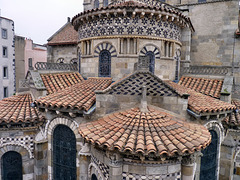
Transept, choir, ambulatory and the radiating chapels of Notre-Du-Port from outside! In the residential-building opposite the church is a public balcony up the third floor, to see this! "Merci beaucoup!" to the people living there, tolerating all the tourists on their stairs up and down.
Unfortunately my camera does not offer the wide angle, needed to take the photo, I wanted...
These "multi-staging" chevets/apses are very typical for the romanesque churches of the Auvergne. Compare this to "Saint-Nectaire" or "Notre-Dame d’Orcival". The mosaics and the capitals are renovated, but still pretty original. Only the roof-tiles got replaced recently.
Note the carved capital in the middle under the roof. Two griffons drinking out of a chalice.
Clermont-Ferrand - Notre-Dame-Du-Port
| 10 Jan 2011 |
|
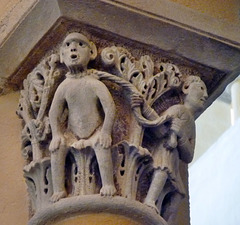
The capitals in the Basilica Notre-Dame-Du-Port are very elaborate. On some of them even a signature (ROTBERTUS) could be found.
This capital, perfectly carved, differs thematically.
It depicts an ape - on a rope, led a man. I have seen a couple of carved monkeys and apes before, but never such a giant creature with such a threatening facial expression. This ape is at least as tall as the man on the side, probably taller, as the ape is bending his knees The ape seen here is probably a symbol for the evil, a creature from hell, - but the evil here is under control of the man.
Jump to top
RSS feed- Martin M. Miles' latest photos with "Clermont-Ferrand" - Photos
- ipernity © 2007-2026
- Help & Contact
|
Club news
|
About ipernity
|
History |
ipernity Club & Prices |
Guide of good conduct
Donate | Group guidelines | Privacy policy | Terms of use | Statutes | In memoria -
Facebook
X
