

Martin M. Miles' photos with the keyword: Lourdes
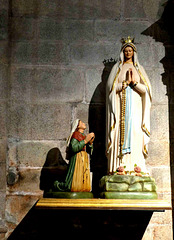
Lugo - Catedral de Santa María
| 29 Mar 2024 |
|
Lugo, today a city with a population of about 100.000, claims to be the oldest city in Galicia. Its founding dates back to the expansionist policies of the Romans during the time of Emperor Augustus. Among other things, this aimed to permanently pacify the northwest of the Iberian Peninsula. Paullus Fabius Maximus founded 14–13 BC. BC in the name of his emperor, the place Lucus Augusti on the site of a building dating back to around 25 BC. BC existing military camp.
It is the only city in the world surrounded by completely intact Roman walls. The wall is between six and eight meters thick, around twelve meters high at the highest point and has 85, mostly semicircular towers. In Roman times the wall had five gates and today it has ten.
A predecessor church existed on the site in 755. In 1129, Bishop Petro III commissioned the local architect Raimund to build a new church in the current Romanesque style, which was completed in 1273. Later renovations and restorations added elements in other styles.
The cathedral was built on the floor plan of a Latin cross with a length of 85 metres.
A Lourdes scene
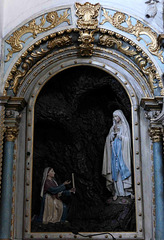
Bragança - Sé Velha de Bragança
| 04 Mar 2024 |
|
|
In Roman times, the region belonged to the province of Gallaecia and was under the administration of Asturica Augusta (now Astorga).
The Romans were followed by the Visigoths and Suebi, who incorporated this region into their empire and introduced wheat cultivation. The first documentary mention of the settlement that developed into today's Bragança was found in the records of the Council of Lugo in 569. Under the administration of King Wamba, the town was recorded as Bregancia in 666.
From 711, the Visigoths were expelled by the Moors. The area was probably sparsely populated when the Reconquista emerged and pushed the Moors southwards. Due to its location on strategic transport routes, Bragança became increasingly important, especially after Portugal gained independence in 1139. King D. Sancho I rebuilt the badly damaged town, refortified it and granted it city rights in 1187. In 1199, D. Sancho I freed the town from the siege by Alfonso IX and established the current Portuguese place name.
In the course of the revolution of 1383 and the attempt by the hereditary Castile to take over Portugal, Bragança fell to its neighbour. It has been Portuguese again since 1401
The church of São João Baptista, known as Sé Velha (old cathedral), was built in the 16th century as part of a monastery complex. It was initially the church of a Jesuit college dedicated to the name of Jesus and from the 18th century until the new Bragança Cathedral was built, it was the episcopal see of the Bragança-Miranda diocese. In the 17th and 18th centuries, the church was remodeled in the Baroque style under the Jesuits.
A Lourdes grotto
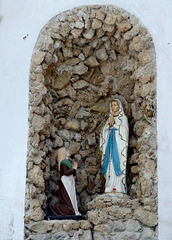
Stilo - San Francesco
| 03 Nov 2022 |
|
|
Stilo (Stilida) was part of the Byzantine Empire in the 6th century. In 982 it suffered damage from a battle between Otto II . and the Arab-Byzantine troops. The battle had begun near Crotone, but when Otto's troops thought they had won, they were placed here and defeated. Otto II died a year later from malaria in Rome.
During the Middle Ages, the coastal inhabitants moved further inland and moved to where Stilo is today. Between 1065 and 1071 Stilo resisted the Norman invasion. At that time it was fortified. Today Stilo is a small town with a population of around 2500.
San Francesco is a 16th-century late Baroque church with a little Lourdes chapel.
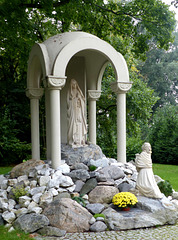
Poznań - Kościół św. Jana Jerozolimskiego za mura…
| 28 Jun 2022 |
|
|
Long before the Christianization of Poland Poznań was an important cultural and political center of the Western Polans. It consisted of a fortified stronghold between the Warta and Cybina rivers. Mieszko I, the first historically recorded ruler of the West Polans and of the early Polish state which they dominated, built one of his main headquarters in Poznań. Mieszko's baptism in 966, seen as a defining moment in the Christianization of the Polish state, may have taken place in Poznań.
Following the baptism, construction began of Poznań's cathedral, the first in Poland. It became the place of burial of the early Piast monarchs, among them Mieszko I, Boleslaus I, Mieszko II Lambert, and Casimir I.
In 1038, Duke Bretislaus I of Bohemia sacked and destroyed both Poznań and Gniezno. In 1138, by the testament of Boleslaus III, Poland was divided into separate duchies under the late king's sons, and Poznań and its surroundings became the domain of Mieszko III the Old.
In 1249, Duke Przemysł I began constructing the Royal Castle on a hill on the left bank of the Warta. Then in 1253, Przemysł issued a charter for the founding of a town under Magdeburg law, between the castle and the river. A large number of German settlers were brought to aid in the building and settlement of the city, which was surrounded by a defensive wall, integrated with the castle.
Poznan was a major center for the fur trade by the late 16th century. Suburban settlements developed around the city walls, on the river islands, and on the right bank, however, the city's development was hampered by regular major fires and floods.
In the 17th century and the 18th, Poznań was affected by a series of wars, attendant military occupations, lootings, and destruction – the Northern Wars, the War of the Polish Succession, and the Seven Years' War. It was also hit by outbreaks of plague, and by floods, particularly that of 1736, which destroyed most of the suburban buildings. The population declined from 20,000 around 1600 to 6,000 around 1730, and Bambergian and Dutch settlers were brought in to rebuild the devastated suburbs.
In 1793, in the Second Partition of Poland, Poznań came under the control of the Kingdom of Prussia.
-
The original church on this site was built at the end of the 11th century outside Poznań's medieval defensive walls.
The church is dedicated to St. John of Jerusalem (John the Baptist), the patron saint of the Knights Hospitallers, to whom the church belonged until 1832.
According to Jan Długosz, in 1170 Mieszko III and the bishop of Poznań set up a pilgrims' hospice there. In 1187 the church and hospice were granted to the Order of the Knights Hospitallers. Around the beginning of the 13th century, the Order began construction of a new church, which is essentially the building that survives to this day. It was one of the first brick-built churches in Poland. At some point, the church was re-dedicated to the Order's patron saint,
Following damage in the late 15th century, the church was rebuilt in Gothic style. In 1736 a Baroque chapel was added on the south side. In 1832 the Prussian government abolished the Order, and the church became a parish church.
In the garden area by the church is this Lourdes statue.
Saint-Auban - Notre Dame De La Clue
| 17 Dec 2019 |
|
|
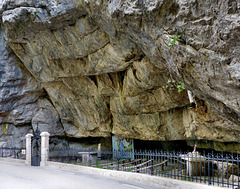
The Esteron river cut a very deep gorge into the mountain. Only a mule track existed, before the road through the gorge was constructed. In 1892, during the roadworks, a cave was discovered and converted into an oratory of Notre-Dame-de-Lourdes.
A Grotto
| 07 Nov 2009 |
|
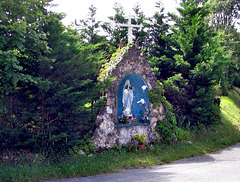
...the second half of the 19th century, this kind of Grottos were very fashionable in the catholic areas in Europe. A small "Lourdes" for every garden...
Lourdes
| 01 Sep 2009 |
|
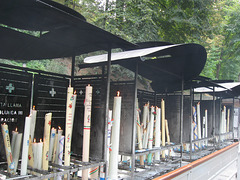
......Next to the grotto is a big area, where the candles can be lightened - and burn. They are so many, that they have built special metal huts with chimneys - just for the thousands of candles....
Jump to top
RSS feed- Martin M. Miles' latest photos with "Lourdes" - Photos
- ipernity © 2007-2026
- Help & Contact
|
Club news
|
About ipernity
|
History |
ipernity Club & Prices |
Guide of good conduct
Donate | Group guidelines | Privacy policy | Terms of use | Statutes | In memoria -
Facebook
X
