

Martin M. Miles' photos with the keyword: beardpuller

Chur - Kathedrale St. Mariae Himmelfahrt
| 15 Jun 2017 |
|
A cathedral may have existed here already within the 5th century. The Kathedrale St. Mariae Himmelfahrt (= "Saint Mary of the Assumption") of today was erected 1150 - 1272, from east to west.
The crypt, under the risen choir, is probably the oldest part of the cathedral. The architectural concept is very similar to that of neighbouring St. Luzius, built the same time.
Not only the massive bundle piers along the nave offer much room for complex capitals, the smaller ones in the aisles have capitals as well.
Some scholars have connected these works with that of Benedetto Antelami, who worked in Parma (Italy) around 1200.
Saint-Robert - Saint-Robert
| 06 Apr 2014 |
|
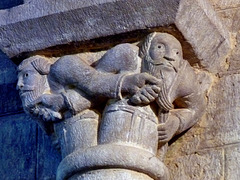
Once "Saint Robert" was the center of a thriving priory, dependent on the important Bendictian abbey "La Chaise-Dieu" in the Auvergne (250kms east). The priory got established here around 1080, the erection of the large pilgrim-church started soon after. The church is dedicated to Saint Robert, aka Robert de Turlande. He had founded La Chaise Dieu in 1053, and got canonized already in 1070.
This church got ruined during the Hundred Years´ War - and what can be still seen is transept, crossing tower, choir ambulatory. Where the large nave was, the parking lot stretches now. The ruins of the nave finally got demolished around.
After the French Revolution the church was used for the fabrication and storage of weapons and ammunition. It got restored within the 19th century. The village of Saint-Robert surrounding the church is one of the nicest in France - a "plus beaux villages de France".
All churches, designed and built for the pilgrims, have a similar design with choir/apse and ambulatory. Saint-Robert is sometimes compared with Saint-Pierre in Beaulieu-sur-Dordogne (70kms southeast). I do see strong parallels to churches in the Auvergne and even Burgundy. The monks from "La Chaise-Dieu" probably sent experienced architects and masons to the priory. Some of the delicately carved capitals here are mutilated, some seem not completed.
These beardpullers are not mutilated at all. Beardpullers can often be found on capitals, created within the 11th/12th century. Some see them a symbol of masturbation. These two gentlemen are so perfectly carved, that for a while I saw them as a work brought in here during the recent renovation, but I could not find a proof.

Aulnay - Saint-Pierre
| 23 Sep 2013 |
|
|
"Saint-Pierre d'Aulnay" is a church outside of Aulnay, in the center of an old graveyard. The setting has not changed for centuries. For the pilgrims of the 12th century this church was a major halt - and it still is for all the tourists...
A predecessing church „Saint-Pierre-de-la-Tour“ had been here, that, when the pilgrimage to Santiago de Compostella got more and more popular, was obviously to small, as Aulnay was conveniently situated between Poitiers and Saintes on the Via Turonensis. A new, larger church was needed, so the place was handed over to the chapter of the cathedral in Poitiers. The canons then probably planned this church, that was erected from about 1130/1140 on.
"Saint-Pierre d'Aulnay" is a gem of the "style saintongeais". For Peter Strafford ("Romanesque Churches Of France") this is "one of the best examples of late Romanesque architecture in what used to be Aquitaine".
Not only the exterior of Saint-Pierre is decorated with many wonderful works of art, the carved capitals of the nave, are extraordenary as well.
Different groups of stone carvers have worked here over the decades, so there are different styles of carvings here. This one differs from the decorative symmetric works (previous uploads), depicting two beard pulling devils. Compared to the evil devils, the victim looks pretty relaxed.
Toulouges - Assomption de la Vierge
| 23 May 2013 |
|
A thousand years ago, Toulouges was an important village in the diocese of Elne. By now Toulouges is just another western suburb of Perpignan.
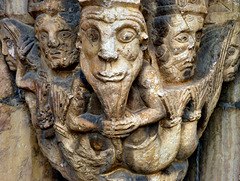
The "Église de l'Assomption de la Vierge" in Toulouges has an extraordenary southern portal, that is even more elaborate that one in Brouilla (see previous uploads). The left side of the portal is very weathered and partly lost. The tympanum is weathered as well and may depict St. Michael fighting the dragon.
The right side is still pretty complete. One of the two capitals (see previous upload) depicts a group centered around a beard pulling merman. Two mermaids flank the merman, while two bearded humans (?) peep over the fins. Though the carving style is comparably rough, all faces are very individual.
Jump to top
RSS feed- Martin M. Miles' latest photos with "beardpuller" - Photos
- ipernity © 2007-2026
- Help & Contact
|
Club news
|
About ipernity
|
History |
ipernity Club & Prices |
Guide of good conduct
Donate | Group guidelines | Privacy policy | Terms of use | Statutes | In memoria -
Facebook
X
