

Martin M. Miles' photos with the keyword: Old Town Hall

Dortmund - Altes Rathaus
| 12 Jul 2025 |
|
With over 600,000 inhabitants Dortmund is the third-largest city in North Rhine-Westphalia and the ninth-largest city in Germany.
Dortmund tradition has attributed the city's founding to Charlemagne, even though this is ultimately not documented. Traces of such a castle—considered to have been founded by Charlemagne due to its typical square layout—can still be found today in Dortmund's city center. Since the "Hellweg" became the preferred travel route for kings between the West Frankish part of the empire and Saxon, it was necessary to establish palaces along the route. Its assumed that the city rose to become an important palace in Westphalia and the Hellweg region in the 10th century.
In 1152, a court assembly took place here under King Frederick Barbarossa. Craftsmen and traders settled and contributed to Dortmund's gradual development as a city. As early as 1200, the city was fortified with city walls. In 1232 a major city fire broke out. It destroyed the city almost completely. The fire also lost the city archives and with it all documents. The privileges, which had been lost in the city fire, were renewed in 1236 by Frederick II.
In 1293, the city was granted brewing rights, and an unprecedented development of the beer industry began within the city. The influence of Dortmund's citizens also grew. This citizenry or patriciate consisted of influential families with excellent trading relations throughout Europe. They were important in the Hanseatic League
In 1389, Dortmund survived the Great Dortmund Feud against the Count of Mark and the Archbishop of Cologne and their allies. However, the city's economic decline began. This process was continued and intensified by the Thirty Years' War, leading to the city's decline into a small farming town, with the population declining to 4,500 by 1793. In 1808, Dortmund, as part of the Napoleonic Grand Duchy of Berg, became the prefecture of the Ruhr Department. After the Prussian victory over Napoleon, Dortmund finally fell to the Prussian province of Westphalia in 1815.
Only with the onset of industrialization was the decline halted. From the mid-19th century onward, coal mining and steel processing led to Dortmund's renewed rise and its transformation into an industrial city. With the opening of the Cologne-Minden Railway in 1847, Dortmund became an important transportation hub in the Ruhr region. The opening of the Dortmund-Ems Canal and thus the port in 1899 made a further significant contribution to economic development. This infrastructure paved Dortmund's path to becoming a major city. The city grew beyond the narrow confines of the medieval ramparts.
In 1876, over 50,000 people lived in Dortmund; by 1929, their number had risen to over 530,000.
During WW II, the city was destroyed by a total of 105 air raids. During the major raid on March 12, 1945, over 4,800 tons of bombs hit the city. This attack was the heaviest bombing raid on a German city. 95% of the historic city center and 59% of the residential area were destroyed. According to contemporary reports, it was initially considered not to rebuild the city center. However, reconstruction progressed quickly and by 1950 the city had 500,000 inhabitants.
-
Dortmund's Altes Rathaus (Old Town Hall) was built in 1899 in the Renaissance Revival style. After WW II, it was rebuilt in a simplified form. At the top of the gable is the eagle of Dortmund's city coat of arms. The facades are made of red sandstone, with plastered surfaces on the sides. The front features the coats of arms of the eight Hanseatic cities of Bremen, Hamburg, Cologne, Lippstadt, Lübeck, Münster, Osnabrück, and Soest.
Adjacent to the Old Town Hall are the Berswordt Hall, built in 2002, and the new Town Hall.
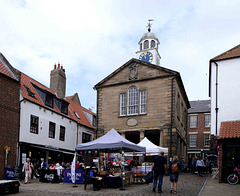
Whitby - Old Town Hall
| 08 Mar 2025 |
|
Whitby Abbey was founded in 657 AD by King Oswiu, as an act of thanksgiving, after defeating Penda, the pagan king of Mercia. The abbey became the leading royal nunnery of the kingdom of Deira, and the burial-place of its royal family. In 664, the Synod of Whitby took place, which determined the calculation of the Christian date of Easter, according to which Easter always falls on the first Sunday after the first full moon after the beginning of spring on March 21st. This rule for the movable holiday prevailed throughout Europe and is still in force today.
When Henry VIII dissolved the monasteries and the abbey here surrendered in 1539. By then the town that had developed had between 20 and 30 houses and a population of about 200.
The city was the training ground for Britain's most important seafarer, James Cook. His monument overlooks the city's harbor.
The Old Town Hall, built in the neoclassical style, measures 10 m in length and 8.2 m in width and was furnished with a clock at the expense of the town.
The building has an open ground floor with the upper floor supported by columns. This allowed the undercroft to be used for market trading. The upper floor, accessed by a spiral staircase in the centre of the lower floor, is where the courts used to meet.
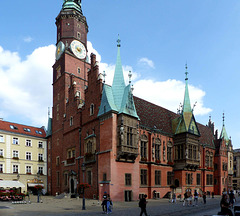
Wroclaw - Stary Ratusz
| 22 May 2022 |
|
|
The history of Wroclaw dates back more than a thousand years. At various times, it has been part of the Kingdom of Poland, the Kingdom of Bohemia, the Kingdom of Hungary, the Habsburg monarchy of Austria, the Kingdom of Prussia, and Germany. Wrocław became part of Poland again in 1945 as part of the result of extensive border changes and expulsions after WWII.
In 990 Mieszko I of Poland conquered Silesia and Wrocław. The town became a commercial center. In the 12th century Polish, Bohemian, Jewish, Walloon, and German communities existed here.
Wroclaw was devastated in 1241 during the first Mongol invasion of Poland. In the 13th century due to migration from Saxony and Bavaria, Wroclaw got germanised. The population adopted the German language and culture and the name changed to Breslau.
Between 1342 and 1344 two fires destroyed large parts of the city, which was a part of the Bohemian Kingdom at that time. Charles IV`s , successors Wenceslaus and Sigismund became involved in a long-lasting feud with the city and its magistrate, culminating in the revolt in 1418 when local craftsmen killed seven councilors.
After the city had defeated the Bohemian Hussites the city was besieged by a combined Polish-Czech force in 1474, however, a ceasefire was signed, according to which the city remained under Hungarian rule.
The Reformation reached Breslau already in 1518, and in 1523 the town council unanimously appointed a new pastor and thus introduced the Reformation in Breslau.
In 1526, the Habsburg monarchy of Austria inherited Bohemia, Silesia, and the city of Breslau. In 1609 German emperor Rudolf II granted the free exercise of church services to all Bohemian and Silesian Protestants. In the following Thirty Years' War, the city suffered badly. It was occupied by Saxon and Swedish troops and lost 18,000 of its 40,000 residents to the plague.
The Counter-Reformation had started with Rudolf II who encouraged Catholic orders to settle in Breslau. The dominance of the German population under the Habsburg rule in the city became more visible, while the Polish population diminished in numbers.
After Frederick the Great besieged the city for a year, it surrendered in 1741. In 1742, Queen Maria Theresa handed over Silesia to the Prussian king.
-
The Old Town Hall stands at the center of Rynek, the city’s Market Square. The Gothic town hall, built from the 13th century on, is a main landmark of the city.
The first mention of it dates back to 1299. At that time the building did serve mainly for trade. Until the 16th century, several structural extensions and reconstructions took place. Between 1328 and 1333 the building was extended; it received a second floor, in which the rooms for the town council were located. Between 1343 and 1357, a courtroom was added to the second floor. In addition, the west tower was raised and extended.
The biggest reconstruction of the building took place between 1470 and 1480, the building was significantly enlarged and received a late Gothic facade.
At the beginning of the 19th century, the old building became too small for the administration. Between 1860 and 1863, a neo-Gothic extension was built next to the existing town hall, the New Town Hall. After the opening of the new building became the historical town hall.
Since the beginning of the 20th century, it has served as a city museum. In the cellar rooms, there is still the tavern "Schweidnitzer Keller", which has existed since about 1275.
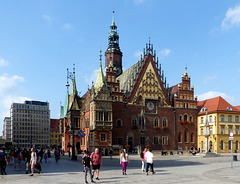
Wroclaw - Stary Ratusz
| 22 May 2022 |
|
|
The history of Wroclaw dates back more than a thousand years. At various times, it has been part of the Kingdom of Poland, the Kingdom of Bohemia, the Kingdom of Hungary, the Habsburg monarchy of Austria, the Kingdom of Prussia, and Germany. Wrocław became part of Poland again in 1945 as part of the result of extensive border changes and expulsions after WWII.
In 990 Mieszko I of Poland conquered Silesia and Wrocław. The town became a commercial center. In the 12th century Polish, Bohemian, Jewish, Walloon, and German communities existed here.
Wroclaw was devastated in 1241 during the first Mongol invasion of Poland. In the 13th century due to migration from Saxony and Bavaria, Wroclaw got germanised. The population adopted the German language and culture and the name changed to Breslau.
Between 1342 and 1344 two fires destroyed large parts of the city, which was a part of the Bohemian Kingdom at that time. Charles IV`s , successors Wenceslaus and Sigismund became involved in a long-lasting feud with the city and its magistrate, culminating in the revolt in 1418 when local craftsmen killed seven councilors.
After the city had defeated the Bohemian Hussites the city was besieged by a combined Polish-Czech force in 1474, however, a ceasefire was signed, according to which the city remained under Hungarian rule.
The Reformation reached Breslau already in 1518, and in 1523 the town council unanimously appointed a new pastor and thus introduced the Reformation in Breslau.
In 1526, the Habsburg monarchy of Austria inherited Bohemia, Silesia, and the city of Breslau. In 1609 German emperor Rudolf II granted the free exercise of church services to all Bohemian and Silesian Protestants. In the following Thirty Years' War, the city suffered badly. It was occupied by Saxon and Swedish troops and lost 18,000 of its 40,000 residents to the plague.
The Counter-Reformation had started with Rudolf II who encouraged Catholic orders to settle in Breslau. The dominance of the German population under the Habsburg rule in the city became more visible, while the Polish population diminished in numbers.
After Frederick the Great besieged the city for a year, it surrendered in 1741. In 1742, Queen Maria Theresa handed over Silesia to the Prussian king.
-
The Old Town Hall stands at the center of Rynek, the city’s Market Square. The Gothic town hall, built from the 13th century on, is a main landmark of the city.
The first mention of it dates back to 1299. At that time the building did serve mainly for trade. Until the 16th century, several structural extensions and reconstructions took place. Between 1328 and 1333 the building was extended; it received a second floor, in which the rooms for the town council were located. Between 1343 and 1357, a courtroom was added to the second floor. In addition, the west tower was raised and extended.
The biggest reconstruction of the building took place between 1470 and 1480, the building was significantly enlarged and received a late Gothic facade.
At the beginning of the 19th century, the old building became too small for the administration. Between 1860 and 1863, a neo-Gothic extension was built next to the existing town hall, the New Town Hall. After the opening of the new building became the historical town hall.
Since the beginning of the 20th century, it has served as a city museum. In the cellar rooms, there is still the tavern "Schweidnitzer Keller", which has existed since about 1275.
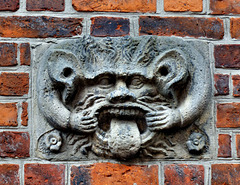
Hannover - Altes Rathaus PiP
| 14 Jul 2021 |
|
|
|
With more than 500.000 inhabitants Hannover is the capital and largest city of the German state of Lower Saxony.
Hannover was founded in medieval times on the east bank of the River Leine. It was a small village of ferrymen and fishermen. It became a comparatively large town in the 13th century, receiving town privileges in 1241, owing to its position at a natural crossroads. It was connected to the Hanseatic League city of Bremen by the Leine and was situated north-west of the Harz mountains so that east-west traffic passed through it.
In the 14th century the main churches of Hanover were built, as well as a city wall with three city gates.
Between 1714 and 1837 three kings of Great Britain were concurrently also Electoral Princes of Hanover.
As an important railway and road junction and production centre, Hannover was a major target for strategic bombing during World War II. More than 90% of the city centre was destroyed in a total of 88 bombing raids. So today Hannover lacks it´s medieval heart. Only a few buildings got rebuilt and restored.
-
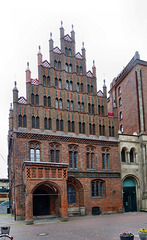
The Old Town Hall (Altes Rathaus) was the first town hall of the city of Hannover. It is Hannover´s oldest secular building, erected in the Brick Gothic style.
The erection of the building started in 1410. But it underwent several reconstructions and extensions. The original first floor became today's basement due to late medieval fills. In 1844, a renovation of the wings took place and one half-timbered wing of the 16th century was demolished and replaced by what is now nicknamed the "Doge's Palace", which houses the registry office.
When the old town hall was to be demolished at the end of the 19th century, a citizens' initiative was formed. The building was ultimately spared. It was renovated from 1877 to 1891, restoring it to the assumed condition from the time it was built, as this was considered a "pure" architectural style.
The air raids on Hanover in 1943 led to the partial destruction of the building complex. Restorations took place in 1953 and in 1964 the show gable on the west side was reconstructed.
A peculiar little relief on the town hall. What did the mayor want to tell his citizens with it?
Hannover - Altes Rathaus
| 14 Jul 2021 |
|
|
With more than 500.000 inhabitants Hannover is the capital and largest city of the German state of Lower Saxony.
Hannover was founded in medieval times on the east bank of the River Leine. It was a small village of ferrymen and fishermen. It became a comparatively large town in the 13th century, receiving town privileges in 1241, owing to its position at a natural crossroads. It was connected to the Hanseatic League city of Bremen by the Leine and was situated north-west of the Harz mountains so that east-west traffic passed through it.
In the 14th century the main churches of Hanover were built, as well as a city wall with three city gates.
Between 1714 and 1837 three kings of Great Britain were concurrently also Electoral Princes of Hanover.
As an important railway and road junction and production centre, Hannover was a major target for strategic bombing during World War II. More than 90% of the city centre was destroyed in a total of 88 bombing raids. So today Hannover lacks it´s medieval heart. Only a few buildings got rebuilt and restored.
-
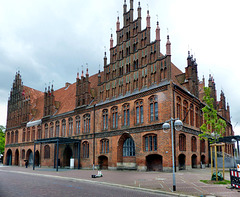
The Old Town Hall (Altes Rathaus) was the first town hall of the city of Hannover. It is Hannover´s oldest secular building, erected in the Brick Gothic style.
The erection of the building started in 1410. But it underwent several reconstructions and extensions. The original first floor became today's basement due to late medieval fills. In 1844, a renovation of the wings took place and one half-timbered wing of the 16th century was demolished and replaced by what is now nicknamed the "Doge's Palace", which houses the registry office.
When the old town hall was to be demolished at the end of the 19th century, a citizens' initiative was formed. The building was ultimately spared. It was renovated from 1877 to 1891, restoring it to the assumed condition from the time it was built, as this was considered a "pure" architectural style.
The air raids on Hanover in 1943 led to the partial destruction of the building complex. Restorations took place in 1953 and in 1964 the show gable on the west side was reconstructed.
Hannover - Altes Rathaus
| 14 Jul 2021 |
|
|
With more than 500.000 inhabitants Hannover is the capital and largest city of the German state of Lower Saxony.
Hannover was founded in medieval times on the east bank of the River Leine. It was a small village of ferrymen and fishermen. It became a comparatively large town in the 13th century, receiving town privileges in 1241, owing to its position at a natural crossroads. It was connected to the Hanseatic League city of Bremen by the Leine and was situated north-west of the Harz mountains so that east-west traffic passed through it.
In the 14th century the main churches of Hanover were built, as well as a city wall with three city gates.
Between 1714 and 1837 three kings of Great Britain were concurrently also Electoral Princes of Hanover.
As an important railway and road junction and production centre, Hannover was a major target for strategic bombing during World War II. More than 90% of the city centre was destroyed in a total of 88 bombing raids. So today Hannover lacks it´s medieval heart. Only a few buildings got rebuilt and restored.
-
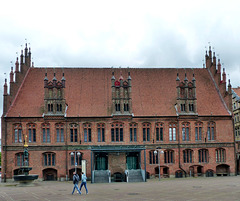
The Old Town Hall (Altes Rathaus) was the first town hall of the city of Hannover. It is Hannover´s oldest secular building, erected in the Brick Gothic style.
The erection of the building started in 1410. But it underwent several reconstructions and extensions. The original first floor became today's basement due to late medieval fills. In 1844, a renovation of the wings took place and one half-timbered wing of the 16th century was demolished and replaced by what is now nicknamed the "Doge's Palace", which houses the registry office.
When the old town hall was to be demolished at the end of the 19th century, a citizens' initiative was formed. The building was ultimately spared. It was renovated from 1877 to 1891, restoring it to the assumed condition from the time it was built, as this was considered a "pure" architectural style.
The air raids on Hanover in 1943 led to the partial destruction of the building complex. Restorations took place in 1953 and in 1964 the show gable on the west side was reconstructed.
Hannover - Altes Rathaus
| 14 Jul 2021 |
|
|
With more than 500.000 inhabitants Hannover is the capital and largest city of the German state of Lower Saxony.
Hannover was founded in medieval times on the east bank of the River Leine. It was a small village of ferrymen and fishermen that became a comparatively large town in the 13th century, receiving town privileges in 1241, owing to its position at a natural crossroads. It was connected to the Hanseatic League city of Bremen by the Leine and was situated north-west of the Harz mountains, so that east-west traffic passed through it.
In the 14th century the main churches of Hanover were built, as well as a city wall with three city gates.
Between 1714 and 1837 three kings of Great Britain were concurrently also Electoral Princes of Hanover.
As an important railway and road junction and production centre, Hannover was a major target for strategic bombing during World War II. More than 90% of the city centre was destroyed in a total of 88 bombing raids. So today Hannover lacks it´s medieval heart. Only few buildings got rebuilt and restored.
-
The Old Town Hall (Altes Rathhaus) was the first town hall of the city of Hannover. It is Hannover´s oldest secular building, erected in the Brick Gothic style.
The erection of the building started in 1410. But it underwent several reconstructions and extensions. The original first floor became today's basement due to late medieval fills . In 1844, a renovation of the wings took place and one half timbered wing of the 16th century, was demolished and replaced by what is now nicknamed the "Doge's Palace", which houses the registry office.
When the old town hall was to be demolished at the end of the 19th century, a citizens' initiative was formed. The building was ultimately spared. It was renovated from 1877 to 1891, restoring it to the assumed condition from the time it was built, as this was considered a "pure" architectural style.
The air raids on Hanover in 1943 led to the partial destruction of the building complex. Restorations took place in 1953 and in 1964 the show gable on the west side was reconstructed.
Kelheim - Altes Rathaus
| 04 Feb 2021 |
|
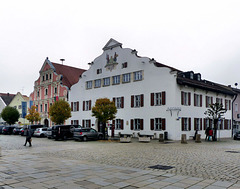
Kelheim is situated at the confluence of the rivers Altmühl and Danube. Kelheim was first mentioned in the 9th century when it was the seat of a count. 200 years later it was owned by the House of Wittelsbach. Duke Ludwig I (aka "Ludwig der Kelheimer") made Kelheim to one of his favourite residences. After his murder on the bridge in Kehlheim in 1231, the Wittelsbachers moved the residence to Landshut. The crime was never cleared up since the murderer was immediately lynched, though many suspected Emperor Frederick II to be behind the deed.
The support of the House of Wittelsbach continued as Kelheim was an important Danube crossing. It developed into an important trading point for wine, salt, fish, cattle, stones and wood.
In 1548 the city had its town hall representative built on the middle of the street crossing. After its demolition (1824), the town clerk's house became the town hall. This was built in 1598 and renovated in the 17th century.
Jump to top
RSS feed- Martin M. Miles' latest photos with "Old Town Hall" - Photos
- ipernity © 2007-2026
- Help & Contact
|
Club news
|
About ipernity
|
History |
ipernity Club & Prices |
Guide of good conduct
Donate | Group guidelines | Privacy policy | Terms of use | Statutes | In memoria -
Facebook
X
