

Martin M. Miles' photos with the keyword: Saint Helena

Dortmund - Petrikirche
| 20 Jul 2025 |
|
Petrikirche is a hall church in the High Gothic style, which approximates the ideal type of this church form. The building has a nearly square floor plan with a comparatively short choir.
St. Peter's Church, along with St. Reinoldi's Church and St. Mary's Church, is another medieval church located directly on Westenhellweg. The three-bay structure was begun in 1322 and is made of sandstone.
Antwerp retable is the name given to a type of winged altarpiece produced for export, particularly in Antwerp workshops during the first third of the 16th century. Antwerp retables are generally characterized by their intricately detailed carvings, but also by certain standardizations, such as their dimensions and the frequent repetition of certain groups of figures. Over 200 examples are still preserved today in churches and museums in various European countries.
At 5.65 meters high and 7.40 meters wide with the double doors open, the Dortmund carved altar, the "Goldenes Wunder von Westfalen", is considered the largest surviving Antwerp altarpiece. The retable features two pairs of wings, the interior of which is also sculpturally carved.
The altar was originally commissioned by the Dortmund Franciscans from Jan Gillisz Wrage in Antwerp for their monastery church. After the monastery was dissolved during secularization, the St. Peter's congregation acquired the altar and brought it to their church. During World War II, the altar was removed and returned to Dortmund in 1954. It was restored in St. Peter's Church from the early 1960s onwards and reinstalled in 1985.
The winged altar is opened differently throughout the church year, revealing different images on the front.
From Thanksgiving to Holy Week and from Easter to Pentecost, the actual gilded carved altar with 36 compartments and a total of 633 gilded figures can be seen inside. It depicts the detailed story of Jesus' Passion, with the crucifixion at its center.
The preparation for the flagelation of Jesus. The two people in the background are already holding scourges, while one is still being made in the foreground.

Dortmund - Petrikirche
| 19 Jul 2025 |
|
Petrikirche is a hall church in the High Gothic style, which approximates the ideal type of this church form. The building has a nearly square floor plan with a comparatively short choir.
St. Peter's Church, along with St. Reinoldi's Church and St. Mary's Church, is another medieval church located directly on Westenhellweg. The three-bay structure was begun in 1322 and is made of sandstone.
Antwerp retable is the name given to a type of winged altarpiece produced for export, particularly in Antwerp workshops during the first third of the 16th century. Antwerp retables are generally characterized by their intricately detailed carvings, but also by certain standardizations, such as their dimensions and the frequent repetition of certain groups of figures. Over 200 examples are still preserved today in churches and museums in various European countries.
At 5.65 meters high and 7.40 meters wide with the double doors open, the Dortmund carved altar, the "Goldenes Wunder von Westfalen", is considered the largest surviving Antwerp altarpiece. The retable features two pairs of wings, the interior of which is also sculpturally carved.
The altar was originally commissioned by the Dortmund Franciscans from Jan Gillisz Wrage in Antwerp for their monastery church. After the monastery was dissolved during secularization, the St. Peter's congregation acquired the altar and brought it to their church. During World War II, the altar was removed and returned to Dortmund in 1954. It was restored in St. Peter's Church from the early 1960s onwards and reinstalled in 1985.
The winged altar is opened differently throughout the church year, revealing different images on the front.
From Thanksgiving to Holy Week and from Easter to Pentecost, the actual gilded carved altar with 36 compartments and a total of 633 gilded figures can be seen inside. It depicts the detailed story of Jesus' Passion, with the crucifixion at its center.
Below - Jesus carries the cross
Above - Jesus is nailed to the cross

Dortmund - Petrikirche
| 19 Jul 2025 |
|
Petrikirche is a hall church in the High Gothic style, which approximates the ideal type of this church form. The building has a nearly square floor plan with a comparatively short choir.
St. Peter's Church, along with St. Reinoldi's Church and St. Mary's Church, is another medieval church located directly on Westenhellweg. The three-bay structure was begun in 1322 and is made of sandstone.
Antwerp retable is the name given to a type of winged altarpiece produced for export, particularly in Antwerp workshops during the first third of the 16th century. Antwerp retables are generally characterized by their intricately detailed carvings, but also by certain standardizations, such as their dimensions and the frequent repetition of certain groups of figures. Over 200 examples are still preserved today in churches and museums in various European countries.
At 5.65 meters high and 7.40 meters wide with the double doors open, the Dortmund carved altar, the "Goldenes Wunder von Westfalen", is considered the largest surviving Antwerp altarpiece. The retable features two pairs of wings, the interior of which is also sculpturally carved.
The altar was originally commissioned by the Dortmund Franciscans from Jan Gillisz Wrage in Antwerp for their monastery church. After the monastery was dissolved during secularization, the St. Peter's congregation acquired the altar and brought it to their church. During World War II, the altar was removed and returned to Dortmund in 1954. It was restored in St. Peter's Church from the early 1960s onwards and reinstalled in 1985.
The winged altar is opened differently throughout the church year, revealing different images on the front.
From Thanksgiving to Holy Week and from Easter to Pentecost, the actual gilded carved altar with 36 compartments and a total of 633 gilded figures can be seen inside. It depicts the detailed story of Jesus' Passion, with the crucifixion at its center.
A detail from the previous upload
A boy riding a hobby horse

Dortmund - Petrikirche
| 19 Jul 2025 |
|
Petrikirche is a hall church in the High Gothic style, which approximates the ideal type of this church form. The building has a nearly square floor plan with a comparatively short choir.
St. Peter's Church, along with St. Reinoldi's Church and St. Mary's Church, is another medieval church located directly on Westenhellweg. The three-bay structure was begun in 1322 and is made of sandstone.
Antwerp retable is the name given to a type of winged altarpiece produced for export, particularly in Antwerp workshops during the first third of the 16th century. Antwerp retables are generally characterized by their intricately detailed carvings, but also by certain standardizations, such as their dimensions and the frequent repetition of certain groups of figures. Over 200 examples are still preserved today in churches and museums in various European countries.
At 5.65 meters high and 7.40 meters wide with the double doors open, the Dortmund carved altar, the "Goldenes Wunder von Westfalen", is considered the largest surviving Antwerp altarpiece. The retable features two pairs of wings, the interior of which is also sculpturally carved.
The altar was originally commissioned by the Dortmund Franciscans from Jan Gillisz Wrage in Antwerp for their monastery church. After the monastery was dissolved during secularization, the St. Peter's congregation acquired the altar and brought it to their church. During World War II, the altar was removed and returned to Dortmund in 1954. It was restored in St. Peter's Church from the early 1960s onwards and reinstalled in 1985.
The winged altar is opened differently throughout the church year, revealing different images on the front.
From Thanksgiving to Holy Week and from Easter to Pentecost, the actual gilded carved altar with 36 compartments and a total of 633 gilded figures can be seen inside. It depicts the detailed story of Jesus' Passion, with the crucifixion at its center.
Matthew 27:24
When Pilate saw that he was getting nowhere, but that instead an uproar was starting, he took water and washed his hands in front of the crowd. “I am innocent of this man’s blood,” he said. “It is your responsibility!”

Dortmund - Petrikirche
| 19 Jul 2025 |
|
Petrikirche is a hall church in the High Gothic style, which approximates the ideal type of this church form. The building has a nearly square floor plan with a comparatively short choir.
St. Peter's Church, along with St. Reinoldi's Church and St. Mary's Church, is another medieval church located directly on Westenhellweg. The three-bay structure was begun in 1322 and is made of sandstone.
Antwerp retable is the name given to a type of winged altarpiece produced for export, particularly in Antwerp workshops during the first third of the 16th century. Antwerp retables are generally characterized by their intricately detailed carvings, but also by certain standardizations, such as their dimensions and the frequent repetition of certain groups of figures. Over 200 examples are still preserved today in churches and museums in various European countries.
At 5.65 meters high and 7.40 meters wide with the double doors open, the Dortmund carved altar, the "Goldenes Wunder von Westfalen", is considered the largest surviving Antwerp altarpiece. The retable features two pairs of wings, the interior of which is also sculpturally carved.
The altar was originally commissioned by the Dortmund Franciscans from Jan Gillisz Wrage in Antwerp for their monastery church. After the monastery was dissolved during secularization, the St. Peter's congregation acquired the altar and brought it to their church. During World War II, the altar was removed and returned to Dortmund in 1954. It was restored in St. Peter's Church from the early 1960s onwards and reinstalled in 1985.
The winged altar is opened differently throughout the church year, revealing different images on the front.
From Thanksgiving to Holy Week and from Easter to Pentecost, the actual gilded carved altar with 36 compartments and a total of 633 gilded figures can be seen inside. It depicts the detailed story of Jesus' Passion, with the crucifixion at its center.
Jesus Arrested

Dortmund - Petrikirche
| 17 Jul 2025 |
|
|
Petrikirche is a hall church in the High Gothic style, which approximates the ideal type of this church form. The building has a nearly square floor plan with a comparatively short choir.
St. Peter's Church, along with St. Reinoldi's Church and St. Mary's Church, is another medieval church located directly on Westenhellweg. The three-bay structure was begun in 1322 and is made of sandstone.
Antwerp retable is the name given to a type of winged altarpiece produced for export, particularly in Antwerp workshops during the first third of the 16th century. Antwerp retables are generally characterized by their intricately detailed carvings, but also by certain standardizations, such as their dimensions and the frequent repetition of certain groups of figures. Over 200 examples are still preserved today in churches and museums in various European countries.
At 5.65 meters high and 7.40 meters wide with the double doors open, the Dortmund carved altar, the "Goldenes Wunder von Westfalen", is considered the largest surviving Antwerp altarpiece. The retable features two pairs of wings, the interior of which is also sculpturally carved.
The altar was originally commissioned by the Dortmund Franciscans from Jan Gillisz Wrage in Antwerp for their monastery church. After the monastery was dissolved during secularization, the St. Peter's congregation acquired the altar and brought it to their church. During World War II, the altar was removed and returned to Dortmund in 1954. It was restored in St. Peter's Church from the early 1960s onwards and reinstalled in 1985.
The winged altar is opened differently throughout the church year, revealing different images on the front.
From Thanksgiving to Holy Week and from Easter to Pentecost, the actual gilded carved altar with 36 compartments and a total of 633 gilded figures can be seen inside. It depicts the detailed story of Jesus' Passion, with the crucifixion at its center.
The lowest level depicts the story of the discovery of the True Cross by Saint Helena, the mother of Emperor Constantine.
After Heraclius has killed Chosroes, who had stolen the True Cross (previous upload), he brings the Cross back to Jesusalem.

Dortmund - Petrikirche
| 16 Jul 2025 |
|
|
Petrikirche is a hall church in the High Gothic style, which approximates the ideal type of this church form. The building has a nearly square floor plan with a comparatively short choir.
St. Peter's Church, along with St. Reinoldi's Church and St. Mary's Church, is another medieval church located directly on Westenhellweg. The three-bay structure was begun in 1322 and is made of sandstone.
Antwerp retable is the name given to a type of winged altarpiece produced for export, particularly in Antwerp workshops during the first third of the 16th century. Antwerp retables are generally characterized by their intricately detailed carvings, but also by certain standardizations, such as their dimensions and the frequent repetition of certain groups of figures. Over 200 examples are still preserved today in churches and museums in various European countries.
At 5.65 meters high and 7.40 meters wide with the double doors open, the Dortmund carved altar, the "Goldenes Wunder von Westfalen", is considered the largest surviving Antwerp altarpiece. The retable features two pairs of wings, the interior of which is also sculpturally carved.
The altar was originally commissioned by the Dortmund Franciscans from Jan Gillisz Wrage in Antwerp for their monastery church. After the monastery was dissolved during secularization, the St. Peter's congregation acquired the altar and brought it to their church. During World War II, the altar was removed and returned to Dortmund in 1954. It was restored in St. Peter's Church from the early 1960s onwards and reinstalled in 1985.
The winged altar is opened differently throughout the church year, revealing different images on the front.
From Thanksgiving to Holy Week and from Easter to Pentecost, the actual gilded carved altar with 36 compartments and a total of 633 gilded figures can be seen inside. It depicts the detailed story of Jesus' Passion, with the crucifixion at its center.
The lowest level depicts the story of the discovery of the True Cross by Saint Helena, the mother of Emperor Constantine.
Heraclius beheads Chosroes, who had stolen the cross.

Dortmund - Petrikirche
| 16 Jul 2025 |
|
Petrikirche is a hall church in the High Gothic style, which approximates the ideal type of this church form. The building has a nearly square floor plan with a comparatively short choir.
St. Peter's Church, along with St. Reinoldi's Church and St. Mary's Church, is another medieval church located directly on Westenhellweg. The three-bay structure was begun in 1322 and is made of sandstone.
Antwerp retable is the name given to a type of winged altarpiece produced for export, particularly in Antwerp workshops during the first third of the 16th century. Antwerp retables are generally characterized by their intricately detailed carvings, but also by certain standardizations, such as their dimensions and the frequent repetition of certain groups of figures. Over 200 examples are still preserved today in churches and museums in various European countries.
At 5.65 meters high and 7.40 meters wide with the double doors open, the Dortmund carved altar, the "Goldenes Wunder von Westfalen", is considered the largest surviving Antwerp altarpiece. The retable features two pairs of wings, the interior of which is also sculpturally carved.
The altar was originally commissioned by the Dortmund Franciscans from Jan Gillisz Wrage in Antwerp for their monastery church. After the monastery was dissolved during secularization, the St. Peter's congregation acquired the altar and brought it to their church. During World War II, the altar was removed and returned to Dortmund in 1954. It was restored in St. Peter's Church from the early 1960s onwards and reinstalled in 1985.
The winged altar is opened differently throughout the church year, revealing different images on the front.
From Thanksgiving to Holy Week and from Easter to Pentecost, the actual gilded carved altar with 36 compartments and a total of 633 gilded figures can be seen inside. It depicts the detailed story of Jesus' Passion, with the crucifixion at its center.
The lowest level depicts the story of the discovery of the True Cross by Saint Helena, the mother of Emperor Constantine.
Emperor Constantine wins the Battle of the Milvian Bridge in 312 AD.

Dortmund - Petrikirche
| 16 Jul 2025 |
|
|
|
Petrikirche is a hall church in the High Gothic style, which approximates the ideal type of this church form. The building has a nearly square floor plan with a comparatively short choir.
St. Peter's Church, along with St. Reinoldi's Church and St. Mary's Church, is another medieval church located directly on Westenhellweg. The three-bay structure was begun in 1322 and is made of sandstone.
Antwerp retable is the name given to a type of winged altarpiece produced for export, particularly in Antwerp workshops during the first third of the 16th century. Antwerp retables are generally characterized by their intricately detailed carvings, but also by certain standardizations, such as their dimensions and the frequent repetition of certain groups of figures. Over 200 examples are still preserved today in churches and museums in various European countries.
At 5.65 meters high and 7.40 meters wide with the double doors open, the Dortmund carved altar, the "Goldenes Wunder von Westfalen", is considered the largest surviving Antwerp altarpiece. The retable features two pairs of wings, the interior of which is also sculpturally carved.
The altar was originally commissioned by the Dortmund Franciscans from Jan Gillisz Wrage in Antwerp for their monastery church. After the monastery was dissolved during secularization, the St. Peter's congregation acquired the altar and brought it to their church. During World War II, the altar was removed and returned to Dortmund in 1954. It was restored in St. Peter's Church from the early 1960s onwards and reinstalled in 1985.
The winged altar is opened differently throughout the church year, revealing different images on the front.
From Thanksgiving to Holy Week and from Easter to Pentecost, the actual gilded carved altar with 36 compartments and a total of 633 gilded figures can be seen inside. It depicts the detailed story of Jesus' Passion, with the crucifixion at its center.
The lowest level depicts the story of the discovery of the True Cross by Saint Helena, the mother of Emperor Constantine.
In the background, you can see three crosses being unearthed. The True Cross performs a miracle and is thus recognized.
Trier
| 20 Feb 2013 |
|
Founded by the Romans around 30 BC as "Augusta Treverorum", Trier claims (just like Xanten, Cologne, Worms, Speyer...) to be the oldest existing German city.
Trier, the center of a diocese already within the 3rd century, was destroyed by the Alemanni (275), rebuilt under Constantine the Great, who resided in "Augusta Treverorum". Under his the reign Maximin of Trier (329–346), the fifth Bishop here, started the construction of an giant ecclesial ensemble with four basilicas and a baptisterium on the foundations of a Roman settlement.
The buildings, ruined by the Franks, got rebuilt and destroyed again by the Vikings (Normans) in 882. In 977 Emperor Otto II installed his senior official Egbert of Trier as Bishop. Egbert started a building process, that reused lots of the ruined structures.
Constantine´s mother Helena lived in Trier for quite some time. Saint Ambros of Milan, born in Trier, wrote that Saint Helena travelled to Jerusalem at the age of 76. There she not only discovered the Holy Sepulchre, Golgotha and the True Cross but returned loaded with relics. She brought to Trier the relics of the Apostle Matthias (now in St. Matthias) - and the "Holy Robe". The "Holy Robe" (aka "Heiliger Rock") was first mentioned to be here in 1198, what may have ended a rivalry between the Cathedral in Trier and the Abbey in Pruem (60kms north), as Pepin the Short had given "Jesus´Sandals" to that abbey in 752.
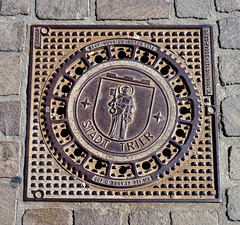
The Cathedral of Trier is dedicated to Saint Peter, so probably the whole episcopal space around the Cathedral is under his special protection. Even the sewers, as seen on this gullycover.
Trier - Cathedral of Trier
| 20 Feb 2013 |
|
Founded by the Romans around 30 BC as "Augusta Treverorum", Trier claims (just like Xanten, Cologne, Worms, Speyer...) to be the oldest existing German city.
Trier, the center of a diocese already within the 3rd century, was destroyed by the Alemanni (275), rebuilt under Constantine the Great, who resided in "Augusta Treverorum". Under his the reign Maximin of Trier (329–346), the fifth Bishop here, started the construction of an giant ecclesial ensemble with four basilicas and a baptisterium. This was done on the foundations of a Roman settlement - and had a floorplan about 4 times larger than the Cathedral of today.
The buildings, ruined by the Franks, got rebuilt and destroyed again by the Vikings (Normans) in 882. In 977 Emperor Otto II installed his senior official Egbert of Trier as Bishop. Egbert started a building process, that reused lots of the ruined structures. The result can be seen today. The western apse was consecrated in 1224, but the building continued over the centuries.
Constantine´s mother Helena lived in Trier for quite some time. Saint Ambros of Milan, born in Trier, wrote that Saint Helena travelled to Jerusalem at the age of 76. There she not only discovered the Holy Sepulchre, Golgotha and the True Cross but returned loaded with relics. She brought to Trier the relics of the Apostle Matthias (now in St. Matthias) - and the "Holy Robe". The "Holy Robe" (aka "Heiliger Rock") was first mentioned to be here in 1198, what may have ended a rivalry between the Cathedral in Trier and the Abbey in Pruem (60kms north), as Pepin the Short had given "Jesus´Sandals" to that abbey in 752.
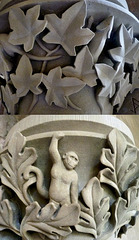
The Gothic cloister, joining the Cathedral and the neighbouring Liebfrauenkirche. The whole area got severely damaged in WWII, one tower of the Cathedral collapsed after being hit, in August 1944. The reconstruction of the complex, including this cloister, started directly after the war. So at least parts of the structures seen now, are new, like these details in the cloister. These capitals that replace lost ones, foliage populated by mice and apes.
Trier - Cathedral of Trier
| 20 Feb 2013 |
|
Founded by the Romans around 30 BC as "Augusta Treverorum", Trier claims (just like Xanten, Cologne, Worms, Speyer...) to be the oldest existing German city.
Trier, the center of a diocese already within the 3rd century, was destroyed by the Alemanni (275), rebuilt under Constantine the Great, who resided in "Augusta Treverorum". Under his the reign Maximin of Trier (329–346), the fifth Bishop here, started the construction of an giant ecclesial ensemble with four basilicas and a baptisterium. This was done on the foundations of a Roman settlement - and had a floorplan about 4 times larger than the Cathedral of today.
The buildings, ruined by the Franks, got rebuilt and destroyed again by the Vikings (Normans) in 882. In 977 Emperor Otto II installed his senior official Egbert of Trier as Bishop. Egbert started a building process, that reused lots of the ruined structures. The result can be seen today. The western apse was consecrated in 1224, but the building continued over the centuries.
Constantine´s mother Helena lived in Trier for quite some time. Saint Ambros of Milan, born in Trier, wrote that Saint Helena travelled to Jerusalem at the age of 76. There she not only discovered the Holy Sepulchre, Golgotha and the True Cross but returned loaded with relics. She brought to Trier the relics of the Apostle Matthias (now in St. Matthias) - and the "Holy Robe". The "Holy Robe" (aka "Heiliger Rock") was first mentioned to be here in 1198, what may have ended a rivalry between the Cathedral in Trier and the Abbey in Pruem (60kms north), as Pepin the Short had given "Jesus´Sandals" to that abbey in 752.
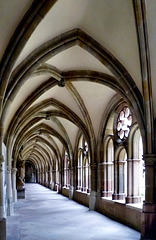
The Gothic cloister, joining the Cathedral and the neighbouring Liebfrauenkirche. The whole area got severely damaged in WWII, one tower of the Cathedral collapsed after being hit, in August 1944. The reconstruction of the episcopal complex, including this cloister, started directly after the war.
Trier - Cathedral of Trier
| 20 Feb 2013 |
|
Founded by the Romans around 30 BC as "Augusta Treverorum", Trier claims (just like Xanten, Cologne, Worms, Speyer...) to be the oldest existing German city.
Trier, the center of a diocese already within the 3rd century, was destroyed by the Alemanni (275), rebuilt under Constantine the Great, who resided in "Augusta Treverorum". Under his the reign Maximin of Trier (329–346), the fifth Bishop here, started the construction of an giant ecclesial ensemble with four basilicas and a baptisterium. This was done on the foundations of a Roman settlement - and had a floorplan about 4 times larger than the Cathedral of today.
The buildings, ruined by the Franks, got rebuilt and destroyed again by the Vikings (Normans) in 882. In 977 Emperor Otto II installed his senior official Egbert of Trier as Bishop. Egbert started a building process, that reused lots of the ruined structures. The result can be seen today. The western apse was consecrated in 1224, but the building continued over the centuries.
Constantine´s mother Helena lived in Trier for quite some time. Saint Ambros of Milan, born in Trier, wrote that Saint Helena travelled to Jerusalem at the age of 76. There she not only discovered the Holy Sepulchre, Golgotha and the True Cross but returned loaded with relics. She brought to Trier the relics of the Apostle Matthias (now in St. Matthias) - and the "Holy Robe". The "Holy Robe" (aka "Heiliger Rock") was first mentioned to be here in 1198, what may have ended a rivalry between the Cathedral in Trier and the Abbey in Pruem (60kms north), as Pepin the Short had given "Jesus´Sandals" to that abbey in 752.
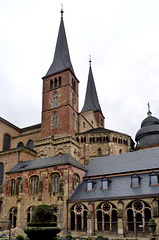
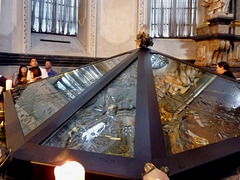
The eastern apse, seen from the cloister. Inside the round structure, that seems to be glued on to the apse, is that giant reliquar (seen before), that holds the "Holy Robe".
Trier - Cathedral of Trier
| 14 Feb 2013 |
|
Founded by the Romans around 30 BC as "Augusta Treverorum", Trier claims (just like Xanten, Cologne, Worms, Speyer...) to be the oldest existing German city.
Trier, the center of a diocese already within the 3rd century, was destroyed by the Alemanni (275), rebuilt under Constantine the Great, who resided in "Augusta Treverorum". Under his the reign Maximin of Trier (329–346), the fifth Bishop here, started the construction of an giant ecclesial ensemble with four basilicas and a baptisterium. This was done on the foundations of a Roman settlement - and had a floorplan about 4 times larger than the Cathedral of today.
The buildings, ruined by the Franks, got rebuilt and destroyed again by the Vikings (Normans) in 882. In 977 Emperor Otto II installed his senior official Egbert of Trier as Bishop, what did not prevent Egbert from supporting Otto´s rival Henry II (Henry the Wrangler) for some time. Egbert started a building process, that reused lots of the ruined structures. The result can be seen today. The western apse was consecrated in 1224, but the building continued over the centuries.
Constantine´s mother Helena lived in Trier for quite some time. Saint Ambros of Milan, born in Trier, wrote that Saint Helena travelled to Jerusalem at the age of 76. There she not only discovered the Holy Sepulchre and Golgotha but returned loaded with relics. She brought to Trier the relics of the Apostle Matthias (now in St. Matthias) - and the "Holy Robe". The "Holy Robe" (aka "Heiliger Rock") was first mentioned to be here in 1198, what may have ended a rivalry between the Cathedral in Trier and the Abbey in Pruem (60kms north), as Pepin the Short had given "Jesus´Sandals" to the abbey in 752.
I have been in Trier a couple of times meanwhile, so I will upload photos taken on different times, temperatures, lights and weathers.
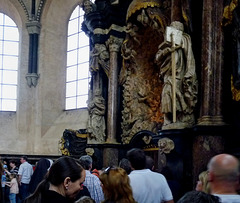
During the "Heilig-Rock-Tage" (only a few days per year) the large shrine, holding the "Holy Robe" (aka "Seamless robe of Jesus", "Holy Coat of Trier") can be circled by visitors. The "Holy Robe" cannot be seen, as this is hidden under light-tight covers.
The "Seamless robe of Jesus" refers to
John 19:23-24
"When the soldiers had crucified Jesus, they took his garments and divided them into four parts, one part for each soldier; also his tunic. But the tunic was seamless, woven in one piece from top to bottom, so they said to one another, “Let us not tear it, but cast lots for it to see whose it shall be."
The authenticity of the robe has been disputed over centuries. Martin Luther called it the "Scam of Trier" (1546). From 1626 to 1794 it has been kept in Ehrenbreitstein Fortress near Koblenz and later in Augsburg. The robe returned to Trier in 1810, but travelling and futile attempts at preservation over the time, lead to a very fragile state of the robe. A scientific examination has not been conducted.
Here is a German website:
www.bistum-trier.de/heilig-rock-tage/
Trier - Cathedral of Trier
| 14 Feb 2013 |
|
Founded by the Romans around 30 BC as "Augusta Treverorum", Trier claims (just like Xanten, Cologne, Worms, Speyer...) to be the oldest existing German city.
Trier, the center of a diocese already within the 3rd century, was destroyed by the Alemanni (275), rebuilt under Constantine the Great, who resided in "Augusta Treverorum". Under his the reign Maximin of Trier (329–346), the fifth Bishop here, started the construction of an giant ecclesial ensemble with four basilicas and a baptisterium. This was done on the foundations of a Roman settlement - and had a floorplan about 4 times larger than the Cathedral of today.
The buildings, ruined by the Franks, got rebuilt and destroyed again by the Vikings (Normans) in 882. In 977 Emperor Otto II installed his senior official Egbert of Trier as Bishop, what did not prevent Egbert from supporting Otto´s rival Henry II (Henry the Wrangler) for some time. Egbert started a building process, that reused lots of the ruined structures. The result can be seen today. The western apse was consecrated in 1224, but the building continued over the centuries.
Constantine´s mother Helena lived in Trier for quite some time. Saint Ambros of Milan, born in Trier, wrote that Saint Helena travelled to Jerusalem at the age of 76. There she not only discovered the Holy Sepulchre and Golgotha but returned loaded with relics. She brought to Trier the relics of the Apostle Matthias (now in St. Matthias) - and the "Holy Robe". The "Holy Robe" (aka "Heiliger Rock") was first mentioned to be here in 1198, what may have ended a rivalry between the Cathedral in Trier and the Abbey in Pruem (60kms north), as Pepin the Short had given "Jesus´Sandals" to the abbey in 752.
I have been in Trier a couple of times meanwhile, so I will upload photos taken on different times, temperatures, lights and weathers.
Standing in a queue in front of the door the the chamber, where the "Holy Robe" is kept in a reliquary. This door is open only during the "Heilig-Rock-Tage", what means only a few days per year. The "Holy Robe" (aka "Seamless robe of Jesus", "Holy Coat of Trier").
John 19:23-24
"When the soldiers had crucified Jesus, they took his garments and divided them into four parts, one part for each soldier; also his tunic. But the tunic was seamless, woven in one piece from top to bottom, so they said to one another, “Let us not tear it, but cast lots for it to see whose it shall be."
The authenticity of the robe has been disputed over centuries. Martin Luther called it the "Scam of Trier" (1546). From 1626 to 1794 it has been kept in Ehrenbreitstein Fortress near Koblenz and later in Augsburg. The robe returned to Trier in 1810, but travelling and futile attempts at preservation over the time, lead to a very fragile state of the robe. A scientific examination has not been conducted.
Here is a German website:
www.bistum-trier.de/heilig-rock-tage/
Trier - Cathedral of Trier
| 14 Feb 2013 |
|
Founded by the Romans around 30 BC as "Augusta Treverorum", Trier claims (just like Xanten, Cologne, Worms, Speyer...) to be the oldest existing German city.
Trier, the center of a diocese already within the 3rd century, was destroyed by the Alemanni (275), rebuilt under Constantine the Great, who resided in "Augusta Treverorum". Under his the reign Maximin of Trier (329–346), the fifth Bishop here, started the construction of an giant ecclesial ensemble with four basilicas and a baptisterium. This was done on the foundations of a Roman settlement - and had a floorplan about 4 times larger than the Cathedral of today.
The buildings, ruined by the Franks, got rebuilt and destroyed again by the Vikings (Normans) in 882. In 977 Emperor Otto II installed his senior official Egbert of Trier as Bishop, what did not prevent Egbert from supporting Otto´s rival Henry II (Henry the Wrangler) for some time. Egbert started a building process, that reused lots of the ruined structures. The result can be seen today. The western apse was consecrated in 1224, but the building continued over the centuries.
Constantine´s mother Helena lived in Trier for quite some time. Saint Ambros of Milan, born in Trier, wrote that Saint Helena travelled to Jerusalem at the age of 76. There she not only discovered the Holy Sepulchre and Golgotha but returned loaded with relics. She brought to Trier the relics of the Apostle Matthias (now in St. Matthias) - and the "Holy Robe". The "Holy Robe" (aka "Heiliger Rock") was first mentioned to be here in 1198, what may have ended a rivalry between the Cathedral in Trier and the Abbey in Pruem (60kms north), as Pepin the Short had given "Jesus´Sandals" to the abbey in 752.
I have been in Trier a couple of times meanwhile, so I will upload photos taken on different times, temperatures, lights and weathers.
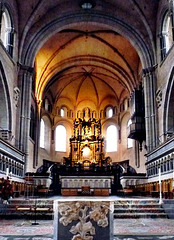
The eastern choir, now more detailled. Two Baroque staircases run up to what looks like the main altar. This structure has a small (closed) door. This entrance leads to a round chamber, where the "Holy Robe" is kept in a huge reliquary. During one of my visits this door was open. as the "Heilige Rock Tage" had started..
Trier - Cathedral of Trier
| 14 Feb 2013 |
|
Founded by the Romans around 30 BC as "Augusta Treverorum", Trier claims (just like Xanten, Cologne, Worms, Speyer...) to be the oldest existing German city.
Trier, the center of a diocese already within the 3rd century, was destroyed by the Alemanni (275), rebuilt under Constantine the Great, who resided in "Augusta Treverorum". Under his the reign Maximin of Trier (329–346), the fifth Bishop here, started the construction of an giant ecclesial ensemble with four basilicas and a baptisterium. This was done on the foundations of a Roman settlement - and had a floorplan about 4 times larger than the Cathedral of today.
The buildings, ruined by the Franks, got rebuilt and destroyed again by the Vikings (Normans) in 882. In 977 Emperor Otto II installed his senior official Egbert of Trier as Bishop, what did not prevent Egbert from supporting Otto´s rival Henry II (Henry the Wrangler) for some time. Egbert started a building process, that reused lots of the ruined structures. The result can be seen today. The western apse was consecrated in 1224, but the building continued over the centuries.
Constantine´s mother Helena lived in Trier for quite some time. Saint Ambros of Milan, born in Trier, wrote that Saint Helena travelled to Jerusalem at the age of 76. There she not only discovered the Holy Sepulchre and Golgotha but returned loaded with relics. She brought to Trier the relics of the Apostle Matthias (now in St. Matthias) - and the "Holy Robe". The "Holy Robe" (aka "Heiliger Rock") was first mentioned to be here in 1198, what may have ended a rivalry between the Cathedral in Trier and the Abbey in Pruem (60kms north), as Pepin the Short had given "Jesus´Sandals" to the abbey in 752.
I have been in Trier a couple of times meanwhile, so I will upload photos taken on different times, temperatures, lights and weathers.
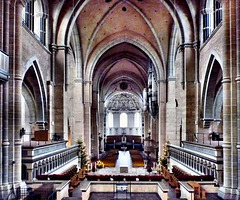
The central nave, now seen from east to west. The cathedral is 112 meters long and 41 meters wide. The Baroque baptismal font seen on the previous upload seems tiny, seen from the eastern choir.
Trier - Cathedral of Trier
| 13 Feb 2013 |
|
Founded by the Romans around 30 BC as "Augusta Treverorum", Trier claims (just like Xanten, Cologne, Worms, Speyer...) to be the oldest existing German city.
Trier, the center of a diocese already within the 3rd century, was destroyed by the Alemanni (275), rebuilt under Constantine the Great, who resided in "Augusta Treverorum". Under his the reign Maximin of Trier (329–346), the fifth Bishop here, started the construction of an giant ecclesial ensemble with four basilicas and a baptisterium. This was done on the foundations of a Roman settlement - and had a floorplan about 4 times larger than the Cathedral of today.
The buildings, ruined by the Franks, got rebuilt and destroyed again by the Vikings (Normans) in 882. In 977 Emperor Otto II installed his senior official Egbert of Trier as Bishop, what did not prevent Egbert from supporting Otto´s rival Henry II (Henry the Wrangler) for some time. Egbert started a building process, that reused lots of the ruined structures. The result can be seen today. The western apse was consecrated in 1224, but the building continued over the centuries.
Constantine´s mother Helena lived in Trier for quite some time. Saint Ambros of Milan, born in Trier, wrote that Saint Helena travelled to Jerusalem at the age of 76. There she not only discovered the Holy Sepulchre and Golgotha but returned loaded with relics. She brought to Trier the relics of the Apostle Matthias (now in St. Matthias) - and the "Holy Robe". The "Holy Robe" (aka "Heiliger Rock") was first mentioned to be here in 1198, what may have ended a rivalry between the Cathedral in Trier and the Abbey in Pruem (60kms north), as Pepin the Short had given "Jesus´Sandals" to the abbey in 752.
I have been in Trier a couple of times meanwhile, so I will upload photos taken on different times, temperatures, lights and weathers.
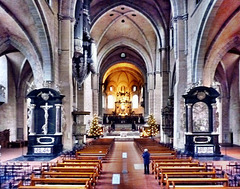
The central nave is decorated with christmas trees. I´m facing east. The cathedral is 112 meters long and 41 meters wide. It has two "elevated" apses, one west (where I stand) and one east. Behind the eastern apse is the place, where the "Holy Robe" is kept.
Every time has left traces, especially the Baroque era.
Jump to top
RSS feed- Martin M. Miles' latest photos with "Saint Helena" - Photos
- ipernity © 2007-2026
- Help & Contact
|
Club news
|
About ipernity
|
History |
ipernity Club & Prices |
Guide of good conduct
Donate | Group guidelines | Privacy policy | Terms of use | Statutes | In memoria -
Facebook
X
