

Martin M. Miles' photos with the keyword: Cappella Colleoni
Bergamo - Santa Maria Maggiore / Cappella Colleoni
| 12 Sep 2017 |
|
Bergamo was the settlement of a Celtic tribe but got conquered by the Romans in 196 BC. Looted by Attila´s troops in the 5th century, it became the capital of a Lombardian duchy a century later. After the conquest of the Lombard Kingdom by Charlemagne, the Franks ruled here.
End of the 11th century Bergamo had become an independent commune, with a lot of feuding between the local the Guelph and Ghibelline factions.
In 1428 Bergamo was ceded in 1428 by the Duchy of Milan to the Republic of Venice and was transformed into a fortified city, protecting the trade routes leading into the Rhine Valley.
The French Revolutionary Army ended more than three centuries of Venetian rule in 1797. Bergamo was part of the "Cisalpine Republic".
At Congress of Vienna, Bergamo was assigned to the (Austrian) Kingdom of Lombardy–Venetia. Giuseppe Garibaldi conquered Bergamo in 1859. The city was incorporated into the newly founded Kingdom of Italy.
Bergamo´s two centres are the Città alta ("upper city"), a hilltop medieval town, and the Città bassa ("lower city").
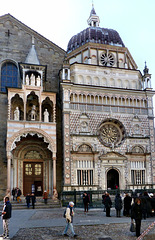
Next to the Duomo di Bergamo, opening to the Piazza Duomo, is the "Basilica di Santa Maria Maggiore".
The church was founded in 1137 on the site of aan older church and the altar was consecrated in 1185, but during the 13th and 15th century the works slowed down and the Romanesque church never got completed. Many chapels were added later. Here (left) is Santa Maria Maggiore´s porch, created by Giovanni da Campione in 1353.
To the right is the Cappella Colleoni, built (1472 - 1476) for Bartolomeo Colleoni, captain-general of the Republic of Venice. He had a sacristy teared down and commisioned Giovanni Antonio Amadeo to design this mausoleum, the Cappella Colleoni, for him and his beloved daughter Medea, who died 1470 at the age of 15.
Bartolomeo Colleoni is not only remembered for this elaborate mausolem, but as well for his coat of arms, representing three human testes on the shield.
Bergamo - Cappella Colleoni
| 11 Sep 2017 |
|
|
|
Bergamo was the settlement of a Celtic tribe but got conquered by the Romans in 196 BC. Looted by Attila´s troops in the 5th century, it became the capital of a Lombardian duchy a century later. After the conquest of the Lombard Kingdom by Charlemagne, the Franks ruled here.
End of the 11th century Bergamo had become an independent commune, with a lot of feuding between the local the Guelph and Ghibelline factions.
In 1428 Bergamo was ceded in 1428 by the Duchy of Milan to the Republic of Venice and was transformed into a fortified city, protecting the trade routes leading into the Rhine Valley.
The French Revolutionary Army ended more than three centuries of Venetian rule in 1797. Bergamo was part of the "Cisalpine Republic".
At Congress of Vienna, Bergamo was assigned to the (Austrian) Kingdom of Lombardy–Venetia. Giuseppe Garibaldi conquered Bergamo in 1859. The city was incorporated into the newly founded Kingdom of Italy.
Bergamo has two centres: Città alta ("upper city"), a hilltop medieval town, and the Città bassa ("lower city").
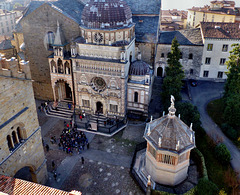
Standig on top of the Torre Civica in the Città alta. The tower was erected in the 11th/12th century as a tower house for the (Ghibelline) Suardi family.
The facade of the Romanesque basilica Santa Maria Maggiore and the Cappella Colleoni, erected between 1472 and 1476 as a mausoleum for Bartolomeo Colleoni and his daughter Medea.
On the right is the roof of the octagonal baptistery, built in 1340. In 1650 the baptistery was dismantled, but was saved, and in 1856 reassembled. It was moved to its present site in 1889.
Bergamo - Cappella Colleoni
| 11 Sep 2017 |
|
Bergamo was the settlement of a Celtic tribe but got conquered by the Romans in 196 BC. Looted by Attila´s troops in the 5th century, it became the capital of a Lombardian duchy a century later. After the conquest of the Lombard Kingdom by Charlemagne, the Franks ruled here.
End of the 11th century Bergamo had become an independent commune, with a lot of feuding between the local the Guelph and Ghibelline factions.
In 1428 Bergamo was ceded in 1428 by the Duchy of Milan to the Republic of Venice and was transformed into a fortified city, protecting the trade routes leading into the Rhine Valley.
The French Revolutionary Army ended more than three centuries of Venetian rule in 1797. Bergamo was part of the "Cisalpine Republic".
At Congress of Vienna, Bergamo was assigned to the (Austrian) Kingdom of Lombardy–Venetia. Giuseppe Garibaldi conquered Bergamo in 1859. The city was incorporated into the newly founded Kingdom of Italy.
Bergamo has two centres: Città alta ("upper city"), a hilltop medieval town, and the Città bassa ("lower city").
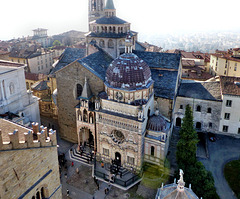
Standig on top of the Torre Civica in the Città alta. The tower was erected in the 11th/12th century as a tower house for the (Ghibelline) Suardi family.
Seen to the left is a part of the Palazzo della Ragione´s stepped gable and a part of the Duomo´s facade. Further right is the Romanesque basilica Santa Maria Maggiore and the Cappella Colleoni, erected between 1472 and 1476 as a mausoleum for Bartolomeo Colleoni and his daughter Medea. Only partly seen is the roof of the small, octagonal baptistery.
Bergamo
| 09 Sep 2017 |
|
|
|
Bergamo was the settlement of a Celtic tribe but got conquered by the Romans in 196 BC. Looted by Attila´s troops in the 5th century, it became the capital of a Lombardian duchy a century later. After the conquest of the Lombard Kingdom by Charlemagne, the Franks ruled here.
End of the 11th century Bergamo had become an independent commune, with a lot of feuding between the local the Guelph and Ghibelline factions.
In 1428 Bergamo was ceded in 1428 by the Duchy of Milan to the Republic of Venice and was transformed into a fortified city, protecting the trade routes leading into the Rhine Valley.
The French Revolutionary Army ended more than three centuries of Venetian rule in 1797. Bergamo was part of the "Cisalpine Republic".
At Congress of Vienna, Bergamo was assigned to the (Austrian) Kingdom of Lombardy–Venetia. Giuseppe Garibaldi conquered Bergamo in 1859. The city was incorporated into the newly founded Kingdom of Italy.
Bergamo has two centres: Città alta ("upper city"), a hilltop medieval town, and the Città bassa ("lower city").
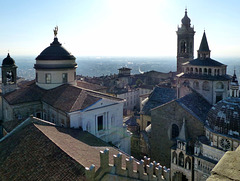
Standig on top of the Torre Civica in the Città alta. The tower was erected in the 11th/12th century as a tower house for the (Ghibelline) Suardi family.
Just in front is Palazzo della Ragione´s stepped gable, behind the Palazzo is the Duomo di Bergamo. Further to the right are Santa Maria Maggiore and the Cappella Colleoni.
Jump to top
RSS feed- Martin M. Miles' latest photos with "Cappella Colleoni" - Photos
- ipernity © 2007-2026
- Help & Contact
|
Club news
|
About ipernity
|
History |
ipernity Club & Prices |
Guide of good conduct
Donate | Group guidelines | Privacy policy | Terms of use | Statutes | In memoria -
Facebook
X
