

Martin M. Miles' photos with the keyword: Coeur de Lion
Fontevraud Abbey
| 19 Jan 2015 |
|
|
|
Fontevraud Abbey, founded in 1101 by itinerant reforming preacher Robert d'Arbrissel followed his concept of the "ideal city". It was a "double monastery", that was always led by a woman.
From the very beginning the convent had a strong support from the aristocracy, above all from the House of Plantagenet. The list of the abbesses is like a "who is who" of the medieval nobility.
Eleanor of Aquitaine, one of the most powerful ladies of medieval times, joined the convent, when she retired from the political power game in 1200. She died here in 1204. This church was the chosen burial place for the House of Plantagenet.
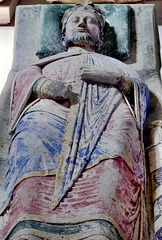
In the center of the nave, near the choir, are the tombs. The recumbent effigies from the early 13th century still have some of the original colours.
Richard I of England (1157 – 1199)
(aka "Richard Lionheart", "Richard Coeur de Lion", "Richard Loewenherz", "Richard Plantagenêt") son of Henry II of England and Eleanor of Aquitaine, Duke of Aquitaine, Duke of Gascony, Lord of Cyprus, Count of Poitiers, Count of Anjou, King of England.
Eldest son of Henry II of England. He commanded an "own" armee against his father at the age of 16. He was King of England since 1189. During the 3rd Crusade, he was one of the commanders, leading the campaign after the departure of Philip II of France. Prisoner of Leopold V, Duke of Austria, and Henry VI, Holy Roman Emperor, between Dec. 1102 and Feb. 1104. England paid a ransom of 65.000 pounds of silver. Taxes rose, what caused local uproars in England. He died, after being wounded by a crossbow bolt during the siege of Chalus (Haute-Vienne), in the arms of his mother.
Fontevraud Abbey
| 19 Jan 2015 |
|
Fontevraud Abbey, founded in 1101 by itinerant reforming preacher Robert d'Arbrissel followed his concept of the "ideal city". It was a "double monastery", that was always led by a woman.
From the very beginning the convent had a strong support from the aristocracy, above all from the House of Plantagenet. The list of the abbesses is like a "who is who" of the medieval nobility.
Eleanor of Aquitaine, one of the most powerful ladies of medieval times, joined the convent, when she retired from the political power game in 1200. She died here in 1204. This church was the chosen burial place for the House of Plantagenet.
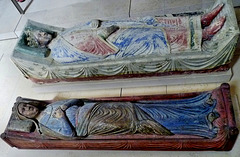
In the center of the nave, near the choir, are the tombs. The recumbent effigies from the early 13th century still have some of the original colours.
Here are the tombs of
Richard I of England (1157 – 1199)
(aka "Richard Lionheart", "Richard Coeur de Lion", "Richard Loewenherz", "Richard Plantagenêt") son of Henry II of England and Eleanor of Aquitaine, Duke of Aquitaine, Duke of Gascony, Lord of Cyprus, Count of Poitiers, Count of Anjou, King of England.
Isabella of Angoulême (1188 – 1246)
(aka "Isabelle d'Angoulême") spouse of Henry II of England´s and Eleanor of Aquitaine´s son John, King of England (aka "John Lackland", "Jean sans Terre"), Queen consort of England, spouse of Hugh X of Lusignan, Countess of Angoulême.
Richard was son of Eleanor and King Henry II (previous uploads), Isabella was their daughter in law.
Richard´s effigy is carved from stone, Isabella´s from wood. Nobody knows why. I was very surprised of Richard´s shoe size. Maybe the marches to Jerusalem and back (3rd crusade) caused that. The way back home took very long, Leopold V, Duke of Austria and later Henry VI, Holy Roman Emperor, kept him prisoner between Dec. 1102 and Feb. 1104.
65,000 pounds of silver were delivered to Austria as ransom. Rumours say, that the more than 300 million "Maria Theresa Thalers", silver coins minted by the Austrians between 1751 and 2000 all contained at least some "English silver".
Fontevraud Abbey
| 19 Jan 2015 |
|
Fontevraud Abbey, founded in 1101 by itinerant reforming preacher Robert d'Arbrissel followed his concept of the "ideal city". It was a "double monastery", that was always led by a woman.
From the very beginning the convent had a strong support from the aristocracy, above all from the House of Plantagenet. The list of the abbesses is like a "who is who" of the medieval nobility.
Eleanor of Aquitaine, one of the most powerful ladies of medieval times, joined the convent, when she retired from the political power game in 1200. She died here in 1204. This church was the chosen burial place for the House of Plantagenet.
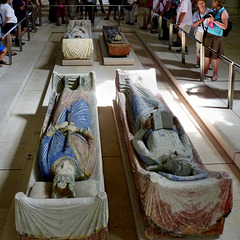
In the center of the nave, near the choir, are four tombs. The recumbent effigies from the early 13th century still have some of the original colours.
Here are the tombs of
Henry II of England (1133 – 1189)
(aka "Curtmantle", Court-manteau", "FitzEmpress", "Henry Plantagenet") Count of Anjou, Count of Maine, Duke of Normandy, Duke of Aquitaine, Count of Nantes, King of England.
Eleanor of Aquitaine (1122 – 1204)
(aka "Aliénor d'Aquitaine") Duchess of Aquitaine, Spouse of King Louis VII of France (two children), Queen consort of France, Spouse of King Henry II of England (eight children), Queen consort of England.
Richard I of England (1157 – 1199)
(aka "Richard Lionheart", "Richard Coeur de Lion", "Richard Loewenherz", "Richard Plantagenêt") son of Henry II of England and Eleanor of Aquitaine, Duke of Aquitaine, Duke of Gascony, Lord of Cyprus, Count of Poitiers, Count of Anjou, King of England.
Isabella of Angoulême (1188 – 1246)
(aka "Isabelle d'Angoulême") spouse of Henry II of England´s and Eleanor of Aquitaine´s son John, King of England (aka "John Lackland", "Jean sans Terre"), Queen consort of England, spouse of Hugh X of Lusignan, Countess of Angoulême.
Uzerche - Saint-Pierre
| 02 Apr 2014 |
|
Uzerche has been a strategic place since the early times. The Visigoths looted the town in the 6th century, later it was besieged by Saracen troops. Pepin the Short, son of Charles Martel, father of Charlemagne) upgraded the fortification, so that in Carolingian times, there were 18 towers here, what did not help against the Normans, who looted Uzerche in 909.
The town recovered, a Benedictine monastery was founded within the 10th century. In 1095 Pope Urban II visited Uzerche on his way to Clermont-Ferrand, where he agitated for the first crusade. The abbey prospered and a large pilgrim-church was erected over a crypt, from the early 11th century on. Pilgrims arrived in great numbers, and as the Norman influence had grown in the area, even Henry I of England, son of William the Conqueror, and Richard I of England (aka "Lionheart", "Coeur de Lion") have been here.
The church got fortified during the Hundred Years War - and still has three fortification towers.
In the 18th the abbey got secularised and Saint-Pierre became a secular collegiate church. Meanwhile it serves as a parish church.
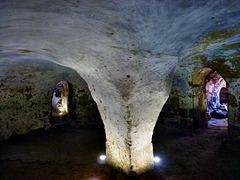
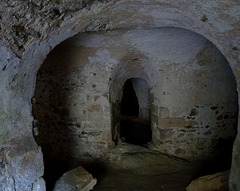
The crypt is huge, as it has the same dimensions as choir, ambulatory and radial chapel. The crypt was built 1020-1050. Choir, ambulatory and chapels were completed around 1070. The church was consecrated in 1097, when the first three spans of the nave were added.
Uzerche - Saint-Pierre
| 02 Apr 2014 |
|
Uzerche has been a strategic place since the early times. The Visigoths looted the town in the 6th century, later it was besieged by Saracen troops. Pepin the Short, son of Charles Martel, father of Charlemagne) upgraded the fortification, so that in Carolingian times, there were 18 towers here, what did not help against the Normans, who looted Uzerche in 909.
The town recovered, a Benedictine monastery was founded within the 10th century. In 1095 Pope Urban II visited Uzerche on his way to Clermont-Ferrand, where he agitated for the first crusade. The abbey prospered and a large pilgrim-church was erected over a crypt, from the early 11th century on. Pilgrims arrived in great numbers, and as the Norman influence had grown in the area, even Henry I of England, son of William the Conqueror, and Richard I of England (aka "Lionheart", "Coeur de Lion") have been here.
The church got fortified during the Hundred Years War - and still has three fortification towers.
In the 18th the abbey got secularised and Saint-Pierre became a secular collegiate church. Meanwhile it serves as a parish church.
The crypt is huge, as it has the same dimensions as choir, ambulatory and radial chapel. The crypt was built 1020-1050. Choir, ambulatory and chapels were completed around 1070. The church was consecrated in 1097, when the first three spans of the nave were added.
Uzerche - Saint-Pierre
| 02 Apr 2014 |
|
Uzerche has been a strategic place since the early times. The Visigoths looted the town in the 6th century, later it was besieged by Saracen troops. Pepin the Short, son of Charles Martel, father of Charlemagne) upgraded the fortification, so that in Carolingian times, there were 18 towers here, what did not help against the Normans, who looted Uzerche in 909.
The town recovered, a Benedictine monastery was founded within the 10th century. In 1095 Pope Urban II visited Uzerche on his way to Clermont-Ferrand, where he agitated for the first crusade. The abbey prospered and a large pilgrim-church was erected over a crypt, from the early 11th century on. Pilgrims arrived in great numbers, and as the Norman influence had grown in the area, even Henry I of England, son of William the Conqueror, and Richard I of England (aka "Lionheart", "Coeur de Lion") have been here.
The church got fortified during the Hundred Years War - and still has three fortification towers.
In the 18th the abbey got secularised and Saint-Pierre became a secular collegiate church. Meanwhile it serves as a parish church.
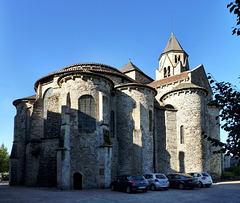
Saint-Piere seen from northeast.
One arm of the transept, choir, ambulatory and radial chapels are visible - from outside. Quite a volume! The door seen, leads into the crypt, on which the church was erected. It is huge, as it has the same dimensions as choir, ambulatory and radial chapel. Once the relics of Saint Leon and Saint Coronat were kept here.
Uzerche - Saint-Pierre
| 02 Apr 2014 |
|
Uzerche has been a strategic place since the early times. The Visigoths looted the town in the 6th century, later it was besieged by Saracen troops. Pepin the Short, son of Charles Martel, father of Charlemagne) upgraded the fortification, so that in Carolingian times, there were 18 towers here, what did not help against the Normans, who looted Uzerche in 909.
The town recovered, a Benedictine monastery was founded within the 10th century. In 1095 Pope Urban II visited Uzerche on his way to Clermont-Ferrand, where he agitated for the first crusade. The abbey prospered and a large pilgrim-church was erected over a crypt, from the early 11th century on. Pilgrims arrived in great numbers, and as the Norman influence had grown in the area, even Henry I of England, son of William the Conqueror, and Richard I of England (aka "Lionheart", "Coeur de Lion") have been here.
The church got fortified during the Hundred Years War - and still has three fortification towers.
In the 18th the abbey got secularised and Saint-Pierre became a secular collegiate church. Meanwhile it serves as a parish church.
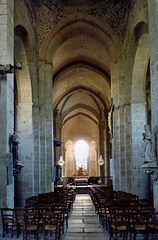
The nave is rather high and narrow. Light floods in from the eastern windows. A few steps lead up to the choir, with the monk´s stalls around the altar, and the ambulatory, a "must have" for a medieval church, designed for the pilgrims´ flow.
Uzerche - Saint-Pierre
| 02 Apr 2014 |
|
Uzerche has been a strategic place since the early times. The Visigoths looted the town in the 6th century, later it was besieged by Saracen troops. Pepin the Short, son of Charles Martel, father of Charlemagne) upgraded the fortification, so that in Carolingian times, there were 18 towers here, what did not help against the Normans, who looted Uzerche in 909.
The town recovered, a Benedictine monastery was founded within the 10th century. In 1095 Pope Urban II visited Uzerche on his way to Clermont-Ferrand, where he agitated for the first crusade. The abbey prospered and a large pilgrim-church was erected over a crypt, from the early 11th century on. Pilgrims arrived in great numbers, and as the Norman influence had grown in the area, even Henry I of England, son of William the Conqueror, and Richard I of England (aka "Lionheart", "Coeur de Lion") have been here.
The church got fortified during the Hundred Years War - and still has three fortification towers.
In the 18th the abbey got secularised and Saint-Pierre became a secular collegiate church. Meanwhile it serves as a parish church.
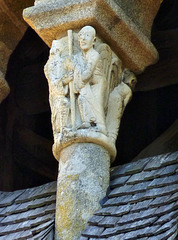
One of the capitals, that are high on the tower. The angel keeps an eye on the town below.
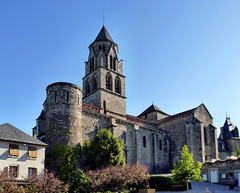
Uzerche - Saint-Pierre
| 02 Apr 2014 |
|
Uzerche has been a strategic place since the early times. The Visigoths looted the town in the 6th century, later it was besieged by Saracen troops. Pepin the Short, son of Charles Martel, father of Charlemagne) upgraded the fortification, so that in Carolingian times, there were 18 towers here, what did not help against the Normans, who looted Uzerche in 909.
The town recovered, a Benedictine monastery was founded within the 10th century. In 1095 Pope Urban II visited Uzerche on his way to Clermont-Ferrand, where he agitated for the first crusade. The abbey prospered and a large pilgrim-church was erected over a crypt, from the early 11th century on. Pilgrims arrived in great numbers, and as the Norman influence had grown in the area, even Henry I of England, son of William the Conqueror, and Richard I of England (aka "Lionheart", "Coeur de Lion") have been here.
The church got fortified during the Hundred Years War - and still has three fortification towers.
The abbey got secularised in the 18th century and Saint-Pierre became a secular collegiate church. Meanwhile it serves as a parish church.
Jump to top
RSS feed- Martin M. Miles' latest photos with "Coeur de Lion" - Photos
- ipernity © 2007-2026
- Help & Contact
|
Club news
|
About ipernity
|
History |
ipernity Club & Prices |
Guide of good conduct
Donate | Group guidelines | Privacy policy | Terms of use | Statutes | In memoria -
Facebook
X
