

Martin M. Miles' photos with the keyword: magi

Paris - Musée de Cluny
| 10 Jan 2026 |
|
|
The Hôtel de Cluny was built in the late 15th century on the site of an older building constructed after the Abbey of Cluny acquired the ancient Roman baths in 1340.
The manor house was rebuilt under Jacques d’Amboise, Abbot Commander of Cluny (1485–1510). In the 18th century, the tower of the Hôtel de Cluny served as an observatory for the astronomers Joseph-Nicolas Delisle, Jérôme Lalande, and Charles Messier. During the French Revolution in 1789, the manor house was confiscated.
In 1832, the archaeologist and art collector Alexandre Du Sommerard acquired the Hôtel de Cluny and used it to display his extensive collection of medieval artifacts. After his death, the collection became the property of the French state. The building opened as a museum in 1843.
The museum underwent a complete renovation over three years and reopened in 2022.
Triptych
known as the
"Saint du Sulpice de Tarn Triptych"
Ivory, Paris about 1300
lower register:
Adoration of the Magi, Virgin and Child, Presentation at the Temple,
upper register:
Christ carrying the Cross, Crucifixion, Deposition from the Cross
Heraklion - Historical Museum of Crete
| 31 Mar 2025 |
|
|
|
Crete is the largest and most populous of the Greek islands, is located about 100 km south of the Peloponnese. Crete was the center of Europe's first advanced civilization, the Minoans, from 3000 to 1400 BC. The Minoan civilization was overrun by the Mycenaean civilization from mainland Greece. Crete was later ruled by Rome, then successively by the Byzantine Empire, Andalusian Arabs, the Byzantine Empire again, the Venetian Republic, and the Ottoman Empire. In 1898 Crete, whose people had for some time wanted to join the Greek state, achieved independence from the Ottomans, formally becoming the Cretan State. Crete became part of Greece in December 1913.
Heraklion is the largest city and the administrative capital of the island of Crete. With a municipal population of about 180.000 it is the fourth largest city in Greece. The greater area of Heraklion has been continuously inhabited since at least 7000 BCE, making it one of the oldest inhabited regions in Europe. As a major center of the Minoan civilization it often considered Europe's oldest city.
The Historical Museum of Crete (HMC) was founded by the Society of Cretan Historical Studies, in 1953. The HMC now offers a composite view of Cretan history and art from the early Christian centuries to the 20th century.
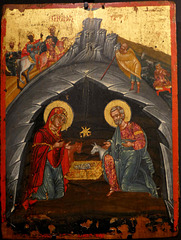
The Nativity
The Magi are approaching from the left, the shepherds from the right.
Oviedo - Catedral de Oviedo
| 29 Mar 2024 |
|
|
Oviedo was founded on a hill that the Romans called Ovetao. The monks Máximo and Fromestano founded a monastery in 761 on the Roman road here and built a hermitage in honour of the martyr San Vicente. Later, two dozen monks from the Muslim south joined the founders and, according to a document elected Fromestano as their first abbot. They received the protection of Fruela I, who chose the site as a residence for his wife Munia, who gave birth here to their son and later King Alfonso II.
It was also Alfonso II who moved the capital here in 812 and made Oviedo the seat of the bishopric. However, in 912, under García I, Oviedo lost its function as capital to León as part of the reconquest. Alfonso II fortified Oviedo and equipped it with palaces and churches.
During his reign, a tomb attributed to St James the Elder was discovered in Santiago de Compostela in 812. The king travelled from Oviedo to Santiago and is said to have been the first pilgrim to Santiago. He is also said to have opened the first Way of St James, the Camino Primitivo. This Way of St James ensured the economic revitalisation of the city throughout the Middle Ages.
The current cathedral had at least three predecessor buildings: The high medieval churches of King Fruela I from the 8th century and King Alfonso II from the 9th century, as well as their late medieval, Romanesque successors.
Gothic architecture did not reach Asturias until the end of the 13th century. At that time, the Gothic remodelling of the cathedral began, starting with the chapter house and the cloister. It was not until a hundred years later that the Gothic remodelling of the cathedral began.
Construction of the Gothic church began in 1382 and was to last until the 16th century. The nave was completed in 1498 and work on the façade and towers (of which only one was ultimately built) began in 1500. Construction of the tower began in 1508 and was completed in 1552, but it burnt down in 1575. The reconstruction, completed in 1587, was influenced by Burgos, as can be seen in the openwork helmet.
On 11 October 1934, during the Asturian miners' strike, a group of revolutionaries detonated a bomb in the crypt of the "Cámara Santa", severely damaging the building. The reconstruction after this catastrophe took place between 1939 and 1942 with the greatest possible attention and restoration to the original.
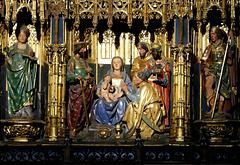
The Magi - a detail of the main altar
Tui - Cathedral de Santa Maria
| 22 Jun 2010 |
|
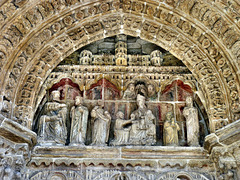
The gothic tympanum still has some of the original colours. The adoration of the magi, wise men coming from the east. The left one is still talking to Herod, who sits on his throne in a very relaxed way, while the right one is already kneeling in Bethlehem, offering gold, mhyrr or incense.
Jump to top
RSS feed- Martin M. Miles' latest photos with "magi" - Photos
- ipernity © 2007-2026
- Help & Contact
|
Club news
|
About ipernity
|
History |
ipernity Club & Prices |
Guide of good conduct
Donate | Group guidelines | Privacy policy | Terms of use | Statutes | In memoria -
Facebook
X
