

Martin M. Miles' photos with the keyword: atlant
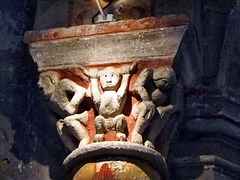
Gannat - Sainte Croix
| 09 Oct 2011 |
|
The parish church Sainte Croix in Gannat is the result of a very long and complex history. Two apses and some parts of the transept date back to the 12th century. The three rows of the nave and the side aisles were built during the 13th century. From the 14th to the 16th century ten (!) chapels were adjoined without any specific architectural order.
This nicely coloured capital from the transept is probably one of the oldest inside the church. Depicted are two atlants at the corners, moaning under the heavy load (see the open mouth) - and a gymnast in the center just starting his skilled performance on a horiziontal bar.
Or is the person just a very short weightlifter?
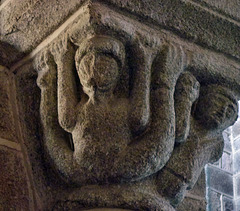
Châtel-Montagne - Notre-Dame
| 14 Sep 2011 |
|
In 1082 some Seigneur Dalmas and his wife Étiennette gave all the properties they owned in "Castrumin Montanis", including a church, to Cluny. This legal act was important enough to get an official approval from Pope Urban II in 1095.
A priory was set up - and a small church was erected. Parts of this church can still be found in the church seen here, built 1100 - 1200. The priory never really flourished, the community of monks was small - and already from 1462 on, the church was used as a parish church.
The church is quite large for a remote village of a population well under 500 (today). When it was planned during the boom of pilgrimage to Santiago de Compostella, Châtel-Montagne was ideally placed on one of the many "Chemin de St-Jacques" in France.
As seen already, not only the architectoral structure is built from granite, the carved capitals are carved from this extrem hard stone as well. So they cannot be that fine and detailled as sandstone-carvings can be. They do have a certain kind of roughness.
A very flexible atlant, a bit like the merman/atlant seen before, bit this one has a very strange face. I agree with Bernard Craplet, who describes this as an atlant "with the head of an ape". Well, the feet are pretty ape-like as well, and as apes are very flexible - the atlant seen here probably is an ape.
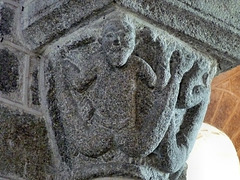
Châtel-Montagne - Notre-Dame
| 14 Sep 2011 |
|
In 1082 some Seigneur Dalmas and his wife Étiennette gave all the properties they owned in "Castrumin Montanis", including a church, to Cluny. This legal act was important enough to get an official approval from Pope Urban II in 1095.
A priory was set up - and a small church was erected. Parts of this church can still be found in the church seen here, built 1100 - 1200. The priory never really flourished, the community of monks was small - and already from 1462 on, the church was used as a parish church.
The church is quite large for a remote village of a population well under 500 (today). When it was planned during the boom of pilgrimage to Santiago de Compostella, Châtel-Montagne was ideally placed on one of the many "Chemin de St-Jacques" in France.
As seen already, not only the architectoral structure is built from granite, the carved capitals are carved from this extrem hard stone as well. So they cannot be that fine and detailled as sandstone-carvings can be. They do have a certain kind of roughness.
Bernard Craplet describes this as a "siren". I have the impression, this is a baldy, smiling merman. There are fins on the thighs. It does not have the alluring, seductive touch mermaids often have. And, despite being a merman, he works here as an atlant.
Jump to top
RSS feed- Martin M. Miles' latest photos with "atlant" - Photos
- ipernity © 2007-2026
- Help & Contact
|
Club news
|
About ipernity
|
History |
ipernity Club & Prices |
Guide of good conduct
Donate | Group guidelines | Privacy policy | Terms of use | Statutes | In memoria -
Facebook
X
