

Martin M. Miles' photos with the keyword: Iron Age

Amathous
| 19 Mar 2026 |
|
|
Amathous is now a suburb of Limassol and was once the capital of one of the four kingdoms of Cyprus.
The earliest traces date back to the Early Iron Age, around 1100 BC. The legendary founder of the city was Kinyras, who named it after his mother, Amathous. The inhabitants of Amathous were considered Pelasgians. In fact, they spoke Eteocypriot, a non-Greek language. Inscriptions attest to the existence of this language until the 4th century BC. Amathous was built on coastal cliffs with a natural harbour and experienced an early heyday. From the 10th century BC onwards, Greeks from Euboea left pottery here. In the post-Phoenician period of the 8th century BC, a palace and a harbour were constructed.
High upon a cliff, a temple was erected for the Hellenes, which became a place of worship dedicated to Aphrodite in her particular local manifestation as Aphrodite Amathusia, as well as to a bearded male form of Aphrodite known as Aphroditos. According to legend, the festive Adonia were held there, during which athletes competed against one another in sporting contests, dancing and singing to honour Adonis.
In the 1st century AD, a Roman temple was built. Despite political subjugation, the temple complex remained so significant during the Roman period that ‘Amathusia’ became synonymous with ‘Cypriot’. The city became the seat of one of the island’s four administrative units.
In the 4th century, Amathous was a bishopric. By the end of the 12th century, Amathous was almost deserted; the tombs had been plundered. As late as 1869, stone blocks were being exported and used in the construction of the Suez Canal.
Many artefacts from Amathous are now mainly held in Paris and London, though the majority are in Cypriot museums.

Amathous
| 19 Mar 2026 |
|
|
Amathous is now a suburb of Limassol and was once the capital of one of the four kingdoms of Cyprus.
The earliest traces date back to the Early Iron Age, around 1100 BC. The legendary founder of the city was Kinyras, who named it after his mother, Amathous. The inhabitants of Amathous were considered Pelasgians. In fact, they spoke Eteocypriot, a non-Greek language. Inscriptions attest to the existence of this language until the 4th century BC. Amathous was built on coastal cliffs with a natural harbour and experienced an early heyday. From the 10th century BC onwards, Greeks from Euboea left pottery here. In the post-Phoenician period of the 8th century BC, a palace and a harbour were constructed.
High upon a cliff, a temple was erected for the Hellenes, which became a place of worship dedicated to Aphrodite in her particular local manifestation as Aphrodite Amathusia, as well as to a bearded male form of Aphrodite known as Aphroditos. According to legend, the festive Adonia were held there, during which athletes competed against one another in sporting contests, dancing and singing to honour Adonis.
In the 1st century AD, a Roman temple was built. Despite political subjugation, the temple complex remained so significant during the Roman period that ‘Amathusia’ became synonymous with ‘Cypriot’. The city became the seat of one of the island’s four administrative units.
In the 4th century, Amathous was a bishopric. By the end of the 12th century, Amathous was almost deserted; the tombs had been plundered. As late as 1869, stone blocks were being exported and used in the construction of the Suez Canal.
Many artefacts from Amathous are now mainly held in Paris and London, though the majority are in Cypriot museums.

Amathous
| 19 Mar 2026 |
|
|
Amathous is now a suburb of Limassol and was once the capital of one of the four kingdoms of Cyprus.
The earliest traces date back to the Early Iron Age, around 1100 BC. The legendary founder of the city was Kinyras, who named it after his mother, Amathous. The inhabitants of Amathous were considered Pelasgians. In fact, they spoke Eteocypriot, a non-Greek language. Inscriptions attest to the existence of this language until the 4th century BC. Amathous was built on coastal cliffs with a natural harbour and experienced an early heyday. From the 10th century BC onwards, Greeks from Euboea left pottery here. In the post-Phoenician period of the 8th century BC, a palace and a harbour were constructed.
High upon a cliff, a temple was erected for the Hellenes, which became a place of worship dedicated to Aphrodite in her particular local manifestation as Aphrodite Amathusia, as well as to a bearded male form of Aphrodite known as Aphroditos. According to legend, the festive Adonia were held there, during which athletes competed against one another in sporting contests, dancing and singing to honour Adonis.
In the 1st century AD, a Roman temple was built. Despite political subjugation, the temple complex remained so significant during the Roman period that ‘Amathusia’ became synonymous with ‘Cypriot’. The city became the seat of one of the island’s four administrative units.
In the 4th century, Amathous was a bishopric. By the end of the 12th century, Amathous was almost deserted; the tombs had been plundered. As late as 1869, stone blocks were being exported and used in the construction of the Suez Canal.
Many artefacts from Amathous are now mainly held in Paris and London, though the majority are in Cypriot museums.

Amathous
| 19 Mar 2026 |
|
|
Amathous is now a suburb of Limassol and was once the capital of one of the four kingdoms of Cyprus.
The earliest traces date back to the Early Iron Age, around 1100 BC. The legendary founder of the city was Kinyras, who named it after his mother, Amathous. The inhabitants of Amathous were considered Pelasgians. In fact, they spoke Eteocypriot, a non-Greek language. Inscriptions attest to the existence of this language until the 4th century BC. Amathous was built on coastal cliffs with a natural harbour and experienced an early heyday. From the 10th century BC onwards, Greeks from Euboea left pottery here. In the post-Phoenician period of the 8th century BC, a palace and a harbour were constructed.
High upon a cliff, a temple was erected for the Hellenes, which became a place of worship dedicated to Aphrodite in her particular local manifestation as Aphrodite Amathusia, as well as to a bearded male form of Aphrodite known as Aphroditos. According to legend, the festive Adonia were held there, during which athletes competed against one another in sporting contests, dancing and singing to honour Adonis.
In the 1st century AD, a Roman temple was built. Despite political subjugation, the temple complex remained so significant during the Roman period that ‘Amathusia’ became synonymous with ‘Cypriot’. The city became the seat of one of the island’s four administrative units.
In the 4th century, Amathous was a bishopric. By the end of the 12th century, Amathous was almost deserted; the tombs had been plundered. As late as 1869, stone blocks were being exported and used in the construction of the Suez Canal.
Many artefacts from Amathous are now mainly held in Paris and London, though the majority are in Cypriot museums.

Amathous
| 19 Mar 2026 |
|
|
Amathous is now a suburb of Limassol and was once the capital of one of the four kingdoms of Cyprus.
The earliest traces date back to the Early Iron Age, around 1100 BC. The legendary founder of the city was Kinyras, who named it after his mother, Amathous. The inhabitants of Amathous were considered Pelasgians. In fact, they spoke Eteocypriot, a non-Greek language. Inscriptions attest to the existence of this language until the 4th century BC. Amathous was built on coastal cliffs with a natural harbour and experienced an early heyday. From the 10th century BC onwards, Greeks from Euboea left pottery here. In the post-Phoenician period of the 8th century BC, a palace and a harbour were constructed.
High upon a cliff, a temple was erected for the Hellenes, which became a place of worship dedicated to Aphrodite in her particular local manifestation as Aphrodite Amathusia, as well as to a bearded male form of Aphrodite known as Aphroditos. According to legend, the festive Adonia were held there, during which athletes competed against one another in sporting contests, dancing and singing to honour Adonis.
In the 1st century AD, a Roman temple was built. Despite political subjugation, the temple complex remained so significant during the Roman period that ‘Amathusia’ became synonymous with ‘Cypriot’. The city became the seat of one of the island’s four administrative units.
In the 4th century, Amathous was a bishopric. By the end of the 12th century, Amathous was almost deserted; the tombs had been plundered. As late as 1869, stone blocks were being exported and used in the construction of the Suez Canal.
Many artefacts from Amathous are now mainly held in Paris and London, though the majority are in Cypriot museums.

Amathous
| 19 Mar 2026 |
|
|
Amathous is now a suburb of Limassol and was once the capital of one of the four kingdoms of Cyprus.
The earliest traces date back to the Early Iron Age, around 1100 BC. The legendary founder of the city was Kinyras, who named it after his mother, Amathous. The inhabitants of Amathous were considered Pelasgians. In fact, they spoke Eteocypriot, a non-Greek language. Inscriptions attest to the existence of this language until the 4th century BC. Amathous was built on coastal cliffs with a natural harbour and experienced an early heyday. From the 10th century BC onwards, Greeks from Euboea left pottery here. In the post-Phoenician period of the 8th century BC, a palace and a harbour were constructed.
High upon a cliff, a temple was erected for the Hellenes, which became a place of worship dedicated to Aphrodite in her particular local manifestation as Aphrodite Amathusia, as well as to a bearded male form of Aphrodite known as Aphroditos. According to legend, the festive Adonia were held there, during which athletes competed against one another in sporting contests, dancing and singing to honour Adonis.
In the 1st century AD, a Roman temple was built. Despite political subjugation, the temple complex remained so significant during the Roman period that ‘Amathusia’ became synonymous with ‘Cypriot’. The city became the seat of one of the island’s four administrative units.
In the 4th century, Amathous was a bishopric. By the end of the 12th century, Amathous was almost deserted; the tombs had been plundered. As late as 1869, stone blocks were being exported and used in the construction of the Suez Canal.
Many artefacts from Amathous are now mainly held in Paris and London, though the majority are in Cypriot museums.
Rennibister Earth House
| 28 Jan 2025 |
|
|
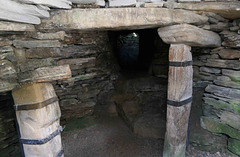
Rennibister Earth House is souterrain, an underground structure from the Iron Age on the mainland of Orkney. It was discovered in 1926 when a the weight of a threshing machine caused the roof to collapse. During the excavations, the skeletal remains of six adults and twelve children were uncovered.
The oval, 3.7 metre long and 2.5 metre wide chamber made of dry stonework, in which one can stand upright, has five side chambers and a ceiling with corbels, the span of which is shortened by being supported on four pillars. The entrance was via a 70 x 70 cm wide corridor, which originally led from a wooden roundhouse above ground. Today, the entrance, which leads via a vertical iron ladder, is located in the chamber.
Rennibister Earth House
| 28 Jan 2025 |
|
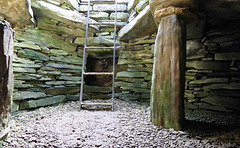
Rennibister Earth House is souterrain, an underground structure from the Iron Age on the mainland of Orkney. It was discovered in 1926 when a threshing machine caused the roof to collapse. During the excavations, the skeletal remains of six adults and twelve children were uncovered.
The oval, 3.7 metre long and 2.5 metre wide chamber made of dry stonework, in which one can stand upright, has five side chambers and a ceiling with corbels, the span of which is shortened by being supported on four pillars. The entrance was via a 70 x 70 cm wide corridor, which originally led from a wooden roundhouse above ground. Today, the entrance, which leads via a vertical iron ladder, is located in the chamber.
Rennibister Earth House
| 28 Jan 2025 |
|
|
|
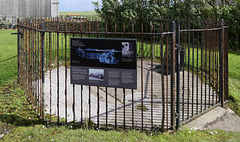
Rennibister Earth House is souterrain, an underground structure from the Iron Age on the mainland of Orkney. It was discovered in 1926 when a threshing machine caused the roof to collapse. During the excavations, the skeletal remains of six adults and twelve children were uncovered.
The oval, 3.7 metre long and 2.5 metre wide chamber made of dry stonework, in which one can stand upright, has five side chambers and a ceiling with corbels, the span of which is shortened by being supported on four pillars. The entrance was via a 70 x 70 cm wide corridor, which originally led from a wooden roundhouse above ground. Today, the entrance, which leads via a vertical iron ladder, is located in the chamber.
Grain Earth House
| 28 Jan 2025 |
|
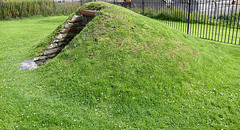
The Grain Earth House is located in an industrial area to the west of Kirkwall Bay. The earth house was discovered by a farmer ploughing in 1827. The chamber remained sealed and intact until 1857 when antiquarians decided to explore the interior.
The subterranean chamber is one of 25 prehistoric souterrains on Orkney. Above ground, only a small, green mound can be seen, characterised by a modern entrance built above it. About two metres below the surface lies an example of an Iron Age souterrain, built and used in the first millennium BC. It consists of a gently sloping, curved corridor that ends in an oval chamber. The chamber and the corridor are covered with flat stone slabs. Inside the chamber, four massive, approximately 1.5 m high stone columns stand close to the edge and support the weight of the roof of the 4.9 m long chamber. The roof is 2.0 metres below the floor.
The purpose of the souterrains is unknown. Today, a cultic function is most likely, but a use as a storage room cannot be completely ruled out.
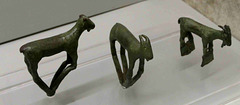
Évora - Museo de Évora
| 14 Aug 2024 |
|
The Romans conquered the place in 57 BC. BC and expanded it into a walled city. The city gained importance because it was at the intersection of several important transport routes.
During the barbarian invasions, Évora came under the rule of the Visigothic king Leovigild in 584.
In 715, the city was conquered by the Moors. During the Moorish rule (715–1165), the town slowly began to prosper again and developed into an agricultural center with a fortress and a mosque.
Évora was wrested from the Moors through an attack by Geraldo Sem Pavor ("Gerald the Fearless") in 1165. The town came under the rule of the Portuguese king Afonso I in 1166. It then flourished during the Middle Ages, especially in the 15th century.
The official name of the museum is “Museo Nacional Fray Manuel del Cenáculo”. It is located in the old bishop's palace.
Zoomorphic ex votos / bronze / Iron Age
Jump to top
RSS feed- Martin M. Miles' latest photos with "Iron Age" - Photos
- ipernity © 2007-2026
- Help & Contact
|
Club news
|
About ipernity
|
History |
ipernity Club & Prices |
Guide of good conduct
Donate | Group guidelines | Privacy policy | Terms of use | Statutes | In memoria -
Facebook
X
