

Martin M. Miles' photos with the keyword: fibula

Mainz - Landesmuseum
| 30 Jan 2026 |
|
|
Mainz was founded around 20 BC by the Romans under the name “Mogontiacum” as a military camp. Today's capital of the state of Rhineland-Palatinate forms a metropolitan area with Wiesbaden, the neighboring capital of Hesse, with a combined population of around 500,000.
The "Republic of Mainz", a product of the French Revolution, was the first democratic state on German territory. The state was represented in Paris by the well-known naturalist Georg Forster, who had been in the Pacific with Captain Cook as a boy. The Mainz Republic ended after only five months in July 1793 following the conquest of the city by Prussian and Austrian troops. Georg Forster died in Paris in 1794.
The State Museum is one of the oldest museums in Germany. Its origins lie in a collection of 36 paintings that Napoleon gifted to the city of Mainz in 1803 to establish an art gallery.
Today the Landesmuseum has extensive art and cultural history collections, ranging from prehistory to modern art.
Große Adlerfibel / Pfauenfibel
Large Eagle Fibula / Peacock Fibula
ca 975 - 1025

Mainz - Landesmuseum
| 30 Jan 2026 |
|
|
Mainz was founded around 20 BC by the Romans under the name “Mogontiacum” as a military camp. Today's capital of the state of Rhineland-Palatinate forms a metropolitan area with Wiesbaden, the neighboring capital of Hesse, with a combined population of around 500,000.
The "Republic of Mainz", a product of the French Revolution, was the first democratic state on German territory. The state was represented in Paris by the well-known naturalist Georg Forster, who had been in the Pacific with Captain Cook as a boy. The Mainz Republic ended after only five months in July 1793 following the conquest of the city by Prussian and Austrian troops. Georg Forster died in Paris in 1794.
The State Museum is one of the oldest museums in Germany. Its origins lie in a collection of 36 paintings that Napoleon gifted to the city of Mainz in 1803 to establish an art gallery.
Today the Landesmuseum has extensive art and cultural history collections, ranging from prehistory to modern art.
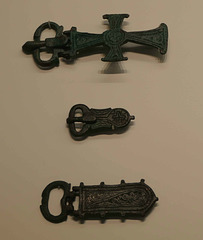
Grave goods from a woman's grave
Fibulae / 6th century
Toulouse - Musée Saint-Raymond
| 23 Nov 2025 |
|
|
Toulouse, then known as Tolose, was an important Gallic city. It became part of the Roman Empire under the name of Tolosa. It was the capital of the province of Gallia Narbonensis, situated between the Mediterranean Sea and the Atlantic Ocean. From the 4th century onward, Toulouse was the seat of the Archdiocese of Toulouse.
In 413, Toulouse became part of the Visigothic Kingdom. In 507, following the Visigoths' defeat by the Franks, the Visigothic kingdom of Toulouse came to an end. In 721, the city was unsuccessfully besieged by Arabs for several months. Upto 843, Toulouse was the seat of the Kingdom of Aquitaine, after which the independent County of Toulouse was established, a center of Languedoc culture.
In 1208 Pope Innocent III called for a crusade against the Albigensians, during which the city was plundered. In 1228, after a grueling and destructive war of almost 20 years, Raymond VII of Toulouse gave up resistance and signed the Treaty of Paris.
During the Renaissance, Toulouse was one of the wealthiest cities in France. Woad a plant that at the time provided the only stable blue dye, thrived well in the near Lauragais region. The city's dominant market position gradually ended after 1550, when the Portuguese began importing the more affordable indigo from their colonies.
-
The site originally was a necropolis, and in later constructions was a hospital for the poor and pilgrims, prison, student residence, stables, barracks and presbytery, eventually becoming a museum in 1891. It is housed in the former Saint-Raymond university college dating from the sixteenth century that borders Basilica of Saint-Sernin.
The museum, founded in 1892, by now is the archeological museum of the region
-
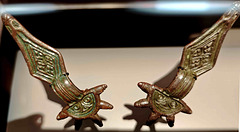
Pair of Visigothic fibulae
5th century

Toulouse - Musée Saint-Raymond
| 23 Nov 2025 |
|
|
Toulouse, then known as Tolose, was an important Gallic city. It became part of the Roman Empire under the name of Tolosa. It was the capital of the province of Gallia Narbonensis, situated between the Mediterranean Sea and the Atlantic Ocean. From the 4th century onward, Toulouse was the seat of the Archdiocese of Toulouse.
In 413, Toulouse became part of the Visigothic Kingdom. In 507, following the Visigoths' defeat by the Franks, the Visigothic kingdom of Toulouse came to an end. In 721, the city was unsuccessfully besieged by Arabs for several months. Upto 843, Toulouse was the seat of the Kingdom of Aquitaine, after which the independent County of Toulouse was established, a center of Languedoc culture.
In 1208 Pope Innocent III called for a crusade against the Albigensians, during which the city was plundered. In 1228, after a grueling and destructive war of almost 20 years, Raymond VII of Toulouse gave up resistance and signed the Treaty of Paris.
During the Renaissance, Toulouse was one of the wealthiest cities in France. Woad a plant that at the time provided the only stable blue dye, thrived well in the near Lauragais region. The city's dominant market position gradually ended after 1550, when the Portuguese began importing the more affordable indigo from their colonies.
-
The site originally was a necropolis, and in later constructions was a hospital for the poor and pilgrims, prison, student residence, stables, barracks and presbytery, eventually becoming a museum in 1891. It is housed in the former Saint-Raymond university college dating from the sixteenth century that borders Basilica of Saint-Sernin.
The museum, founded in 1892, by now is the archeological museum of the region
-
Pair of Visigothic fibulae
5th century
Málaga - Museo de Málaga
| 08 Jul 2024 |
|
|
Málaga's history spans around 2,800 years, making it one of the oldest continuously inhabited cities in Western Europe. The city was founded around the 8th century BC by seafaring Phoenicians, who called the city Malaka.
From the 6th century BC, the city was under the hegemony of ancient Carthage and from the Second Punic War (218 BC) under Roman rule. The city experienced an economic boom thanks to the production of garum.
The Migration Period meant eventful years for Málaga. After the Vandals and the Alans, Visigoths and Eastern Romans fought for control. In 571, the city was briefly occupied by troops of the Visigothic king Leovigild, but it was not until around 616 that the Eastern Romans finally handed the city over to the Visigoths.
The Moors conquered Málaga in 711 and the city gained importance in the 11th century when the Hammudids established one of their residences here. In 1053, the King of Granada had the last Hammudid caliph poisoned and conquered the city. After the conquest by the Catholic Monarchs in the course of the Reconquista in 1487, "reforms" began to transform the city into a Christian settlement. In Muslim times, the Jewish quarter was located in the eastern part of the city. In the 11th century, the city took in numerous Jews who had fled from the intolerant Berbers in Córdoba. In the middle of the 11th century, around 200 Jews lived in Málaga out of a population of around 20,000. After the city was conquered by Castile in 1487, all of Malaga's Jews were taken prisoner. Around 1490 it was decided that the city should be repopulated by Christians. Jews and Muslims had to leave Málaga within 15 days.
Today Málaga is a city that lives very much from tourism and offers tourists a lot - for example museums
The Museo de Málaga houses the Museo de Bellas Artes (Museum of Fine Arts) and the Museo Arqueológico Provincial (the Provincial Museum of Archaeology).
The museum is located in the Palacio de la Aduana (Customs Palace), designed in 1788.
Artefacts from Visigothic necropolos / 5th - 7th cent.
Fibulae
Málaga - Museo de Málaga
| 08 Jul 2024 |
|
Málaga's history spans around 2,800 years, making it one of the oldest continuously inhabited cities in Western Europe. The city was founded around the 8th century BC by seafaring Phoenicians, who called the city Malaka.
From the 6th century BC, the city was under the hegemony of ancient Carthage and from the Second Punic War (218 BC) under Roman rule. The city experienced an economic boom thanks to the production of garum.
The Migration Period meant eventful years for Málaga. After the Vandals and the Alans, Visigoths and Eastern Romans fought for control. In 571, the city was briefly occupied by troops of the Visigothic king Leovigild, but it was not until around 616 that the Eastern Romans finally handed the city over to the Visigoths.
The Moors conquered Málaga in 711 and the city gained importance in the 11th century when the Hammudids established one of their residences here. In 1053, the King of Granada had the last Hammudid caliph poisoned and conquered the city. After the conquest by the Catholic Monarchs in the course of the Reconquista in 1487, "reforms" began to transform the city into a Christian settlement. In Muslim times, the Jewish quarter was located in the eastern part of the city. In the 11th century, the city took in numerous Jews who had fled from the intolerant Berbers in Córdoba. In the middle of the 11th century, around 200 Jews lived in Málaga out of a population of around 20,000. After the city was conquered by Castile in 1487, all of Malaga's Jews were taken prisoner. Around 1490 it was decided that the city should be repopulated by Christians. Jews and Muslims had to leave Málaga within 15 days.
Today Málaga is a city that lives very much from tourism and offers tourists a lot - for example museums
The Museo de Málaga houses the Museo de Bellas Artes (Museum of Fine Arts) and the Museo Arqueológico Provincial (the Provincial Museum of Archaeology).
The museum is located in the Palacio de la Aduana (Customs Palace), designed in 1788.
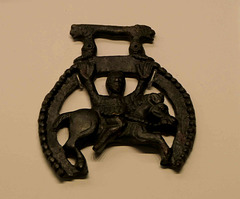
Artefacts from Visigothic necropolos / 5th - 7th cent.
Fibula
Cáceres - Museo de Cáceres
| 14 Jan 2024 |
|
|
Cáceres goes back to the Roman fortress Castra Caecilia, which was built in 79 BC. A Celtiberian settlement that dates back to around 35 BC. In the 6th century, large parts of the city were destroyed by the invading Visigoths and only later rebuilt by the Moors. The Arabs rebuilt the city, including a wall, palaces, and various towers.
Cáceres was reconquered by the Christians in 1229. During this period the city had an important Jewish quarter. In the 15th century when the total population was 2,000, nearly 140 Jewish families lived in Cáceres. The Jewish population was expelled by Queen Isabella and Ferdinand of Aragon in 1492.
Cáceres flourished during the Discovery of the Americas, as influential Spanish families and nobles built homes and small palaces there, and many members of families from Extremadura participated in the voyages where they made their fortunes.
Today Cáceres is a city with a population of about 100.000.
The museum is located in the historic town of the city and is housed in two historic buildings, the “Palacio de las Veletas” and the “Casa de los Caballos”.
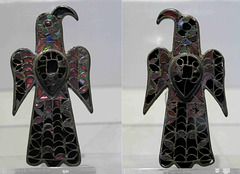
Bronze fibulae in the shape of eagles
Visigothic,
5th/6th century
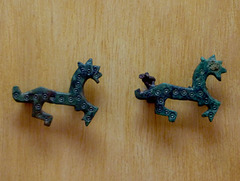
Civaux - Museum
| 28 May 2015 |
|
Civaux, a village with a population of about 1000, has a history rooting very deep. Humans populated the area already, when stepp bisons and mammoths were hunted. Many "pre-historic" artefacts have been excavated in and around Civaux, proving that this place was inhabited over tens of thousands of years.
A settlement stood on the site of the village in Gallo-Roman times, and there are still traces of Roman temples. Excavations have revealed the sites of a theater (capacity 3000), a fortified camp, and the foundations of many villas.
This has been a place of very early christianisation. A funeral stele has been found dating to around 400, a pagan temple and a very early baptisterium were excavated next to the church. A polygonal apse was probably built as will around 400, what actually means that this church, dedicated to Saint Gervais and Saint Protais is one of the oldest in France.
At that time a kind of pilgrimage must have developed. The relics of Saint Gervais and Saint Protais had been miraculously discovered by Saint Ambrose in Milan in 386, so the saints got very popular in Merovingian times, but that does not explain the enigma of Civaux. The village stands in the center of a huge merovingian necropolis.
As many sarcophagi were sold as water basins or troughs in later time, the exact number of graves is unknown. Serious estimations are between 15.000 and 20.000 graves.
Special thanks to the lady of the "Archaeological Museum Civaux", who helped me a lot.
This pair of small fibulae was discovered in the tomb of a child. The brooches, depicting galloping horses, are probably from the 7th century. Crafted in Merovingian times.
www.tourisme-vienne.com/en/activite/88/musee-archeologique
Jump to top
RSS feed- Martin M. Miles' latest photos with "fibula" - Photos
- ipernity © 2007-2026
- Help & Contact
|
Club news
|
About ipernity
|
History |
ipernity Club & Prices |
Guide of good conduct
Donate | Group guidelines | Privacy policy | Terms of use | Statutes | In memoria -
Facebook
X
