

Martin M. Miles' photos with the keyword: Linlithgow Palace
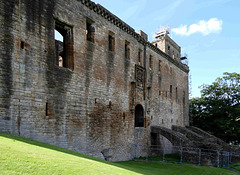
Linlithgow - Palace
| 08 Jan 2025 |
|
In the Middle Ages, Linlithgow rose to prominence as a royal town and residence, centred on Linlithgow Palace, a residence of the Scottish kings on the raised hill beside the loch, as it was a logical stopover between Edinburgh to the east and Stirling to the west.
In the Middle Ages, Linlithgow rose to prominence as a royal town and residence, centred on Linlithgow Palace, a residence of the Scottish kings on the raised hill beside the loch, as it was a logical stopover between Edinburgh to the east and Stirling to the west.
The palace was one of the principal residences of the monarchs of Scotland in the 15th and 16th centuries. Mary, Queen of Scots, was born at Linlithgow Palace in 1542. The security of the palace by fitting was increaed by iron window grills. Regent Arran was worried his enemies, including Cardinal Beaton, would take Mary. He considered putting the queen in Blackness Castle, a stronger fortress. Henry VIII hoped that Mary would be separated from her mother and taken to Tantallon Castle. Mary was teething and plans to move her were delayed.
Following lengthy negotiations between the armed factions at Linlithgow, Mary was taken to Stirling Castle by her mother, escorted by the Earl of Lennox, and an armed force. As an adult Queen Mary often visited Linlithgow, but did not commission new building work at the palace.
After the Union of the Crowns in 1603 the Royal Court became largely based in England and Linlithgow was used very little. The North Range, said to be in very poor condition and collapsed in 1607. In 1746 the palace burned out.
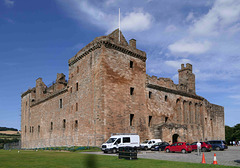
Linlithgow - Palace
| 08 Jan 2025 |
|
In the Middle Ages, Linlithgow rose to prominence as a royal town and residence, centred on Linlithgow Palace, a residence of the Scottish kings on the raised hill beside the loch, as it was a logical stopover between Edinburgh to the east and Stirling to the west.
In the Middle Ages, Linlithgow rose to prominence as a royal town and residence, centred on Linlithgow Palace, a residence of the Scottish kings on the raised hill beside the loch, as it was a logical stopover between Edinburgh to the east and Stirling to the west.
The palace was one of the principal residences of the monarchs of Scotland in the 15th and 16th centuries. Mary, Queen of Scots, was born at Linlithgow Palace in 1542. The security of the palace by fitting was increaed by iron window grills. Regent Arran was worried his enemies, including Cardinal Beaton, would take Mary. He considered putting the queen in Blackness Castle, a stronger fortress. Henry VIII hoped that Mary would be separated from her mother and taken to Tantallon Castle. Mary was teething and plans to move her were delayed.
Following lengthy negotiations between the armed factions at Linlithgow, Mary was taken to Stirling Castle by her mother, escorted by the Earl of Lennox, and an armed force. As an adult Queen Mary often visited Linlithgow, but did not commission new building work at the palace.
After the Union of the Crowns in 1603 the Royal Court became largely based in England and Linlithgow was used very little. The North Range, said to be in very poor condition and collapsed in 1607. In 1746 the palace burned out.
Jump to top
RSS feed- Martin M. Miles' latest photos with "Linlithgow Palace" - Photos
- ipernity © 2007-2026
- Help & Contact
|
Club news
|
About ipernity
|
History |
ipernity Club & Prices |
Guide of good conduct
Donate | Group guidelines | Privacy policy | Terms of use | Statutes | In memoria -
Facebook
X
