

Martin M. Miles' photos with the keyword: Akrotiri
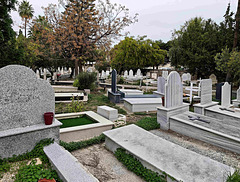
Larnaca - Cemetery
| 11 Mar 2026 |
|
With a population of over 50,000, Larnaca is one of the largest cities in Cyprus.
Cyprus was a British protectorate under nominal Ottoman suzerainty, established by the Cyprus Convention in 1878, following the Russo-Turkish War, in exchange for British support of the Ottomans during the Congress of Berlin. This remained in place until 1914, when after the Ottomans joined the Central Powers, in turn entering WW I, Britain declared the complete annexation of Cyprus under a military administration status.
The Crown Colony of Cyprus was proclaimed in 1925, after Britain's annexation of Cyprus was verified and finally confirmed again in the Treaty of Lausanne.
Great Britain granted Cyprus independence in 1960 and founded the modern Republic of Cyprus. Archbishop Makarios III was elected as the first president of independent Cyprus. As part of the independence agreement, Great Britain retained the sovereign base areas of Akrotiri and Dhekelia as British overseas territories.
A British cemetery in the center of Larnaca

Athens - National Archaeological Museum
| 30 May 2025 |
|
|
Athens, the southernmost capital on the European mainland, is one of the world's oldest cities, with its recorded history spanning over 3,400 years. According to Greek mythology the city was named after Athena, the ancient Greek goddess of wisdom. Classical Athens was one of the most powerful city-states in ancient Greece. It was a centre for democracy, the arts, education and philosophy, and was highly influential throughout the European continent, particularly in Ancient Rome. For this reason it is often regarded as the cradle of Western civilisation and the birthplace of democracy.
Planning for an archaeological museum began with the founding of the Kingdom of Greece. Once financing was secured, construction began in 1866. The main building was inaugurated in 1874, followed by the two side wings in 1881 and 1885.
In 2009, the museum was expanded by approximately 24,000 m² of exhibition space, allowing it to display over 2,000 additional ancient exhibits.
The about 11,000 objects on display come from all regions of Greece, as all important finds were brought exclusively there until the 20th century, so it is considered one of the greatest museums in the world and contains the richest collection of Greek Antiquity artifacts worldwide.
The Akrotiri frescoes - 1700 BC.
The Antelope Fresco
was found during the excavations at Akrotiri on the southern coast of the ringed islands of Santorini which was covered by thick deposits of ash and pumice from the great Bronze Age eruption of the Santorini volcano that occurred between 1627 and 1600 BC. This is a leading example of Minoan painting. It depics two antelopes sketched with strong, dark lines on a white plaster background.
The Boxer Fresco
Depicted to the left depicts two boys boxing, perhaps a ritual sport rather than a competitive match. They wear only a belt and loincloth with a boxing glove only on the right hand. The boy on the left wears a surprising amount of jewellery (necklace, earrings, bracelets..), whilst his opponent has none.
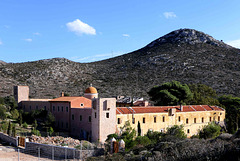
Gouverneto Monastery
| 11 Apr 2025 |
|
|
The monastery, founded in the 11th century, is located on the northeastern edge of the Akrotiri peninsula just 5km apart from Agia Triada.
In 1637 a census, recorded shortly before the Turkish invasion, revealed that at the time there were 60 monks living there, making it one of the largest in Crete at the time.
During the uoproars of 1821, the Turks slaughtered the monks and plundered the monastery. The Germans established a guardhouse in the monastery to control the area during WWII.
The fortress-like wall is shaped like a parallelogram, with four square towers at its four corners. In the center of the monastery courtyard are the domed church and two chapels.
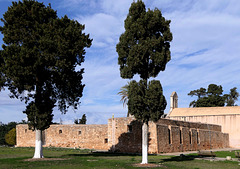
Monastery of St. John the Merciful
| 11 Apr 2025 |
|
|
The Monastery of St. John the Merciful was founded in the 16th century and was fortified. Its walls are in excellent condition, as are its gates, which are closed for tourists in winter.
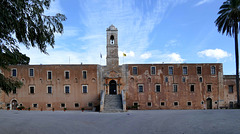
Agia Triada Monastery
| 11 Apr 2025 |
|
|
The monastery was built in the 17th century by the monks Jeremiah and Lavrentios of the Venetian Zangaroli family on the site of an existing church.
The monastery was severely damaged and burned in 1821 during the uprising against the Turkish occupiers. The monastery remained abandoned for several years. After restoration and reconstruction in 1830, it was inhabited again and developed into Crete's theological school. The Agia Triada Monastery is now the largest working monastery in Crete.
Unfortunately, we were unable to visit it.
Jump to top
RSS feed- Martin M. Miles' latest photos with "Akrotiri" - Photos
- ipernity © 2007-2026
- Help & Contact
|
Club news
|
About ipernity
|
History |
ipernity Club & Prices |
Guide of good conduct
Donate | Group guidelines | Privacy policy | Terms of use | Statutes | In memoria -
Facebook
X
