
Martin M. Miles' photos with the keyword: Max Liebermann

Wuppertal - Von der Heydt-Museum
| 12 Feb 2026 |
|
|
Wuppertal, a city with around 360,000 inhabitants, is located south of the Ruhr area. Wuppertal was one of the first highly industrialized regions in Germany.
The cityscape is dominated by the valley of the Wupper River which winds its way through the city for around 20 km. The "Schwebebahn", a suspension railway, in operation since 1901, is the city's landmark and most famous attraction. It is the oldest suspension railway still in operation. Most of the13km- route runs above the Wupper River.
The Von der Heydt Museum was founded in 1902 as a municipal museum. Since 1961, it has borne the name von der Heydt in memory of the banking family that played an important role in promoting the museum. During the Nazi era, numerous works in the Von der Heydt Museum were confiscated as “degenerate art” and subsequently sold or destroyed.
Max Liebermann ( 1847 - 1935 )
Bildnis Felix Benjamin / Portrait of Felix Benjamin / 1921

Liège - La Boverie
| 25 Aug 2025 |
|
Liège is the center of the largest Walloon agglomeration, and the cultural center of the Walloon region of Belgium. The city, with a population of about 200.000, is located at the confluence of the Ourthe and Meuse rivers.
Around 705, Saint Lambert of Maastricht is credited with completing the Christianization of the region, but conversion may still not have been quite universal, since Lambert was murdered in Liège. To enshrine his relics, the successor, Hubertus (later St. Hubert), built a basilica which became the nucleus of the city.
In 1468, following an uprising of the inhabitants against Burgundian rule, xof Burgundy had the city plundered and systematically destroyed. The few survivors who had fled into the forests—Charles the Bold allegedly had more than 5,000 inhabitants murdered—were only able to return to the city for reconstruction after seven years.
In 1789, partly in connection with the French Revolution, the Liège Revolution occurred. It was directed against the absolutist rule of the Prince-Bishop and was crushed in early 1791 by troops commissioned by the Holy Roman Empire. In 1795, Liège was occupied by French troops and became part of the First French Republic. The Congress of Vienna annexed it to the Kingdom of the Netherlands, which in 1830 became the Kingdom of Belgium, to which Liège has belonged ever since.
Originally built for the 1905 Liège World Exhibition, the building has housed the collections of the Musée des beaux-arts de Liège since 2016. The collections of the Musée des beaux-arts de Liège include more than 700 paintings and sculptures, as well as more than 40,000 works on paper.
Max Liebermann (1847 - 1935)
Le chevalier sur la plage / The rider on the beach
1904

Essen - Museum Folkwang
| 01 Aug 2025 |
|
Essen is the central and, after Dortmund, second-largest city of the Ruhr district, the largest urban area in Germany. Because of its central location, Essen is often regarded as the Ruhr's "secret capital".
The city dates back to the Essen women's monastery founded before 850. In addition to this monastery, Werden Monastery, founded by Liudger around 800, was a center of late antique and early Christian textual tradition. Elevated to the status of a free imperial city by Emperor Charles IV in the 14th century, Essen had been an arms manufacturer since the late Middle Ages and, with industrialization, rose to become one of the most important centers of the mining industry. After a massive decline in heavy industry from the mid-1960s onwards, Essen developed a strong service sector as part of structural change.
With the Museum Folkwang, Essen boasts a renowned collection of modern art. It was opened in Hagen in 1902 by Karl Ernst Osthaus under the name Folkwang Museum and long played a pioneering role in the field of modern art. After Osthaus's death in 1921, his collection was sold to Essen. The collection has been housed there ever since. During the Nazi era, the museum lost 1,400 works, including significant parts of its collection, in the "Degenerate Art" campaign. After the war, these losses were largely replaced through repurchases or new acquisitions.
Max Liebermann (1847 – 1935)
Der Papageienmann / The Parrot Man / 1902
Berlin - Alte Nationalgalerie
| 01 Jul 2025 |
|
The Alte Nationalgalerie (Old National Gallery) on Museum Island is a museum with 19th-century works of art from the collection of the Prussian Cultural Heritage Foundation.
Designed by Friedrich August Stüler on behalf of King Frederick William IV from 1862 onwards, it was completed in the Neo-Classical and Neo-Renaissance styles by 1876.
The building was severely damaged during WW II by bombing. It was reopened in 1949, but reconstruction took until 1969. Between 1998 and 2001 the museum was extensively renovated.
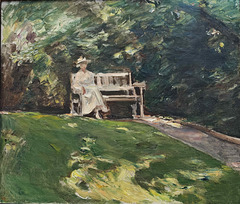
Max Liebermann (1847 - 1935)
Die Gartenbank / The Garden Bench / 1916

Halle - Moritzburg
| 29 Jun 2023 |
|
The Moritzburg is a ruined castle that has been reconstructed as a museum. In 1484 the foundation stone was laid for what later became the residence of the archbishops of Magdeburg. It was built in the late Gothic style and now houses an art museum.
Portrait Friedrich Kuhnt / 1910
Max Liebermann (1847 - 1935)
Jump to top
RSS feed- Martin M. Miles' latest photos with "Max Liebermann" - Photos
- ipernity © 2007-2026
- Help & Contact
|
Club news
|
About ipernity
|
History |
ipernity Club & Prices |
Guide of good conduct
Donate | Group guidelines | Privacy policy | Terms of use | Statutes | In memoria -
Facebook
X
