

StoneRoad2013's photos with the keyword: jet
![cos[26] - Messerschmitt Me 262](https://cdn.ipernity.com/200/77/36/53227736.53518dbf.240.jpg?r2 "cos[26] - Messerschmitt Me 262")
cos[26] - Messerschmitt Me 262
| 29 Jan 2026 |
|
Developed during WW2, flying as a jet fighter / fighter-bomber 1944-45
[also flown by the Czechoslovak Air Force until 1951.
en.wikipedia.org/wiki/Messerschmitt_Me_262
![yam[25] - Hunter and Meteor](https://cdn.ipernity.com/200/34/10/53033410.32a433ad.240.jpg?r2 "yam[25] - Hunter and Meteor")
yam[25] - Hunter and Meteor
| 30 Jul 2025 |
|
left : Hawker Hunter FGA.78
en.wikipedia.org/wiki/Hawker_Hunter
right : Gloster Meteor
Developed right at the end of WW2 - first flew during 1943, In service 1944 to the 1980s, the last RAF planes were used as target tugs.
en.wikipedia.org/wiki/Gloster_Meteor
![yam[25] - Vampire {2 of 2}](https://cdn.ipernity.com/200/33/76/53033376.4a7b241f.240.jpg?r2 "yam[25] - Vampire {2 of 2}")
yam[25] - Vampire {2 of 2}
![yam[25] - Vampire {1 of 2}](https://cdn.ipernity.com/200/33/78/53033378.1c44b3d4.240.jpg?r2 "yam[25] - Vampire {1 of 2}")
yam[25] - Vampire {1 of 2}
| 30 Jul 2025 |
|
de Havilland Vampire
Single jet engine, twin tail booms.
In service 1946 to 1990 - quite a number survive, with some still airworthy.
en.wikipedia.org/wiki/De_Havilland_Vampire
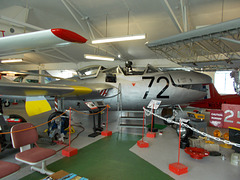
sam - DH Vampire
| 06 Aug 2022 |
|
Not too easy too see, but there's a De Havilland "Vampire" in there.
{WZ515}
The Vampire was the second jet fighter to enter service with the RAF and the first jet to cross the Atlantic. Development began in 1941, and tehy were in front line service from 1946 to 1953 and remained as a trainer up to the mid-1960s.
This one was built as a trainer, serving with various units and retired in 1968. it was bought back by Hawker Siddeley [it was in a TV play "The Aerodrome"] and arrived at SAM in 1990, having been swopped for a Lancaster's gun turret.
en.wikipedia.org/wiki/De_Havilland_Vampire
![sam - EE Canberra [1 of 2]](https://cdn.ipernity.com/200/84/24/51488424.035f0ef4.240.jpg?r2 "sam - EE Canberra [1 of 2]")
sam - EE Canberra [1 of 2]
| 06 Aug 2022 |
|
English Electric Canberra [T4 - WE188]
Design started in 1946, and the first jet-powered medium bomber entered service with the RAF in 1950. In 1957 a Canberra set a world altitude record of 70,310ft.
The SAM example first flew in 1952, and served as a target tug for the RAF before being returned to British Aerospace.
Cockpit access required a certain amount of flexibility ...
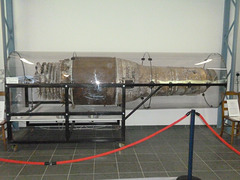
BBH - Orpheus
| 08 Apr 2012 |
|
The somewhat sad remains of the Bristol-Siddeley "Orpheus" jet engine from Bluebird K7, having spent nearly 35 years underwater. The casing has acted as a sacrificial anode, and the loss of material by corrosion has protected the rest of the vessel. On display in the Bluebird Annex of the Ruskin Museum, Coniston.
Jump to top
RSS feed- StoneRoad2013's latest photos with "jet" - Photos
- ipernity © 2007-2026
- Help & Contact
|
Club news
|
About ipernity
|
History |
ipernity Club & Prices |
Guide of good conduct
Donate | Group guidelines | Privacy policy | Terms of use | Statutes | In memoria -
Facebook
X
