

Phil's photos with the keyword: Flight
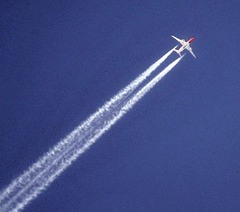
"Dreamliner".
| 02 Jan 2020 |
|
|
|
A Norwegian Airlines Boeing 787-9 "Dreamliner" (Registration LN-LNV) at an altitude of 38,000 feet en-route from New York to Amsterdam, photographed as it flew over my home yesterday. Aircraft and flight information from "Flightradar" (see links below).
(Website....click on one of the aircraft for details).
www.flightradar24.com/53.94,-2.64/9
LN-LNV. Aircraft details and flight history.
www.flightradar24.com/data/aircraft/ln-lnv
Camera: Nikon D500.
Lens: AF-S VR Zoom-Nikkor 70-300mm f/4.5-5.6G IF-ED
Processing Software: Nikon Capture NX2.
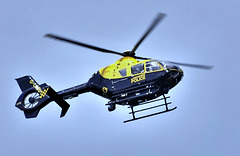
Police Eurocopter EC135
| 04 Sep 2019 |
|
|
|
The Eurocopter EC135 is a twin-engine civil light utility helicopter produced by Airbus Helicopters (formerly known as Eurocopter). It is capable of flight under instrument flight rules (IFR) and is outfitted with a digital automatic flight control system (AFCS). First flying on 15 February 1994, it entered service in 1996 and 1,300 have been delivered up to January 2018 to 300 operators in 60 countries, accumulating over 4.5 million flight hours. It is mainly used for helicopter emergency medical services, law enforcement, offshore wind and military flight training.
(Wikipedia)
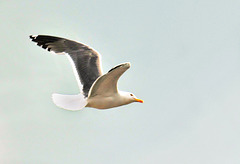
Seagull in flight (2)
| 24 Jul 2019 |
|
|
|
The European herring gull (Larus argentatus) is a large gull up to 26 inches (66 cm) long. One of the best known of all gulls along the shores of Western Europe, it was once abundant. It breeds across Northern Europe, Western Europe, Central Europe, Eastern Europe, Scandinavia and the Baltic states. Some European herring gulls, especially those resident in colder areas, migrate further south in winter, but many are permanent residents, e.g. in Ireland, Britain, Iceland, or on the North Sea shores. European herring gulls have a varied diet including fish, crustaceans and dead animals as well as some plants. While herring gull numbers appear to have been harmed in recent years, possibly by fish population declines and competition, they have proved able to survive in human-adapted areas and can often be seen in towns acting as scavengers.
(Wikipedia).
Camera: Nikon D500
Lens: AF-S Nikkor 70-200mm f/2.8G ED VR II
Software: Nikon Capture NX2
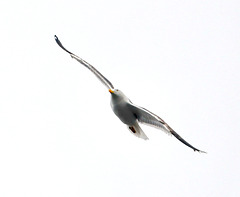
Seagull in flight.
| 20 Jul 2019 |
|
|
|
The European herring gull (Larus argentatus) is a large gull up to 26 inches (66 cm) long. One of the best known of all gulls along the shores of Western Europe, it was once abundant. It breeds across Northern Europe, Western Europe, Central Europe, Eastern Europe, Scandinavia and the Baltic states. Some European herring gulls, especially those resident in colder areas, migrate further south in winter, but many are permanent residents, e.g. in Ireland, Britain, Iceland, or on the North Sea shores. European herring gulls have a varied diet including fish, crustaceans and dead animals as well as some plants. While herring gull numbers appear to have been harmed in recent years, possibly by fish population declines and competition, they have proved able to survive in human-adapted areas and can often be seen in towns acting as scavengers.
(Wikipedia).
Camera: Nikon D500
Lens: AF-S Nikkor 70-200mm f/2.8G ED VR II
Software: Nikon Capture NX2
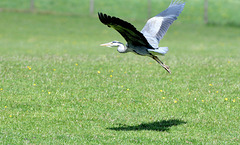
Grey heron (3 of 3).
| 22 May 2019 |
|
|
|
The grey heron (Ardea cinerea) is a long-legged predatory wading bird of the heron family, Ardeidae, native throughout temperate Europe and Asia and parts of Africa. It is resident in much of its range but some populations from the more Northern parts migrate southwards in autumn. A bird of wetland areas, it can be seen around lakes, rivers, ponds, marshes and on the sea coast. It feeds mostly on aquatic creatures which it catches after standing stationary beside or in the water or stalking its prey through the shallows. Standing up to 1 m tall, adults weigh from 1 to 2 kg (2.2 to 4.4 lb). They have a white head and neck with a broad black stripe that extends from the eye to the black crest. The body and wings are grey above and the underparts are greyish-white, with some black on the flanks. The long, sharply pointed beak is pinkish-yellow and the legs are brown.
(Wikipedia).
Camera: Nikon D500
Lens: AF-S Nikkor 70-200mm f/2.8G ED VR II
Software: Nikon Capture NX2
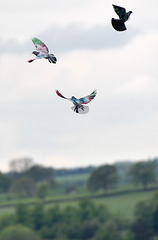
Painted pigeons (3 of 3).
| 18 May 2019 |
|
|
|
Camera: Nikon D500
Lens: AF-S Nikkor 70-200mm f/2.8G ED VR II
Software: Nikon Capture NX2
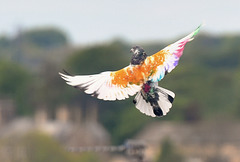
Painted pigeons (2 of 3).
| 18 May 2019 |
|
|
|
Camera: Nikon D500
Lens: AF-S Nikkor 70-200mm f/2.8G ED VR II
Software: Nikon Capture NX2
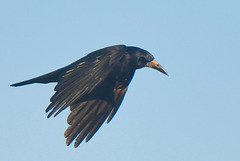
Rook (Corvus frugilegus).
| 15 May 2019 |
|
|
|
The rook (Corvus frugilegus) is a member of the family Corvidae in the passerine order of birds. It was given its binomial name by Carl Linnaeus in 1758. The binomial is from Latin; Corvus for "raven" and frugilegus is Latin for "fruit-gathering" from frux, "fruit" and legere, "to pick". The English name is ultimately derived from the bird's harsh call. Rooks are distinguished from similar members of the crow family by the bare grey-white skin around the base of the adult's bill in front of the eyes. The feathering around the legs also looks shaggier and laxer than the carrion crow. The juvenile is superficially more similar to the crow because it lacks the bare patch at the base of the bill but it has a thinner bill and loses the facial feathers after about six months.
(Wikipedia).
Camera: Nikon D500
Lens: AF-S Nikkor 70-200mm f/2.8G ED VR II
Software: Nikon Capture NX2
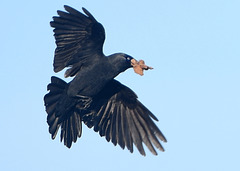
Fast food.
| 14 May 2019 |
|
|
|
A jackdaw carrying what appears to be a slice of brown bread back to it's nest on nearby buildings. The bird was about 30 metres / 33 yards from my shooting position according to the EXIF information so I had to crop the photo quite a lot to get a reasonably large image with my 200mm lens, therefore the resolution is not quite perfect. I used "continuous high speed" (10 frames per second) shooting mode and "continuous auto-focus" with an exposure compensation of +1.7 to avoid the bird becoming a silhouette against the bright blue sky.
Camera: Nikon D500
Lens: AF-S Nikkor 70-200mm f/2.8G ED VR II
Software: Nikon Capture NX2
Jump to top
RSS feed- Phil's latest photos with "Flight" - Photos
- ipernity © 2007-2026
- Help & Contact
|
Club news
|
About ipernity
|
History |
ipernity Club & Prices |
Guide of good conduct
Donate | Group guidelines | Privacy policy | Terms of use | Statutes | In memoria -
Facebook
X
