

Scott Holcomb's photos with the keyword: The Getty Villa
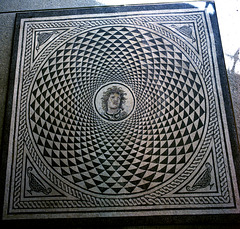
Mosaic Floor with Head of Medusa
| 05 Oct 2022 |
|
|
|
Roman, about AD 115-150
Stone tesserae
The Getty Villa
A bust of the gorgon Medusa occupies the center of this Roman mosaic floor. Although early Greek representations of Medusa emphasized her hideous and monstrous appearance, a more human-appearing figure had become the norm by the time of this mosaic in the 100s A.D. Medusa's former snaky locks are now just wild curls and she even takes on traits derived from representations of Alexander the Great and Hellenistic kings, like her wind-blown hair and turned head. In this mosaic, Medusa is placed in a shield of concentric circles, whose alternating black and white triangles create an optical illusion of continuous motion. An outer square encloses the shield and kantharoi or drinking cups fill the outer corners. This spinning shield motif with the gorgon's head as its central point appears frequently on Roman mosaic floors. The basic design derives from Athena's aegis, the scaly protective cloak decorated with Medusa's decapitated head.
This photo was taken by a Kowa/SIX medium format film camera with a KOWA 1:3.5/55mm lens using Kodak Portra 800 film, the negative scanned by an Epson Perfection V600 and digitally rendered with Photoshop.

Eternal Youth
| 11 Nov 2021 |
|
|
|
Portrait Bust with Inscription
Roman - A.D. 100-115
Marble
The Getty Villa Museum
A portrait bust of a very young child with hair cut short above the brow in the Trajanic style, and behind, above the right ear, is a so-called lock of Horus.
Description from the Getty Villa website
This photo was taken by a Kowa/SIX medium format film camera with a KOWA 1:3.5/55mm lens using Ilford Delta 3200 film, the negative scanned by an Epson Perfection V600 and digitally rendered with Photoshop.
Dionysos
| 30 Oct 2021 |
|
|
|
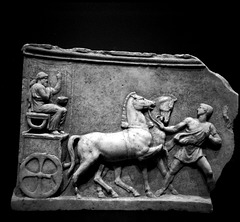
Dionysos being Transported to the Sanctuary
Greek - 50 B.C.
Marble
The Getty Villa Museum
The scene depicts a ritual procession transporting a cult statue of the wine-god Dionysos to a festival or sanctuary. The bearded god has long hair tied in the rear, wears a long-sleeved tunic, and holds a phiale (libation vessel) in his now-broken right hand. The statue, seated on a folding stool under a canopy supported by four thyrsoi (ritual staffs sacred to the deity), is being drawn on a two-wheeled cart. A youth wearing a short belted tunic and a pilos (conical-shaped cap) leads the two spirited horses.
Description from the Getty Villa website
This photo was taken by a Kowa/SIX medium format film camera with a KOWA 1:3.5/55mm lens using Ilford Delta 3200 film, the negative scanned by an Epson Perfection V600 and digitally rendered with Photoshop.
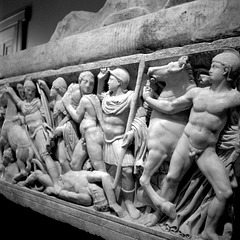
Roman Sarcophagus
| 28 Oct 2021 |
|
|
Sarcophagus with Lid
Roman, AD 180-220 (Created in Athens, Greece)
Marble
The Getty Villa
The Greek hero Achilles decorates this Roman sarcophagus. The front shows Achilles desecrating the corpse of the fallen Trojan hero Hektor by dragging it behind his chariot. The life of Achilles was a popular subject for the decoration of Roman sarcophagi.
Burial in a sarcophagus was a popular custom during the period from about 150 to 250 A.D. Sarcophagi were mass produced in a few centers, one of which was Athens. Athenian sarcophagi were carved on all four sides and often surmounted with reclining figures.
Description from the Getty Villa website
This photo was taken by a Kowa/SIX medium format film camera with a KOWA 1:3.5/55mm lens using Ilford Delta 3200 film, the negative scanned by an Epson Perfection V600 and digitally rendered with Photoshop.
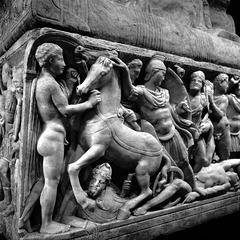
Sarcophagus Trojan Scene
| 28 Oct 2021 |
|
|
Sarcophagus with Lid
Roman, AD 180-220 (Created in Athens, Greece)
Marble
The Getty Villa
The Greek hero Achilles decorates this Roman sarcophagus. The front shows Achilles desecrating the corpse of the fallen Trojan hero Hektor by dragging it behind his chariot. The life of Achilles was a popular subject for the decoration of Roman sarcophagi.
Burial in a sarcophagus was a popular custom during the period from about 150 to 250 A.D. Sarcophagi were mass produced in a few centers, one of which was Athens. Athenian sarcophagi were carved on all four sides and often surmounted with reclining figures.
Description from the Getty Villa website
This photo was taken by a Kowa/SIX medium format film camera with a KOWA 1:3.5/55mm lens using Ilford Delta 3200 film, the negative scanned by an Epson Perfection V600 and digitally rendered with Photoshop.
Jump to top
RSS feed- Scott Holcomb's latest photos with "The Getty Villa" - Photos
- ipernity © 2007-2026
- Help & Contact
|
Club news
|
About ipernity
|
History |
ipernity Club & Prices |
Guide of good conduct
Donate | Group guidelines | Privacy policy | Terms of use | Statutes | In memoria -
Facebook
X
