

Jaap van 't Veen's photos with the keyword: Pays d'Auge
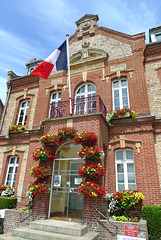
France - Houlgate, ville fleurie
| 22 Aug 2025 |
|
|
|
The name Houlgate comes directly from the Normans, who settled in the area in the 9th century. From the 11th century onwards, the village - then called Beuzeval - was inhabited by fishermen and farmers. In the mid-19th century, beach holidays became popular and the village was renamed Beuzeval-les-Bains. In 1905, the name was changed to the current Houlgate.
Houlgate has been called “the pearl of La Côte Fleurie” (Flower Coast) for over 100 years, which is not surprising given that it has retained its Belle Epoque charm with 300 beautiful architectural villas, built in the mid to late 19th century.
The town is richly decorated with flowers around the town hall and the local tourist office. Nearby is a small rose garden.

France: Beuvron-en-Auge, Église Saint-Martin
| 20 Aug 2025 |
|
|
|
The Église Saint-Martin (Saint-Martin church) was built between 1640 and 1643. The original church stood within the walls of Harcourt Castle, but was moved to a site north of the village that belonged to Bec-Hellouin Abbey.
Around 1920, the original bell tower, which was in poor condition, was replaced by a brick tower in neo-Gothic style. The church therefore stands out for its red brick tower and white exterior.
The furnishings and interior were thoroughly renovated at the end of the 19th century and in the 20th century. The stained-glass windows and organ were installed in 1924. However, several old elements have been preserved. The most striking is the 18th-century high altar.
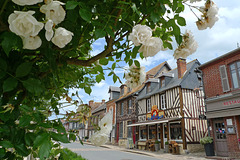
France: Beuvron-en-Auge
| 18 Aug 2025 |
|
|
|
The origins of Beuvron-en-Auge probably date back to Gallo-Roman times. The name ‘Beuvron’ appears in other forms in documents as early as the 11th century. It refers to a small river that flows through the village: Beuvron = beaver river.
In the 12th century, a small rural community emerged. For centuries, until the end of the 18th century, the lands of Beuvron belonged to the powerful d'Harcourt family, who made a major contribution to the economic development of the village.
The development of the village accelerated in the 15th century and reached its peak in the 17th and 18th centuries, when tanning and weaving ensured the prosperity of the village. In the 19th century, Beuvron was in danger of becoming a ghost village. In the 1970s, the remaining inhabitants decided to breathe new life into the village. The half-timbered houses were restored and the market hall, which had been demolished in 1958, was rebuilt. Slowly, Beuvron regained its former charm.
Beuvron-en-Auge nowadays has about 40 half-timbered houses, mainly located around the market hall on Place Michel Vermughen. The village is officially recognised as one of “Les Plus Beaux Villages de France” (The Most Beautiful Villages of France) because of its well-preserved Norman architecture.
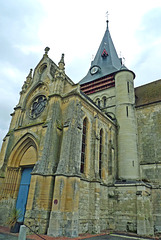
France: Beaumont-en-Auge, Église Saint-Saveur
| 15 Aug 2025 |
|
|
|
In the 9th century a watchtower was built, which was converted into a place of worship and part of a monastery. This sturdy church - Église Saint-Saveur - was constructed in the 11th century by the lord of Beaumont and has become a place of worship and pilgrimage. The church was extended with two apses, tall flamboyant crossings, a rose window, a primitive tower, a bell tower, scarlet half-timbering and a wooden spire.
This former priory church is characterized by a mixture of architectural styles. Wars, the Revolution, abandonment and multiple acts of destruction have left a deep mark on its history. The various phases of reconstruction have gradually transformed the original layout. Apart from the tower, which has retained its Romanesque style, the nave and choir, which were partially destroyed in 1612, have been remodeled.
An extension of the monks' building, the parish church, destroyed in 1804, was enlarged with a ‘neo-Gothic’ porch in 1861. Major renovations have been undertaken in recent decades: stained glass windows damaged during World War II in 1952 and a restoration of the bell tower in 2007.
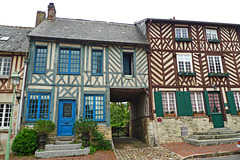
France: Beaumont-en-Auge
| 13 Aug 2025 |
|
|
|
Beaumont-en-Auge is dating back to the foundation of a Benedictine priory in 1060, giving the village a regional stature. It has played an important role in French history, reaching its peak at the end of the 18th century.
The village is located on a 90 meters high outcrop, offering vast panoramic views of the Touques valley. Before the Christian era, the Celts who populated Normandy must have occupied this easily defensible peak.
Nowadays the village with around 500 inhabitants - is well-known for its colourful half-timbered houses. Beaumont-en-Auge is listed as one of the prettiest villages in France.
To be honest, we were a little disappointed about Beaumont. The number of half-timbered houses was quite limited, while the large number of parked cars detracted from the atmosphere and charm of the village.
Jump to top
RSS feed- Jaap van 't Veen's latest photos with "Pays d'Auge" - Photos
- ipernity © 2007-2026
- Help & Contact
|
Club news
|
About ipernity
|
History |
ipernity Club & Prices |
Guide of good conduct
Donate | Group guidelines | Privacy policy | Terms of use | Statutes | In memoria -
Facebook
X
