

Jaap van 't Veen's photos with the keyword: Witte Pauwenburcht
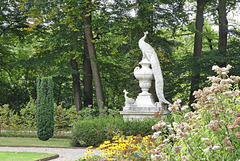
Nederland - Kasteel Staverden
| 07 Nov 2025 |
|
|
|
Kasteel Staverden (Staverden Castle) was frequently used as a hunting lodge by the Dukes of Gelre. Since 1400 there were feudal lords living at Staverden Castle, who had to preserve and defend the castle. They also were charged with the duty of keeping white peacocks. The peacock feathers were used to adorn the duke's tournament helmet. There are still white peacocks on the grounds and the castle has a wind vane in the shape of a white peacock. White peacocks still live at Staverden, in a peacock cage a few hundred meters from the castle. Kasteel Staverden is also called Witte Pauwenburcht (White Peacock Castle).
The castle gardens of Staverden are among the most beautiful in the Netherlands. It offers flower beds, elegant water features and centuries-old trees. The gardens are designed in a classic English landscape style. In a large geometric garden laid out in 1907 - one can find ‘of course’ a sculpture of two peacocks. It is unclear how old the sculpture is and who created it; it may have been on the estate for much longer. This sandstone statue on a tall square pedestal is an official Dutch national monument.
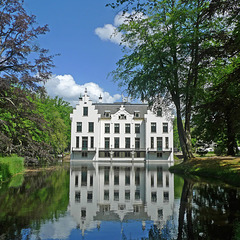
Nederland - Staverden
| 29 May 2020 |
|
|
|
Kasteel en landgoed Staverden (Staverden Castle and estate) have a long history. The counts of Gelderland (later dukes) probably already had a court in Staverden in the 12th century. In 1299, Count Reinald I obtained city rights from the German king Rudolph. But it never came to a real city development. Research has shown that Staverden was probably never meant to become a real city. Staverden Estate however does have 16 farms, spread across its lands; a coach house, orangery, watermill, dovecot, workers' houses, a church and a cemetery. It is officially the smallest city in the Netherlands and most probably in the world with its ca. 30 inhabitants (situation 2018).
The castle was frequently used as a hunting lodge by the Dukes of Gelre. Since 1400 there were feudal lords living at castle Staverden, who had to preserve and defend the castle. They also were charged with the duty of keeping white peacocks. The peacock feathers were used to adorn the duke's tournament helmet. There are still white peacocks on the grounds, the castle has a wind vane in the shape of a white peacock and in the surrounding garden one can find a statue of a peacock (PiP 5). Kasteel Staverden (Castle Staverden) is also called Witte Pauwenburcht (White Peacock Castle).
Around 1600 the castle was owned by the Van Haersoltes , who rebuilt it into a more habitable house. Around 1840 the manor was rebuilt again; Staverden Castle got its current form between 1853 and 1905, after the estate was purchased by Frederik Bernard s’Jacob , former mayor of Rotterdam. His heirs sold the house to the current owner, the foundation Geldersch Landschap en Kasteelen .
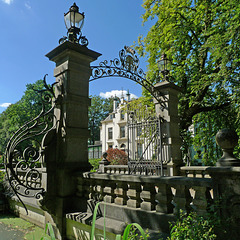
Nederland - Staverden
| 17 Aug 2018 |
|
|
|
Around the year of 1300 Count Reinald van Gelre founded a settlement on the northern Veluwe. The ‘village’ was given city rights in 1298 as a form of encouragement and as a reward for his ambitions. But the development of Staverden never happened and there has never been any urban development since. It never came to anything more than the castle. Staverden Estate however does have 16 farms spread across its lands; a coach house, orangery, watermill, dovecot, workers' houses, a church and a cemetery, and is officially the smallest city in the Netherlands and the Benelux with its ca. 50 inhabitants (situation 2018).
The castle was frequently used as a hunting lodge by the Dukes of Gelre. Since 1400 there were feudal lords living at castle Staverden, who had to preserve and defend the castle. Around 1600 the castle was owned by the Van Haersoltes , who rebuilt it into a more habitable house.
Around 1840 the manor was rebuilt again; Staverden Castle got its current form in 1905, after the estate was purchased by Frederik Bernard s’Jacob , former mayor of Rotterdam. His heirs sold the house to the current owner, the foundation Geldersch Landschap en Kasteelen .
(Picture from another season: www.ipernity.com/doc/294067/21893815)
Jump to top
RSS feed- Jaap van 't Veen's latest photos with "Witte Pauwenburcht" - Photos
- ipernity © 2007-2026
- Help & Contact
|
Club news
|
About ipernity
|
History |
ipernity Club & Prices |
Guide of good conduct
Donate | Group guidelines | Privacy policy | Terms of use | Statutes | In memoria -
Facebook
X
