

Jaap van 't Veen's photos with the keyword: Le Péloponnèse
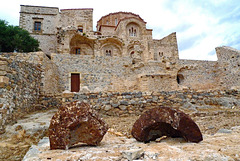
Greece - Monemvasia, Agia Sofia
| 08 Apr 2019 |
|
|
|
Agia Sofia is an impressive church of high architectural value, founded in the middle of the 12th century. Oral and written reports link the church to the Byzantine Emperor Andronicos II Palaiologos (1282-1328). Carvings of the church date from the 12th century and its frescoes are from around the year of 1400.
It is situated in the Upper Town of Monemvasia and is one of the view buildings there that is more or less intact. During the first period of Ottoman rule many Christian people left the town, but the church was saved because the Turks decided to convert Agia Sofia in a mosque.
The Ottomans converted it to a mosque and whitewashed the wall-paintings. On the return of the Venetians, the catholic doctrine church was consecrated to Madonna del Carmine.
The Ottomans converted it to a mosque once again, while one of the very first things the Greeks did, when they got the town back in 1821after the Greek War of Independence, was to demolish the minaret that had been built. The octagonal domed Agia Sofia was consecrated to Virgin Mary Hodegitria. It was considered to be a faithful replica of Agia Sofia in Constantinople, the former Byzantine capital.
Since then, and given that the church of Agia Sofia was the only well preserved building in the Upper Town (Ano Polis), a series of renovation works followed. The last of these were completed some years ago. It is considered being one of the oldest and most important Byzantine churches in Greece,
Standing on the highest point of Monemvasia the church (and Upper Town) are accessible through a steep path with stairs and slippery stones.
(More images of Monemvasia: www.ipernity.com/doc/294067/48410582 )
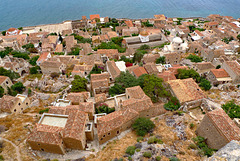
Greece - Monemvasia
| 01 Apr 2019 |
|
|
|
Monemvasia is a town, which is located on a small island - 300 metres wide and 1.000 metres long - off the east coast of the Peloponnese. The island - cut off from the coast by an earthquake in the year of 375 - is connected with the mainland by a 200 metres long causeway. Its area consists mostly of a large plateau some 100 meters above sea level and a rather small piece of land with the walled town itself.
The town's name derives from the Greek words, mone and emvasia , meaning "single entrance". It is also called “Gibraltar of the east”
The town and fortress were founded in 583 by inhabitants of the mainland, seeking refuge from the Slavic and the Avaric invasion of Greece. From the 10th century, Monemvasia developed into an important trade and maritime centre.
Monemvasia - a natural fortress - was inhabited and soon became a strategic fortress claimed the Byzantines, Franks, Venetians and Ottomans. The town was liberated from Ottoman rule on July 23, 1821 by Tzannetakis Grigorakis, who entered the town with his private army during the Greek War of Independence.
Monemvasia became linked with mainland Peloponnese in 1971 by the causeway and a small bridge. The town has become an important touristic site with an increasing number of visitors, strolling along the cobbled streets and paths amid the mansions and Byzantine churches. Medieval buildings have been restored and many of them converted into hotels. These days, though, only around 20 people live in the kastro (fort) permanently.
(I took the main picture from the Upper Town, which was home to the Venetian aristocracy and nowadays offering a wonderful panoramic view of (the rooftops of) Monemvasia and the surrounding area.)
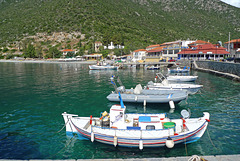
Greece - Plaka
| 15 Feb 2019 |
|
|
|
Plaka - considered being the sea port of Leonidio - is one of those quaint picturesque seaside villages on the Peloponnese.
Plaka has a little harbour with some (fishing) boats, a couple of small taverns, cafes and shops adjacent to the clear water and a pebbled beach. At least during our visit it looks if tourism had not spoiled this authentic fishing village.
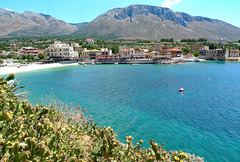
Greece - Gerolimenas
| 14 Jan 2019 |
|
|
|
Gerolimenas is a small sleepy village with some fishing boats along its shore on the Mani peninsula. In the late 19th and early 20th centuries it was an important harbour, from where goods were shipped to Piraeus and other Greek islands. Once Gerolimenas was one of the most remote villages in the Peloponnese and till the 1970’s it only could be reached by boat or donkey.
Gerolimenas means “Old Harbour” and derives from the ancient " Ιερός Λιμήν " (Ieros Limen).
In the past a fishing village, nowadays the village - with some hotels and restaurants - is a popular destination for tourists. Although during our visit it was very quiet and peaceful. The traditional stone buildings are scattered around the natural harbour and a small pebble beach.
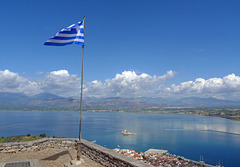
Greece - Nafplion
| 16 Feb 2018 |
|
|
|
Palamidi is a vast spectacular fortress that dominates Nafplio, nestled on the crest of a 216-metre high hill above the city. It was built between 1711 and 1714 by the Venetians built the castle during their second occupation of this part of Greece. It was one of the most important and impressive ‘castles’ the Venetians built outside their own country.
This fort consists of eight bastions (PiP2), each was self contained, ensuring that if one bastion was breached the others could still be separately defended. The bastions were built one on top of the other and they all connected with one wall. Yet, in 1715, one year after completion, it was captured by the Turks and remained under their control until 1822, when it was captured by the Greeks.
Nafplio is one of the first places in Greece that won independence. November 29th, 1822, a group of Greek rebels overpowered the Turks in Palamidi and the next day the town could celebrate its freedom.
From 1840 and for nearly a hundred years, Palamidi was used as a prison. Theodoros Kolokotronis, hero of the Greek Revolution, was one of the prisoners. His cell can still be visited. Prisoners, who were held in Palamidi, constructed the stairs from Nafplio up to the castle was built. It is often said by locals in Nafplio that there are 999 steps, but I did read several numbers; some say "only" 857, others 901 or 913. The fortress can also be reached by car. The views of Nafplio, Bourtzi Castle, the Argolic Gulf and surrounding country are overwhelming (main picture and PiP3).
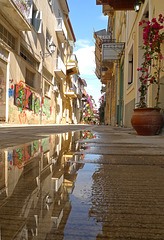
Greece - Nafplio
| 05 Feb 2018 |
|
|
|
Nafplio (or Nafplion) was the first capital of the newly born Greek state - after a Turkish occupation - between 1823 and 1834. It is situated along the Argolic Gulf in the north-eastern part of the Peloponnesus, just a couple of hours by car from Athens. The city with a small port is built on a small peninsula beneath the towering Palamidi fortress.
According to mythology, the town was founded by Nafplios, the son of god Poseidon and the daughter of Danaus Anymone. The history traces back to the prehistoric era when soldiers from here participated in the Argonautic expedition and the Trojan War alike. The town declined during the Roman times and flourished again during the Byzantine times. Frankish, Venetian and Turkish conquerors left their mark in the town and strongly influenced its culture, architecture and traditions during the centuries.
It is said that Nafplio is one of the most prettiest and romantic towns of Greece. After our visit I fully agree with that. It was such a pleasure strolling through the medieval old town with its narrow streets, lined with small shops, boutiques, (art) galleries, cafés and restaurants. Well preserved mansions with their architecture and beauty were on many places full with blooming jasmine and bougainvillea. .
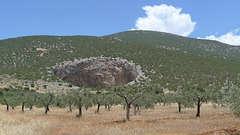
Greece - Didyma ‘craters’
| 08 Jan 2018 |
|
|
|
Didyma is a small rural and very quiet village in the middle of nowhere on the Peloponnese between Epidaurus and Porto Cheli. It is (well) known for its craters or caves, which are located one kilometer west of the village in the slope of Mount Didimo.
The Big Cave (Μεγαλη Σπηλια - Megali Spilia), can be seen from the main road. From a distance (main picture) it looks impressive, but once at the edge of the cave - after a short walk - I was rather disappointed, as there is no depth to the cave at all and the ground of the doline is full of debris and some shrubs growing between the rocks.
Much more interesting is the Small Cave (Μικρη Σπηλια - Mikri Spilia), which is situated below ground level and is not visible from the road, as it is also surrounded by trees. The cave is only accessible through a steep stair (PiP1) is leading down into the rock towards the inside of the round doline (PiP2). There is a path going round along two little Byzantine churches: One is Aghios Georgios with its wall murals dating back to the 13th century and the other chapel built into the surrounding rock, the Metamorfosis of Sortiros (PiP3).
There is still some debate today how these cave holes came into being. It is for sure that they were not caused by space meteorites, as no evidence of un-earthly rock has been discovered around the area. Most probably the holes were created by underground natural gas explosions many centuries ago, as there are more similar holes on the opposite side of Mount Didimo.
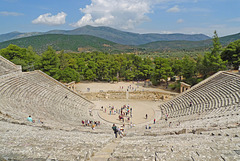
Greece - Epidaurus
| 11 Dec 2017 |
|
|
|
The (ancient) theatre of Epidaurus is considered to be the most perfect ancient Greek theatre with regard to acoustics and aesthetics. It was part of the sanctuary dedicated to the ancient Greek God of medicine, Asclepius. At a maximum capacity of about 13.000 spectators, the theatre hosted music, singing and dramatic games that were included in the worship of Asclepius. It was also used as a means to heal patients, since there was a belief that the observation of dramatic shows had positive effects on mental and physical health.
The monument shows the characteristic structure of a classical Hellenistic theatre with an auditorium, orchestra and staging building. It was built in the late 4th century BC and enlarged in the mid-2nd century AD. During Roman times, the theatre (unlike many Greek theatres) did not suffer any modifications.
The auditorium has 55 rows of seats resting on a natural slope and facing the stage area set against a backdrop of lush landscape. It was divided into two parts: a 21-rows of seats part, aimed for the citizens and a 34-rows of seats part aimed for the priests and rulers.
The theatre is famous for its exceptional acoustics. Any sound on the open-air stage, whether a stentorian voice or a whisper, a deep breath or the sound of a match struck is perfectly audible to all spectators, even in the topmost row of seats, that is nearly 60 metres away.
For centuries the theatre remained covered by a slope of trees until the year 1881, when several excavations took place. Since 1938, when modern dramas started to be presented again in the theatre, it has hosted hundreds of plays. The famous Athens Epidaurus Festival begun in1954 and is held every summer with famous ancient dramas or modern plays.
Greece, Stemnitsa, Prodromou Monastery
| 23 Jun 2017 |
|
|
|
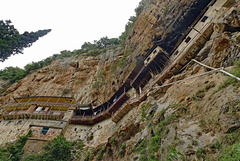
The Prodromou Monastery (Moni Timíou Prodrómou - Μονή Τιμίου Προδρόμου) is one of the most famous monasteries in the Peloponnese. The particularly picturesque and visually stunning monastery is situated on/against the eastern cliffs of the Lousios River Gorge with its stone buildings and ramshackle wooden balconies, seeming to hang from the overhanging cliffside. The three-storied east and south wings and the two-storied north wing contain cells, storerooms, and service areas.
It is said to date back to the year of 1167, but reliable sources estimate the foundation somewhere in the 16th century. The monastery is dedicated to Saint John the Baptist, who in the Orthodox tradition is usually called Pródromos (the Forerunner, meaning the one who came before Jesus). The monastery houses a literally hidden gem: a very small (2.25 x 4.90 m) domed, rock hewn church (PiP 3) with an iconostasis from the 16th century; frescoes were painted directly on the rock walls (PiP 4) outside the church.
Due to its inaccessible location Moni Prodromou played a large role in the Greek War of Independence in 1821 as a medical and supply station for the Greek soldiers and as refuge for civilians. The original door is still intact and the bullet holes are indicative of the fighting that occurred in this area.
The monastery still houses a monk community and during our visit we were welcomed by one of them with Greek coffee, water, bread and honey sweet loukoumia. It can be reached from the main road between Stemnitsa and Dimitsana through a 7 km long particularly steep, winding and narrow road and a 15 minutes walk.
Jump to top
RSS feed- Jaap van 't Veen's latest photos with "Le Péloponnèse" - Photos
- ipernity © 2007-2026
- Help & Contact
|
Club news
|
About ipernity
|
History |
ipernity Club & Prices |
Guide of good conduct
Donate | Group guidelines | Privacy policy | Terms of use | Statutes | In memoria -
Facebook
X
