

Jaap van 't Veen's photos with the keyword: Falaise

France - Falaise, Vieux Lavoir
| 08 Sep 2025 |
|
|
|
Vieux Lavoir (Old Wash House) is located at the foot of Falaise Castle, in the historic Val d'Ante district, one of the oldest parts of the city. The wash house uses water from the Ante River.
This washing house of the former tanneries, built in the 17th century, was used by washerwomen until the 1970s. After that, the building fell into disrepair, prompting the municipality to prohibit access in 2010.
After a three-year restoration, the Vieux Lavoir was reopened to the public at the end of May 2025.
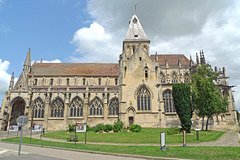
France- Falaise, Église Saint-Gervais-Saint-Protai…
| 03 Sep 2025 |
|
|
|
The Église Saint-Gervais-Saint-Protais -commonly called Église Saint-Gervais (Saint-Gervais church) was built in the 11th century under William the Conqueror and completed under his son. The church was consecrated in 1124. The Romanesque parts of the current building date from that period. The church was under the authority of the Abbaye-aux-Dames abbey in Caen, which is reflected in its architecture.
Saint-Gervais suffered considerable damage during the siege of 1204 and was rebuilt in Gothic style. Further alterations were made in the 15th, 16th and 18th centuries. The wooden vaulted ceiling is a highlight inside the church.
Saint-Gervais was again severely damaged by bombing at the end of the Second World War during the “Battle of the Falaise Pocket” and was thoroughly restored in the following decades.

France - Falaise, Porte des Cordeliers
| 01 Sep 2025 |
|
|
|
Together with five other city gates the Porte des Cordeliers marked the control of entry to and exit from the fortified town of Falaise as from the Middle Ages. Designed as a gatehouse ( chatelet ) this access point was protected by a flanking tower to the north and was equipped with a portcullis. The present day edifice dates essentially from the 13th century.
The Porte des Cordeliers is also referred as the Porte Ogise or Porte Ogier . It owes its name from les Cordeliers : Franciscan monks from a nearby monastery. In France known as the brothers of the “Order of the Cordeliers”, because of the rope belt (French = corde) they wore around their waists.
The Porte des Cordeliers is the best-preserved city gate in Falaise; the others have been severely damaged or even completely destroyed.
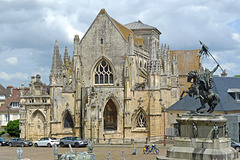
France - Falaise, Église Sainte-Trinité
| 29 Aug 2025 |
|
|
|
After an earlier smaller church - dating from 840 - was destroyed during a siege by king Philippe II of France, the current Église Sainte-Trinité was rebuilt in Gothic style in 1240. Following severe damage during the Hundred Years' War, the nave (15th century) and the choir, chapels and portal (16th century) were rebuilt.
An extension to the church was built in such a way that carts could pass through the church unhindered via an arch (PiP3). Such an arch is rare in France and unique in Normandy.
The Sainte-Trinité church has a richly decorated choir and a chestnut wood vault (PiP6).
The church - located right at the foot of Falaise Castle - has been classified as a historic monument since 1889.
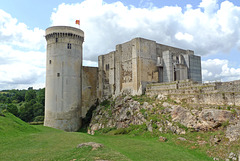
France - Falaise, Château Guillaume-le-Conquérant
| 27 Aug 2025 |
|
|
|
Château Guillaume-le-Conquérant (Castle of William the Conqueror or Falaise Castle) is located on a rocky outcrop above the town. The first stone castle on this site was built between 962 and 1020, most likely by Richard II of Normandy. Around 1027, Richard II's grandson, William the Conqueror, was born in this castle. He would become the first Norman king of England.
The current castle was built in 1123 by Henry I of England on the remains of its predecessor. The main castle consists of three keeps. The oldest is the large quadrangular keep, built by Henry I. The other two were added in the 12th and 13th centuries.
During the Hundred Years' War, between 1337 and 1453, Falaise Castle changed hands several times. At the end of the 16th century, the castle was severely damaged after a siege. The castle was abandoned in the 17th century and subsequently fell into disrepair. In August 1944, the castle complex was largely destroyed after fierce fighting between Allied and German troops during the “Battle of the Falaise Pocket”.
In 1840 it was declared a monument historique .
Between 1987 and 1997, Falaise Castle was completely restored, using a lot of concrete and steel.
Today, the castle is still the landmark of Falaise.
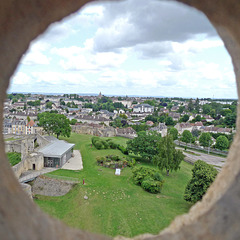
Frankrijk - Falaise
| 25 Aug 2025 |
|
|
|
Falaise is best known as the birthplace of William the Conqueror (Guillaume le Conquérant). The town is located on the edge of a rocky massif. It was not until the end of prehistory and the beginning of the Christian era that the area, and Falaise in particular, became permanently inhabited. In 911 AD, the town became part of the Duchy of Normandy.
William the Conqueror (born 1027) was the first Norman king of England. At the end of the 12th century, Philippe II of France took control of Normandy and Falaise. During the Hundred Years' War (1337–1453), the town remained under English control until 1450, when the French conquered Falaise.
From the Middle Ages onwards, Falaise expanded around the castle. In 1590, the castle was besieged by the troops of Henri IV of France. The damage caused by cannons during this last siege marked the end of Falaise as an important military strategic point.
Falaise was an important centre for trade and craft products, which is why it became a prosperous town early on. At the height of its power, the town was protected by impressive fortifications: a 2-kilometre-long city wall with 50 towers and 6 defensive gates. Today, more than two-thirds of the wall have been preserved.
In 1851, a statue of William the Conqueror was unveiled in the square in front of the castle (PiP4).
In August 1944, Falaise was the town where the last major battle for the liberation of Normandy was fought in what became known as the “Batlle of the Falaise Pocket”.
Jump to top
RSS feed- Jaap van 't Veen's latest photos with "Falaise" - Photos
- ipernity © 2007-2026
- Help & Contact
|
Club news
|
About ipernity
|
History |
ipernity Club & Prices |
Guide of good conduct
Donate | Group guidelines | Privacy policy | Terms of use | Statutes | In memoria -
Facebook
X
