

Jaap van 't Veen's photos with the keyword: Antwerp

België - Antwerpen, Sint-Carolus Borromeuskerk
| 28 Jan 2026 |
|
|
|
In 1615, Jesuits from Antwerp began construction of their Baroque church. In 1621, the Onze-Lieve-Vrouwekerk - as it was initially called - was completed. In 1773, the Jesuit order was abolished. A few decades later, the church became the parish church that it still is today and was given the name of its new patron saint: Sint-Carolus Borromeuskerk (St. Charles Borromeo Church).
This is the Rubens Church par excellence. As a painter, decorator and architect, Peter Paul Rubens had a hand in the tower, the façade, the high altar, the ceiling stucco work and the Lady Chapel.
Large sums of money were spent on decorating the interior. It was not for nothing that the church was called “the marble temple”. On 18 July 1718, lightning struck, destroying no fewer than 39 of Rubens' ceiling paintings in the flames. This was followed by a somewhat austere reconstruction of the column basilica. During the restoration in the 1980s, attempts were made to recreate the original interior from before 1718.

België - Antwerpen, Onze-Lieve-Vrouwekathedraal
| 26 Jan 2026 |
|
|
|
The history of Onze-Lieve-Vrouwekathedraal (Cathedral of our Lady) began in the 9th century with a small chapel dedicated to Our Lady. In 1124, it was granted parish church status and replaced by a larger Romanesque church.
When that became too small, an ambitious project was launched in 1352: the construction of the largest Gothic church in the Netherlands with two identical, tall towers. After almost 170 years, the Cathedral of Our Lady was completed. The north tower was finished with a height of 123 metres. The south tower only reached halfway. After a fire in 1533, completion was never resumed. In 1559, the church was given the title of “Cathedral”.
The building was not spared from disaster. During the Iconoclastic Fury in 1566, the Protestants destroyed a large part of the interior. Years later, numerous art treasures were destroyed, removed or sold. When the French conquered the city in 1794, they plundered the church.
In 1816, the Cathedral of Our Lady was restored to its former glory with the return of important works of art, including three paintings by Rubens.

België - Antwerpen, Het Steen
| 23 Jan 2026 |
|
|
|
Het Steen is the oldest preserved building in Antwerp. Its location has been essential to the development of the city. As early as the 9th century, the first settlement with earthen ramparts was established here. A castle, a stone wall and a gatehouse were built at the entrance, which later became Het Steen . Over the centuries, the function of the impressive building changed frequently: from gatehouse to prison, from sawmill to museum. After its latest renovation in 2021, the medieval fortress of Het Steen houses a tourist centre for the city of Antwerp.
In front of Het Steen stands the Lange Wapper : a statue of a legendary giant from Antwerp folklore, who comes to life at night and chases drunks wandering through the city (PiP 3).

België - Antwerpen, Rubenshuis
| 07 Jan 2026 |
|
|
|
Peter Paul Rubens is one of Antwerp's most famous residents. He lived and worked here for much of his life. When he returned to Antwerp from Italy in 1608, he had a house on Vaartstraat (now Wapper) renovated two years later. He designed the Rubenshuis (Rubens House) and studio himself, modelled on the Renaissance palaces in Italy.
In 1937, the city of Antwerp purchased the property. Shortly after the Second World War, it was officially opened as a museum. The Baroque garden has been reconstructed as much as possible to its original state and contains more than 17,000 plants.

België - Antwerpen, Vlaeykensgang
| 05 Jan 2026 |
|
|
|
The Vlaeykensgang is a picturesque courtyard dating back to 1591. In the past, the poorest inhabitants of the city lived here, together with the shoemakers. They were responsible for ringing the alarm bell of the nearby cathedral. In the 1960s, there were plans to demolish this medieval street, until antique dealer Axel Vervoordt bought the Vlaeykensgang and had it restored.
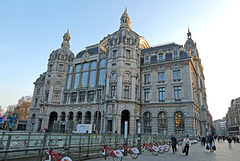
België - Antwerpen Centraal
| 02 Jan 2026 |
|
|
|
Antwerpen-Centraal (Antwerp Central) is the name of the main railway station in Antwerp. The original building was constructed between 1895 and 1905; it replaced the wooden train station from the mid 19th century.
The stone clad terminus buildings were designed by architect L. Delacenserie. It has a huge dome above the waiting room and eight smaller towers of which six were demolished during the 1950s. Fortunately they were reconstructed in 2009 together with several ornaments, including large lion statues. The rich interior is lavishly decorated with more than twenty different kinds of marble and stone.
Antwerpen-Centraal has been voted one of the most beautiful railway stations in the world on several occasions, including by Newsweek, Mashable and The Telegraph.
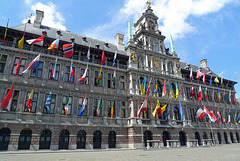
België - Antwerpen, stadhuis
| 06 Mar 2020 |
|
|
|
The majestic stadhuis (city hall) is built in the sixteenth century; construction of the building - after designs made by Cornelis Floris de Vriendt and several other architects and artists - started in 1561 and was completed four years later. At that time Antwerp was one of the largest and most important cities in the world. As one of the world's most powerful commercial centers the new city hall was to become a symbol of the city's wealth and power. It is considered being the most important Renaissance building in the “Low Countries”.
During the Spanish Fury in 1576, the new building was set on fire by Spanish soldiers, leaving only the exterior walls standing. The city hall was rebuilt three years later, in 1579.
The façade is richly decorated with statues, ornaments and coat of arms. It is facing the Grote Markt with its wonderful 16th and 17th centuries houses (PiPs). The stadhuis is decorated with the flags of the countries of the European Union, in addition to flags of all the countries that have a consulate in Antwerp.
The ground floor of the building originally housed small shops. The construction of the city hall was partly funded with the rent received from those shopkeepers.
The stadhuis of Antwerp is since 1999 inscribed on UNESCO's World Heritage List along with the belfries of Belgium and France.
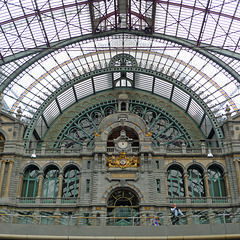
België: Antwerpen-Centraal
| 10 Nov 2017 |
|
|
|
Antwerpen-Centraal (Antwerp Central) is the name of the main railway station in Antwerp. The original station building was constructed between 1895 and 1905; it replaced the wooden train station from the mid 19th century.
The stone clad terminus buildings were designed by the Bruges architect L. Delacenserie. It has a huge dome above the waiting room and eight smaller towers of which six were demolished during the 1950s. Fortunately they were reconstructed in 2009 together with several ornaments, including large lion statues. The rich interior is lavishly decorated with more than twenty different kinds of marble and stone.
Nowadays the railway station is considered being the finest example of railway architecture in Belgium. In 2009 the American magazine “Newsweek” judged Antwerpen-Centraal the world's fourth greatest train station. Five years later it was awarded by the British-American magazine “Mashable” with the first place for the most beautiful railway station in the world.
Jump to top
RSS feed- Jaap van 't Veen's latest photos with "Antwerp" - Photos
- ipernity © 2007-2026
- Help & Contact
|
Club news
|
About ipernity
|
History |
ipernity Club & Prices |
Guide of good conduct
Donate | Group guidelines | Privacy policy | Terms of use | Statutes | In memoria -
Facebook
X
