

Jaap van 't Veen's photos with the keyword: Niedersachsen

Germany - Gildehaus, Geologisches Freilichtmuseum
| 18 Mar 2026 |
|
|
|
The Geologisches Freilichtmuseum (Geological Open-Air Museum) is a 200-metre circular path, showcasing more than 50 information boards and 16 different types of rock, including 30.000-year-old travertine and 1.4 billion-year-old Indian granite. The site also includes examples of historic quarrying equipment.
The ‘museum’ is located near the Romberg Quarry (PiP 4 and 5) ; the only Bentheim sandstone quarry, which is still in operation. (Although officially not open for visitors a local inhabitant told me there was no problem to have a quick look.)

Germany - Bad Bentheim, Schloss Bentheim/Kronenbur…
| 16 Mar 2026 |
|
|
|
Kronenburg (Crown Castle) is the medieval main building of Bentheim Castle, which was rebuilt in neo-Gothic style between 1883 and 1914.
After war damage in the 18th century, the castle had become uninhabitable and was used as a prison from 1817 to 1865. In 1883, Prince Alexis II Zu Bentheim und Steinfurt commissioned the building to be rebuilt and the residential wing to be converted into a modern aristocratic residence. In 1914, at the start of the First World War, the renovation was stopped.
Kronenburg nowadays offers ornate state rooms, which are furnished in the 19th-century style.

Germany - Bad Bentheim, Burg Bentheim
| 06 Mar 2026 |
|
|
|
Burg Bentheim (Bentheim Castle), built from Bentheim sandstone, stands on a sandstone outcrop over 90 metres high above Bad Bentheim. It is the largest hilltop castle in northwestern Germany.
The first mention of the castle dates back to 1050. Around 1160, the castle walls, the tower of St. Catherine's Church and the powder tower were built. After wars, military campaigns and epidemics, Burg Bentheim was expanded between 1883 and 1914.
In the 18th century, many settlements in Germany were converted into baroque castles. However, the county of Bentheim did not have the money for this. That is why Burg Bentheim has retained its original form.
The castle has remained in the family ‘Zu Bentheim und Steinfurt’since the 12th century. It is the landmark of the town of Bad Bentheim.

Germany - Gildehaus, Ostmühle
| 27 Feb 2026 |
|
|
|
The Ostmühle (East Mill) on the Mühlenberg (100 meter above sea level) in Gildehaus is a Dutch-style tower mill. The mill was built in 1749/1750 from Bentheim sandstone and has a long and turbulent history. Three year before a violent storm destroyed a wooden mill on the same spot. The mill was privately owned from 1913 to 1986. It was in danger of being demolished several times.
After a restoration the mill has been in operation again. Today, it is preserved as a historical monument and is open to the public on certain days, allowing visitors to see its historic milling equipment.
Germany - Burg Lage
| 22 May 2024 |
|
|
|
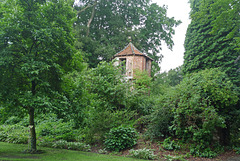
Burg Lage (Lage Castle) dates from the 14th century and belonged to the possessions of the bishop of Utrecht. Later, it came into the possession of King Philip II of Spain. At the end of the 16th century, the castle was renovated. In the course of the Eighty Years' War (or Dutch revolt), which gave the Netherlands its independence, Burg Lage was blown up and never rebuilt. Since then, it has remained a ruin and its thick walls are overgrown with ivy.
Lage, or officially “Herrlichkeit Lage”, refers to the time between the end of the Thirty Years' War and the year of 1803, in which Lage was an independent small state with its own jurisdiction. Since the late 19th century large parts of Lage are Dutch-owned, since 1977 by the Dutch “Twickel Foundation”.
Germany - Lage, watermill
| 20 May 2024 |
|
|
|
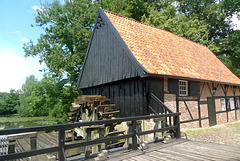
The watermill in Lage was first officially mentioned in the year of 1270. It was about 200 years later that King Philip II of Spain, as ruler of the Netherlands, approved building of a mill on the river Dinkel. It is supposed that this was a reconstruction or expansion of an existing mill.
The current mill looks like it is from the late 17th century. A distinguishing feature is the two undershot waterwheels that drive both a flour mill and an oil mill. In the early years of the 20th century, electricity was also generated at the mill to supply the community of Lage. After World War I, the oil mill was shut down. The grist mill kept running until 1957, although the last years by a diesel engine. After the last miller’s death, the mill stood empty.
In 1962, when the building was threatening to fall down, the most urgent safety work started. Ten years later, Grafschaft Bentheim brought about a comprehensive restoration on the mill, giving it once more its two waterwheels and restoring the weir to improve flow rates. Nowadays the mill can be run again.
(Lage, or officially Herrlichkeit Lage), refers to the time between the end of the Thirty Years' War and the year of 1803, in which Lage was an independent small state with its own jurisdiction. Since the late 19th century large parts of Lage are Dutch-owned, since 1977 by the Dutch ‘Twickel Foundation’.)
Germany - Gildehaus, Ostmühle
| 26 Jul 2019 |
|
|
|
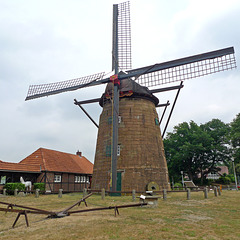
The Ostmühle (East Mill) on the Mühlenberg (100 meter above sea level) in Gildehaus is a Dutch tower mill. The mill was built in 1749/1750 from Bentheim sandstone and has a long and turbulent history. Three year before a violent storm destroyed a wooden mill on the same spot. The mill was privately owned from 1913 to 1986. It was in danger of being demolished several times.
The mill has been in operation again since 1986 and is managed and maintained by the tourist information Gildehaus. In the year 2011 an extensive renovation took place. When there is enough wind, hobby millers will make crispy bread from the freshly milled grain in the adjacent bakery. Mill and bakery are now a museum and can be visited, but has limited opening hours (during our vist it was closed).
Germany - Breese im Bruche
| 18 Dec 2017 |
|
|
|
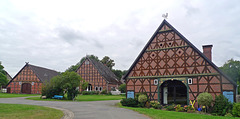
Breese im Bruche is a so called Rundlingsdorf or Rundling . Such a Rundling is a more or less circular village and were typical in the Early Medieval period. These kind of villages were originally found across a strip of central Germany from Kiel to Bohemia.
A Rundling was a relatively common village form used by the Slavs. It usually comprises a central, circular village green owned in common with about 10 or 15 individually owned Low German houses, radiating out around it like the spokes of a wheel.
There are no contemporary historical records of the founding of these circular villages, but most probably they were founded in the 12th century; although Breese im Bruche is dating back to the 13th century.
Germany - Sögel, Clemenswerth Castle
| 22 Sep 2016 |
|
|
|
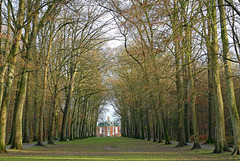
Clemenswerth Castle (Schloss Clemenswerth) was erected as a hunting lodge for Elector Clemens August I of Bavaria. It was built between 1737 and 1747 in baroque style. The complex consists of a main building (which was only used by the elector), surrounding lodges for guests, a chapel (PiP’s) with monastery and a large kitchen.
Clemenswerth (meaning Island of Clemens) is the only remaining star-shaped hunting complex in the world and is considered being one of the most unique castles in Germany. The buildings are surrounded by a baroque garden with flowerbeds, hedges and avenues with imposing trees.
Nowadays 18th century Clemenswerth Castle houses the Emslandmuseum and numerous events take place in the buildings and grounds.
Germany - Lage, watermill
| 24 Jul 2016 |
|
|
|
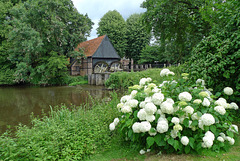
The watermill in Lage was first officially mentioned in the year of 1270. It was about 200 years later that King Philip II of Spain, as ruler of the Netherlands*, approved building of a mill on the river Dinkel. It is supposed that this was a reconstruction or expansion of an existing mill.
The current mill looks like it is from the late 17th century. A distinguishing feature is the two undershot waterwheels that drive both a flour mill and an oil mill. In the early years of the 20th century, electricity was also generated at the mill to supply the community of Lage. After World War I, the oil mill was shut down. The grist mill kept running until 1957, although the last years by a diesel engine. After the last miller’s death, the mill stood empty.
In 1962, when the building was threatening to fall down, the most urgent safety work started. Ten years later, Grafschaft Bentheim brought about a comprehensive restoration on the mill, giving it once more its two waterwheels and restoring the weir to improve flow rates.
Nowadays the mill can be run again. The former miller’s dwelling houses a tea parlour (Grafschafter Teestube).
*Lage, or officially ‘Herrlichkeit Lage’, refers to the time between the end of the Thirty Years' War and the year of 1803, in which Lage was a self-standing small state with its own jurisdiction. Since the late 19th century large parts of Lage are Dutch-owned, since 1977 by the Dutch ‘Twickel Foundation’.
Jump to top
RSS feed- Jaap van 't Veen's latest photos with "Niedersachsen" - Photos
- ipernity © 2007-2026
- Help & Contact
|
Club news
|
About ipernity
|
History |
ipernity Club & Prices |
Guide of good conduct
Donate | Group guidelines | Privacy policy | Terms of use | Statutes | In memoria -
Facebook
X
