

Jaap van 't Veen's photos with the keyword: Onze Lieve Vrouw ter Nood
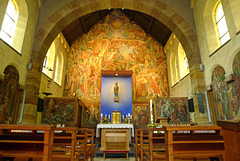
Nederland - Heiloo, Onze Lieve Vrouw ter Nood - Ge…
| 19 May 2025 |
|
|
|
Onze Lieve Vrouw ter Nood (Our Lady in Distress) is the largest Marian pilgrimage site in the Netherlands.
The history of the Sanctuary goes back to the end of the 14th century. At that time, a farmer found a statue of the Virgin on his land. He took it home with him, but miraculously it returned to the place of invention. Around the same time a ship got in distress off the coast near Heiloo. In his distress the skipper prayed to God. Above the roar of the waves and the roar of the wind, he heard a clear woman's voice saying: 'If you are going to honour me, the wind will turn'. The skipper recognized the voice of the Mother of God and promised to devote himself to her worship. When safely ashore, the two stories came together and the place for the construction of the Genadekapel (Chapel of Grace) was found.
In the period from 1573 to 1909, there was no chapel at the pilgrimage site. A deeply religious person from Alkmaar had a new Chapel of Grace built, which was consecrated in 1909. This chapel soon proved too small to accommodate the large number of pilgrims who came here to honour Mary under her favourite name ‘Onze Lieve Vrouw ter Nood’. Nothing came of building a basilica, but in 1930 the new Genadekapel succeeded in replacing the simple chapel from 1909. The fine murals in the new Chapel of Grace were done by H.A. Bijvoet.
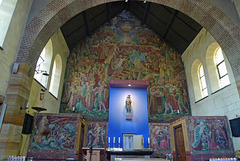
Nederland - Heiloo, Onze Lieve Vrouw ter Nood
| 24 Jun 2019 |
|
|
|
Onze Lieve Vrouw ter Nood (Our Lady in Distress) is located just south of Heiloo. It is the largest Marian pilgrimage site in the Netherlands. The history of the Sanctuary goes back to the end of the 14th century.
At that time, a farmer found a statue of the Virgin on his land. He took it home with him, but miraculously it returned to the place of invention. Around the same time a ship got in distress off the coast near Heiloo. In his distress the skipper prayed to God. Above the roar of the waves and the roar of the wind, he heard a clear woman's voice saying: 'If you are going to honour me, the wind will turn'. The skipper recognized the voice of the Mother of God and promised to devote himself to her worship. When safely ashore, the two stories came together and the place for the construction of the Genadekapel (Chapel of Grace) was found.
A document from 1409 has been kept in the archives of the Archdiocese of Utrecht that speaks of the capelle in de banne van Heiligenloo .
In the courtyard of the Chapel of Grace there is a well with healing water, called Runxput . During the Reformation the chapel was destroyed and the well was filled with debris from the chapel. In 1713, at the time of cattle plague, the water started to sprout from under the rubble. History tells that animals that drank from this water survived the plague. After this miracle pilgrimage to the sanctuary flourished again. Nowadays the Marian pilgrimage site is visited by tens of thousands of people.
Jump to top
RSS feed- Jaap van 't Veen's latest photos with "Onze Lieve Vrouw ter Nood" - Photos
- ipernity © 2007-2025
- Help & Contact
|
Club news
|
About ipernity
|
History |
ipernity Club & Prices |
Guide of good conduct
Donate | Group guidelines | Privacy policy | Terms of use | Statutes | In memoria -
Facebook
X
