
Anne Elliott's photos with the keyword: tethered outdoors
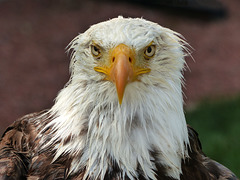
How dare you take a photo of me looking like this?
| 13 Sep 2018 |
|
|
My thoughts are with all those living on the east coast and inland, who are facing or about to face the force of Hurricane Florence.
What a relief to wake up (very late) this morning and discover that the forecast overnight snow flurries did not arrive here, at least not in my part of the city! Around 1:00 am this morning, the temperature was -1C (windchill -6C)! I am SO not ready for this!
My actual destination on 21 August 2018 was the Alberta Birds of Prey Centre, near Lethbridge. I know some people feel that photographing birds that are not out in the wild is cheating. I kind of agree, though I think it's fine as long as someone says where it was taken. I have seen and photographed many wild Bald Eagles in their natural habitat, but I still love seeing them at the Alberta Birds of Prey Centre in Coaldale - up close and personal, at least when zoomed. This adult had just done a flight display and had been given a hosepipe shower to cool him down. Poor guy, he seems to have lost his regal look.
"Once a common sight in much of the continent, the bald eagle was severely affected in the mid-20th century by a variety of factors, among them the thinning of egg shells attributed to use of the pesticide DDT. Bald eagles, like many birds of prey, were especially affected by DDT due to biomagnification. DDT itself was not lethal to the adult bird, but it interfered with the bird's calcium metabolism, making the bird either sterile or unable to lay healthy eggs. Female eagles laid eggs that were too brittle to withstand the weight of a brooding adult, making it nearly impossible for the eggs to hatch. It is estimated that in the early 18th century, the bald eagle population was 300,000–500,000,[118] but by the 1950s there were only 412 nesting pairs in the 48 contiguous states of the US. Other factors in bald eagle population reductions were a widespread loss of suitable habitat, as well as both legal and illegal shooting. DDT was completely banned in Canada in 1989, though its use had been highly restricted since the late 1970s." From Wikipedia.
en.wikipedia.org/wiki/Bald_eagle
On the spur of the moment the previous night, I decided that I might just try and get up early the next morning and go for a drive. The smoke from the British Columbia wildfires hasn't been hanging around the last few days, so I knew I really should make the most of a clear day.
It turned out to be such a great day, with some much-appreciated sightings. I must have spent about 8 or 9 hours driving and almost every inch of my body ached like crazy. Now, each summer, I try and do two or three longer (for me) drives, making sure I don't lose confidence to get there. I left home at 9:00 am, just a bit later than I had hoped. Arrived back home somewhere around 8:30 pm.
Weather-wise, it was around 24C, so not too hot. Unfortunately, I discovered that it was still smokey from the British Columbia wildfires, making distant hills barely visible and deleting mountains from view, but it didn't have too much effect on closer photography.
It was a good day for Hawks, seeing three on the way south and a few on the way home. I almost missed two of the hawks, as the hay bale was way out in a large field. At first, I thought there were three hawks together, but when I stopped to take a few photos, I realized that there were only two - one looked almost like two hawks close together, but then I saw that it had its wings mantled. I guess it wanted to make sure that the second hawk behind it couldn't steal any of the food from it.
A lone Common Nighthawk also helped make my day. For several years, I had longed to see one of these unusual birds and, finally last year (2017), I managed to find four of them. That time was almost two months earlier than my recent find, so I wasn't expecting to see any in late August. I would still love to find one lying on a wooden railing rather than a metal railing. Last year, I got a photo of one on a fence post, but the angle was not the greatest. These birds are 9½ inches from the tip of bill to the tip of tail.
A Horned Lark, a Vesper Sparrow, a Mourning Dove, and a Western Meadowlark gave me the chance for a photo or two and, to my delight, a hawk I spotted way in the distance did turn out to be a Ferruginous Hawk. A happy sighting, as they tend to be few and far between.
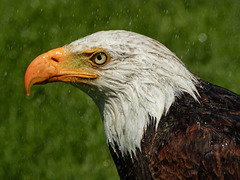
Bald Eagle getting a hosepipe shower
| 15 Mar 2018 |
|
|
|
Flickr problems, yet again!
Today, 15 March 2018, Calgary is under yet another Snowfall Warning, and it has been snowing all morning. Snowfall, with total amounts of 10 to 20 cm is expected. Heavy snowfall will continue over much of southern Alberta today. At this time of year, we tend to get snow, then it melts or starts to melt, then it snows again, and so on. Yesterday, I had to get across the city and was amazed that there was hardly any snow left in many places. I don't know how so much snow could just disappear like that, especially leaving no flooding.
Needless to say, this is not a photo that was taken in the wild! I would never be able to get such a close shot or even a close view like this, unless the bird was captive for one reason or another. This bird had just had some flight training and was given a hosepipe shower to cool off. I posted a similar photo ages ago.
This particular Bald Eagle resides at the Alberta Birds of Prey Centre in Coaldale, southern Alberta. This is a wonderful place that rehabilitates and releases (whenever possible) various birds of prey - hawks, owls, Bald Eagles, Turkey Vultures,and Golden Eagles. Some of these birds act as Wildlife Ambassadors, too, including educating the public away from the Centre. Sometimes, a bird is used as a foster parent, too.
I often see Bald Eagles flying wild, both in the city and in the surrounding areas. Usually when I see one, it is flying or perched far away. Too far away to see any detail at all, which is why I love going to this Centre, to see raptors up close.
"Once a common sight in much of the continent, the bald eagle was severely affected in the mid-20th century by a variety of factors, among them the thinning of egg shells attributed to use of the pesticide DDT. Bald eagles, like many birds of prey, were especially affected by DDT due to biomagnification. DDT itself was not lethal to the adult bird, but it interfered with the bird's calcium metabolism, making the bird either sterile or unable to lay healthy eggs. Female eagles laid eggs that were too brittle to withstand the weight of a brooding adult, making it nearly impossible for the eggs to hatch. It is estimated that in the early 18th century, the bald eagle population was 300,000–500,000,[118] but by the 1950s there were only 412 nesting pairs in the 48 contiguous states of the US. Other factors in bald eagle population reductions were a widespread loss of suitable habitat, as well as both legal and illegal shooting. DDT was completely banned in Canada in 1989, though its use had been highly restricted since the late 1970s." From Wikipedia.
en.wikipedia.org/wiki/Bald_eagle
Last summer (2017), we had practically no 'normal' summer days. Most were too hot thanks to an almost endless heatwave, and also too smoky thanks to all the devastating wildfires in British Columbia and Alberta. The weather forecast for 3 August 2017 looked good; sunshine all day, with rain forecast on several of the coming days. I decided to finally do a drive all the way down south to near Lethbridge, so that I could again visit the Alberta Birds of Prey Centre in Coaldale. The previous year (2016), I did this drive for the very first time on my own and I wanted to make sure I didn't lose my courage to do it again. During the 511 kms that I drove, I had to ask for help with directions twice - both times in the same small hamlet. It was a hot day, with a temperature of 31C when I was at the Centre.
Though the forecast was for sun all day, there was no mention of the smoke haze that completely blocked out the mountains and pretty much the foothills, too. Very quickly, I was almost tempted to turn around and come home, but I had noticed rain in the forecast for the coming days. I reckoned I would still be able to photograph the fairly close birds at the Centre, which worked out fine.
Amazingly, I managed to make myself get up early that morning, and set off just before 8:30 am. My intention was to drive straight to Coaldale without stopping anywhere en route. Not an easy thing for me to do, as I much prefer driving slowly along the back roads rather than the less interesting highways. However, I knew it would take me a few hours to get there and I wanted to have as much time as possible down there. On the way home, I drove one dusty, gravel road, but saw nothing but a couple of Horned Larks perched on fence posts. A couple of old barns (that I had seen before) and a few scenic shots, were more or less all I took.
I finally arrived home at 8:30 pm, after a 12-hour day, totally tired out, and my car was just about out of gas. So happy to have been down there again, though.

Bald Eagle after a cooling hosepipe shower
| 08 Feb 2018 |
|
|
|
Rick Mercer's video "Plus 1 in Canada". I can so relate to this - so funny! And, yes, it's snowing AGAIN today, heavily. Temperature this morning is -19C (windchill -27C). Wish I could say that it will be yet another day at home, but I have to somehow drive half way across the city for a regular dental appointment. I can barely tell where the road is. We are still under a Winter Storm Warning, with a total of up to 35 cm of snow expected.
youtu.be/wkDvqQKGgDA
-------------------------------------------------------------------------------------------------
Needless to say, this is not a photo that was taken in the wild! I would never be able to get such a close shot or even a close view like this, unless the bird was captive for one reason or another. This bird had just had some flight training and was given a hosepipe shower to cool off.
This particular Bald Eagle resides at the Alberta Birds of Prey Centre in Coaldale, southern Alberta. This is a wonderful place that rehabilitates and releases (whenever possible) various birds of prey - hawks, owls, Bald Eagles, Turkey Vultures,and Golden Eagles. Some of these birds act as Wildlife Ambassadors, too, including educating the public away from the Centre. Sometimes, a bird is also used as a foster parent.
I often see Bald Eagles flying wild, both in the city and in the surrounding areas. Usually when I see one, it is flying or perched far away. Too far away to see any detail at all, which is why I love going to this Centre, to see raptors up close.
"Once a common sight in much of the continent, the bald eagle was severely affected in the mid-20th century by a variety of factors, among them the thinning of egg shells attributed to use of the pesticide DDT. Bald eagles, like many birds of prey, were especially affected by DDT due to biomagnification. DDT itself was not lethal to the adult bird, but it interfered with the bird's calcium metabolism, making the bird either sterile or unable to lay healthy eggs. Female eagles laid eggs that were too brittle to withstand the weight of a brooding adult, making it nearly impossible for the eggs to hatch. It is estimated that in the early 18th century, the bald eagle population was 300,000–500,000,[118] but by the 1950s there were only 412 nesting pairs in the 48 contiguous states of the US. Other factors in bald eagle population reductions were a widespread loss of suitable habitat, as well as both legal and illegal shooting. DDT was completely banned in Canada in 1989, though its use had been highly restricted since the late 1970s." From Wikipedia.
en.wikipedia.org/wiki/Bald_eagle
Last summer (2017), we had practically no 'normal' summer days. Most were too hot thanks to an almost endless heatwave, and also too smoky thanks to all the wildfires in British Columbia and Alberta. The weather forecast for 3 August 2017 looked good; sunshine all day, with rain forecast on several of the coming days. I decided to finally do a drive all the way down south to near Lethbridge, so that I could again visit the Alberta Birds of Prey Centre in Coaldale. The previous year (2016), I did this drive for the very first time on my own and I wanted to make sure I didn't lose my courage to do it again. During the 511 kms that I drove, I had to ask for help with directions twice - both times in the same small hamlet. It was a hot day, with a temperature of 31C when I was at the Centre.
Though the forecast was for sun all day, there was no mention of the smoke haze that completely blocked out the mountains and pretty much the foothills, too. Very quickly, I was almost tempted to turn around and come home, but I had noticed rain in the forecast for the coming days. I reckoned I would still be able to photograph the fairly close birds at the Centre, which worked out fine.
Amazingly, I managed to make myself get up early that morning, and set off just before 8:30 am. My intention was to drive straight to Coaldale without stopping anywhere en route. Not an easy thing for me to do, as I much prefer driving slowly along the back roads rather than the less interesting highways. However, I knew it would take me a few hours to get there and I wanted to have as much time as possible down there. On the way home, I drove one dusty, gravel road, but saw nothing but a couple of Horned Larks perched on fence posts. A couple of old barns (that I had seen before) and a few scenic shots, were more or less all I took.
I finally arrived home at 8:30 pm, after a 12-hour day, totally tired out, and my car was just about out of gas. So happy to have been down there again, though.
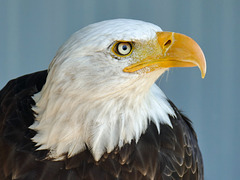
Once was wild
| 08 Dec 2017 |
|
|
|
Needless to say, this is not a photo that was taken in the wild! I would never be able to get such a close shot or even a close view like this, unless the bird was captive for one reason or another.
This particular Bald Eagle resides at the Alberta Birds of Prey Centre in Coaldale, southern Alberta. This is a wonderful place that rehabilitates and releases (whenever possible) various birds of prey - hawks, owls, Bald Eagles, Turkey Vultures,and Golden Eagles. Some of these birds act as Wildlife Ambassadors, too, including educating the public away from the Centre. Sometimes, a bird is used as a foster parent, too.
I often see Bald Eagles flying wild, both here in the city and in the surrounding areas. Usually when I see one, it is flying or perched far away. Too far away to see any detail at all, which is why I love going to this Centre, to see raptors up close.
"Once a common sight in much of the continent, the bald eagle was severely affected in the mid-20th century by a variety of factors, among them the thinning of egg shells attributed to use of the pesticide DDT. Bald eagles, like many birds of prey, were especially affected by DDT due to biomagnification. DDT itself was not lethal to the adult bird, but it interfered with the bird's calcium metabolism, making the bird either sterile or unable to lay healthy eggs. Female eagles laid eggs that were too brittle to withstand the weight of a brooding adult, making it nearly impossible for the eggs to hatch. It is estimated that in the early 18th century, the bald eagle population was 300,000–500,000,[118] but by the 1950s there were only 412 nesting pairs in the 48 contiguous states of the US. Other factors in bald eagle population reductions were a widespread loss of suitable habitat, as well as both legal and illegal shooting. DDT was completely banned in Canada in 1989, though its use had been highly restricted since the late 1970s." From Wikipedia.
en.wikipedia.org/wiki/Bald_eagle
This summer, we had practically no 'normal' summer days. They have been either too hot thanks to our endless heatwave, or too smoky thanks to all the wildfires in British Columbia and Alberta. The forecast for this day looked good, sunshine all day, with rain forecast on several of the coming days. I decided to finally do a drive all the way down south to near Lethbridge, so that I could again visit the Alberta Birds of Prey Centre in Coaldale. Last year, I did this drive for the very first time on my own and I wanted to make sure I didn't lose my courage to do it again. During the 511 kms that I drove, I had to ask for help with directions twice - both times in the same small hamlet!
The forecast was for sun all day, but there was no mention of the smoke haze that completely blocked out the mountains and pretty much the foothills, too. Shortly after leaving home, I was almost tempted to turn around and come home, but I had noticed rain in the forecast for some coming days. I reckoned I would still be able to photograph the fairly close birds at the Centre, which worked out fine.
Amazingly, I had managed to make myself get up early on the morning of 3 August 2017, and set off just before 8:30 am. My intention was to drive straight to Coaldale without stopping anywhere en route. Not an easy thing for me to do, as I much prefer driving the backroads rather than the highways. However, I knew it would take me a few hours to get there and I wanted to have as much time as possible down there. On the way home, I drove just one dusty, gravel road, but saw nothing but a couple of Horned Larks perched on fence posts. A couple of old barns (that I had seen before) and a few scenic shots, were more or less all I took.
Twelve hours later, I finally arrived home, at 8:30 pm, totally tired out, and my car was just about out of gas. For the first time in the year that I had had this vehicle, the gas level warning light came on. A great day.
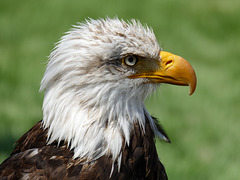
Bald Eagle / Haliaeetus leucocephalus
| 17 Oct 2017 |
|
Needless to say, this is not a photo that was taken in the wild! I would never be able to get such a close shot or even a close view like this, unless the bird was captive for one reason or another. This bird had just had some flight training and was given a hosepipe shower to cool off.
This particular Bald Eagle resides at the Alberta Birds of Prey Centre in Coaldale, southern Alberta. This is a wonderful place that rehabilitates and releases (whenever possible) various birds of prey - hawks, owls, Bald Eagles, Turkey Vultures,and Golden Eagles. Some of these birds act as Wildlife Ambassadors, too, including educating the public away from the Centre. Sometimes, a bird is used as a foster parent, too.
I often see Bald Eagles flying wild, both in the city and in the surrounding areas. Usually when I see one, it is flying or perched far away. Too far away to see any detail at all, which is why I love going to this Centre, to see raptors up close.
"Once a common sight in much of the continent, the bald eagle was severely affected in the mid-20th century by a variety of factors, among them the thinning of egg shells attributed to use of the pesticide DDT. Bald eagles, like many birds of prey, were especially affected by DDT due to biomagnification. DDT itself was not lethal to the adult bird, but it interfered with the bird's calcium metabolism, making the bird either sterile or unable to lay healthy eggs. Female eagles laid eggs that were too brittle to withstand the weight of a brooding adult, making it nearly impossible for the eggs to hatch. It is estimated that in the early 18th century, the bald eagle population was 300,000–500,000,[118] but by the 1950s there were only 412 nesting pairs in the 48 contiguous states of the US. Other factors in bald eagle population reductions were a widespread loss of suitable habitat, as well as both legal and illegal shooting. DDT was completely banned in Canada in 1989, though its use had been highly restricted since the late 1970s." From Wikipedia.
en.wikipedia.org/wiki/Bald_eagle
This summer, we had practically no 'normal' summer days. They have been either too hot thanks to our endless heatwave, or too smoky thanks to all the wildfires in British Columbia and Alberta. The forecast for this day looked good, sunshine all day, with rain forecast on several of the coming days. I decided to finally do a drive all the way down south to near Lethbridge, so that I could again visit the Alberta Birds of Prey Centre in Coaldale. Last year, I did this drive for the very first time on my own and I wanted to make sure I didn't lose my courage to do it again. During the 511 kms that I drove, I had to ask for help with directions twice - both times in the same small hamlet!
The forecast was for sun all day, but there was no mention of the smoke haze that completely blocked out the mountains and pretty much the foothills, too. Shortly after leaving home, I was almost tempted to turn around and come home, but I had noticed rain in the forecast for some coming days. I reckoned I would still be able to photograph the fairly close birds at the Centre, which worked out fine.
Amazingly, I had managed to make myself get up early on the morning of 3 August 2017, and set off just before 8:30 am. My intention was to drive straight to Coaldale without stopping anywhere en route. Not an easy thing for me to do, as I much prefer driving the backroads rather than the highways. However, I knew it would take me a few hours to get there and I wanted to have as much time as possible down there. On the way home, I drove just one dusty, gravel road, but saw nothing but a couple of Horned Larks perched on fence posts. A couple of old barns (that I had seen before) and a few scenic shots, were more or less all I took.
Twelve hours later, I finally arrived home, at 8:30 pm, totally tired out, and my car was just about out of gas. For the first time in the year that I have had this vehicle, the gas level warning light came on.
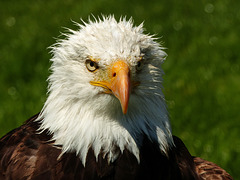
Spiked hairdo
| 16 Aug 2017 |
|
|
|
Needless to say, this is not a photo that was taken in the wild! I would never be able to get such a close shot or even a close view like this, unless the bird was captive for one reason or another. This bird had just had some flight training and was given a hosepipe shower to cool off.
This particular Bald Eagle resides at the Alberta Birds of Prey Centre in Coaldale, southern Alberta. This is a wonderful place that rehabilitates and releases (whenever possible) various birds of prey - hawks, owls, Bald Eagles, Turkey Vultures,and Golden Eagles. Some of these birds act as Wildlife Ambassadors, too, including educating the public away from the Centre. Sometimes, a bird is used as a foster parent, too.
I often see Bald Eagles flying wild, both in the city and in the surrounding areas. Usually when I see one, it is flying or perched far away. Too far away to see any detail at all, which is why I love going to this Centre, to see raptors up close.
"Once a common sight in much of the continent, the bald eagle was severely affected in the mid-20th century by a variety of factors, among them the thinning of egg shells attributed to use of the pesticide DDT. Bald eagles, like many birds of prey, were especially affected by DDT due to biomagnification. DDT itself was not lethal to the adult bird, but it interfered with the bird's calcium metabolism, making the bird either sterile or unable to lay healthy eggs. Female eagles laid eggs that were too brittle to withstand the weight of a brooding adult, making it nearly impossible for the eggs to hatch. It is estimated that in the early 18th century, the bald eagle population was 300,000–500,000,[118] but by the 1950s there were only 412 nesting pairs in the 48 contiguous states of the US. Other factors in bald eagle population reductions were a widespread loss of suitable habitat, as well as both legal and illegal shooting. DDT was completely banned in Canada in 1989, though its use had been highly restricted since the late 1970s." From Wikipedia.
en.wikipedia.org/wiki/Bald_eagle
This summer, we have had practically no 'normal' summer days. They have been either too hot thanks to our endless heatwave, or too smoky thanks to all the wildfires in British Columbia and Alberta. The forecast for this day looked good, sunshine all day, with rain forecast on several of the coming days. I decided to finally do a drive all the way down south to near Lethbridge, so that I could again visit the Alberta Birds of Prey Centre in Coaldale. Last year, I did this drive for the very first time on my own and I wanted to make sure I didn't lose my courage to do it again. During the 511 kms that I drove, I had to ask for help with directions twice - both times in the same small hamlet!
The forecast was for sun all day, but there was no mention of the smoke haze that completely blocked out the mountains and pretty much the foothills, too. Shortly after leaving home, I was almost tempted to turn around and come home, but I had noticed rain in the forecast for some coming days. I reckoned I would still be able to photograph the fairly close birds at the Centre, which worked out fine.
Amazingly, I had managed to make myself get up early on the morning of 3 August 2017, and set off just before 8:30 am. My intention was to drive straight to Coaldale without stopping anywhere en route. Not an easy thing for me to do, as I much prefer driving the backroads rather than the highways. However, I knew it would take me a few hours to get there and I wanted to have as much time as possible down there. On the way home, I drove just one dusty, gravel road, but saw nothing but a couple of Horned Larks perched on fence posts. A couple of old barns (that I had seen before) and a few scenic shots, were more or less all I took, except for photos at the Centre.
Twelve hours later, I finally arrived home, at 8:30 pm, totally tired out, and my car was just about out of gas. For the first time in the year that I have had this vehicle, the gas level warning light came on. Also, it surprises me that the oil change light has never come on, as I have done 8,500 km in just under 12 months. I was given free oil changes for the life of the car, but was told that I can't get them done until the light comes on, on the dashboard. After doing a bit of Googling, it seems that it is quite normal to have done this many km, or more, before the maintenance light comes on for getting a first oil change. My previous vehicle was 17 years old and things have obviously changed with newer cars!
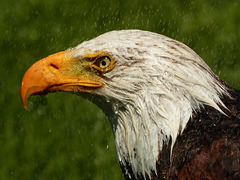
Cooling down
| 11 Aug 2017 |
|
Needless to say, this is not a photo that was taken in the wild! I would never be able to get such a close shot or even a close view like this, unless the bird was captive for one reason or another. This bird had just had some flight training and was given a hosepipe shower to cool off.
This particular Bald Eagle resides at the Alberta Birds of Prey Centre in Coaldale, southern Alberta. This is a wonderful place that rehabilitates and releases (whenever possible) various birds of prey - hawks, owls, Bald Eagles, Turkey Vultures,and Golden Eagles. Some of these birds act as Wildlife Ambassadors, too, including educating the public away from the Centre. Sometimes, a bird is used as a foster parent, too.
I often see Bald Eagles flying wild, both in the city and in the surrounding areas. Usually when I see one, it is flying or perched far away. Too far away to see any detail at all, which is why I love going to this Centre, to see raptors up close.
"Once a common sight in much of the continent, the bald eagle was severely affected in the mid-20th century by a variety of factors, among them the thinning of egg shells attributed to use of the pesticide DDT. Bald eagles, like many birds of prey, were especially affected by DDT due to biomagnification. DDT itself was not lethal to the adult bird, but it interfered with the bird's calcium metabolism, making the bird either sterile or unable to lay healthy eggs. Female eagles laid eggs that were too brittle to withstand the weight of a brooding adult, making it nearly impossible for the eggs to hatch. It is estimated that in the early 18th century, the bald eagle population was 300,000–500,000,[118] but by the 1950s there were only 412 nesting pairs in the 48 contiguous states of the US. Other factors in bald eagle population reductions were a widespread loss of suitable habitat, as well as both legal and illegal shooting. DDT was completely banned in Canada in 1989, though its use had been highly restricted since the late 1970s." From Wikipedia.
en.wikipedia.org/wiki/Bald_eagle
This summer, we have had practically no 'normal' summer days. They have been either too hot thanks to our endless heatwave, or too smoky thanks to all the wildfires in British Columbia and Alberta. The forecast for this day looked good, sunshine all day, with rain forecast on several of the coming days. I decided to finally do a drive all the way down south to near Lethbridge, so that I could again visit the Alberta Birds of Prey Centre in Coaldale. Last year, I did this drive for the very first time on my own and I wanted to make sure I didn't lose my courage to do it again. During the 511 kms that I drove, I had to ask for help with directions twice - both times in the same small hamlet!
The forecast was for sun all day, but there was no mention of the smoke haze that completely blocked out the mountains and pretty much the foothills, too. Shortly after leaving home, I was almost tempted to turn around and come home, but I had noticed rain in the forecast for some coming days. I reckoned I would still be able to photograph the fairly close birds at the Centre, which worked out fine.
Amazingly, I had managed to make myself get up early on the morning of 3 August 2017, and set off just before 8:30 am. My intention was to drive straight to Coaldale without stopping anywhere en route. Not an easy thing for me to do, as I much prefer driving the backroads rather than the highways. However, I knew it would take me a few hours to get there and I wanted to have as much time as possible down there. On the way home, I drove just one dusty, gravel road, but saw nothing but a couple of Horned Larks perched on fence posts. A couple of old barns (that I had seen before) and a few scenic shots, were more or less all I took.
Twelve hours later, I finally arrived home, at 8:30 pm, totally tired out, and my car was just about out of gas. For the first time in the year that I have had this vehicle, the gas level warning light came on. Also, it surprises me that the oil change light has never come on, as I have done 8,500 km in just under 12 months. I was given free oil changes for the life of the car, but was told that I can't get them done until the light comes on, on the dashboard. After doing a bit of Googling, it seems that it is quite normal to have done this many km, or more, before the maintenance light comes on for getting a first oil change. My previous vehicle was 17 years old and things have obviously changed with newer cars!
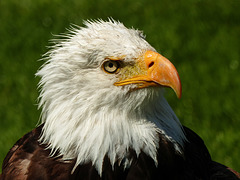
Anyone have a comb?
| 04 Aug 2017 |
|
|
|
Needless to say, this is not a photo that was taken in the wild! I would never be able to get such a close shot or even a close view like this, unless the bird was captive for one reason or another.
This summer, we have had practically no 'normal' summer days. They have been either too hot thanks to our endless heatwave, or too smoky thanks to all the wildfires in British Columbia and Alberta. The forecast for yesterday looked good, sunshine all day, with rain forecast on several of the coming days. I decided to finally do a drive all the way down south to near Lethbridge, so that I could again visit the Alberta Birds of Prey Centre in Coaldale. Last year, I did this drive for the very first time on my own and I wanted to make sure I didn't lose my courage to do it again. During the 511 kms that I drove, I had to ask for help with directions twice - both times in the same small hamlet!
The forecast was for sun all day, but there was no mention of the smoke haze that completely blocked out the mountains and pretty much the foothills, too. I was almost tempted to turn around and come home, but I had noticed rain in the forecast for some coming days. I reckoned I would still be able to photograph the fairly close birds at the Centre, which worked out fine.
This particular Bald Eagle resides at the Alberta Birds of Prey Centre in Coaldale. This is a wonderful place that rehabilitates and releases (whenever possible) various birds of prey - hawks, owls, Bald Eagles, Turkey Vultures,and Golden Eagles. Some of these birds act as Wildlife Ambassadors, too, including educating the public away from the Centre. Sometimes, a bird is used as a foster parent, too.
I often see Bald Eagles flying wild, both in the city and in the surrounding areas. Usually when I see one, it is flying or perched far away. Too far away to see any detail at all, which is why I love going to this Centre, to see raptors up close.
Amazingly, I managed to make myself get up early yesterday morning, 3 August 2017, and set off just before 8:30 am. My intention was to drive straight to Coaldale without stopping anywhere en route. Not an easy thing for me to do, as I much prefer driving the backroads rather than the highways. However, I knew it would take me a few hours to get there and I wanted to have as much time as possible down there. On the way home, I drove one dusty, gravel road, but saw nothing but a couple of Horned Larks perched on fence posts. A couple of old barns (that I had seen before) and a few scenic shots, were more or less all I took.
Twelve hours later, I finally arrived home, at 8:30 pm, totally tired out, and my car was just about out of gas. For the first time in the year that I have had this vehicle, the gas level warning light came on. Also, it surprises me that the oil change light has never come on, as I have done 8,500 km in just under 12 months. I was given free oil changes for the life of the car, but was told that I can't get them done until the light comes on, on the dashboard. Think I'd better contact the dealership and ask about this. Almost a year sounds far too long to not have an oil change.
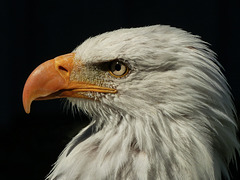
That majestic look
| 18 Dec 2016 |
|
|
|
Our deep-freeze has finally come to an end today, 18 December 2016! The temperature is only -1C (at noon), with a windchill of -10C.
This particular bird resides at the Alberta Birds of Prey Centre in Coaldale, southern Alberta, a wonderful place that rehabilitates and releases (whenever possible) various birds of prey - hawks, owls, Bald Eagles, Turkey Vultures,and Golden Eagles. Some of these birds act as Wildlife Ambassadors, too, educating the public away from the Centre.
I often see Bald Eagles flying wild, both in the city and in the surrounding areas. Usually when I see one, it is flying or perched far away. Too far away to see any detail at all, which is why I love going to this Centre, to see raptors up close.
It had been a few years since my last visit there - I've been maybe three or four times - and I had been longing to go back. Much too far and all new driving territory for me to even think about driving there myself. However, on 9 September 2016, that is exactly what I did. A friend had said she would come along, too, but she emailed me at 1:00 am to say that she assumed the trip had been cancelled, as she hadn't heard back about the time to meet. In fact, I had sent two emails giving the time, so I don't know what happened there. Very unfortunate, as it would have been great to have had company on such a long drive and I know she would have had lots of fun with her camera.
I knew it would be a long day and further than I would normally drive - and in a brand new car that I was still learning to drive! It didn't look or feel quite as new after travelling 481 km! Only got lost twice, one minor and the other major. Must have taken a wrong turn somewhere down south and I ended up in the city of Lethbridge, that I had very carefully planned to avoid. After three and three-quarter hours, I finally arrived, to my huge relief.
Despite getting there later than I had hoped, I still had plenty of time to wander round the grounds and photograph the various raptors. Some were tethered out in a couple of grassy areas and others were in outdoor cages. Wonderful to get such a close look at the various majestic birds.
I took a slightly different way home via #845 (?) making absolutely sure that I didn't accidentally find myself in Lethbridge again and it wasn't too long before I found myself in the area that I had driven a few weeks before, when I went SW of Vulcan to look for Common Nighthawks (without any luck). Just so happy that I finally made myself do this drive. When I Googled the Centre's website, I had discovered that they were closing two days later for the winter. So, it was either a case of going when I did or not at all till next May onward.
The very next day, 10 September 2016, I took my daughter on a long drive in Kananaskis. This was yet another place that I had longed to be able to drive for many years - and finally I did it! I had been lots of times with various friends, but this was the very first time I had ever driven myself.
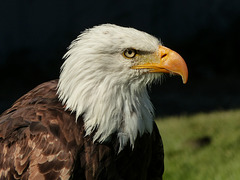
Happy Thanksgiving to all Americans, everywhere!
| 25 Nov 2016 |
|
|
|
Happy Thanksgiving to all Americans, everywhere!
Wanted to wish all Americans, at home or living in other countries around the world, a wonderful Thanksgiving today. Special thoughts to those who are serving their country, and their families, especially those who will not be able to spend the day together. I do hope you all have a happy and safe day. No matter what our circumstances are, there are always endless things, large and small, to be thankful for, especially when compared to those who live in many less fortunate countries around the world. Enjoy your turkey dinner, if you are lucky enough to have one, and enjoy the company of family and friends, if you are fortunate enough to have either or both! Our Canadian Thanksgiving was on 10 October this year.
This particular bird resides at the Alberta Birds of Prey Centre in Coaldale, southern Alberta, a wonderful place that rehabilitates and releases (whenever possible) various birds of prey - hawks, owls, Bald Eagles, Turkey Vultures,and Golden Eagles. Some of these birds act as Wildlife Ambassadors, too, educating the public away from the Centre.
I often see Bald Eagles flying wild, both in the city and in the surrounding areas. Usually when I see one, it is flying or perched far away. Too far away to see any detail at all, which is why I love going to this Centre, to see raptors up close.
It had been a few years since my last visit there - I've been maybe three or four times - and I had been longing to go back. Much too far and all new driving territory for me to even think about driving there myself. However, on 9 September 2016, that is exactly what I did. A friend had said she would come along, too, but she emailed me at 1:00 am to say that she assumed the trip had been cancelled, as she hadn't heard back about the time to meet. In fact, I had sent two emails giving the time, so I don't know what happened there. Very unfortunate, as it would have been great to have had company on such a long drive and I know she would have had lots of fun with her camera.
I knew it would be a long day and further than I would normally drive - and in a brand new car that I am still learning to drive! It didn't look or feel quite as new after travelling 481 km! Only got lost twice, one minor and the other major. Must have taken a wrong turn somewhere down south and I ended up in the city of Lethbridge, that I had very carefully planned to avoid. After three and three-quarter hours, I finally arrived, to my huge relief.
Despite getting there later than I had hoped, I still had more than enough time to wander round the grounds and photograph the various raptors. Some were tethered out in a couple of grassy areas and others were in large outdoor cages. Wonderful to get such a close look at the various majestic birds.
I took a slightly different way home via #845 (?) making absolutely sure that I didn't accidentally find myself in Lethbridge again and it wasn't too long before I found myself in the area that I had driven a few weeks before, when I went SW of Vulcan to look for Common NIghthawks (without any luck). Just so happy that I finally made myself do this drive. When I Googled the Centre's website, I had discovered that they were closing two days later for the winter. So, it was either a case of going when I did or not at all till next May onwards.
The very next day, 10 September 2016, I took my daughter on a long drive in Kananaskis. This was yet another place that I had longed to be able to drive for many years - and finally I did it! I had been lots of times with various friends, but this was the very first time I had ever driven myself.
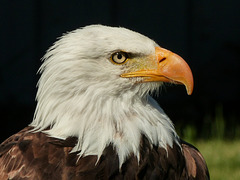
Regal
| 12 Oct 2016 |
|
|
Almost 2:00 pm and there are hardly any new photos on my Contacts' page. Hmm, I wonder if it's because Flickr has yet again made changes, which usually results in some kind of mess .... sigh.
This particular bird resides at the Alberta Birds of Prey Centre in Coaldale, southern Alberta, a wonderful place that rehabilitates and releases (whenever possible) various birds of prey - hawks, owls, Bald Eagles, Turkey Vultures,and Golden Eagles. Some of these birds act as Wildlife Ambassadors, too, educating the public.
I often see Bald Eagles flying wild, both in the city and in the surrounding areas. Usually when I see one, it is flying or perched far away. Too far away to see any detail at all, which is why I love going to this Centre, to see raptors up close.
It had been a few years since my last visit there - I've been maybe three or four times - and I had been longing to go back. Much too far and all new driving territory for me to even think about driving there myself. However, a month ago, on 9 September 2016, that is exactly what I did. A friend had said she would come along, too, but she emailed me at 1:00 am to say that she assumed the trip had been cancelled, as she hadn't heard back about the time to meet. In fact, I had sent two emails giving the time, so I don't know what happened there. Very unfortunate, as it would have been great to have had company on such a long drive and I know she would have had lots of fun with her camera.
I knew it would be a long day and further than I would normally drive - and in a brand new car that I have yet to learn to drive! It didn't look or feel quite as new after travelling 481 km! Only got lost twice, one minor and the other major. Must have taken a wrong turn somewhere down south and I ended up in the city of Lethbridge, that I had very carefully planned to avoid. After three and three-quarter hours, I finally arrived, to my huge relief.
Despite getting there later than I had hoped, I still had more than enough time to wander round the grounds and photograph the various raptors. Some were tethered out in a grassy area and others were in large outdoor cages. Wonderful to get such a close look at the various majestic birds.
I took a slightly different way home via #845 (?) making absolutely sure that I didn't accidentally find myself in Lethbridge again and it wasn't too long before I found myself in the area that I had driven a few weeks before, when I went SW of Vulcan to look for Common NIghthawks (without any luck). Just so happy that I finally made myself do this drive. When I Googled the Centre's website, I discovered that they were closing two days later for the winter. So, it was either a case of going the next day or not at all till next May onwards.
The very next day, 10 September 2016, I took my daughter on a long drive in Kananaskis. This was yet another place that I had longed to be able to drive for many years - and finally I did it! I had been lots of times with various friends, but this was the very first time I had ever driven myself.
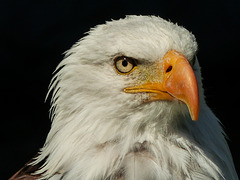
Bald Eagle portrait
| 12 Sep 2016 |
|
This particular bird resides at the Alberta Bird of Prey Centre in Coaldale, southern Alberta, a wonderful place that rehabilitates and releases (whenever possible) various birds of prey - hawks, owls, Bald Eagles, Turkey Vultures,and Golden Eagle. Some of these birds act as Wildlife Ambassadors, too, educating the public.
I often see Bald Eagles flying wild, both in the city and in the surrounding areas. Usually when I see one, it is flying or perched far away. Too far away to see any detail at all, which is why I love going to this Centre, to see raptors up close.
It had been a few years since my last visit there - I've been maybe three or four times - and I had been longing to go back. Much too far and all new driving territory for me to even think about driving there myself. However, three days ago, on 9 September 2016, that is exactly what I did. A friend had said she would come along, too, but she emailed me at 1:00 am to say that she assumed the trip had been cancelled, as she hadn't heard back about the time to meet. In fact, I had sent two emails giving the time, so I don't know what happened there. Very unfortunate, as it would have been great to have had company on such a long drive.
I knew it would be a long day and further than I would normally drive - and in a brand new car that I have yet to learn to drive! It doesn't look or feel quite as new now, after travelling 481 km! Only got lost twice, one minor and the other major. Must have taken a wrong turn somewhere down south and I ended up in the city of Lethbridge, that I had very carefully planned to avoid. After three and three-quarter hours, I finally arrived, to my huge relief.
Despite getting there later than I had hoped, I still had more than enough time to wander round the grounds and photograph the various raptors. Some were tethered out in a grassy area and others were in large outdoor cages. Wonderful to get such a close look at the various majestic birds.
I took a slightly different way home via #845 (?) making absolutely sure that I didn't accidentally find myself in Lethbridge again and it wasn't too long before I found myself in the area that I had driven a few weeks ago, when I went SW of Vulcan to look for Common NIghthawks (without any luck). Just so happy that I finally made myself do this drive. When I Googled the Centre's website a few days ago, I discovered that they were closing two days later for the winter. So, it was either a case of going the next day or not at all till next May onwards.
The very next day, 10 September 2016, I took my daughter on a long drive in Kananaskis. This was yet another place that I had longed to be able to drive for many years - and finally I did it! I had been lots of times with various friends, but this was the very first time I had ever driven myself.
Jump to top
RSS feed- Anne Elliott's latest photos with "tethered outdoors" - Photos
- ipernity © 2007-2026
- Help & Contact
|
Club news
|
About ipernity
|
History |
ipernity Club & Prices |
Guide of good conduct
Donate | Group guidelines | Privacy policy | Terms of use | Statutes | In memoria -
Facebook
X
